


David Mullen ASC
Moderator
There are no rules here, just personal taste combined with the visual needs of the project.
Gordon Willis used to object to what he called "tromboning" -- grabbing a tight shot on a long lens from the same camera position as the wider shot. He prefered to stick to a limited range and move the camera closer or further. For example, a lot of "Manhattan" is shot on a 100mm anamorphic lens.
Roger Deakins is also someone who prefers single-camera shooting and short to medium focal lengths. Most of "Shawshank Redemption" was shot on a 35mm and 50mm I believe.
"Psycho" was mostly shot with a 50mm lens. Hitchcock did not like distorted perspectives too much.
Multiple camera shooting tends to encourage longer lenses, since it makes it easier to get two cameras on a scene if they are farther back, than up close and wide-angle. A lot of Ridley and Tony Scott's movies are shot with multiple cameras with zoom lenses grabbing shots in widely different frame sizes.
One issue to consider when doing that style is that just as it is harder to be precise with the lighting and framing, it is also harder to be as precise with the mic placement if every camera is looking at wildly different frames.
Kurosawa was one of the innovators of multiple camera shooting with long lenses, starting with the final battle scene in "Seven Samurai" (most of the rest of the movie is single-camera.)
At the other end of the spectrum from Ozu or Hitchcock or Gordon Willis is that Michael Bay style where one shot is super wide-angle and the other super telephoto. It's sort of a commercial / music video style which is all about aggressive eye-grabbing imagery, not about subtlety.
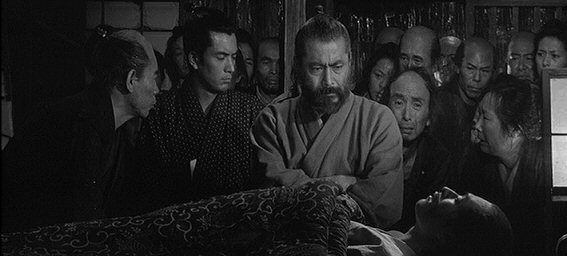
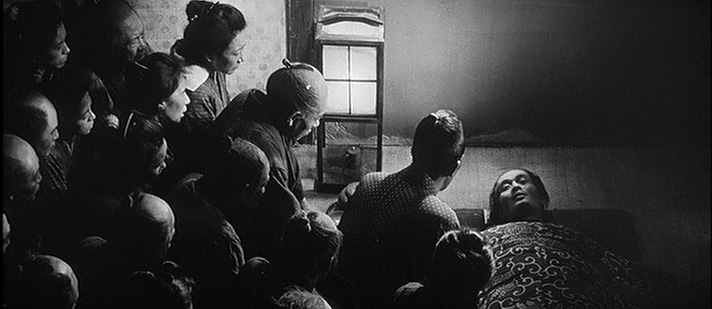
Kurosawa experimented with longer lens for indoor shooting, requiring sets be built with a lot of room to back up the camera. Sometimes he'd use a 500mm anamorphic lens (more like a 250mm spherical in horizontal view) and light a scene to f/22 to get deep focus, creating an interesting flattened perspective that resembles Japanese scroll art sometimes. The best example of this style is in "Red Beard":
Gordon Willis used to object to what he called "tromboning" -- grabbing a tight shot on a long lens from the same camera position as the wider shot. He prefered to stick to a limited range and move the camera closer or further. For example, a lot of "Manhattan" is shot on a 100mm anamorphic lens.
Roger Deakins is also someone who prefers single-camera shooting and short to medium focal lengths. Most of "Shawshank Redemption" was shot on a 35mm and 50mm I believe.
"Psycho" was mostly shot with a 50mm lens. Hitchcock did not like distorted perspectives too much.
Multiple camera shooting tends to encourage longer lenses, since it makes it easier to get two cameras on a scene if they are farther back, than up close and wide-angle. A lot of Ridley and Tony Scott's movies are shot with multiple cameras with zoom lenses grabbing shots in widely different frame sizes.
One issue to consider when doing that style is that just as it is harder to be precise with the lighting and framing, it is also harder to be as precise with the mic placement if every camera is looking at wildly different frames.
Kurosawa was one of the innovators of multiple camera shooting with long lenses, starting with the final battle scene in "Seven Samurai" (most of the rest of the movie is single-camera.)
At the other end of the spectrum from Ozu or Hitchcock or Gordon Willis is that Michael Bay style where one shot is super wide-angle and the other super telephoto. It's sort of a commercial / music video style which is all about aggressive eye-grabbing imagery, not about subtlety.
Kurosawa experimented with longer lens for indoor shooting, requiring sets be built with a lot of room to back up the camera. Sometimes he'd use a 500mm anamorphic lens (more like a 250mm spherical in horizontal view) and light a scene to f/22 to get deep focus, creating an interesting flattened perspective that resembles Japanese scroll art sometimes. The best example of this style is in "Red Beard":


