Welcome to our community

Be a part of something great, join today!

  • Hey all, just changed over the backend after 15 years I figured time to give it a bit of an update, its probably gonna be a bit weird for most of you and i am sure there is a few bugs to work out but it should kinda work the same as before... hopefully :)

Resolution vs Sharpness: A Fresh Perspective

Michael Cioni

Well-known member
Joined
Mar 18, 2008
Messages
341
Reaction score
0
Points
0
Location
6381 DeLongpre | LA | CA | 90028
Website
www.lightiron.com
Friends on RU:
I am really excited to release a recording of a presentation myself and a few of my colleagues presented at the Camerimage Film Festival last November. I think many of you will really enjoy the perspective we've presented in this fresh analysis. For those of you who want to jump right into it, here is the direct link:

https://vimeo.com/248235757

But I also posted a bit of a a behind-the-scenes story on my michaelcioni.tumblr.com blog. I've reposted a small section of the blog entry here because I think some of you may find the context relevant. I call this

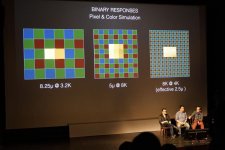
SLIDE 61


So last November, my colleagues Dan Sasaki, Ian Vertovec, and myself presented a resolution thesis in a session at the MCK Theater, a lecture hall a short walk away from the Opera Nova where most of the films at the festival are screened. Our session was titled “The Beauty of 8K Large Format” and the 260 seat room was quickly filled to capacity while the MCK lobby played host to another hundred or so who viewed the lecture on monitors that lined the lobby walls.

Before we get to Slide 61, I wanted to briefly share a more personal note. This event embodies why I do what I do. Over the years I have had the honor of leading teams of talent who are willing to challenge the status quo and I always gravitate towards people who are comfortable with being uncomfortable. While all are welcome to disagree with my conclusions, I find few are willing to criticize my passion. My primary goal is to identify the boundaries of where technology and creativity intersect and learn how to leverage that area for improved creative control. While doing that, I aim to keep an open mind as to what living in this intersection teaches me over time. This technological and creative place is often a state of mind; a place where I believe the best ingredients reside for unbridled innovation. I call working in this place being technative.

We all understand that some things in art are binary; that is to say they are absolute (aspect ratios, framerates, focal lengths, incident light readings, etc.). But we also respect many things in art are open to interpretation. This is why conversations are so critical and why an open mind is possibly the most important tool for artists, especially in technologically-driven industries like ours. In our Camerimage presentation, we argued that resolution is not only important, it’s the core ingredient to the 3 most important mechanical components in creating images from a camera:
1. Acquisition & Exhibition (separating these concepts from one another)
2. Resolution & Sharpness (separating these concepts from one another)
3. Magnification & Perspective (understanding their relationship with 1 & 2)

Every time Dan, Ian, and myself made a point, we used a chart (binary) to back up our point followed by an image (subjective) to allow for personal interpretation. Our strategy in delivering this message was to use the combination of technology and creativity together in order to allow each audience member to follow along and draw their own conclusions. So why is it that Slide 61 resonated with so many people?

The actual story of Slide 61 began a few years back when I borrowed the first prototype RED 8K VV sensor from RED President, Jarred Land. At the time, many people on our team (not withstanding the cinematography community) were concerned about what a 35 megapixel CMOS sensor would do to a face. Specifically, there was concern about the balance between sharpness, contrast, and optics based on an massive jump in motion picture pixel count and pixel density. At the time time we were doing initial tests, the climate for large format photography was beginning an upward trend (you could argue, again). Arri recently released the Alexa 65, a 20 megapixel, 54mm large format sensor. Tarantino recently directed The Hateful Eight, shot and released in Panavision Ultra 70mm. My father and I attended a special screening of Kubrick’s 2001: A Space Odyssey remastered in 4K and released on a brand new 65mm print at Arclight Cinemas. So after testing a prototype 8K Weapon, I decided to publish one of our tests and see what the reaction was. AC Phil Newman, Keenan Mock, and AP Megan Swanson helped me shoot a short portrait of my friend Erin Gales, a health coach and professional body builder. On the surface, this portrait was a safe way to gather intel about what people understood or didn’t understand about large format and high resolution. The comments on the Vimeo link still demonstrate how new the concept of large format is. It’s also pretty clear proof as to how expectation and bias significantly impacts opinion.

We discussed this concept among others when Dan Sasaki, Ian Vertovec and myself presented 90 minutes of a fact-finding thesis on the importance and beneficiary effects of creative control granted through high resolution. It’s important to note that our end presentation was not our objective; in other words, we were not set on proving resolution is power through our conclusions, rather our independent research concluded there is power in resolution. However, I’ve done well over a hundred presentations in my life and there was something odd about this presentation which is actually what prompted me to document this entire story:

When it was over, there were no questions.

At first I thought we failed to defend our conclusions. I thought my slides were too few. Then perhaps too much. We had not previously practiced the deck, so maybe the audience felt we were unprepared. But as it turns out, none of this was the case. And that’s where this experience will never leave me. Over the next few hours, days, weeks, and now even months, more and more people reach out and say this information was so profound, even revolutionary, that people simply needed time to react to it. One person explained to me the following day, “This information is so profound it cuts to the core of some of our beliefs. You challenged my believes so well that I am beginning to doubt what I thought was true. When I doubt myself instead of defend myself, my reaction is to remain silent. In that moment, I think the whole room was going though the same process.”

That made me feel a lot better and I hope at least a few of these concepts resonate with you, too.

I don’t yet know if this event was momentary thing; lightning in a bottle, or perhaps the beginning of new awakening, but what I do know is the images we are capturing in 8K are different in ways we could have never predicted when we started this journey. Leon Silverman told me once, “In the complex world of art and technology, the teacher is only one semester ahead of the student.” That’s exactly what encapsulates moments like this. And that’s exactly what personally drives me to keep exploring what’s around the next corner.

| m |
 

Attachments

  • slide 61.jpg
    slide 61.jpg
    86.8 KB · Views: 0
Got a special sneak peek at this final presentation and I have to say it's all dead one and well presented. We're all in the very same mindset of the power behind this much captured detail and resolution. It's an incredible technical achievement that translates beautifully into a creative tool.
 
The Vista Vision sensor truly creates a beautiful image. I guess in the end that's what matters.

Part 2 didn't sit that well with me. I think there was some fuzzy logic going on in terms of 'film resolution' and how 'hyper acuity' works. If anything, I think Hyper Acuity would take 6 shades of brown and average them out to one solid color. If we are able to discern the fine variations, I think that's an indication that what we are seeing is within our 'color acuity' range.

I agree that we as humans are good at "filling in the gaps" where there is information missing. This can be both good and bad. But I don't agree that adding more information outside the limit of human vision (established best case acuity) will add to how we process images.

At the same time, I felt that Steve Yedlin in his ResDemo over simplified a few things, as I DO see benefits of higher resolution images.

It's my take that the differences we see are simply attributed to the scaling aspect of things. Scaling images up and down in size, relative to a fixed viewpoint, will make edges and transitions appear differently. But all these apparent changes exist within the frame of our acuity—otherwise we wouldn't see them.

A good example is the "sharpness challenge" where to images are put side to side. Which is sharper—left or right? Many go with the image of the right, since the lower resolution make the edge transitions (same as sharpening halos when sharpening) appear bigger for that size/viewing distance, which in turn makes it look "sharper". Of course when we zoom in—again changing the scaling for the same viewing distance—we now see that the lower resolution image can't support the blow up and breaks apart. But all of this is firmly within human acuity, in my opinion.
 
Michael, thanks for posting both the detailed text of your thoughts as well as the video presentation. I really buy most of what you are saying, except I think there's one logical fallacy at the very end, at 55:55 in the video. The claim is "same lens, same field of view, totally different perspective when comparing s35 and VV". This sets off my snake-oil detector, bigly. I think I understand what you were really trying to explain, and I think that an explanation (not the one given) really does offer a deep insight that validates your triangle. But you shouldn't make the audience work so hard to get past another pervasive misconception: what's so special about larger-format lenses.

As I'm sure you know from your VFX experience, if you use a virtual camera and a virtual lens to insert a VFX element in a match-move, all that matters to get the perspectives to line up is to equalize the fields of view between the virtual and physical cameras. This can be done with a virtual super-8 frame and e.g. a 4.8mm lens, a virtual super-16 frame and a 11.66mm lens, or a RED VV frame and a 40.96mm lens. As long as all three formats are rendered to 8K, the rendered-out frames will be pixel-for-pixel identical (except for top and bottom cropping differences, if any).

When you explained that you equalized FOV for the same lens between S35 and VV, there was a huge change of perspective (and depth of field), which is no surprise, because to get the same FOV for the face, you had to push the camera in quite a bit, moving it almost past the laptop on the desk. And while you may have kept the face the same apparent size, of course the size of the background changes because of perspective. BUT! Here's where the confusion comes in, and here's the fix. The confusion comes in because many, many people have been conditioned (wrongly) to believe that VV lenses have magically better perspective than S35 lenses; that they have greater "depth"; Better "perspective"; more "draw". That is as wrong as saying that resolution = sharpness. What is correct is that because larger format sensors allow greater MTF at equal resolutions (all MTF curves I've ever seen show a decrease in MTF % as lp/mm increase), *that* creates the enhanced image quality that invites one to look deeper into the image.

Could you have placed a wider angle lens on an s35 camera to get essentially a pixel-for-pixel copy of the longer lens on VV? Yes. Would it have the same perspective? Yes. Would it have the same depth of field? Not at the same aperture, but there's math to tell you at what aperture they would have identical depths of field. Would they have the same look? Not necessarily! The MTF of an 8K lens focusing to 5um pixels can be superior that of an 8K lens focusing to 3.5um pixels, which means that yes, you can wander into new perspective territory precisely because you have the magnification and resolution/contrast backing you up. That's a valid and important point. But it's also a point that doesn't repeat the fallacy that larger format lenses achieve perspectives impossible with smaller format lenses. It emphasizes the relationship between the perspective leg of the triangle and the other two legs, and why all three legs are important.
 
You're absolutely right, Michael, valid points. The fact is, in the vast and complex argument of what 8K and large format offers, there are numerous ways we worked to delver the information. But as students of the technology ourselves, all of those conclusions evolve over time. In other words, it's an evolutionary process that requires reflection and willingness to re-test and re-evaluate.

So you're going to love this: after Camerimage we came to the same conclusion as you did and created and entirely new (stand-alone) analysis of the *exact* relationships you spoke of with regard to these different formats and their properties. This new format comparison analysis video will come out very soon as part of Panavision's PanaLab (and will be shown on social media). I really welcome your thoughts once this comes out.

But I will say that when you work within the physics of spacial relationships, lens and lighting limitations, large format does have "an extra gear" that does not always exist in smaller gates. The key point to us is flexibility and when all things are assembled together in an apples-to-apples test, large format gives you the most choices.

Michael


Michael, thanks for posting both the detailed text of your thoughts as well as the video presentation. I really buy most of what you are saying, except I think there's one logical fallacy at the very end, at 55:55 in the video. The claim is "same lens, same field of view, totally different perspective when comparing s35 and VV". This sets off my snake-oil detector, bigly. I think I understand what you were really trying to explain, and I think that an explanation (not the one given) really does offer a deep insight that validates your triangle. But you shouldn't make the audience work so hard to get past another pervasive misconception: what's so special about larger-format lenses.

As I'm sure you know from your VFX experience, if you use a virtual camera and a virtual lens to insert a VFX element in a match-move, all that matters to get the perspectives to line up is to equalize the fields of view between the virtual and physical cameras. This can be done with a virtual super-8 frame and e.g. a 4.8mm lens, a virtual super-16 frame and a 11.66mm lens, or a RED VV frame and a 40.96mm lens. As long as all three formats are rendered to 8K, the rendered-out frames will be pixel-for-pixel identical (except for top and bottom cropping differences, if any).

When you explained that you equalized FOV for the same lens between S35 and VV, there was a huge change of perspective (and depth of field), which is no surprise, because to get the same FOV for the face, you had to push the camera in quite a bit, moving it almost past the laptop on the desk. And while you may have kept the face the same apparent size, of course the size of the background changes because of perspective. BUT! Here's where the confusion comes in, and here's the fix. The confusion comes in because many, many people have been conditioned (wrongly) to believe that VV lenses have magically better perspective than S35 lenses; that they have greater "depth"; Better "perspective"; more "draw". That is as wrong as saying that resolution = sharpness. What is correct is that because larger format sensors allow greater MTF at equal resolutions (all MTF curves I've ever seen show a decrease in MTF % as lp/mm increase), *that* creates the enhanced image quality that invites one to look deeper into the image.

Could you have placed a wider angle lens on an s35 camera to get essentially a pixel-for-pixel copy of the longer lens on VV? Yes. Would it have the same perspective? Yes. Would it have the same depth of field? Not at the same aperture, but there's math to tell you at what aperture they would have identical depths of field. Would they have the same look? Not necessarily! The MTF of an 8K lens focusing to 5um pixels can be superior that of an 8K lens focusing to 3.5um pixels, which means that yes, you can wander into new perspective territory precisely because you have the magnification and resolution/contrast backing you up. That's a valid and important point. But it's also a point that doesn't repeat the fallacy that larger format lenses achieve perspectives impossible with smaller format lenses. It emphasizes the relationship between the perspective leg of the triangle and the other two legs, and why all three legs are important.
 
@Michael Cioni , Will dig deep on what you have linked and presented. [Combined system MTFs are one of my "Passions"/technical necessities].

Just need a few spare hours today lol, but will "Do" due diligence.

Thanks for sharing and posting this as not everybody is in the "Orbit" of things going on in LA etc.

Cheers,

Eric
 
Great stuff Michael!

Touches great points that even some Pro filmmakers still have a hard time understanding!

And thanks again so much for the trust and privilege you gave me to use one of the Early DXL cameras to get a taste of it's amazing Technological advancements the Panavision & LightIron Team built in this camera around the insane RED VV 8K sensor!

Been that it was end of 2016 when Adrien and I shot the DXL as a Prototype, I can not even imagine how absolutely insane of a Camera System has become now, and look forward to shoot it again some day :)
 
Michael,

So glad you have shared the CameraImage presentation. Having watched it several times I come away with a greater understanding. As always you do a great job of taking material that is hard for this old DOP to understand and make that knowledge accessible. Thank you.
 
Nice presentation. Unfortunately your perspective and DOF tied to sensor size claims are inaccurate and there is a thread here with examples that proves it. http://www.yedlin.net/170504.html As are the resolution claims that are affected by OLFP, s/n ratio, A to D conversion bit depth, debayer, compression. They all affect the final resolution. Sharpness is resolution, what it isn't is an edge enhancement and blocking compression alghoritm . That's what you were referring to as "sharpness". There is definitely some very good info there but it does come off as skewed in certain direction, at least for the technical types ;-)
 
Friends on RU:
I am really excited to release a recording of a presentation myself and a few of my colleagues presented at the Camerimage Film Festival last November. I think many of you will really enjoy the perspective we've presented in this fresh analysis. For those of you who want to jump right into it, here is the direct link:

<snipped for space>
I don’t yet know if this event was momentary thing; lightning in a bottle, or perhaps the beginning of new awakening, but what I do know is the images we are capturing in 8K are different in ways we could have never predicted when we started this journey. Leon Silverman told me once, “In the complex world of art and technology, the teacher is only one semester ahead of the student.” That’s exactly what encapsulates moments like this. And that’s exactly what personally drives me to keep exploring what’s around the next corner.

| m |

LOVE Panavision and what you guys are trying to do.

Please please please devise a 100 MP sensor AND GLOBAL SHUTTER (or near as you can) and if you have a sensor that even shoots 10 fps we can do a lot with that.

__________________________________________________________________________________________________________________________________________________

OK I will preface this with that I was married to a professional editor and book designer for 20 years (she also worked in academia at a Ph.D level) AND also did some film/script work... But her key strength as an editor was to turn dyslexitized and ADD'ed submissions for papers to be published (from very bright and learned individuals) into clear concise and extremely well expressed prose (sp). This typically goes with the territory for very bright folks that are schizophrenics between art and science (such as the Film business and other inter disciplinary fields). Typically visual people are very non linear, and you guys are forced at short notice to take a very multidimensional and visual subject and turn into a linear coherent narrative... (Fail).

Similarly being ADD and Dyslexic (myself) and visual thinker and scientist and having several research fellowships I always needed some one to help me with STRUCTURE... ! (My X-wife was brutal in this regard but have learnt a lot as a result :-) lol). NOW I can do this pretty much for myself but it IS important to seek the advice of an academic editor or supervisor for very complex and important presentations. [Just kind advise you are welcome to ignore].

Similarly having done my Ph.D studies at Cambridge in the U.K. I had my arse kicked twenty times around the block until I was fully cognizant of what a focal theory that develops into a TRUE THESIS really IS.

I know this all sounds very snobby and dismissive, but I have been there and learnt the lessons for what is really needed, and sometimes some real world academic "Rigor" IS required.

___________________________________________________________________________________________________________________________________________________

We discussed this concept among others when Dan Sasaki, Ian Vertovec and myself presented 90 minutes of a fact-finding thesis

"Fact finding thesis"... That is an oxymoron and in academia/technical/scientific research you would be crucified for that... [I don't know where to start on that one as it would be a very lengthy discourse].

We all understand that some things in art are binary; that is to say they are absolute (aspect ratios, framerates, focal lengths, incident light readings, etc.).
Another Oxymoron, https://en.wikipedia.org/wiki/Binary_opposition

There are several more examples of that kind of thing... So either keep it really simple or really get to grips with the terms and concepts you are attempting to wield. These are potentially very powerful conceptual tools but you have to know how to use them properly. These are not just random imprecise fuzzy terms and vague constructs you are using here.

"Lightning in a bottle" ... Nope... Very beautiful and excellent scrabble pieces in a bottle tipped out onto a table. Sorry if this sounds old fashioned and pedantic BUT you have to give your audience some structure up front. Give them a clue as to the thrust of your presentation. Explain WHY you have to examine certain elements. All the individual elements are important and fascinating, but frankly very jumbled up and smashed together. (Definitely some of the more disparate and digressive elements should have been cut; interesting YES, useful to the thrust of your presentation... NO :-) ). That makes things difficult to follow (EVEN if YOU understand what you are going on about you have to be able to put yourself into the audience's shoes and perspective to make sure you genuinely communicate exactly what it is you so badly want and need to communicate.).

___________________________________________________________________________________________________________________________________________________

So @MC what IS your "Thesis" ...In five to ten lines; and what is your focal theory (not lens theory lol) and how is that developed. What data do you have to support your thesis? How would you go about the structured acquisition of further data that is directly relevant to actually prove your thesis?

____________________________________________________________________________________________________________________________________________________

Technical side notes/questions: How did you guys manage to make it through that presentation without talking about artifacts related to data and image compression (and even de-mosaicking or even to an extent wavelet compression schemes (all being good) ) ?

Personal note: Yup the retina is important, but the way those pathways map into the visual cortex are waaaaay more important. I agree on angular resolution being effectively ten arc seconds (that's what I typically design around), but one arc second is 1 divided by 3600 1/3600 th of a degree... Not sure those lines presented at weird angles was very representative... I'd like to see you discriminate between lines of 20 arc seconds... lol.

___________________________________________________________________________________________________________________________________________________

All of the areas touched on by you guys are VERY important... But frankly very obvious to folks that have been working in digital imaging for 25 years +, but what was at the back my mind is what happens when those images start moving :-) AND I whole heartedly agree there is another dimension and physiological aspect and psychophysical aspect that has not been fully explored yet.

So thumbs up from me, but you guys need much better structure to help transfer the "Goodness" that you guys aim to bring. Was very interesting but not surprised that folks would actually be very confused by the end.

Hope that helps (constructive professional criticism from some one who has been there).

Cheers,

Eric
 
Great stuff Michael!

Touches great points that even some Pro filmmakers still have a hard time understanding!

And thanks again so much for the trust and privilege you gave me to use one of the Early DXL cameras to get a taste of it's amazing Technological advancements the Panavision & LightIron Team built in this camera around the insane RED VV 8K sensor!

Been that it was end of 2016 when Adrien and I shot the DXL as a Prototype, I can not even imagine how absolutely insane of a Camera System has become now, and look forward to shoot it again some day :)

What you shot and what I have seen related to that on 'Social media" LOOKs beautiful and very mature approach to lighting and grading... Really special/subtle and cool (very particular sensibility that reminds me a bit of fashion photography of the late 70's to early 80's... Now being back in fashion perhaps?).
 
Bayer pattern?

https://vimeo.com/248235757

^^^ at 29 minutes and 38 seconds in on the video/presentation there is a slide of a filter array with the title "Bayer Pattern Color Filter Array".

That seems a little different? Maybe? (Not sure on the scope/definition of "Bayer Pattern" these days???).

https://docs.google.com/viewer?url=patentimages.storage.googleapis.com/pdfs/US3971065.pdf

^^That's Bayer's patent, (remarkable).

https://en.wikipedia.org/wiki/Bayer_filter

^^^ Not saying that Wikki is the font of deep knowledge.

The slide on the presentation shows what looks like (can't completely tell)... a Red, Red, Blue, Blue, Green, Green, cell arrangement. Maybe there is an optical illusion there and the blue photosite appear smaller but are they?

The more common variety Bayer pattern is the one with TWO green photo-sites arranged on diagonals to ONE blue and ONE red? (Am I smoking crack on that?)?

I also remember a number of years ago on RED forum when folks were kinda freaking out about a presentation given by a SONY representative about a Bayer pattern that was rotated through 45 degrees... Caused quite a ruckus as the presenter was trying to "Trash" the Bayer pattern, and yet as Graeme (sp) pointed out it IS a Bayer Pattern (just rotated) lol.

Also I remember Panavision (possibly earlier John Galt (times)), was experimenting with non conventional photo-site layouts (if memory serves me right they were rectangular in a vertical orientation).

Just wondering what is the scope of what is considered a "Bayer" pattern these days..?

Honest question.

Ta.

Eric

______________________________________________________________________________________________________________________________________________

That photo/slide almost looks like a close up on an old fashioned but nice CRT/monitor or other display device ? Just looks weird maybe an artifact of slide/presentation then videod then vimeo'd (no idea).
 
So a red epic-W + speedbooster + sigma cine set gives you the best bang for the buck, with current technologie.
 
Nice presentation. Unfortunately your perspective and DOF tied to sensor size claims are inaccurate and there is a thread here with examples that proves it. http://www.yedlin.net/170504.html As are the resolution claims that are affected by OLFP, s/n ratio, A to D conversion bit depth, debayer, compression. They all affect the final resolution. Sharpness is resolution, what it isn't is an edge enhancement and blocking compression alghoritm . That's what you were referring to as "sharpness". There is definitely some very good info there but it does come off as skewed in certain direction, at least for the technical types ;-)

+1

The link you cite by 'Steve" is really excellent and his other similar work. I have designed and built digital stereo photogrammetric workstations from scratch and corresponding imaging equipment/acquisition gear... So we typically adhere to certain focal lengths to format size/diagonal ratios regardless of what the sensor size is. But cinematographers right now seem to be obsessed with shallow depth of field and shooting wide open with super super fast lenses almost to the point where it becomes a crime against fashion to stop down. [Personally I think it just makes cheap sets and crappy locations seem better than they really are (I'll get some flak for that)].

I was really pleased to see / learn of 'Steve's practical "Tableaus"/recreations that physically demonstrate the point. A point that I only had a theoretical/computational reference for (in terms of more exact comparisons between matching focal length to sensor format and projected angles of view.). I work to what is available at the time that meets the technical brief/requirements. So really nice to see very well worked examples in actuality specifically to demonstrate the angle of view versus effective focal length versus format size. And indirectly effects of 'Circle of confusion" + ray angles.

As I say fully worked system MTFs for each step and element in the system and combined MTFs are really helpful.
 
Love this, Appreciate your posts Michael, you nailed it. I especially like how you show how this acquisition approach translates to cell phones.

I think what's a huge tell on shots, is when I pull the camera into the actor with something like a 50mm lens with VV format, I still have a medium/wide to give context ... it creates a huge perceptual depth even on a cell phone, yet also helps move the story through eyes saccade on what is in focus.
 
Panavision used to be all about science among the technical staff when I worked there 30 years ago. I still have the DOF charts I use to calibrate focus scales on lenses. I learned a lot back then from all the throughout preparation and research that went into the customer education and gear. Somehow I feel that marketing sneaked up on the science. Or, maybe I was more gullible at 21 years old ;-)
 
Panavision used to be all about science among the technical staff when I worked there 30 years ago. I still have the DOF charts I use to calibrate focus scales on lenses. I learned a lot back then from all the throughout preparation and research that went into the customer education and gear. Somehow I feel that marketing sneaked up on the science. Or, maybe I was more gullible at 21 years old ;-)

Nope,

I think you are right and heard you loud and clear in post #11.

Skewed/felt like an infomercial/mild propaganda.

On the other hand I'm still trying to relate "Squishy tomato" to non-bayer bayer pattern.

The point being this would not be acceptable for a submitted paper at a journal, nor a so called "White paper" or EVEN a brochure...

At imaging conferences in the past I have been forced at gun point to talk about work in progress (whilst presenting at RIT) other than my main paper, point blank refused.

Came under lot of flak for that as "My standards are too high" etc. blah blah , but I never regretted that.

It's like being a musician don't turn up on stage with an audience and not really have-it or bring it or be well prepared. [I used to be Jazz musician so even with extemporization and improvisation you really need to have your sh*t together].
 
I really think it is a good start to a study. Just a bit more research and preparation , take care of the contradictory theories such as format vs perspective, accute vision vs fuzzy logic, resolution vs sharpness, 4s rule vs detail, etc. (and yes that squishy tomato- my favorite ;-) Add to that true DOF analysis in a film set setting and we would learn amazing digital film making tricks- Panavision style. Like the old times, when i first saw Panaflex Gold-a revelation ;-)
Kudos for the effort and long travel to deliver this presentation. Poland is pretty cold and wet in November...
 
Back
Top