Welcome to our community

Be a part of something great, join today!

  • Hey all, just changed over the backend after 15 years I figured time to give it a bit of an update, its probably gonna be a bit weird for most of you and i am sure there is a few bugs to work out but it should kinda work the same as before... hopefully :)

RED Monstro - Dynamic Range Examined

Phil Holland

Administrator
Staff member
Joined
Apr 19, 2007
Messages
13,392
Reaction score
795
Points
113
Location
Los Angeles
Website
www.phfx.com
If you're curious about RED Monstro and Dynamic Range, I have the backscratcher to attend to that itch here this evening. Everything here is presented in UHD 4K at exact scaled resolution from 8K if you're curious.

I'll keep it simple as I have many tests and this can get complicated fast, but in this case I'll focus on the Xyla tests and measurements. I've tested the Low Light Optimized, Standard, and Skin Tone - Highlight OLPFs as well as "Clear" to see what the sensor really can see (because I'm a curious bastard).

First up, straight Ungraded IPP2 Log3G10 at ISO 6400, which shows what you want to know:
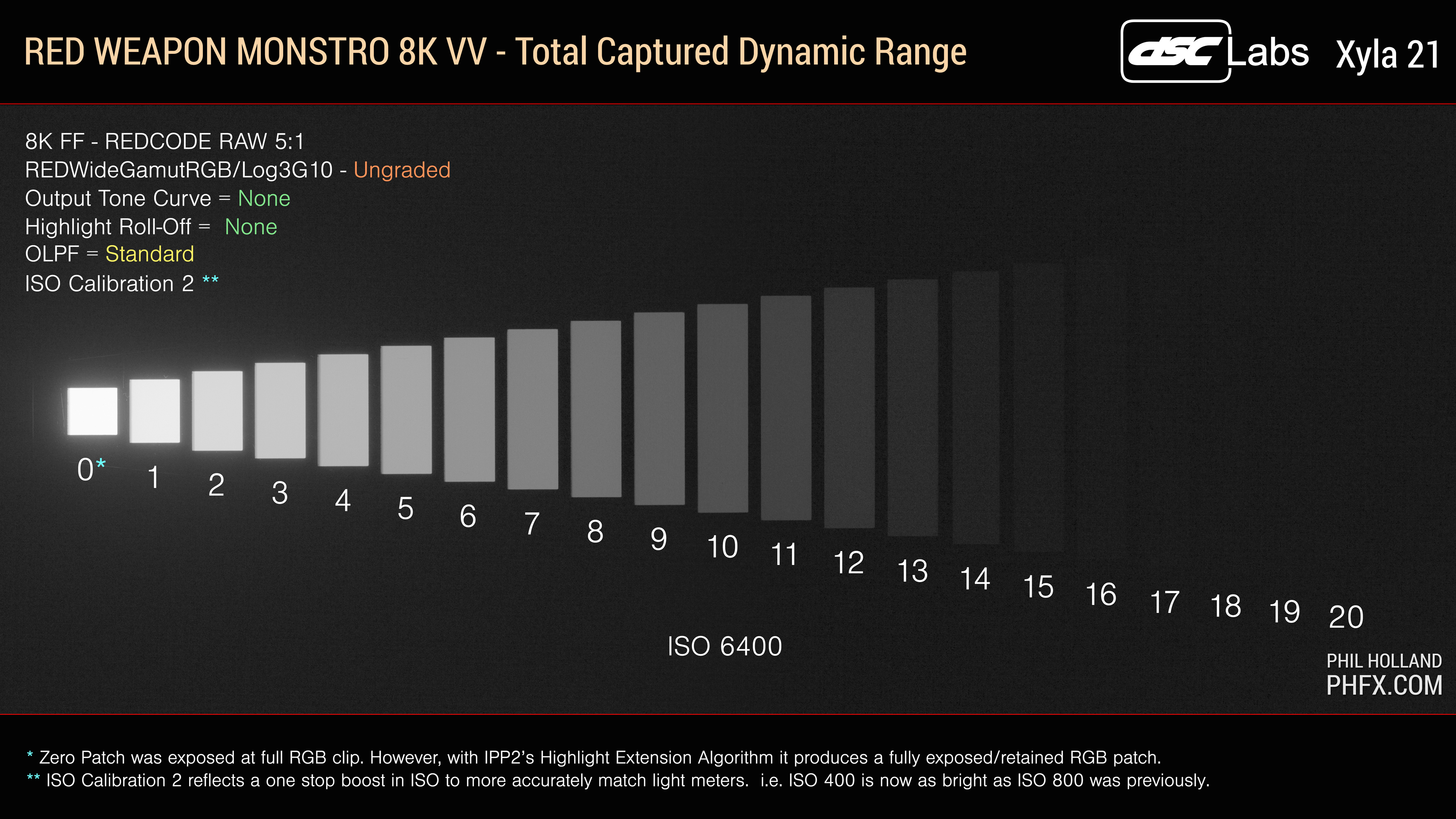


Links to other OLPFs tested: CLR, LLO, STD, STH


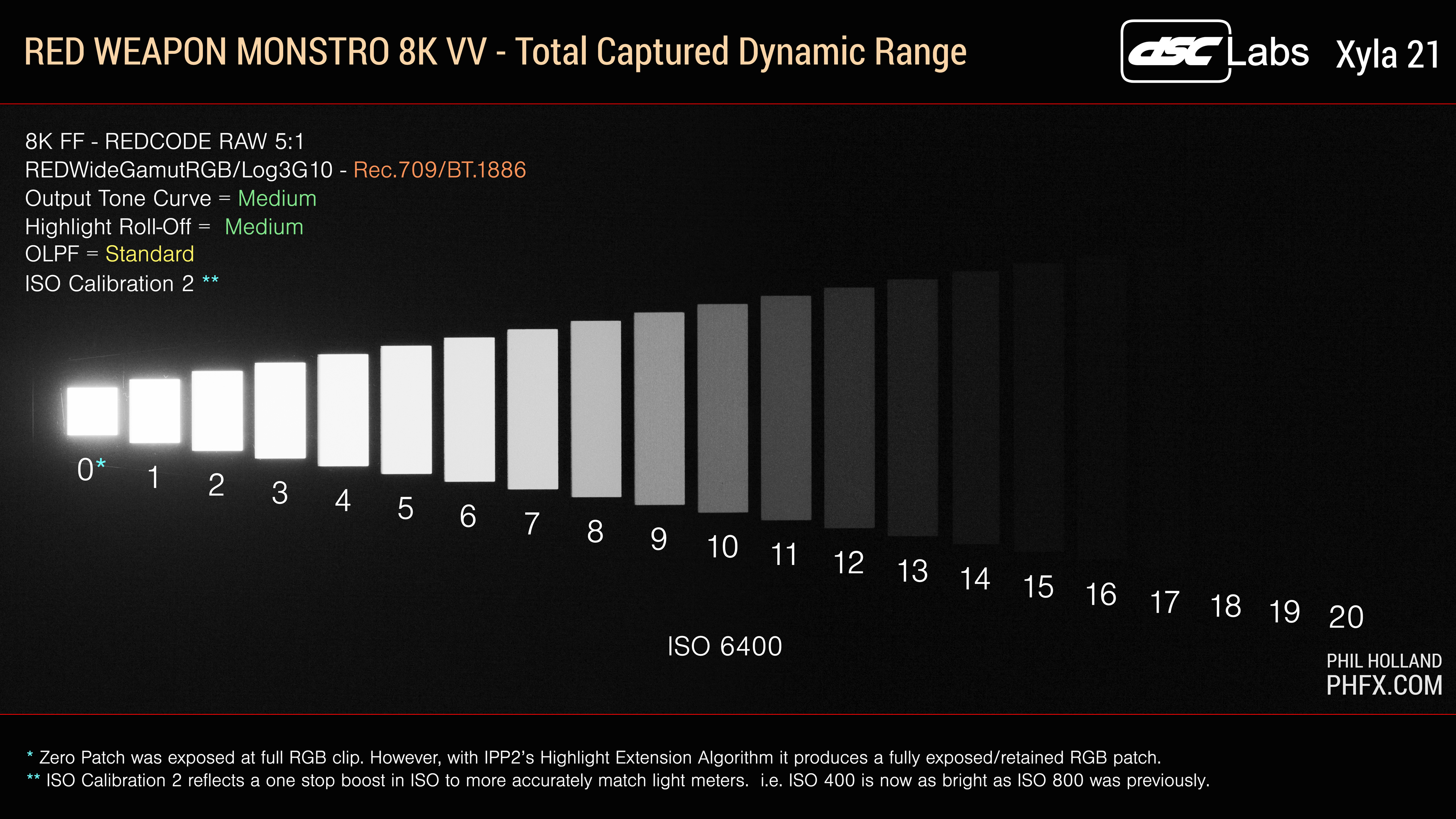
Let's get into some chatter about Total Captured Dynamic Range and "Usable Stops, in this case the extreme ISO 12800 used:


Perhaps the most interesting thing that transpired this time around was the inclusion of RED's new IPP2 tech and the Highlight Extension Algorithm. My traditional method of exposing to full RGB clip was gobbled up back into captured dynamic range and detail on the absolute top end.

Also to note, the Standard OLPF was used in this graphic in comparison to the Clear OLPF, which showcases just how much light you lose (not that much actually) with a color filter such as that.


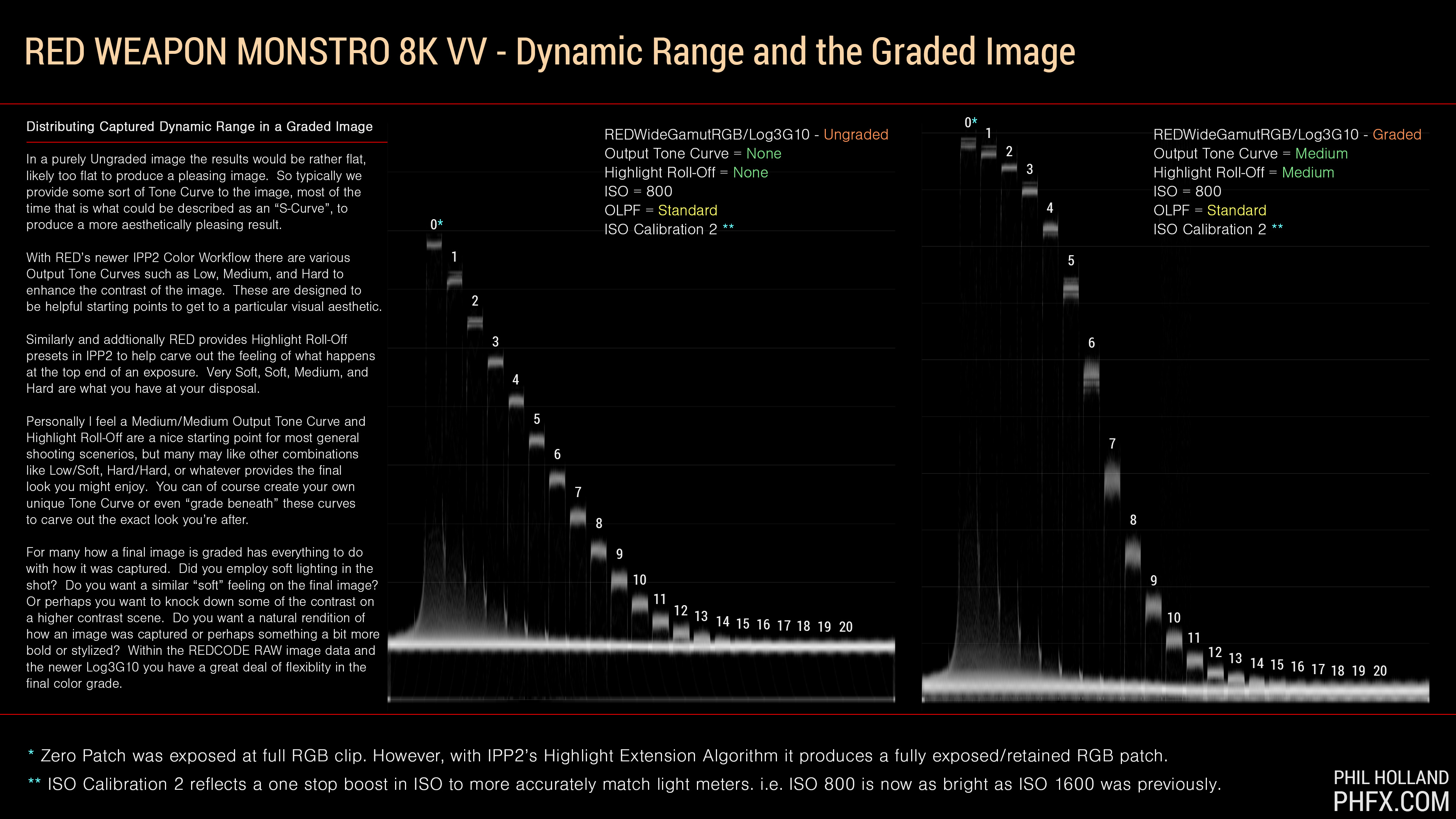
Now let's look at how our Log3G10 flat Ungraded image gets mapped within IPP2s Color Workflow, ISO 800 here:


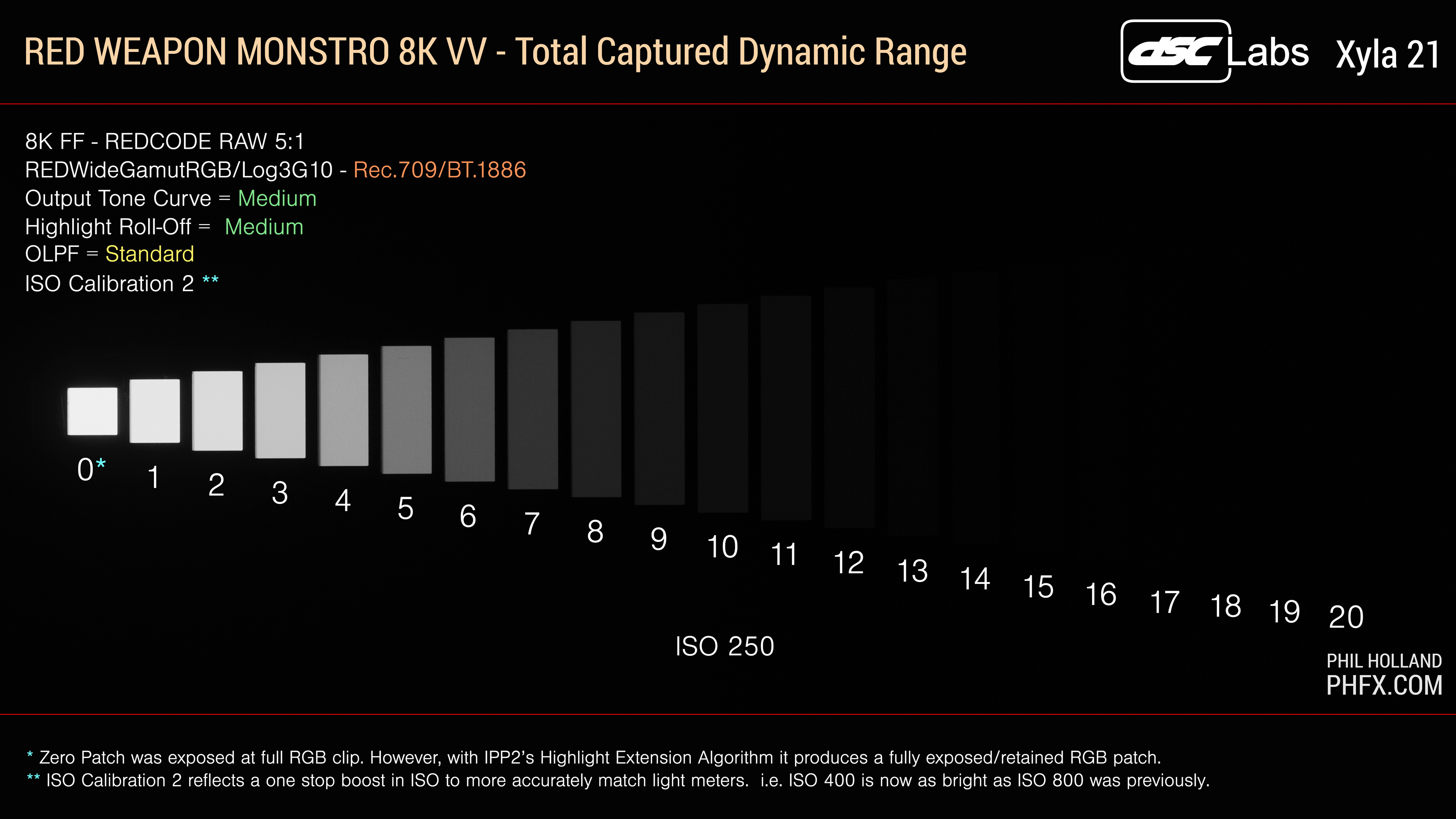
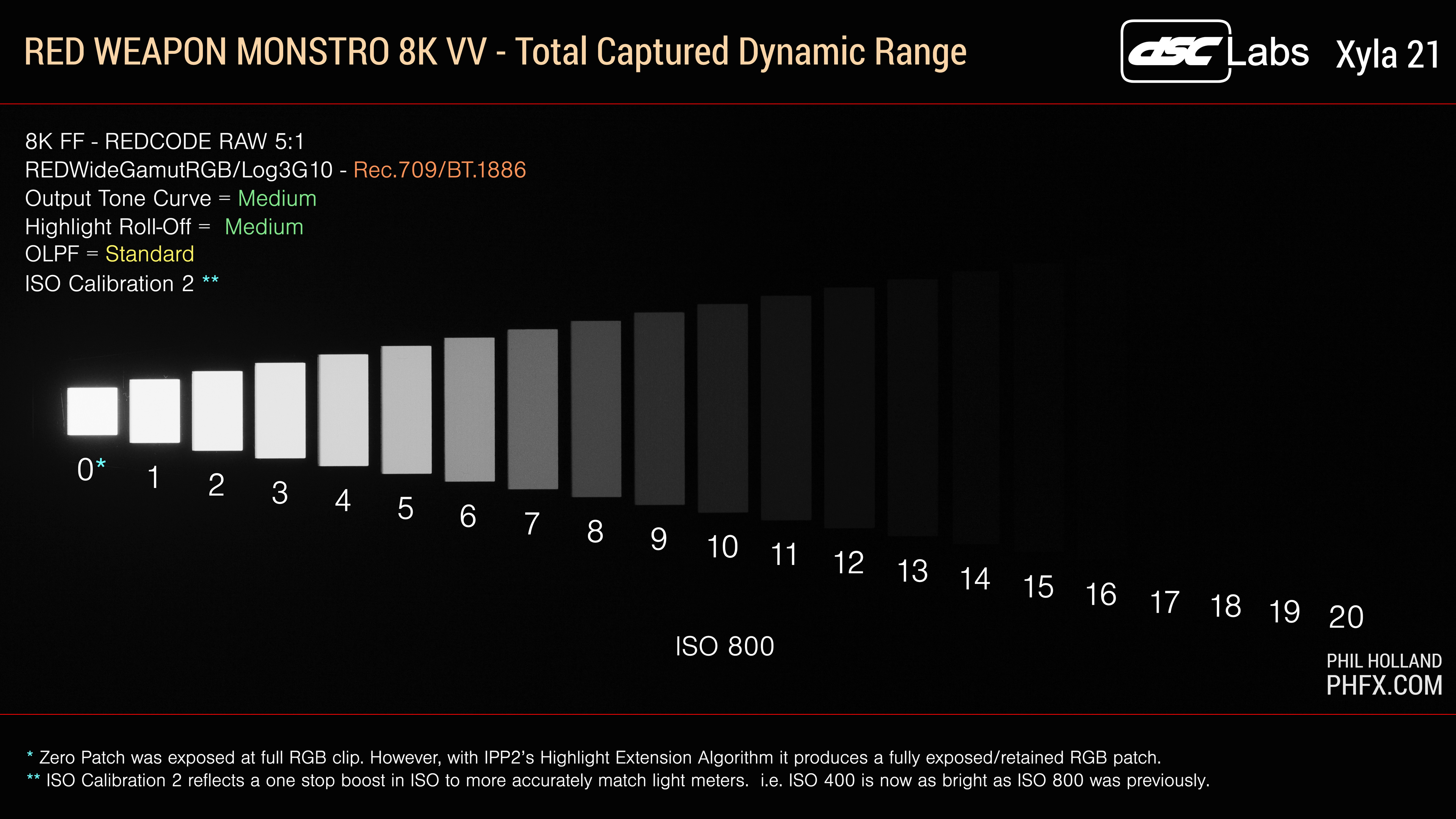
And lastly some graded IPP2 with what I call the standard Medium/Medium Output Tone Curve and Highlight Roll-Off. ISO 250, 800, and 6400 shown here:


In summary for the TL;DR version and some additional observations:

RED Monstro: 17+ stops of Total Captured Dynamic Range, Usable Stops likely around 16-ish for those who do that, and some interesting stuff happening with IPP2 related advancements.

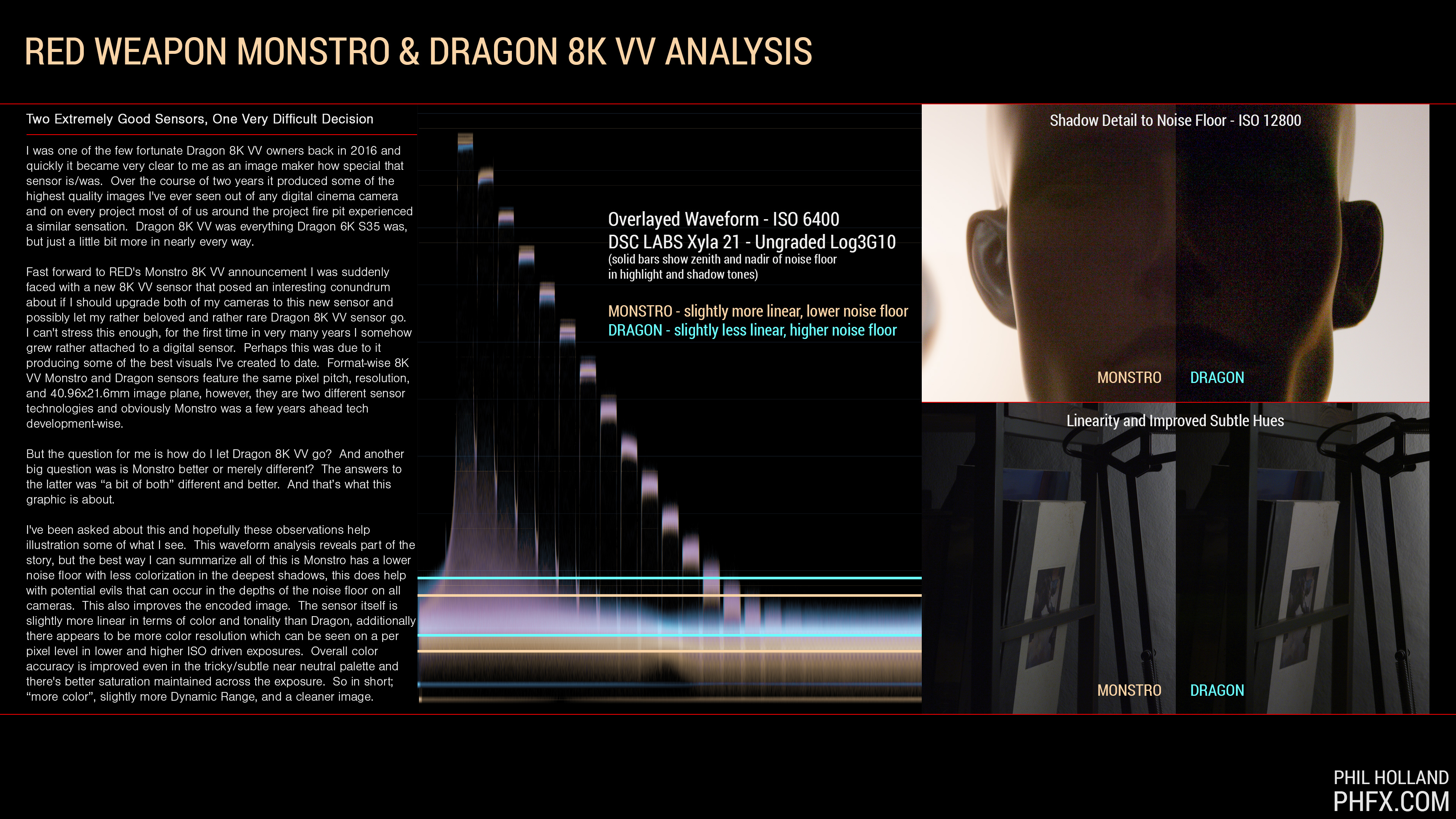
Some other things I'll note about Monstro along the way. At matched levels of "Noise Floor" Monstro is smoother and less toothy than Dragon, also notable, less artifacting if you are doing horrific bad things. Additionally I've observed for Color Resolution, which is a harder topic to demonstrate, but I'll have some sample images shortly.

I'll reiterate though each image states this, this is all using ISO Calibration 2 which boosts things up 1 stop. So for those not familiar with this and IPP2 what was ISO 1600 is now ISO 800 in terms of brightness.


Other than that, please let me know if you've got any questions.

Hope this helps.


*edit, one additional thing showcasing the differences I see between Monstro and Dragon and what lead me to going "all Monstro":
 
Last edited:
Thanks Phil, really appreciated. Would love to see a side by side in terms of color reproduction with same lenses of the Monstro, Helium and the Alexa. And of course a best practices video from you and Red Tech for this new sensor. Am going to upgrade this summer!
 
  • Thread starter
  • Moderator
  • #7
Cheers guys.

Thankyou for your (neverending!) contributions Phil.

Was there any frame averaging - or were these single shots.

Looking forward to your insights into colour resolution.

No frame averaging, just composite of slides to avoid contamination of left and right. If you don't do that the first patch contaminates the darker patches and returns false positives, thus making you think there's more DR than there is to measure. When I compare against the Xyla I do single stop increments reflected and emitted to confirm the results, which take a hell of a lot of time, but confirms the results nonetheless.


Thanks Phil, really appreciated. Would love to see a side by side in terms of color reproduction with same lenses of the Monstro, Helium and the Alexa. And of course a best practices video from you and Red Tech for this new sensor. Am going to upgrade this summer!

Next time I do side by sides will likely be with an LF at a studio somewhere. There will probably be another camera there as well. Don't know when it's going down, but should happen in the next few months.
 
Cheers guys.


No frame averaging, just composite of slides to avoid contamination of left and right. If you don't do that the first patch contaminates the darker patches and returns false positives, thus making you think there's more DR than there is to measure. When I compare against the Xyla I do single stop increments reflected and emitted to confirm the results, which take a hell of a lot of time, but confirms the results nonetheless.


Next time I do side by sides will likely be with an LF at a studio somewhere. There will probably be another camera there as well. Don't know when it's going down, but should happen in the next few months.

That will be great. Can't wait! Curious to see how the Alexa LF Stacks up to Monstro. Seriously think Monstro should be the better sensor in all fronts...
 
interesting Phil, can you compare Monstro with Dragon in Redlogfilm?

wT8VTVX.jpg
 
Phil, Thank you... Wish I only understood more about all this .....

But as you and I have discussed the Monstro is an impressive animal and I believe a game changer. Now we just have to source VV glass for all!
 
  • Thread starter
  • Moderator
  • #15
Thanks

tireless Phil shareing again! ... I think there is more hours in a day where Phil lives ;-)

Boy do I wish sometimes. Part of me wants 36 hour days, but heh, alas that would break us.


How's the roll-off on a Sekonic Chart?

Similar tale as that's also a neutral chart, just with more steps. Roll-Off can be smoother or sudden depending on your preference of curves after the fact and actually even varies on color temperature.


Phil, Thank you... Wish I only understood more about all this .....

But as you and I have discussed the Monstro is an impressive animal and I believe a game changer. Now we just have to source VV glass for all!

This isn't the real world test stuff, but when people start waving numbers around it's good to have a sensible and well executed measurement. Especially as more "Usable Stops" get published by people who have their own methods for defining such things. For me from the peak of the mountain to floor of the Marianna's Trench, RED's published data makes sense.


The other massive reason I do these tests is to know what I can get away with or prefer when dealing with ISO rating/selection. This is actually much more important this time around with RED's new ISO CAL 2 as things are different. For instance, ISO 500 is glass clean, but that would be the same as ISO 1000 from previous calibration, which is one of the reasons why Monstro is spooky good. Some more film-minded aesthetics might be playing more in the ISO 1000-1600 range if they are looking for visible grain/texture/noise. 800 is still a good recommended starting point, and it's pretty darn clean there.

My next few shoots will vary greatly in aesthetic from clean to rather dirty and it will be interesting to see what ISOs I'll be deploying to get there aesthetic-wise.

Most of the 8K work I've been delivering thus far has been in the ISO 800 range and received well with a few higher ISO shots in there, I think one night sequence was ISO 2500 or so.
 
Phil, thank you for all your hard work and sharing with us.
Looking at the waveforms, one could argue that the best way to describe DR is by looking at where the last "vertical gap" exists in the waveform, instead of looking at the horizontal gaps between the stops.
By "vertical gap" I mean - where the signal is clearly separated from the noise floor. In this case - The Monstro VV - it's clearly at the 12th stop.
Excellent result, none the less!!
Cheers.
 
  • Thread starter
  • Moderator
  • #18
Phil, thank you for all your hard work and sharing with us.
Looking at the waveforms, one could argue that the best way to describe DR is by looking at where the last "vertical gap" exists in the waveform, instead of looking at the horizontal gaps between the stops.
By "vertical gap" I mean - where the signal is clearly separated from the noise floor. In this case - The Monstro VV - it's clearly at the 12th stop.
Excellent result, none the less!!
Cheers.

I'll let you "argue that" :)

Actually in that particular "definition" you would be looking at 13th, but taking into account the actual noise floor the it's 15/16 stops in any sort of legal or extended range of shadow. Depending on who you are that is. This is where the nuance is when discussing a Usable Stop falls. I've travelled discussing this with mostly colorists and DPs and their various ways of describing and even testing for this, though most don't test to anything close to this level.

I feel it's important to call out what this measurement/test is. Remember, this is a test from absolute clip, though retained via IPP2's Highlight Extension Algorithm (which is interesting), to the absolute blackest black you can have.

I'll say as an interesting side note, one thing I do with Xyla and chip measurements such as this is create new clamped DR curves and highlight roll-offs to produce interesting color workflows. So for instance if we say where you "stop" seeing interest in shadow detail I can lock you out of what's beyond the 12/13th stop and maintain a rather clean shadow even though there's more meat to it. This is indeed part of what some systems do. This is similar to the tuning of Light Iron Color on the DXL btw and even part of what I'm deploying in philmColor.

Personally I would never limit the DR to sub 13 stops, in fact I'm mostly at the moment creating 13-16 stop "hard outs" with various takes on other tones within the DR to map to say tonal responses of something like Kodak 5219 or similar. Oddly I find I like a lot of the curves from good old Vision 2 sometimes more, but that's a whoooooole different topic.
 
A very interesting test Phil.
Do you think the MX sensor would have 13.5 stops if measure in this way as well?
Tricky question I know, but If one uses say noise reduction tools like Neat Video how far do you think one could go in ISO with Monstro. Say if the end result is 4k TV or 4K blueray (so not cinema).

Best,
Andreas
 
I don't understand how a discussion around DR can involve anything but 'usable stops', since the rest is—per definition—unusable.

Anything outside of 'usable' is firmly within snake oil territory. And the extent to which a certain community reaches for it, will determine how people outside that community looks at said community.
 
Back
Top