Welcome to our community

Be a part of something great, join today!

  • Hey all, just changed over the backend after 15 years I figured time to give it a bit of an update, its probably gonna be a bit weird for most of you and i am sure there is a few bugs to work out but it should kinda work the same as before... hopefully :)

Red and the infraRED

Yes, and it doesn't flicker -- it bands.
Yes. A slight band moving down the picture is what it looks like. I guess a .001% difference does matter.:(

23.98 is a great frame rate for post, but 1/60 shutter is not always to my taste, I guess I'll just have to get the producers to fork out a little bit more for electronic ballasts.
 
I tested my Red at 23.98 with 1/60 shutter and a HMI with mag ballast and it worked fine. 1/48 looked fine to the eye, but on rapid scrubbing in quicktime I could see scroll bars over a white wall.
 
I tested my Red at 23.98 with 1/60 shutter and a HMI with mag ballast and it worked fine. 1/48 looked fine to the eye, but on rapid scrubbing in quicktime I could see scroll bars over a white wall.
You'll also see it if you exaggerate the contrast. It's there, and it's slow-moving, and at first glance you won't see it -- but it's there. 1/40th is another alternative speed that'll make it go away.
 
The images I submitted in post #109 of this thread were shot with the afternoon sun low behind camera. I included foliage in the shot because it is naturally shedding heat as part of its evaporative process. The day had been unseasonable hot for Austin, TX (high of 96F / 35C) and was still a bit warm.

Michael
 
Here's a heads up for one IR solution concerning the Red Cam and other DV cams. The Pancro ND filter has an inherent IR filter built into it. The spectral curve runs from .4 microns ( visible ) out to 2.0 microns in the IR. This is more than enough filtering for cinema applications. The material (metallic alloy) that we evaporate onto a glass substrate is the most neutral material available that is effective within the visible and has the exact percentage of filtering in the IR. So the amount of IR filtering resulting is relative to the density that you are using aka .3 (1 stop ) and will cut 50% of the IR .6 (2 stops),. 9 (3 stops), with the 1.2 (4 stops) resulting in a 93% IR block.

So if you have an application where you want to ND up and filter the IR at the same time, you could use a Pancro combo IR/ND filter. Keeping in mind that the heavier you go with the ND, the more IR you are blocking. A huge upside to the Pancro ND is that any angle of incidence will have the same performance value, whereas a " hot mirror" is very sensitve to the angle that it is on as far as its performance quality. Any multilayer-coated substrate has a built in coefficient of refraction that can degrade its overall performance. The Pancro ND is a single layer coating.
 
Here's a heads up for one IR solution concerning the Red Cam and other DV cams. The Pancro ND filter has an inherent IR filter built into it. The spectral curve runs from .4 microns ( visible ) out to 2.0 microns in the IR. This is more than enough filtering for cinema applications. The material (metallic alloy) that we evaporate onto a glass substrate is the most neutral material available that is effective within the visible and has the exact percentage of filtering in the IR. So the amount of IR filtering resulting is relative to the density that you are using aka .3 (1 stop ) and will cut 50% of the IR .6 (2 stops),. 9 (3 stops), with the 1.2 (4 stops) resulting in a 93% IR block.

So if you have an application where you want to ND up and filter the IR at the same time, you could use a Pancro combo IR/ND filter. Keeping in mind that the heavier you go with the ND, the more IR you are blocking. A huge upside to the Pancro ND is that any angle of incidence will have the same performance value, whereas a " hot mirror" is very sensitve to the angle that it is on as far as its performance quality. Any multilayer-coated substrate has a built in coefficient of refraction that can degrade its overall performance. The Pancro ND is a single layer coating.

Okay...don't want to say I told ya so but...

I just ordered a set of panchro ND''s, just in case I am able to reproduce the problem. Thanks Pancro!

Dylan Macleod
Cinematographer
Toronto, Canada
www.dylanmacleod.com
 
Stacking Pancro ND+IR

Stacking Pancro ND+IR

Here's a heads up for one IR solution concerning the Red Cam and other DV cams. The Pancro ND filter has an inherent IR filter built into it. The spectral curve runs from .4 microns ( visible ) out to 2.0 microns in the IR. This is more than enough filtering for cinema applications. The material (metallic alloy) that we evaporate onto a glass substrate is the most neutral material available that is effective within the visible and has the exact percentage of filtering in the IR. So the amount of IR filtering resulting is relative to the density that you are using aka .3 (1 stop ) and will cut 50% of the IR .6 (2 stops),. 9 (3 stops), with the 1.2 (4 stops) resulting in a 93% IR block.

So if you have an application where you want to ND up and filter the IR at the same time, you could use a Pancro combo IR/ND filter. Keeping in mind that the heavier you go with the ND, the more IR you are blocking. A huge upside to the Pancro ND is that any angle of incidence will have the same performance value, whereas a " hot mirror" is very sensitve to the angle that it is on as far as its performance quality. Any multilayer-coated substrate has a built in coefficient of refraction that can degrade its overall performance. The Pancro ND is a single layer coating.

So, if I understand your explanation and spectrum charts correctly, in order to obtain higher ND filtration one can use stacked Pancro ND+IR for cumulative filtering across the spectrum whereas a "hot mirror" can not be stacked because it reflects IR and subsequent layers would reflect back off the former.

RFQ emailed.

Pawel
www.achtel.com
 
So, if I understand your explanation and spectrum charts correctly, in order to obtain higher ND filtration one can use stacked Pancro ND+IR for cumulative filtering across the spectrum whereas a "hot mirror" can not be stacked because it reflects IR and subsequent layers would reflect back off the former.

RFQ emailed.

Pawel
www.achtel.com

I believe the theory is that the Panchro mirrored ND's block infrared as well as visible light. A separate IR filter is not required.

Dylan Macleod
Cinematographer
Toronto, Canada
www.dylanmacleod.com
 
I believe the theory is that the Panchro mirrored ND's block infrared as well as visible light. A separate IR filter is not required.

Oh, I see. So, if I need higher amount of ND, I would need to put the strongest Pancro ND+IR in front, but subsequent stacks would need to be regular NDs to avoid reflection of IR back. Correct? Or, would the backward reflection be insignificant or dispersed enough to stack multiple ND+IRs instead?

Pawel
www.achtel.com
 
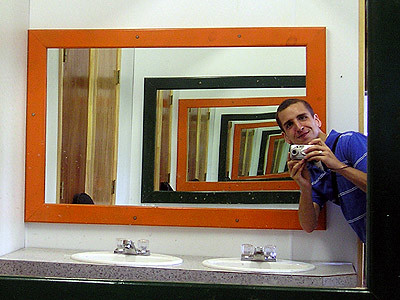
I don't know anything about Panchro ND filters, it's good to hear that they are truly "neutral" across both visible and IR. But are these "mirror" type reflective filters, or absorptive? I would be surprised to hear that you could stack two or more mirror-type filters together and get good results. I'd expect you'd get multiple reflections between the two plates, so any image would have multiple copies...

421498787_4c7f6d99f4.jpg


(not my image, borrowed it from http://www.jeffschuler.net/archive/photo/ )
 
I don't know anything about Panchro ND filters, it's good to hear that they are truly "neutral" across both visible and IR. But are these "mirror" type reflective filters, or absorptive? I would be surprised to hear that you could stack two or more mirror-type filters together and get good results. I'd expect you'd get multiple reflections between the two plates, so any image would have multiple copies...

Yes, that's exactly what I had in mind, except the nested reflections would be attenuated depending on the strengths of each layer. It may still be a lesser harm than letting IR through, though.

I believe Pancro use evaporated inconel layer. My guess would be that they are reflective in IR spectrum and partially reflective and absorbing in visible spectrum. But, this is just my speculation. :clown2:

Pawel
www.achtel.com
 
B+w Nd4

B+w Nd4

I used some high NDs with CMOS and had some success with B+W ND4 screw on filter. These seem to be somewhat reflective compared to other NDs, like Hoya. They also come in weaker densities but this type seems to be not available in larger formats.

Below are un-corrected frames from my footage. If IR contamination was a problem here, surely it would be greatly visible when using ND4.

Pawel
www.achtel.com
 
Any chance of anyone putting some test shots up with the Panchro filters?

I borrowed a set for the express purpose of testing for IR blocking.

Unfortunately (or fortunately you could say) we were unable to reproduce the IR effect. We used a POLA (1 1/2 stops) plus Harrison ND 1.5. That's a total of 6 1/2 stops of visible light being blocked. It was a lightly cloudy day and this might have interfered. No infrared contmination?

I had heard from a cinematographer who used to use a lot of Infrared film, that he bought Panchros for the express purpose of being able to control exposure of Infrared frequencies.

I had to put my filter order in so I took the leap.

They are supposed to be really excellent filters regardless of IR. Because they are "reflective" they remain "neutral" even at high levels of ND.

...and NO...you cannot stack multiple mirrored ND's. You can, however, stack other filters, as long as the Panchro is the furthest from the lens.

When you stare at the front of the lens, there literaly is a mirror over it. Beware if you are shooting kids, or vain performers. :tongue:

Vampires might also be distracted.

I can't remember the exact quote, but I think they are in the neighbourhood of $450 for a 5.65x5.65.

Dylan Macleod
Cinematographer
Toronto, Canada
www.dylanmacleod.com
 
Ghetto Tape job for sure... but it looks like your in toronto in -80 weather and the tape is probably too cold to be flexible so i think we can forgive you :_
 
Are you guys on that island across from Toronto? It looks BALLS COLD. I did a shot on the ferry there a couple of winters ago. The spray was so bad that the bag over the camera was a block of ice by the time we got to the other side!
Cheers,
Harry
 
Back
Top