Aris_Gavriilidis
Well-known member
Alright everyone, it's time for a reality check.
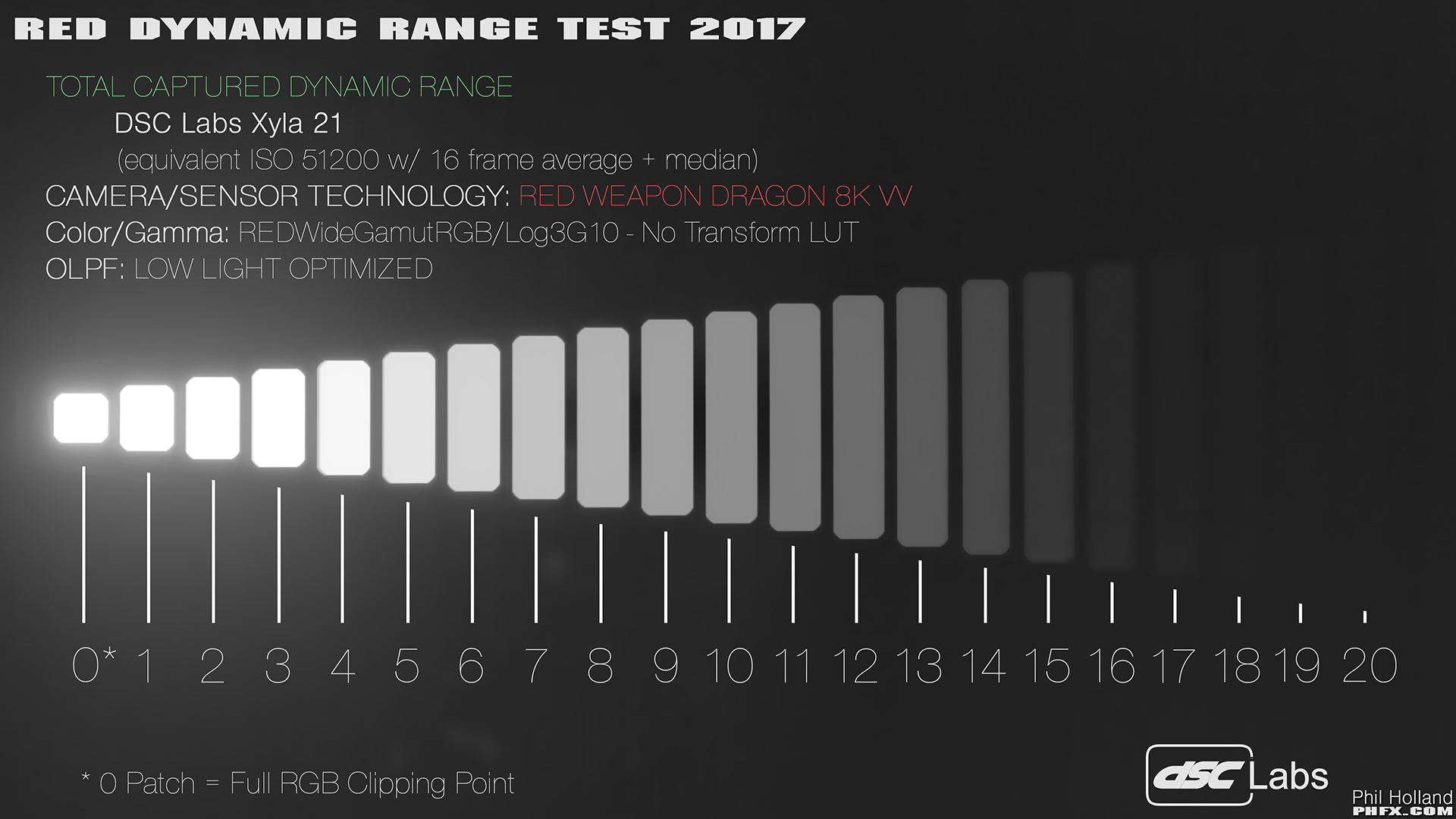
Dynamic range has always been a topic of great dispute when it comes to Red's sensors, particularly the latest ones, though I'm mainly focusing on Dragon here. This is a still from an R3D Erich Roland uploaded on Dropbox a while back. It's a Xyla 21 test, Red Weapon Dragon, with Standard OLPF, processed at ISO 800 with DragonColor2 and RedLogFilm. The first three chips of the chart were completely clipped on the waveform in Resolve, leaving a total of 14 stops of usable range the way I look at it. Keep in mind I'm not looking at this with a calibrated monitor, but rather on a 2014 HP laptop, so there may be a little bit more in the shadows there. What is odd about this image however, is that it is identical to the test Phil Holland conducted with the same chart, the same camera and the same settings, except with a different OLPF, his had the STH though it definitely wouldn't make that massive of a difference. On his test however, though it looks identical, the first 3 chips are apparently not clipping, which seemingly results in 17 stops of total range. Now before I go further, I will point out that I absolutely love Phil's tests and his work is even more impressive. His insanely detailed and comprehensive charts on everything from crop factors to lens coverage and ND's have basically taught me the most important aspects of the Red system, they have actually saved my ass on numerous occasions, I've been shooting on an Epic Dragon for two years now and loving it. So I am by no means bashing Phil's test with the Xyla chart, I'm simply searching for a definite and comprehensive result when it comes to the actual range of the sensor. I have never conducted such a test myself, though I would definitely love to, I just don't have access to a Xyla chart, so sadly at the moment I'm limited to looking at other filmmakers' tests and footage. I know the best thing to do is conduct my own tests so I wouldn't be surprised if there's an error on my part when it comes to analyzing footage I haven't shot myself, nonetheless this does look peculiar and Resolve's waveform does tell part of the story. I sincerely hope I don't start a fight, because that is not my intention here. More importantly I also hope I don't offend Phil in any way, his extensive tests have made an immeasurably valuable impact on this community!
Frame from Erich Roland's test I processed, again, according to the Resolve waveform the first three chips are gone.

Here are the scopes I'm getting just as a form of proof

And Phil's test at ISO 800
http://www.artbyphil.com/phfx/cinem...x_REDWeaponTest2015_xyla21_DC2RLF_ISO0800.jpg
I have to say that I am suspecting that Phil exposed literally a hair lower than Erich, thus getting the first chips within exposure in all three channels, but I am still very curious. That's all this is folks, Im posting this as a result of personal curiosity, nothing more, nothing less. I am a Red Dragon guy and I've never found myself in a situation where I needed more range.
Dynamic range has always been a topic of great dispute when it comes to Red's sensors, particularly the latest ones, though I'm mainly focusing on Dragon here. This is a still from an R3D Erich Roland uploaded on Dropbox a while back. It's a Xyla 21 test, Red Weapon Dragon, with Standard OLPF, processed at ISO 800 with DragonColor2 and RedLogFilm. The first three chips of the chart were completely clipped on the waveform in Resolve, leaving a total of 14 stops of usable range the way I look at it. Keep in mind I'm not looking at this with a calibrated monitor, but rather on a 2014 HP laptop, so there may be a little bit more in the shadows there. What is odd about this image however, is that it is identical to the test Phil Holland conducted with the same chart, the same camera and the same settings, except with a different OLPF, his had the STH though it definitely wouldn't make that massive of a difference. On his test however, though it looks identical, the first 3 chips are apparently not clipping, which seemingly results in 17 stops of total range. Now before I go further, I will point out that I absolutely love Phil's tests and his work is even more impressive. His insanely detailed and comprehensive charts on everything from crop factors to lens coverage and ND's have basically taught me the most important aspects of the Red system, they have actually saved my ass on numerous occasions, I've been shooting on an Epic Dragon for two years now and loving it. So I am by no means bashing Phil's test with the Xyla chart, I'm simply searching for a definite and comprehensive result when it comes to the actual range of the sensor. I have never conducted such a test myself, though I would definitely love to, I just don't have access to a Xyla chart, so sadly at the moment I'm limited to looking at other filmmakers' tests and footage. I know the best thing to do is conduct my own tests so I wouldn't be surprised if there's an error on my part when it comes to analyzing footage I haven't shot myself, nonetheless this does look peculiar and Resolve's waveform does tell part of the story. I sincerely hope I don't start a fight, because that is not my intention here. More importantly I also hope I don't offend Phil in any way, his extensive tests have made an immeasurably valuable impact on this community!
Frame from Erich Roland's test I processed, again, according to the Resolve waveform the first three chips are gone.
Here are the scopes I'm getting just as a form of proof
And Phil's test at ISO 800
http://www.artbyphil.com/phfx/cinem...x_REDWeaponTest2015_xyla21_DC2RLF_ISO0800.jpg
I have to say that I am suspecting that Phil exposed literally a hair lower than Erich, thus getting the first chips within exposure in all three channels, but I am still very curious. That's all this is folks, Im posting this as a result of personal curiosity, nothing more, nothing less. I am a Red Dragon guy and I've never found myself in a situation where I needed more range.