Welcome to our community

Be a part of something great, join today!

  • Hey all, just changed over the backend after 15 years I figured time to give it a bit of an update, its probably gonna be a bit weird for most of you and i am sure there is a few bugs to work out but it should kinda work the same as before... hopefully :)

Quick Question? Where did Dalsa Origin go wrong ?

Zharmane Washington

Well-known member
Joined
Sep 13, 2010
Messages
151
Reaction score
0
Points
16
I am not sure which company came first. I understand Red came about in 1999. Red One was not the first 4k camera but how did Dalsa Origin not reach the level of Red Cinema . Please don't attack me!!! if i knew the answer i wouldn't ask? So please people fill me in.
 
My quick thoughts:
1.) Rental only. One of RED's strong points out of the gate was that it was within the real of possibility for anyone who wanted to own one to do just that.
2.) Uncompressed RAW. Huge data rate, even by today's standards, much less 8 years ago. 400MB/S is still a pretty hefty amount of data. Back then it was only workable with serious infrastructure. Also, offboard recording...

Never been in close contact with it or it's images, so I can't say anything about image quality or ergonomics and the like, but the above two reasons put it in a very different category than any of RED's products.
 
As far as I can tell, Dalsa an imager manufacturer in Canada, was testing the camera as a rental-only model.

Apparently, after much market research, the company chose to go back to doing what they do best and sold off most of their inventory (lenses, post gear, filters, etc) through Alan Gordon in Los Angeles and took the camera back to Canada, never to be seen again.

Rumor had it at the time, that Dalsa had also sold off the IP for the Origin and have been selling the sensors to Aaton for their new Penelope Delta.

Perhaps, someone closer to that camera might have more information.
 
From what I remember, Dalsa used to only make sensors for scientific and military purposes. They tried their hand at making a camera (which I got to use) but back then it was ridiculously comber some. Major overheating issues too. It didn't take too long before they threw in the towel for the camera business. I believe they still make sensors though. Side note: I accidentally knocked the camera off the table and cracked the case. Dalsa was more concerned on how the hell I was able to break the shell?
 

Attachments

  • dalsa0278.JPG
    dalsa0278.JPG
    21 KB · Views: 0
  • dalsa0286.JPG
    dalsa0286.JPG
    18.4 KB · Views: 0
  • dalsa0290.JPG
    dalsa0290.JPG
    19.7 KB · Views: 0
  • dalsa0293.jpg
    dalsa0293.jpg
    26.9 KB · Views: 0
  • dalsa0313.JPG
    dalsa0313.JPG
    16.5 KB · Views: 0
Last edited:
i had never herd of the Dalsa Origin, but after a quick Google, "The camera initially became available for testing in 2006" says the Wikipedia page. If i had to guess to the reason the camera did not catch on as well as the One, i would say from what i read, it would have looked to be a very cumbersome and "scary" system to the early adopters of digital cinema.
 
DALSA was out at trade shows definitely few years before RED. RED actually recruited Dalsa employees. I've done some work for them(DALSA) so I should probably shut up before pissing some people off. IMO the biggest problem of Dalsa was the (then current technology) timing- just 2-3 years shy of nailing it. That and the recession that nearly destroyed their sensor fab...which brings us back to the timing...
 
I keep hearing an occasional rumor that Dalsa actually makes the sensors for RED.
If someone from RED could please clarify whether the sensors actually do come from Dalsa or whether RED does have their own forge.
 
I keep hearing an occasional rumor that Dalsa actually makes the sensors for RED.
If someone from RED could please clarify whether the sensors actually do come from Dalsa or whether RED does have their own forge.

Ha ha. Good luck.
 
For one thing, it seemed to me that Dalsa was under-capitalized and never got much beyond the R&D step with some working prototypes, so it made sense for them to aim smaller, build fewer cameras and rent them out rather than get into larger-scale manufacturing. I think they hoped that they would generate interest with the first few cameras that would lead to someone stepping in with more money. The size of the camera was an indication of their lack of capital because it essentially was a big box of circuit boards; they needed to collaborate with existing companies that made image processors, etc. in order to make things smaller. At least this was my general impression as an outsider.

Combine this with trying to record uncompressed 4K raw data in that day and age (it's still a challenge to record that much data even today).

Red wisely saw that in order to make 4K production-ready, it had to be reduced to workable data levels. As recording technology improves, the levels of compression can go down. I think Redcode compression really is what allowed Red to take off -- indie filmmakers several years ago were never going to be able to deal with uncompressed 4K raw recording.

Yes, some of this is timing, Dalsa was a bit ahead of the times, the support technology wasn't quite there yet, especially in terms of recorders. In fact, most cameras have had that problem, the main stumbling block is recording the information off of the sensor. Look at the Thompson Viper, the camera existed before there were practical ways of recording the image.
 
Dalsa still makes cameras, I've purchased a bunch of them over the last 10 years... but they're industrial cameras. Nice imagers, compact, great dynamic range, but requiring external frame grabber hardware for their high end stuff (and a dedicated PC). They're also quite a bit slower than the Red (16MP+ cameras are limited to a couple frames per second) due to interface limitations - that's why I ordered an Epic-M Monochrome in January - which I will hopefully receive some sunny day in the not too distant future (synch'ing an F500's purchasing policies with RED's sales policies has given my purchasing person fits).
 
Last edited:
Some makers of astronomical cameras that take very long exposures of faint, deep sky objects use Dalsa sensors.
In order to get a full color image with a monochrome sensor, they will take three exposures, each through a red, green, and blue filter.
Other objects might be through a specialized wavelength filter, and, of course, there are images with no filter at all.
 
I concur with a lot of what has been said above; I also might add...

...that dealing with the small mind numbing stuff (not engineering or tech),
the stuff that it takes to sell a camera in Hollywood, is where a lot of fault could lay.

Just really think about that for a second.

We like to think it's all chips and code, but I would like to also put forth that, in
Hollywood and entertainment world in general, that all the little stupid (and not so
stupid) stuff like: people to goto for exposure, trade groups, big and small companies,
party's/events/shows on and on and on...are very important.

And just showing up with awesome tech is not even close to enough. People skills, elbow rubbing,
bullshitting and listening to bullshit is an enormous unsung part. (I know firsthand).

Bad attitudes (or what is taken like bad attitude) is noted and locked away in some individual's minds,
to be used later to shoot down a products legitimacy.

Not everybody does this, but I have been flabbergasted by the vitriol that some of our high ranking
professional colleagues have shown to new companies/products/software (unwarranted and warranted).

This is a F-ing nightmare and minefield for new products, and like I said at the top, this is where a lot of
the miss-steps happen... even with veteran companies.

It's tough for engineering and High, High, tech companies (use to selling to NASA and DARPA etc.)
to really truly rap their minds (or denigrate, depending who you talk to ; - >) around the
artistic/ego driven/mega marketing machine that is Hollywood.

I think this is where RED and specifically Jim Jannard thrived, and at the same time was
flexible in ways that a company like Dalsa couldn't even begin to conceptualize.

What's that old saying "Welcome to Hollywood... We are experts at turning billionaires into millionaires!"


Side note: nothing is more fascinating then seeing some HIGH-end engineer type talking and trying to explain
some deep technical concept to some puffed up self-important Hollywood type.

The excruciating pain I have seen on some engineer's faces is a site to behold...

...I feel for them.
 
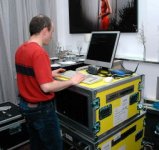
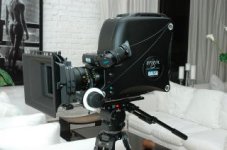
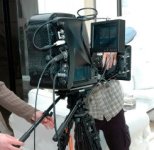
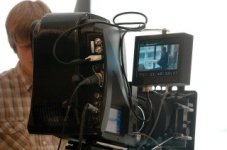
I have two reasons based purely on opinion, but I do remember seeing this camera a few times and also the Evolution or whatever the second version was called. Problem number one, look at that thing! It looks like a tower PC with a lens attached to it. WAAAAY too big and unergonomic even for being as cutting edge as it was. Problem two, they didn't have RED (JJ's) marketing prowess. Clean room at NAB? All the 'hype', crazy product names, military references, cutting edge industrial design this is all integral to RED. Their product was (and is) practical and appealing and they get everybody excited about wanting it.
 
We where recoding 4k back in year 2000, cineon 16bit log... But that was in our scanners. What might be hard to grasp is the size of the machinery and how costly the storage was back then.
A server that took 15terabyte was something that involved kodak, an investment bank and 2 posts house doing a joint venture...And the rack of disc alone was so heavy it actually collapsed the machine room floor... the scanner took 15 sec per frame and scanned rgb separately in 3 passes. To keep the discs cool there was a second rack sized thing that also came at an amazing cost. moving shots over the network was slow.

So when RED announced 4k RAW recorded on camera written in realtime and even high speed onto small memory cards, It was quite hard to think that would actually happen. The Dalsa on the other hand was a big super expansive camera that demanded huge recorders and massive data storage. So it's quite easy to say that the Dalsa cam was not really a part of the indy film revolution... :)
 
In the 80's I commissioned an Audio file suite, it has 2 x 1.5Gb drives, unheard of, they had their own rack and air conditioned room to store the system in, and also a 3.5 inch floppy drive 741k. The SSL desk in a nearby studio had a 500.5k drive to store data. Storing video on some sort of data device wasnt thought even about by operational people let alone a camera that recorded to some sort of disk device. Some times people asked us to transfer a still frame of SD video on to a 3.5inch floppy drive for archive. We thought it was a major break through.

Worth checking on how these things have developed over the last few years and where we are now couldnt not have been imagined back then.
 
We where recoding 4k back in year 2000, cineon 16bit log... But that was in our scanners. What might be hard to grasp is the size of the machinery and how costly the storage was back then.
A server that took 15terabyte was something that involved kodak, an investment bank and 2 posts house doing a joint venture...And the rack of disc alone was so heavy it actually collapsed the machine room floor... the scanner took 15 sec per frame and scanned rgb separately in 3 passes. To keep the discs cool there was a second rack sized thing that also came at an amazing cost. moving shots over the network was slow.

So when RED announced 4k RAW recorded on camera written in realtime and even high speed onto small memory cards, It was quite hard to think that would actually happen. The Dalsa on the other hand was a big super expansive camera that demanded huge recorders and massive data storage. So it's quite easy to say that the Dalsa cam was not really a part of the indy film revolution... :)

My group (when I was a member not the manager) had one of the early Kodak 16MP cameras (early 2000's iirc)... the way they described it (Kodak), there was us and the military... nobody else bought the thing. I remember it ran at a frame per second or less... and had a mechanical shutter (a noisy mechanical shutter).
 
WOW!!! I read every comment and all were great answers. It just seem like they would have done better or joined with RED as a good business move . Thanks again
 
Back
Top