Welcome to our community

Be a part of something great, join today!

  • Hey all, just changed over the backend after 15 years I figured time to give it a bit of an update, its probably gonna be a bit weird for most of you and i am sure there is a few bugs to work out but it should kinda work the same as before... hopefully :)

Poor Alignment for the RED mounting plate.

Björn Benckert

Well-known member
Joined
Dec 5, 2007
Messages
7,423
Reaction score
74
Points
48
Age
52
Website
www.syndicate.se
A little complaint about the Quick release mounting plate..

http://www.red.com/store/products/mounting-plate-epic-2

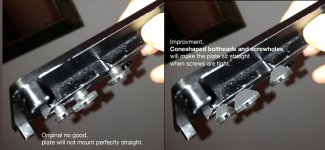
As these cameras are super precise in their build and such I find it a bit sad that this plate is built in a way so there is no possibility to mount the camera perfectly straight. Basically the screws that holds the plate onto the camera body would need to have their heads cone shaped. This could be fixed with new cone headed screws and altering the bolt holes.

For precision work we need to know that the camera aim is 100% straight or at least down to a small small fraction of a degree.

As the current baseplate and the bolts are constructed it's very possible to mount the camera cricket and it's basically impossible to mount the plate and know fur sure that its seated exactly the same from one time to the other. As the screw holes are quite big the current screws can rattle in there and the plate are free to land in any position when the flat headed screws are tightened so it's more like we have to align it by eye which is no good.

For sure this is not uber important for everyone, but for some setups it makes a shit difference..

So please RED keep it in mind for next updated of the quick plate...

Hope my explanation above makes sense. If not I hope that my little psd sketch explains the issue.


For moco work and such this is important. But I also notice that when using very long zooms and mattbox on rods then if the plate is just a little bit cricket... even so little so you could hardly tell by eye when flipping the camera upside down.. then thats enough for the front element to be out of line with the mattebox lens ring.
 

Attachments

  • plate.jpg
    plate.jpg
    94 KB · Views: 0
Bjorn I just notice the same issue recently, my solution was to use the right or left one of the edges of the plate as an alignment straightedge. While those edges are not perfectly aligned with the edge of the body on the left and right side, they're within a mm or two... and the front and back edges are very closely aligned with the body. Using those edges I'm able to align them to within a fraction of a degree. It's not as convenient as it would be if the plate was self aligning... but it does seem to work pretty well at the cost of a few minutes aligning time. I don't take the plate off very often so that seemed workable for me.
 
Last edited:
Bjorn I just notice the same issue recently, my solution was to use the right or left edge of the plate as an alignment straightedge. While those edges are not perfectly aligned with the edge of the body, they're within a mm or two... close enough that I was able to quickly align them (parallel to each other) to within a fraction of a degree. It's not as convenient as it would be if the plate was self aligning... but it does seem to work pretty well at the cost of a few minutes aligning time. I don't take the plate off very often so that seemed workable for me.

Thats what I do as well... but when shooting 3D or when you really want to know that you camera is straight as an arrow down to the last possible "millipixlimeter" well then that sort of "looks good to me" type alignment is not really flying :)


Same thing when shooting stitched plates and such. Or using a 360 head or similar. Then you really want it so that you can dissemble the camera (even swap camera) and know that the aiming of it is as straight as and equal to before as it could possibly be... For such situations the current baseplate is more like a "gaffer tape"solution to something that need to be swiss made.
 
Yea you're definitely right. Just doing a quick calculation of the problem... a very conservative calculation of likely R&R for manual fixture alignment indicates you should be able to get sub arc-minute repeatable alignment doing it by hand (Assuming that parallelism of 20 microns can be achieved, I suspect 10um is likely more realistic). That translates into a misalignment of 1.6mm at 6m(20') distance. At 5k, if your FOV is 6m at 6m then a pixel covers about 1.6mm - so 1 pixel of error. I guess that may or may not cause a problem depending on what you're shooting. If it IS problematic then plan b would be to set up an alignment fixture... a simple straightedge should allow you to get a bit closer... but if you really want precision alignment then you're probably not going to want to use the plate.
 
Yea you're definitely right. Just doing a quick calculation of the problem... a very conservative calculation of likely R&R for manual fixture alignment indicates you should be able to get sub arc-minute repeatable alignment doing it by hand (Assuming that parallelism of 20 microns can be achieved, I suspect 10um is likely more realistic). That translates into a misalignment of 1.6mm at 6m(20') distance. At 5k, if your FOV is 6m at 6m then a pixel covers about 1.6mm - so 1 pixel of error. I guess that may or may not cause a problem depending on what you're shooting. If it IS problematic then plan b would be to set up an alignment fixture... a simple straightedge should allow you to get a bit closer... but if you really want precision alignment then you're probably not going to want to use the plate.

Maybe my eyes are more cricket than yours as when I try to set the plate as straight as humanly possible by trying to hold it as straight as I can and mount it by tightning the screws.. then when when I do that a few times over I can actually have up to a few millimeters offset allready at the tip of a 24-290mm optimo zoom. So then if shooting with that zoom set to 290... and aiming for the horizon... well then can have pretty much a completely new framing so depending what you shot how far away your subject is that error makes quite a difference... Kind of like a riflescope, It does not matter much if it's calibrated if you hold the gun to the guys head... but if you up the distance... soon that error will even make you miss the target.

Again not a problem for the day to day shooting but we are building a Moco rig that has precision down to 0,0002mm in XYZ space... and I want to use the RED Quick plate and release plate for it. Then those screws does not feel right at all... :)
 
Sounds like you've got a challenging project... long zooms are the biggest challenge for this alignment. To get 200nm (assuming you mean linear since you said XYZ) alignment you'd need a custom kinematic mount... and it'll be challenging. Also... generally with these sorts of systems it's the angular precision that gets you not the linear. For instance... with a 3d rig a 10 micron linear offset will result in a 10um misalignment at your (for example) subject 6m away, whereas a 10 micron parallelism error (across the 75mm plate width) would result in the aforementioned 1.6mm error at your subject (Abbe Error). There are companies that make fixturing that can be made repeatable in the neighborhood of what you're looking for (Erowa is one we've used), we've built single digit arcsecond repeatable fixturing for some applications... but it's expensive stuff, and to my knowledge there's nobody in the imaging business that makes the required hardware. The other interesting issues you'll run into if you really need to hold submicron alignments... thermal will be a problem - heating from the Epic will likely deform your fixturing by more than your tolerance unless its carefully managed. Submicron mechanical systems are in rarified air. Another problem you'll run into even if you could align the plate to the camera is that there's no way that the quick release design is able to repeatably mount up to those tolerances (even though it's quite good).
 
Sorry guys but as a mechanical designer I can assure you that these plates will not give you what you want. They were not designed for precise alignment. None of the standard accessories are. Panavision, Arri included.
My suggestion is to either modify them with precisely machined dowel pins or make a precise alignment accessories for that purpose. These accessories were made with speed in mind. Precise alignment and fast setups do not go together. You of all people should know that Bjorn ;)

I'm more of a sloppy guy than you think:)

I actually think it's not to bad. The quick release thing I like it is quite precise the plate on the other hand leaves a lot of precision to ask for without any good reason. Large coneshapped screw heads and holes would solve the issue to a very great extent and speed would not be affected.

So yes, I think I will Mill our own plate and make it right. But for RED it would be quite a small adjustment to the CAD model and then problem would be solved for everyone buying it after that.
 
Yeah, its a problem not just with this quick release, but with most 3rd party accessories that I've come across for the Epic.

What the Arri baseplate does for the Alexa (again, those sneeky Germans think of everything. . . ) is a ridge that runs along the front of the plate so that it aligns perfectly with the front of the body. Simple and effective.
 
Back
Top