Welcome to our community

Be a part of something great, join today!

  • Hey all, just changed over the backend after 15 years I figured time to give it a bit of an update, its probably gonna be a bit weird for most of you and i am sure there is a few bugs to work out but it should kinda work the same as before... hopefully :)

Operating HMIs on Inexpensive Generators

Joined
Oct 7, 2009
Messages
20
Reaction score
0
Points
0
I have an independent feature coming up where we will need to run a Joker 400 and a 4’ 4 bank Kino for extended periods inside a small school bus. Rather than constantly swapping batteries on a Joker Slimverter, I had planned to use a Honda EU1000i generator that we would rig outside the bus, but find that I can buy a 1000W two-stroke generator for what it would cost to rent the Honda for that same time. Does anyone have any experience with the these generators: http://www.heartlandamerica.com/bro...s-generator&PIN=70382&&BC=6000&DL=MCH1&c=True? Since the Joker has a flicker free electronic ballast and Kinos are high frequency I shouldn’t have a problem with unstable power. The generator can be rigged on the front of the vehicle towing the bus, and the windows of the bus will be kept closed, so noise should not be a problem. Is there any reason to spend the extra money on renting the inverter
generator?

Isabelle Landers, Gaffer, Nashua, NH
 
I think you might want to stick with a pure sine wave Gennie like the inverter series that honda and yamaha make. A common problem using modifies sine wave inverters or gennies is that they can cause power supplies to over heat.... And also interfere with other electronics. If you were using tungsten lights it wouldn't be an issue, but with flo or hmi is might.

The is a 2k homelite that is pure sine wave and a copy of the honda 2k for only $499 at Costco right now....

I own a honda 2k and it's fantasic and also very quite. The AC power that come out of it is cleaner than what comes out of most home wall sockets.
 
If you will be recording audio, noise will be a problem.

The two stroke generator linked is extremely noisy, I'd strongly recommend to stick with Honda or Kawasaki for your generator line, add up your total wattage and double the number get a genny that is near your doubled wattage , most generators are over-rated and will be extremely noisy if ran at their maximum output.

Many EB PFC HMI ballasts are capable to accept square-wave power with no problems, contacting the manufacturer would be recommended because every ballast is different.
 
I wouldn't recommended it. In my experience, kinos fail to strike on square wave inverter power and they aren't power factor corrected so they'll effectively draw twice as much power as their wattage indicates and introduce harmonic resonance (or something; I'm not a professional yet so I don't have to know these things) into your sine wave. Jokers can be temperamental, too.

There's a chance you'd damage the ballasts, but maybe I'm over-protective and maybe I've had unusually bad luck. I've seen electronic ballasts go down on the Honda 6500 when coupled with kinos--and it's got a near-perfect sine wave so it's only the distortion from the kino that was taxing them.

The generator would be too noisy to record any sound with unless you hid the generator in a car and ran tons of cable--both bad ideas (of course I've done both). Check its noise against the 6500; if it's any louder skip it. The 6500 has ruined some audio on shoots I've been on, thankfully not my department.

My friend ran a 1.2k with a magnetic ballast off like the world's worst generator (when I wasn't there to stop him) and it functioned but the flicker is crazy. Thankfully I lit some footage that was so insanely ugly earlier in that movie that no one was distracted by a little flicker later on... One way to look at it.
 
Last edited:
kinos .... aren't power factor corrected so they'll effectively draw twice as much power as their wattage indicates and introduce harmonic resonance into your sine wave. Jokers can be temperamental, too.

As Matt’s post implies, choosing a portable generator for a lighting load can be very complicated. When you use lights sources like HMIs, Kinos, CLF lamp banks, & even LEDs, it matters not only what type of generator you use but also what type of power supplies the lights use. In this case, Isabelle will not be able to operate her lights on either one of the 1000W generators because the power supplies her lights use have a poor Leading Power Factor. Since Power Factor is commonly overlooked in choosing generators, I would like to take this opportunity to explain it in detail and show how it affects Isabelle’s choice.

If we look at the technical specifications for the Joker 400, the electronic ballast that it uses has a Power Factor of .64. What that means is that it draws 5.5 Amps rather than the 3.3 Amps you would think using Ohm’s Law (W=VA.) The difference between the actual current drawn by the bulb, 5.5 Amps, and the 3.3 Amps a 400W bulb should draw using Ohm’s Law (W=VxA), is the difference between what is called “Apparent Power” and “True Power.”

If, in this case, you were to measure the actual current (using a Amp Meter) and voltage (using a Volt Meter) traveling through the cable supplying the Joker 400 ballast and multiply them according to Ohm’s Law (VxA= W) you would get the “apparent power” of the bulb (120V x 5.5A = 624W). But, if you were to instead, use a wattmeter to measure the actual amount of energy being converted into real work (light) by the ballast of the Joker 400 you would get the “true power” of the bulb which in this case is specified by the manufacturer as 400W. The ratio of “true power” to “apparent power” is called the “Power Factor” of the light.

A favorite analogy electricians like to use to explain power factor is that if apparent power is a glass of beer, power factor is the foam that prevents you from filling the glass all the way up with beer. When lights with a low power factor are used, a generator must be sized to supply the apparent power (beer plus foam), even though only the true power (beer) counts. With a Power Factor of .64, you must take into account that the Joker 400 ballast draws considerably more amps for it’s true power output of 400W.

The same is true when it comes to Kino Flos. According to Kino Flo’s website a 4’ – 4 bank fixture has an apparent power of 552W, or again draws nearly twice the power (a PFC of .54) for it’s true power output of 300W (4x 75W bulbs.) If you were to use both these lights on the Eastern Steel 1000, the total load 1176W (624W + 552W), would overload the generator because the continuous load rating of the Eastern Steel 1000, according to their website, is 850W. With a continuous load rating of 900W, the Honda EU1000is would like wise be overloaded.

- Guy Holt, Gaffer, ScreenLight & Grip, Lighting & Grip Rental in Boston
 
Renting or purchasing a Honda EU1000i or EU2000i will be worth every penny. That's what I've normally had on shoots with audio recording involved, because they are so quiet, but I did work on one music video where they thought they could get by with a cheaper generic rental from a non-film industry rental house.
The result? HMIs flickering like mad at any frame rate/shutter angle, and the gennie rental cost savings were completely blown away by trying to fix it in post, retouching each frame by hand in AE, before that was deemed impossible and the project was abandoned entirely.
 
In this case, Isabelle will not be able to operate her lights on either one of the 1000W generators because the power supplies her lights use have a poor Leading Power Factor.

Thanks everyone for your input. I’m not too worried about the generator being load. As I said, the generator can be rigged on the front of the vehicle towing the bus, and the windows of the bus kept closed, so noise should not be a problem. If anything, it will blend in with all the other traffic noise and noise of the bus engine.

I am worried about my lighting budget if neither of the 1000W generators will work for me, since we can barely afford them. The producer says that he has a small 2000W gas generator that we can use. There is no reason that it shouldn’t work, right? Even if it draws more than 400W, the Joker ballast is flicker free. And, since the power the 2000W generator provides is not a square wave (its not an inverter generator) the Kinos should be flicker free since they are high frequency ballasts, right? I would need to have a very good argument for why it wouldn’t work, since I think he has already spent the money he saved by offering his generator somewhere else.

Isabelle Landers, Gaffer, Nashua, NH
 
It might work. I'm not an electrician so I don't know. I try to know enough that I can serve as DP and de factor gaffer on no-budget shoots, but this sometimes leads me to be too conservative. Personally, I wouldn't recommend this--but that's me being conservative. Others will have more technical feedback than I can offer.

I've found electronic ballasts are surprisingly sensitive and a voltage spike or some weirdness can damage them or cause them to overheat and shut down. Two-stroke generators aren't recommended for sensitive electronic equipment so it just sounds like asking for trouble. If you're insured for equipment and you've got insurance against the time lost shooting if it goes down I guess go for it--but I think you're risking an awful lot for very little money savings. Then again, it might be fine. And generators are loud even in cars, not to mention the dangers of CO poisoning (make sure you air out the car thoroughly before anyone gets back in it) and then there's the possibility that there won't be enough oxygen for the generator to run smoothly if there's no ventilation and it will grow louder and less efficient.

The two-stroke generators I've used have been way, way too loud to use even when kept outside the building we're shooting in with doors closed (and this was shooting in a well-insulated prison). The 2000w generator may work, but my intuition is you're really pushing your luck: you could lose footage, sound, or damage equipment all too easily. But I can't prove it won't work because I've never tried it and, to be honest, wouldn't. On the other hand, theoretically it could all go fine, too.
 
Last edited:
It might work. I'm not an electrician so I don't know. Personally, I wouldn't recommend this.... I've found electronic ballasts are surprisingly sensitive and a voltage spike or some weirdness can damage them or cause them to overheat and shut down.... The 2000w generator may work, but my intuition is you're really pushing your luck.


Even though he can’t explain why, Matt’s intuition is correct. Isabelle will be pushing her luck, because she will in fact be pushing the capacity of even a 2000W conventional generator with her Apparent Power Load of 1176W. When choosing a generator you must keep in mind that the greater Apparent Power of lights with a poor Power Factor is not the only consideration when operating them on conventional generators. Of equal importance, is the Harmonic Noise that ballasts with a Leading Power Factor kick back into the power stream that severely limits the total amount of Leading Power Factor loads, as compared to Unity Power Factor loads, that can be reliably operated on conventional generators.

waveform_elec_ballast.jpg

Grid Power w/ 1.2Kw Arri non-PFC Elec. Ballast. Center: Conventional AVR Power w/ 1.2Kw Arri non-PFC Elec. Ballast. Right: Inverter Power w/ 1.2Kw Arri non-PFC Elec. Ballast. ​

As the oscilloscope shots above illustrate, given the large sub-transient impedance of conventional generators, even a small degree of harmonic noise being fed back into the power stream results in a large amount of distortion in its’ voltage. Add to that, the fact that the original supply voltage waveform of conventional generators is appreciably distorted to begin with, and you have a situation where the return of any harmonic currents by a non-PFC HMI, Fluorescent, or LED ballast will result in significant waveform distortion of the voltage at the power bus and operational problems with the generator voltage and frequency regulation.

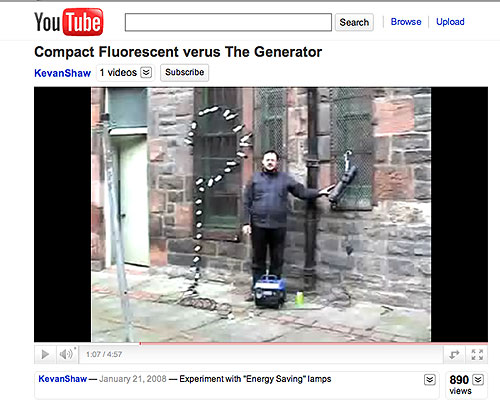
There is a video on You-Tube by a Lighting Designer by the name of Kevan Shaw that illustrates just this, but with CFL bulbs which have a similar Power Factor.

CFL_vs_Gen_Dem.jpg

In his You-Tube Video, “Compact Fluorescent verses the generator,” (available at http://www.youtube.com/watch?v=LeCqreRMzKM) Kevan Shaw compares the effect of equal wattages of CFLs and Incandescent lights on a small portable generator. In his test, he first operates a 575W ETC Source Four Leko with Quartz Halogen bulb on an 850W two stroke conventional gas generator without problem. However, when he tries to operate an equivalent wattage of CFLs (30-18W bulbs) the generator goes berserk. Only after turning off half the CFL Bulbs does the generator operate normally with a remaining load of 15 - 18W CFLs (270 W.) What accounts for the erratic behavior of the generator in this video under a smaller load of CFLs? It is a combination of the poor Power Factor of the CFL bulbs and the harmonic currents they generate.

Even though the 15 CFL bulbs have a True Power of 270W (15 x 18W = 270W ), the Watt indicator on Kevan's generator indicates that they draw twice that in Apparent Power (535W), or have a Power Factor of .5 (270W/535W =.504.) The fact that CFL bulbs consume double the energy (Apparent Power) for the 18 Watts of light (True Power) they generate, is only half the story here. Kevan Shaw’s video also clearly demonstrates the severe effect that loads - like CFLs, HMIs, Kinos, & LEDS - with Leading Power Factors can have on the governing systems of conventional generators.

When Kevan turns off the 18W CFL bulbs one at a time until the generator stabilizes, he is not only demonstrating that 15 – 18W CFL bulbs has roughly the same Apparent Power (535W), according to the generator’s Watt meter, as a 575W incandescent light; but, also that the maximum Leading Power Factor load a 850W conventional generator can operate satisfactorily is 270 Watts (15 – 18W CFL bulbs). Looked at from another angle, 16 - 18W CFL bulbs with an Apparent Power of 576 Watts with a Leading Power Factor overloaded the generator, while 575 Watts of Apparent Power with a Unity Power Factor (the 575W Quartz Leko) did not. What accounts for this difference? Since the load is almost the same (576 & 575 Watts of Apparent Power respectively), the only factor that can account for the generator going berserk with the equivalent load of CFL lights is the harmonic currents that they generate, that the Quartz Leko does not. Without a doubt, Kevan Shaw’s video is a clear demonstration of the adverse effect that harmonic currents have on the governing systems of conventional generators. In fact, Kevan Shaw’s You-Tube video demonstrates that it is not possible to load conventional generators beyond roughly 65% of their rated capacity for more than a short period when the load consists of lights with a poor Leading Power Factor ( Max Apparent Power of 540W/850W Generator = .64) Which translates to a maximum Leading Power Factor load of 1300W on a 2000W conventional generator.

For the same reason that Kevan Shaw was not able to operate more than 270 Watts of CFL bulbs (15–18W bulbs) on his little 850W generator, Isabelle may not be able to operate her lights on a 2000W conventional generator. The adverse effects of the harmonic currents that non-PFC ballasts generate, so graphically demonstrated in Kevan’s video, limits the total amount of Leading Power Factor loads, as compared to Unity Power Factor loads, that can be reliably operated on conventional generators. Where the total Apparent Power of her lighting package consisting of a Joker 400 and a 4’ 4 Bank Kino is 1176W, she will be running the generator at 90% of it's capacity for Leading Power Factor Loads (1176W Apparent Power Load/ 1300W Leading Power Factor Load Capacity = .90 Capacity.) This is pushing the capacity of a 2000W generator because at near full capacity, the voltage will probably drop to 110V which means that amperage will go up 10% and overload the generators capacity for Leading Power Factor loads.

As the oscilloscope shots above also indicate, Isabelle’s best bet is to operate her lighting package on a 2000W inverter generator like the Honda EU2000is? Even though the non-PFC ballasts of her lighting package will kick back the same harmonic currents, the oscilloscope shots above indicate that the voltage waveform of an inverter generator will retain an over all sinusoidal shape because of it’s lower system impedance and purer original power waveform. The appreciable difference in voltage distortion created in the oscilloscope shots by the same light demonstrates that an inverter generator will provide cleaner power, and operate more reliably, regardless of the type of load.

What is true of small lighting loads on small generators, is also true of larger lighting loads on larger generators. For instance, you would think that you could reliably operate a 4k HMI with non-PFC ballast on a conventional 6500W generator. But, where a non-PFC 4k electronic ballast will draw 58A at 120V it will overload a 6500W. To understand why, simply compare its’ Apparent Power of 6960W (58A x 120V = 6960W), to the continuous load capacity of a conventional 6500W generator after de-rating it for a load with Leading Power Factor of .58 (6500W x .65 = 4225W.) Now, if you were to replace the non-PFC 4k electronic ballast with a Power Factor Corrected one, the light would only draw 38A at 120V and have an Apparent Power of 4560W. And since, the ballast has a near Unity Power Factor, the 6500W generator would not have to be derated, and so could operate the 4560W Apparent Power load without a problem. And, if the generator were one of our modified Honda EU6500is inverter generators, you could operate a continuous load of 7500W as long as it consisted of Power Factor Corrected Light sources.

If you don't completely understand what I just said, it's alright. These power generation issues have been vexing set electricians for years. If you haven't already, I would suggest you read the article I wrote for our company newsletter on the use of portable generators in motion picture lighting. In it I cover some of the basic electrical engineering principles behind poor Power Factor, the harmonic distortion it can generate, and how it can adversely affect generators. Use this link for an informative newsletter article that explains the electrical engineering principles behind these issues and how to resolve them.

BoxBook.jpg

This article is cited in the just released 4th Edition of Harry Box's "Set Lighting Technician's Handbook" and featured on the companion website "Box Book Extras." Of the article Harry Box exclaims:

"Great work!... this is the kind of thing I think very few technician's ever get to see, and as a result many people have absolutely no idea why things stop working."

"Following the prescriptions contained in this article enables the operation of bigger lights, or more smaller lights, on portable generators than has ever been possible before."​

The article is available online at http://www.screenlightandgrip.com/html/emailnewsletter_generators.html.

- Guy Holt, Gaffer, ScreenLight & Grip, Lightng & Grip Rental in Boston
 
Hello Guy
Thank you for your detailed explanations here. Maybe you could answer this: In europe, in 240v what inverter generator is needed to power joker 800? 4k hmi (k5600 4k alpha?)

Where it generates 1600W at 240V/50Hz, the Honda EU20i provides sufficient Power to operate the 1375W Apparent Power of the Joker 800 Ballast (12.5A x 110V = 1375W.)

As for the Alpha 4k: since K5600 does not make a ballast for this light, you are free to use a PFC electronic ballast from a third party manufacturer like Power-2-Light. The Power-to-Light (P2L) ballasts are auto-sensing multi-volt electronic ballasts. With an operating range of 95 – 250 Volts, they will operate at either 120 or 240 Volts. Here in the States, to operate them at 120 Volts requires a modification to a Honda EU6500is generator and the use of a step-down transformer. What we do is “retap” the generator to access the full power of the generator that is built into it by Honda for 240V markets and then use a step-down transformer to convert the 240 Volts back to a large 120V circuit.

Unfortunately, you are in a similar situation to the one we are in here in the States. While the European version of the Honda EU6500is, the EU65i, generates more than enough power to operate a 4k, it does not give you access to it. A Power-2-Light 4k ballast will draw 18.5 Amps on each leg of a single phase 240V circuit, but unfortunately the EU65i is outfitted with only 16A 230/240V outlets. To understand why this is, it helps to compare the two generators.

Because 120 Volts/20 Amps (2400 Watts) is the standard circuit for domestic power in North America, Honda outfits the generator for this market with a power output panel that is under-rated for the power generating capacity of the machine when you compare it to how Honda outfits the same generator for the European and UK markets where a standard ring circuit for domestic power is 230/240 Volts and 16 Amps (3680/3840 Watts). Where England and Ireland have not entirely conformed to the European Union Standard of 230 Volts, but still generate 240V power, Honda makes a version of this generator for the UK market with 240V/16A circuits (3840 Watts/circuit).

In other words, to support markets worldwide, including the UK market, Honda has designed the base model of this generator to generate the equivalent of two 240V/16A circuits or 7680 Watts (2x3840W/circuit = 7680W) - which is more than enough power to operate a 4k HMI. When Honda configures this same base model with a power output panel for 120 Volt circuits for the North American Market, it is not fully utilizing the power generating capacity they have built into the machine for the worldwide market. What we do is "tap" the generator at a point that gives us access to the 7680 Watt capacity built into the machine for the world wide market. We then use a Full Power Transformer/Distro to step that down to a single 60A/120V circuit that is capable of powering larger lights or more smaller lights than you could otherwise.

HondaEU65is_Power_Out_Schematic.jpg

In Europe, you have a similar problem: even though the EU65i generates more than enough power to operate a 4k, Honda limits your access to it by giving you only 16A outlets. But, if you look at the wiring schematic for the EU65i (above) you will notice that the three 16A outlets are wired in parallel with no current limiting breaker that limits the load to 16 Amps. Which means, that you could combine the wiring for the outlets into a larger 30A receptacle like the 30A/240V 4-pin twist-lock receptacle that Honda puts on the EU6500is for RV hookups here in the states (see below.)

HondaEU65is_240V_Color_Sch.jpg

You could then plug a Power-2-Light 4k ballast directly into this larger 240V receptacle and since it draws only 18.5 Amps on each leg of the generator’s 240V output, it is well within the capacity of the Honda EU65i. But, just as we must “retap” the EU6500is to access the full 7680 Watts that is built into the generator by Honda for 240V markets, you will have to rewire the output panel of the EU65i to access the same 7680 Watts in a single receptacle.

- Guy Holt, Gaffer, ScreenLight & Grip, Lighting & Grip Rental in Boston
 
Back
Top