Welcome to our community

Be a part of something great, join today!

  • Hey all, just changed over the backend after 15 years I figured time to give it a bit of an update, its probably gonna be a bit weird for most of you and i am sure there is a few bugs to work out but it should kinda work the same as before... hopefully :)

New MacPro predictions? Hopes? Fears?

You guys are going to go totally nuts over the Mac Mini Pro. ;)
 
Oven Update

Looks like Intel, GF and Samsung have 'semi-engineeringly' had to put the Brakes on rolling out EUV (extreme ultraviolet).

The company that makes the EUV ovens (ASML) wasn't exactly forthright about the levels of 'particle' issues (dust created in the process). This mandates the used of Pellicles (a membrane that catches the particles, but also takes away effective power of the beam). ASML were supposed to be at 250 W for HVM (high volume manufacturing), but are only at 100 Watts (before the sapping Pellicle).

For Intel : What this means is they will Not be able to use EUV with their bean-counter requirement profit for 5nm.
And they will PUSH 5nm out a few years (in my opinion) - which will allow their EUV process to be more cost effective.
Which means that 7nm is likely to be pushed out a couple of years.
Which may have something to do with the Intel 10nm not-rollout-again strategy.

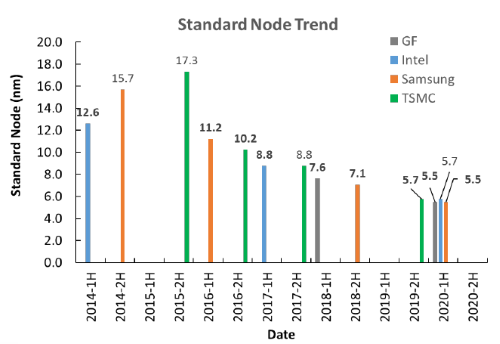
Samsung 'EUV 7nm magic' that they have not been able to explain to anyone how it is going to work:
They're due to let use know in Oct'17 (who knows, Uri Geller may do the presentation ;-) )

4893391-14878580667616646.png


Why this is interesting

Because Intel's 12.6 nm process Xeon chips run slower than AMD Ryzen chips (using a 15.7nm process).
And AMD cores are smaller, and user less power (which is pretty incredible) - and Half the COST of the Xeon.

By the end of this year, AMD will be able to switch from 15.7nm -> 11.2nm, 10.2nm or even 8.8nm (TSMC)
Intel's desktop chips will either remain at 12.6nm - or they will selectively allow the Datacentre chips to also move to 8.8nm.

Translation : At the end of this year Intel are going to have to Massively reduce the price of Xeon chips.
And when AMD move to the next node - AMD's crunching abilities may well overtake Intel.

AJ
 
Apple

For Apple to create a machine that can do more in the same power budget - they need CPUs and GPUs that can do more in the same power envelope.

With AMD's chips having now Caught up with Intel - Apple now have (at least) two CPU options:
+) FORCE Intel to let them have a 10nm chip or
+) Switch to AMD.

Switching to 10nm would mean 50% less heat on the chip -> which means 50% more cores could be running -> 50% CPU jump
Switching to AMD -> 3 x the PCI connectivity + half the price -> Maybe a better deal on Vega chips

Now is not a time that I would want to have shares in Intel ...

Tim : We love Pro's
I am guessing this Must related to the Apple's explosion of the their GPU team.
For Apple's software eco system to be richer, they need lower overhead graphics.
The want developers to universally use a generation of graphics language that encompasses Metal, Direct x, Vulcan (and perhaps even Cuda).
I am guessing that Apple are creating the next Xcode GPU language that will allow more of the heavy lifting to be pushed on the GPU, and allow augmented graphics environments to be more 'codable'.

AJ
 
Last edited:
Watchband Pro?

Oh, DJ, does that mean I can't make a joke about making a rumor Apple is not going to do much? Pro Watch band Lol! Does it have speakers to tell the time in a professional voice.
 
You guys are going to go totally nuts over the Mac Mini Pro. ;)

So, Jeff. They're following my advice to make a stackable MAC Mini Pro :)

I've got an idea for a science fiction script, its 200 years into the future, society has collapsed to a world that looks just like ours in technology, except with the whole science fiction thing revolving around the lasted MAC PRO model 200 years from now, that looks exactly the same in everything including the GUI as today's model, except it has molded cursively in the top of the case, "Not Denying Perfection for the last 204 years." :biggrin:
 
I'll keep the dancing in the streets on hold, but IF, indeed, Apple is beefing up the engineering staff assigned to GPU integration/optimization/coding tools/etc that is extremely good news.

If I understand the situation correctly, CUDA only outperforms other graphics options on content creation software because it has been more aggressively developed to get more out of the hardware/software combo. If Apple seriously engaged, they could decide to push OpenCL/OpenGL/Vulcan/Metal - whatever - and with robust partner support from AMD, write code that runs efficiently on their hardware, to roughly match CUDA performance. If I am misunderstanding the situation please school me up.

As a 30 year Mac guy, I'd also note that the time gap since the nMP release in late 2013 can be viewed as an advantage if a shift from Intel to AMD for CPUs is, in fact, on the horizon. This would give Apple a lot of lead time to code a ground up rewrite of the OS optimized for a different processor architecture - perhaps even pushing more to the GPU as Andrew suggests, but at a deeper level. I'd assume they'd stay on the UNIX kernel, which I assume would make my theoretical new AMD focused OS, able to run Intel hardware in emulation to retain backward compatibility at the expense of some performance. If I'm assuming too much, I'd love to know the real deal.

I can still remember when Macs ran circles around Intel based Windows PCs. IMO, moving to AMD in 2017 for both CPU and GPU has great potential - if Apple comes strong. Intel is a long way from dead, but at this point I have to ask how much of the performance deltas cited in testing are because software/libraries/languages/etc are optimized for Intel vs a clocks/cores/lanes/performance per watt and other fundamental metrics differentials? Apple has used their unique control over both hardware and OS to create a stable platform that typically extracts more performance from components than Windows inherently more generic (to maintain compatibility) OS does. Perhaps they could leverage a close relationship with AMD to take that advantage even further...

Cheers - #19
 
Oven Update

Looks like Intel, GF and Samsung have 'semi-engineeringly' had to put the Brakes on rolling out EUV (extreme ultraviolet).

The company that makes the EUV ovens (ASML) wasn't exactly forthright about the levels of 'particle' issues (dust created in the process). This mandates the used of Pellicles (a membrane that catches the particles, but also takes away effective power of the beam). ASML were supposed to be at 250 W for HVM (high volume manufacturing), but are only at 100 Watts (before the sapping Pellicle).

For Intel : What this means is they will Not be able to use EUV with their bean-counter requirement profit for 5nm.
And they will PUSH 5nm out a few years (in my opinion) - which will allow their EUV process to be more cost effective.
Which means that 7nm is likely to be pushed out a couple of years.
Which may have something to do with the Intel 10nm not-rollout-again strategy.

Samsung 'EUV 7nm magic' that they have not been able to explain to anyone how it is going to work:
They're due to let use know in Oct'17 (who knows, Uri Geller may do the presentation ;-) )

4893391-14878580667616646.png


Why this is interesting

Because Intel's 12.6 nm process Xeon chips run slower than AMD Ryzen chips (using a 15.7nm process).
And AMD cores are smaller, and user less power (which is pretty incredible) - and Half the COST of the Xeon.

By the end of this year, AMD will be able to switch from 15.7nm -> 11.2nm, 10.2nm or even 8.8nm (TSMC)
Intel's desktop chips will either remain at 12.6nm - or they will selectively allow the Datacentre chips to also move to 8.8nm.

Translation : At the end of this year Intel are going to have to Massively reduce the price of Xeon chips.
And when AMD move to the next node - AMD's crunching abilities may well overtake Intel.

AJ

Well Antony, that took the long overdue smile off my face. So, what you are saying is that chart now has additional delays in the GF 7.6 nm node by a few years? I've really been waiting for the first 7nm offerings and arm/etc arrays using them. I'm not much interested in 5nm, as power savings run out at 7nm according to an old Nvidia briefing. What about memory chip processes? I'm looking at processors that can be implemented in the simpler memory processes, which offer a load of performance cost advantages but have too few layers for conventional processor designs.

Stuff it. Anybody got $100 million for a 49% stake in a next generation magnetic computing design? Make that a billion, in case of issues.
 
Blair,

My limited understanding is that CUDA completely maps to one (Nvidia) architecture; The language is too specific to allow (direct) use of the CUDA on another GPU.

OPENGL was the standard that Apple was (initially) hoping to the panacea to graphics needs, but later found that - like the UN - could be inflexible in the modern day.

Vulcan, Directx and Metal are all low overhead. Apple developed the graphics browser engine (WebKit) - and open-sourced it to get content and browsers to work efficiently together (Google 'forked it for Chrome).

For augmented reality, 3D 'stuff', it in Apples (and everyone interests) if a Low overhead language + new webKit is created that works across a multitude of GPU architectures.

Metal scales & works on (Apple designed) ARM cores + Imagination Technologies -> Apple custom GPU blocks in A9 & A10 -> Intel Xeon + AMD Desktop GPUs.

At this point in time, Apple just (I believe) want something Metal-like to replace OPENGL.

Core Efficiency

The higher the bandwidth between GPU and CPU -> the lower the per core memory footprint for effective computation on a CPU core.
The smaller atomic changes in a file system -> the less memory in a transaction
The lower the latency of the file system & higher bandwidth -> the less memory in a transaction and less memory in a core.
The more efficient the language (and ability to let GPU work autonomously) -> the less CPU 'tax' required.


I believe that Apple have been working diligently to phase in APFS (Apple filing system) on Phones and Desktop which I think will increase transaction rate (on solid state systems).

And that to efficiently delve into augmented reality, (I understand) the APIs need to be re-thought out to avoid 'bloat'.

If Microsoft + Apple + AMD are the on the same page : It would likely get a lot of traction with Game companies and frameworks would don't want to rewrite code bases and tune each time for completely different GPU architectures (and GPU languages).

AJ

Edit : This is a bit 'techy' : https://www.nextplatform.com/2017/02/28/amd-researchers-eye-apus-exascale/
But it represents a compute interface to local GPU and Memory. (a sort of 'AMD' APU future).

I am of the opinion that a melding between what Fujitsu are adding in terms of Scalable vector extension and AMDs 'chiplets' is what is needed at each Node; that we need a far far far higher internode bandwidth - and then revisit every piece of software we have ever written -> translate it into 'intention' and let computers abstract the writing of code for us (to run on it).
 
Last edited:
Wayne,

Global Foundry had the cash backing to make a gamble - probably one that shareholders would be displeased with (and so its lucky its privately owned).

GF wanted a head start to be the FIRST to EUV. The first to have designs that work on it.

And with ASML being the only source of most of the components and machinery for parts of the EUV system, GF took ASML at their word on EUV progress.

Up-time require no problems (defects in pellicule, mask defects).
Wafers per house require high powered light source. (there is a new source of EUV in Japan. More brains, more progress)

ASML are a long way off from high power sources 'in the field' - ie actually working consistently in the fab (which are mostly 80W, soon to be 100W) versus the 250W that ASML are getting in their own labs (and needed for HVM)


EUV%20readiness%20Intel%20x%20800_1488239821.jpg


'Actinic' technology for EUV mask inspection

One of the 'gotya's is that you need super-state-of the art to create mask and pellicules at 7nm with few (eg 5 defects).

Those defects might be fixable - but then you need super-super-state of the art equipment to be able to FIND the defects.

Intel has been developing the super-super equipment since 1992 (they report they can create defect free mask at 7nm)

Samsung (who is slightly more 'with it' than GF) decided that it could not 'Trust' ASML would do the needful, and has been trying to create a EUV mask inspector internally for 5 years - but are not there yet.

AJ
 
Last edited:
C'mon Jeff, if don't have an NDA, it's time to spill on this "Mac Mini Pro" !

It was sarcasm.

I do know of one thing in the Apple pipeline that should arrive in the near future. But it's not the droid you guys are looking for. I don't know of anything related to the Mac Pro or similar. Yes, under NDA, not with Apple, with a third party...

I really hope that Apple comes out with an updated, and hopefully more capable than the last model, Mac Pro. While I think Tim Cook's latest statement on supporting the "pro" market is encouraging, we have heard this before only to then see our favorite professional tools be pulled from their product line-up. ...Shake, etc..

Upgrading to a new machine rather than CPU or graphic card can be a pain in the arse. I know they can develop a system to copy the filesystem installs onto a backup and then onto a new system, but it would be easy if they could allow you to swap out a drive and put it in the new machine, reregister the drive to the new machine and boot it. But maybe that whole back up transfer thing instead, as you can depose of the machine at anytime, and not have to download the fire software again.

But seriously, if they want to improve this thing they are going to have to make it bigger to take note powerful CPU and GPU configurations, as well as extra cards, and bottom drive blade expansion modules, to ad things like sound mixer front and 4k be recorded, or extra server or raid disks. The thing esthetically, also doesn't look narrow tall enough, so could do with this.
 
Blair,

My limited understanding is that CUDA completely maps to one (Nvidia) architecture; The language is too specific to allow (direct) use of the CUDA on another GPU.

OPENGL was the standard that Apple was (initially) hoping to the panacea to graphics needs, but later found that - like the UN - could be inflexible in the modern day.

Vulcan, Directx and Metal are all low overhead. Apple developed the graphics browser engine (WebKit) - and open-sourced it to get content and browsers to work efficiently together (Google 'forked it for Chrome).

For augmented reality, 3D 'stuff', it in Apples (and everyone interests) if a Low overhead language + new webKit is created that works across a multitude of GPU architectures.

Metal scales & works on (Apple designed) ARM cores + Imagination Technologies -> Apple custom GPU blocks in A9 & A10 -> Intel Xeon + AMD Desktop GPUs.

At this point in time, Apple just (I believe) want something Metal-like to replace OPENGL.

Core Efficiency

The higher the bandwidth between GPU and CPU -> the lower the per core memory footprint for effective computation on a CPU core.
The smaller atomic changes in a file system -> the less memory in a transaction
The lower the latency of the file system & higher bandwidth -> the less memory in a transaction and less memory in a core.
The more efficient the language (and ability to let GPU work autonomously) -> the less CPU 'tax' required.


I believe that Apple have been working diligently to phase in APFS (Apple filing system) on Phones and Desktop which I think will increase transaction rate (on solid state systems).

And that to efficiently delve into augmented reality, (I understand) the APIs need to be re-thought out to avoid 'bloat'.

If Microsoft + Apple + AMD are the on the same page : It would likely get a lot of traction with Game companies and frameworks would don't want to rewrite code bases and tune each time for completely different GPU architectures (and GPU languages).

AJ

Edit : This is a bit 'techy' : https://www.nextplatform.com/2017/02/28/amd-researchers-eye-apus-exascale/
But it represents a compute interface to local GPU and Memory. (a sort of 'AMD' APU future).

I am of the opinion that a melding between what Fujitsu are adding in terms of Scalable vector extension and AMDs 'chiplets' is what is needed at each Node; that we need a far far far higher internode bandwidth - and then revisit every piece of software we have ever written -> translate it into 'intention' and let computers abstract the writing of code for us (to run on it).


Ahh, Fujitsu, are they doing Tron OS architecture? Now, that was a real OS, maybe one of the last common ones. Even MS resorted to using some of the kernel code.

What happened to writing things in Open CL, like the whole OS.

Programming intentions, rewriting everything with new language processor Antony, now you are talking more my sort of territory. That was my previous aim 25 or so years ago, these shitty OS's still don't reach my design, which was metal like intent of hardware, language, OS and software. Very careful design. Very efficient. My Author to Author product proposal, was an intent program design system, to layout the program in independent intent format to allow compilation onto new systems in as efficient way possible. Except, systems still have hardware dependencies in the data which can be programmed around, or the future processors and compilers adopt a common standard. I wonder how much they can do now days.

A proposal I has was a GPU instruction set with forth like minimum instruction set instruction subset, to give very compact code and compact general purpose processor implementation alongside GPU functions. We are talking a handful of thousands of transistors per core to add the instructions, and the ability to run everything without a separate CPU. You could simply have it separately as a CPU control section. A number of these processors can fit in the same space as a GPU processor, but you would need to figure out some basics and fpu operations. Don't look up current misc designs, they are a bit strange, aimed at the control/micrologic FPGA market. There are some old FPGA ones by Ting, the p32, p64, or was that mup32 and mup64. Probably on the hefty side compared to latter efforts. Bernard (I think) does a compact 16 bit FPGA version. I imagine they are probably the smallest soft cores you can find for the efficiency. But I must reinterate, that higher maths and FPU have to come from somewhere with these designs. I was working on a solution to this I mentioned the year before last I think, that I forgot before I wrote it down and had the memory issues. A real compact solution (of course, I'm planning hundreds of thousands of cores plus, so I'm looking at farming things out, not trying to get the fastest answer per core, that are other designs.

Wayne,

Global Foundry had the cash backing to make a gamble - probably one that shareholders would be displeased with (and so its lucky its privately owned).

GF wanted a head start to be the FIRST to EUV. The first to have designs that work on it.

And with ASML being the only source of most of the components and machinery for parts of the EUV system, GF took ASML at their word on EUV progress.

Up-time require no problems (defects in pellicule, mask defects).
Wafers per house require high powered light source. (there is a new source of EUV in Japan. More brains, more progress)

ASML are a long way off from high power sources 'in the field' - ie actually working consistently in the fab (which are mostly 80W, soon to be 100W) versus the 250W that ASML are getting in their own labs (and needed for HVM)


EUV%20readiness%20Intel%20x%20800_1488239821.jpg


'Actinic' technology for EUV mask inspection

One of the 'gotya's is that you need super-state-of the art to create mask and pellicules at 7nm with few (eg 5 defects).

Those defects might be fixable - but then you need super-super-state of the art equipment to be able to FIND the defects.

Intel has been developing the super-super equipment since 1992 (they report they can create defect free mask at 7nm)

Samsung (who is slightly more 'with it' than GF) decided that it could not 'Trust' ASML would do the needful, and has been trying to create a EUV mask inspector internally for 5 years - but are not there yet.

AJ

There is a way around defects. Back in the 80's Sir Clive Sinclair's company Wafer Scale, came up with the idea of making a wafer of processors and memory that rerouted a round defective processors. In my own designs I can automatically reroute around defective processors. So, you have hundreds, thousands, or more processors. If some are bad you can easily map them out, but the system and programming has to be conducive to this (say if you are streaming on two axis calculating results from previous results from the two axises at that junction. If one processor is defective, it throws out the calculations. You can virtual remap around it, but then you have to realign the results from the rest of the cores, or simply skip a column and row. It is a problem if the calculation uses every processing unit on either axis, otherwise the matrix can end before the end of the axis and the result be passed onto the destination. When you have millions of cites, this may not be a practical issue too often. Actually there is even a further way around this. This sort of thing applies more to direct data i/o to the array. The sort of technology replaces FPGA asic's. Something normal processors, and embedded processors, can't normally do at high rates. Very, very bare metal stuff). Anyway, you could have a 1000 core processor with 50% of the fires defective band mapped out, and still sell it as a 500 core virtual.mix processor (meaning you get what you pay for, and large sections may or may not be blank, slowing it down compared to a defect free 500 core processor. Itnalso means that a 90% defective unit is sellable (but at high defects the interlinks themselves might be too defective). It means your code can't be deterministic beyond a certain limit, as bypassing defective processors will add unkoen delays, which means a metric of layout of defects, and maximum length/area of defects and average of the top 50% of defective cores and top and bottom etc, for estimation statistics etc. Hope it's not too technical. Used to breath these design decisions. Beautiful to work on.
 
It was sarcasm.

I do know of one thing in the Apple pipeline that should arrive in the near future. But it's not the droid you guys are looking for. I don't know of anything related to the Mac Pro or similar. Yes, under NDA, not with Apple, with a third party...

I really hope that Apple comes out with an updated, and hopefully more capable than the last model, Mac Pro. While I think Tim Cook's latest statement on supporting the "pro" market is encouraging, we have heard this before only to then see our favorite professional tools be pulled from their product line-up. ...Shake, etc..

I thought it might be sarcasm.

Still, I wouldn't mind a Mac Mini Pro with 32Gb of RAM and six Thunderbolt 3 / USB 3.1 ports that I could run an external graphics card in an expansion box. Just dreaming.
 
+1 but a stackable GPU drive, extra mini architecture. Actually, a long mini with attachable modules able to take full length gpu cards, and optical + raid. Actually, the width of a card is not far off of the width of a drive slot, they could all mount together like the blade system I suggested using standard components a fat io header to make a backplane, with separate power modules if needed. I've got to slap myself apparently, that's too easy and straight forwards.
 
Hurry Apple, give birth to something!
 
Here's a thought: how about a MacBook Pro with fixed RAM - it's all on the CPU package. GPU, CPU, xGB RAM, all in the one package. Intel has been putting GPUs on the chip for years now. There's a limit to how powerful that can be, but it shames a lot of cheaper graphics cards. Having RAM onboard the CPU package would mean that you don't need a separate cache. RAM and cache become one.

Or, the opposite: put some processing power - just a bit - into the RAM SIMMs. This was explored 20 years ago, and I never heard much about it after that.
 
Back
Top