Welcome to our community

Be a part of something great, join today!

  • Hey all, just changed over the backend after 15 years I figured time to give it a bit of an update, its probably gonna be a bit weird for most of you and i am sure there is a few bugs to work out but it should kinda work the same as before... hopefully :)

Matte box advantages

Jonas Klittmark

Well-known member
Joined
Nov 8, 2011
Messages
208
Reaction score
0
Points
0
Hi guys,

As I'm waiting for my Scarlet to finally be delivered (yay!) I am contemplating whether or not to invest in a matte box for it. I will be using Zeiss ZF lenses and a Tokina 11-16. I realize that the general notion is that I should be using a matte box now that I'm stepping it up to the professional level, but even so, I want to understand why.

On the downside, in addition to adding cost it adds weight and bulk. Also it annihilates any lingering hopes of shooting guerilla style with the Scarlet (not that they're that great to begin with).

So what are the pros?
- Removing flares - Well, I get it but it's not been a huge concern for me so far, maybe because a) the Zeiss lenses are fairly resistant b) flagging it if it's bad is not that hard c) I like the look of it sometimes
- Allowing general filter use - Well, I am hoping that my current set of screw-on 77 mm filters (ND, vari-ND and pola) will do the trick. Maybe I'm missing something?
- Sliding graduated filters - OK, this seems great and is something I have been missing!
- Contrast - this is where it gets interesting. Aside from obvious flares already mentioned, does it also have an impact on contrast in general? Some of the washed out sunny footage I see from amateurs seems to lack a lot of contrast without having obvious flares. Would it have been fixed by using a matte box?
- Anything else? OK, for paid work I get the "I want to look professional"-factor, but I will be shooting my own Indie film(s) so it's not a factor for me right now.

Sorry to post such a basic question but I couldn't find the answer by looking through any current threads. Please be nice. :)

Best regards,
Jonas
 
Yes you got it Jonas its all about the "I want to look professional"-factor, even do many don't like to be honest in that way. i did many tests with, and with out a matte box, and unless you don't have a very difficult light situation, you will never see a difference.
so save that money for something that will really make your movie look different.
 
haha, so true eric, i love the look of my mattbox on, it just..completes the camera.

But to be fair, you are used still lenses where you can screw on filters. This conversation would be different if you were using cine lenses, which you can't screw on filters. I use PL lenses so any form of ND or grad etc. needs to be in a filter tray, leaving me to always use my mattebox. This past week I had some over head practicals, so when shooting up, the flood gave me a slight glow to the top frame. It was not needed for the shot. I urged everyone to not touch my lights =], and simply dropped the eyebrow down, cut it right out.

For me and my set up, it is essential and i love having it on, it wraps the lens and holds my filters. See if it applies to your setup and you can make the call. Seems like if you aren't using 4x filters and can screw them on, and want to be somewhat low key, perhaps its not in your need yet. And while we are on matteboxes, I just want to point out the value of a good quality mattebox, there is a big difference in functionality between the brands. Good luck Jonas!

- edit, as a side note, do some test and maybe look into IRND. I used a 1.2 on a 1.5 the other day for 9 stops and everything looked great! Just another suggestion =].
 
+1 on this. Really trying to figure out if a matte is that important for my needs. We shoot guerrilla all the time, so I'm trying to remove excessive weight.
 
While it's true you can use flags to cut off unwanted flare the matte box gives you advantages over this.

One: time. It's so much easier to adjust a flag on the matte box than to move a c-stand or light stand over and put a flag into position. Over the course of a day this can save quite a bit of time.

Two: space. I don't know about you but shooting in NYC I frequently have to shoot in tiny apartments. Often times the light stands are just out of frame and adding an additional c-stand for a flag (in addition to whatever ones you're using for lighting choices) becomes problematic. If you're shooting in large studio spaces a matte box will be less important (though that top flag is still extremely helpful for taking out flare of the overhead lights...)

Three: choices. If you're using a flag rigged on a c-stand that flag is also going to cut off light that you may want spilling onto a part of your visible scene. Whether its bounced light or whatever, suddenly the scene isn't lit the way you intended. Many times this will be acceptable but other times you'll have to spend more time adjusting to get it back to what you want.

Three: Shooting exteriors. The matte box does a much better job on exteriors of eliminating flare than a screw on. I don't know how many times I've had to change my shot because the screw on wasn't doing the job I wanted.

I used to shoot without a matte box but I was glad when I started borrowing a friend's because it saved me so much time on shoots and just made my life easier. I shoot small so we don't have that many people on set so any time/stress we can save by not having to fiddle with flare is invaluable.

The filter aspect of the matte box isn't that big of a deal to me at the moment but once I start using cine lenses more often it will be.
 
When I'm not using a matte box I always have a French flag standing by and pop it on when needed. Sometimes that can be the best of both worlds. here's a link to a random one I found. http://www.lowinglight.com/products.shtml
 
It's an essential part of light control for me. Shooting in daylight and artificial conditions it really helps eliminate flare, glare, and increase your general contrast in your imagery. Still lenses in general have pretty great control over light travelling within the lens, however if you shoot from f/1.2-f/4 you'll notice a contrast bump under certain lighting conditions and it can protect you from unwanted light entering the entrance pupil.

Speedy filter swaps are nice and you will be shooting with ND filtration frequently if you're shooting on Red. Depending on how you achieve this ND + IR filtration, Hot Mirror/ND, IRND, etc. you can have 1-3 trays for filtration. The interesting thing is if you're using still glass you can combine using slide in filtration and screw on filtration.

Remember, anytime light is hitting your lens it's contaminating the image.

To play devil's advocate, I don't mind shooting naked sometimes at let light travel across the lens. Remember still lenses often come with lens hoods, you could use a clamp on french flag, or even gaff tape and some black wrap to block out stray light. All of those options are cheaper than a matte box.

Don't buy into the "you need one to make your rig look professional". There's many practical and functional reasons to have a matte box to help with your image quality control. You're going to be shooting with a rig in the $15k-$25k range or even more. People will get it.
 
Hey Jonas, your situation sounds quite similar to mine. Shooting an Indie feature. Need to be able to go Guerilla. I prefer not to have the weight etc.

Another point is that Mattebox filters are more expensive than screw ons. And another bonus to no Mattebox for Scarlet set up, is that you don't have to worry about a riser to bring your Scarlet up to standard height. So there are a fair few cost savings.

I have gone the screw in route also. You'll probably want to seriously consider some IR ND's though and the Vari's are supposed to be atrocious on Scarlet and 4k. There is a good screw in 77mm route - via the Tiffen Indie Pros which is the way I went. If you haven't already read up on the IR ND's, it's definitely worth reading up on here on RU.

All that said, dropping in filters fast and easily with a Matte Box is great obviously, grad filters as you mentioned, and I can see why generally it's an essential pro tool, as Phil is right of course about the importance of controlling light. And one other thing that I know might sound a bit ridiculous, is that it's not just clients who see pro when it comes to Matteboxes, it's some actors. Some really do respond to a "Film" camera look.

I will certainly get myself a Mattebox sometime after my Indie is over, if I'm not living on the streets that is, and i can afford something decent and the filters to justify it. But for now all I've done to help with flare control is buy a $35 dollar pretend piece of crapbox off ebay, which gives me few basic flags, that I can also drape/cover further if required. Dirt cheap. Super light, height adjustable and may even just help with the odd actor lol :) At the very least it should help stop cops from asking me for a permit for my professional production... "Sorry sir, carry on, I didn't see your mattebox" :D

http://www.ebay.com/itm/Filmcity-Ma...ltDomain_0&hash=item5648babc00#ht_1861wt_1348
(Note mine goes up to 80mm fronts - which just fits my widest lens - this one is only 77mm - but there's plenty of 80's around)

Best

Lliam
 
Last edited:
Just to point out another issue - cost. My lenses have (so far) 3 different front diameters - that means I would need 3 sets of screw-in filters and one more for every other diameter introduced. Good quality filters don't have that much difference in cost between screw-in and cine version - maybe 1/3. So even having to buy 2 sets will cost me more, let alone 3 or more sets... And sandwiching too many filters will result in vignetting of the image...

Just something to think about...

Peter
 
Great feedback, thanks a bunch guys! I am definitely learning here...

One: time. It's so much easier to adjust a flag on the matte box than to move a c-stand or light stand over and put a flag into position.

That's fair but I wonder if the time saved in setting up the flag is countered by time spent messing with the matte box in combination with still lenses? My lenses all have different front diameters and some of them (particularly the Zeiss 100mm f/2) move quite a bit during focus change etc. I'm not familiar with all the specifics of how to deal with this but it seems to end up with either screwing the matte box on and off of every lens, or changing donuts if it's a swing-away etc.?

Maybe matte-box is not a great combo with still lenses period?
 
increase your general contrast in your imagery

This is very interesting. Do you care to elaborate - maybe with an example of a shot that is contaminated where a matte box would have helped with contrast? And I mean fairly subtle contamination, my eyes are good enough to spot flares etc. :)

I know quite a few times when I shot with my 5D and screw-on ND outside and felt like I got a very milky look without understanding why. Figured I was just being picky but maybe it's a real issue. I would hate to make that mistake on my feature coming up...
 
maybe look into IRND. I used a 1.2 on a 1.5 the other day for 9 stops and everything looked great! Just another suggestion =].

I will definitely start looking into it. On the 5D I have been happy with simply using the vari-ND but it sounds like that solution may not be up to par here. Resolution degradation on top of IR color contamination sounds like a high price to pay for the convenience.

I did not notice these problems when we tried with and without the vari-ND on a Scarlet the other day but I guess one test does not prove anything... Maybe the resolution issue is specific to certain focal lengths and the IR to certain scenarios with lots of IR?
 
it's not just clients who see pro when it comes to Matteboxes, it's some actors. Some really do respond to a "Film" camera look.

You raise a valid point. Honestly, whatever I can do to get a better performance out of my talented but underpaid cast, I will consider. One guy told me he performed better when he heard the sound of real film rolling because he knew how expensive it was and that someone was paying good money, so he had to get his act together... Maybe we can add a little speaker on the Scarlet to emulate the sound? :)
 
Great feedback, thanks a bunch guys! I am definitely learning here...


That's fair but I wonder if the time saved in setting up the flag is countered by time spent messing with the matte box in combination with still lenses? My lenses all have different front diameters and some of them (particularly the Zeiss 100mm f/2) move quite a bit during focus change etc. I'm not familiar with all the specifics of how to deal with this but it seems to end up with either screwing the matte box on and off of every lens, or changing donuts if it's a swing-away etc.?

Maybe matte-box is not a great combo with still lenses period?

I am using my clip-on RED mattebox with all my Canon glass, (including telescoping zooms) and I simply bought a 110mm-XXmm mattebox adaptor for each lens and leave it installed.
http://www.bhphotovideo.com/c/product/679718-REG/Chrosziel_AC_411_77_110_77mm_Step_Down_Ring.html
10 seconds to remove the box from a lens and replace it, with filters, on the next lens choice. Your proposed system would require that you either unscrew filters from the lens every time you change it out or buy multiple filters. I also think that you might be oversimplifying the use of a flag by assuming you have only one light source. A mattebox assures you have the lens shaded from almost every angle, simultaneously. If you simply set up a shot with no movement and you have only one source of light, sure a flag might work fine. Try to follow on-screen action or change angles and you would need a grip following you around with that flag to keep shade on the lens.

BTW, when I just don't want to deal with packing and carrying a MB, I use the Flex Lens Shade and screw on filters. Works pretty good, but definitely slows things down.

Hope this helps you see why a mattebox is much more than just looking cool.

Thanks Jeff, it does help. One question though, do you ever worry that the weight of the matte box is harmful for the lenses as it's sitting out there all the way, especially on telescoping zoom and macro still lenses?
 
That's one of the reasons I got the RED box. It's crazy light. With my 24-70mm Canon (which telescopes) I do help it out a bit when changing zoom to prevent wearing out the internal gears, but I never zoom while rolling. If it was just the standard Canon mount, maybe I'd worry about the mount itself. The Canon mount RED built is really stout with a double lock down system, so I don't think that's an issue. Once RED offers a rod mount for their box, I'll get it, but I chose it so I can use it either clip-on or rod mounted depending on the situation. I've only had my Scarlet for a week, but after setting it up and checking it out, I'm not worried about the weight on the lens too much.
 
Just to point out another issue - cost. My lenses have (so far) 3 different front diameters - that means I would need 3 sets of screw-in filters and one more for every other diameter introduced.

Well, that's just crazy talk. I use screw-in filters of 77mm for my still glass all the time. For each filter I attach a 72mm-77mm step-up ring. (as cheap as $1 each in some places!). For my other lenses I just have step-up rings to get up to 77mm. Cheaper solution than buying filters of different sizes.

An interesting advantage of screw type filters is that there is never any light bleed between the glass and the filter. On a matte box you have to be a bit careful about that or you can see the lens reflection on the filter.


This is very interesting. Do you care to elaborate - maybe with an example of a shot that is contaminated where a matte box would have helped with contrast? And I mean fairly subtle contamination, my eyes are good enough to spot flares etc. :)

I know quite a few times when I shot with my 5D and screw-on ND outside and felt like I got a very milky look without understanding why. Figured I was just being picky but maybe it's a real issue. I would hate to make that mistake on my feature coming up...

Light hitting the front element, especially something real bright like the sun, can certain "soften the punch" of contrast and color within an image. I don't have any side by side examples on me, but I can show you light physically hitting the matte box and what it's protecting from:

phfx_MatteBoxFlareProtection.jpg


So in that example you can see the side and top flag is protecting the front element from the light source as it's casting a shadow across the matte box (top image). The image below shows just exactly where and what that light is doing. It's "dangerously" close to camera and without a matte box or flag of some sort it would introduce flare and glare to the image and thus reducing contrast and color.

We are all familiar with typical lens flares, but there's a whole separate effect of "glare" within the recorded image.

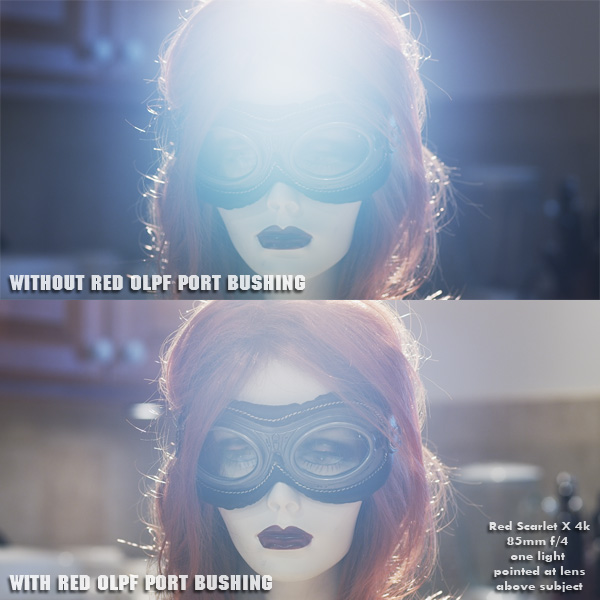
A somewhat extreme example and what Red's new OLPF port bushing protects from is this exact issue:

phfx_scarletXOLPF.jpg


That's an extreme example, but you can see the weird lack of color reproduction and loss of detail on "her" forehead area.
 
Couple of points on a journey I have taken as well. First, if you are going to use a mattebox it has to be practical - you will need standard fronts to your lenses. I got 80mm fronts put on by Duclos lenses. Second, in my books anyway, it has to be swing away. Third, I think your lenses actually lengthen when focusing. Is that correct? Then you cannot use a standard fixed mount on the back of the mattebox. This will preclude you using most models of mattebox eg the O'Connor. I think the Arri MMB1 has a solution for this. The Shoot35 is the cheapest solution (and an excellent one by the way - terrific quality and swing away) but it is 4 x4. That is not a problem unless you are using very wide angle lenses. If you buy the wrong solution it is going to really irritate you. These are some of the specific issues associated with using still glass as opposed to cine glass (I use still glass). Another issue is attaching a clip on - still lenses were never made to take that kind of force on their mounts and I was specifically warned about this by someone who should know.
 
Some lenses shorten and lengthen as they focus, like the Canon 85mm f/1.2L for instance. I'm using the rubber ring with my O-box and it moves in and out with the focus movement without any issue. I have the step down to 80mm opening and most of my lenses fit tight in there. Some of the 72mm threaded lenses have a little gap and that's where you have to problem solve or use a step-up ring.

I originally was a huge swing away fan, but actually prefer the added real estate that the OConnor O-Box WM adds to the rails. Gives me a bit more space for positioning my follow focus. Most swing away matte boxes clamp on ahead of the box slightly and take up too much space.

I don't use clip on matte boxes with still lenses and agree that should be avoided unless you're mounted to the external housing of the lens.


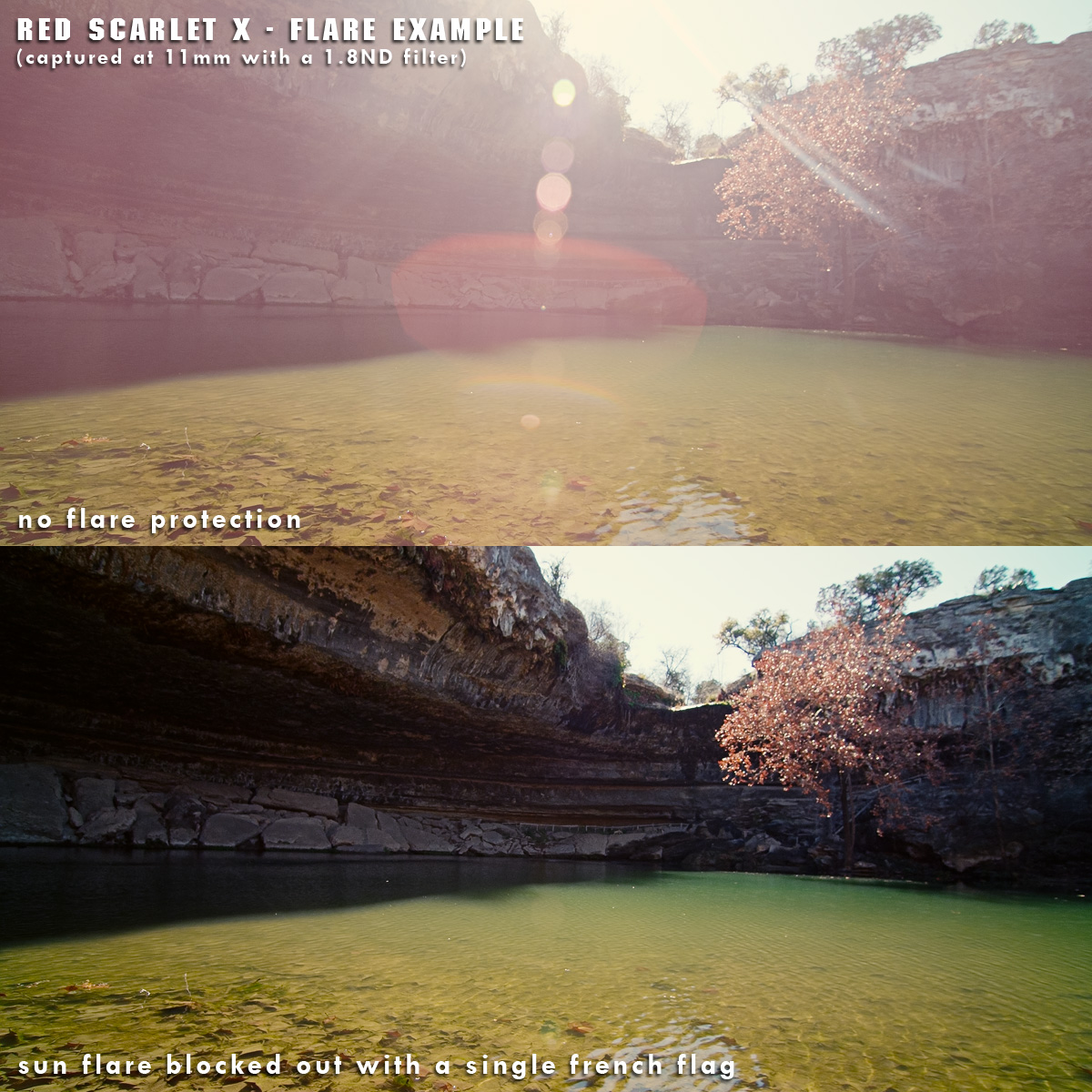
** Aha! I found an example of "with and without" glare/flare protection that I can show! In this particular case a french flag on a flexible arm was used:

redScarletFlareExample.jpg

Wow, that is quite an example... And setting the flares aside - which even I would notice and make sure to eliminate one way or the other - this is exactly the type of washed out look I see all the time and that bothers me. I think I'm sold on getting the MB, if nothing else for my own peace-of-mind knowing that I'm not killing contrast without being aware of it.

Now onto the question of which one to get... The Shoot35 looks great! A few questions:
1) I imagine wide angle lenses will be used quite frequently in combination with the matte box. I will be using the Tokina 11-16mm and Zeiss ZF 21mm. Will these vignette at 4K? What about 3K?
2) My lenses do breathe. The ZF 100mm f/2 is a real pain and travels about an inch. The 21mm does not breathe at all. The 35, 50 and 85mm all breathe about 1/2" or less. The Tokina I'm not sure about because I'm waiting for the new version to come out at the end of March before buying it. Which of these would work with the Shoot35?
3) I notice it uses 15mm with studio spacing. I use 15mm LW right now... Is there a way to mount it anyway? I would rather not have to switch to studio and get new rails, a new follow focus and everything for the time being :/
 
Back
Top