Welcome to our community

Be a part of something great, join today!

  • Hey all, just changed over the backend after 15 years I figured time to give it a bit of an update, its probably gonna be a bit weird for most of you and i am sure there is a few bugs to work out but it should kinda work the same as before... hopefully :)

Manure

Are these shots actual shots from the camera? What I mean is if the majority of the shots in each scene plays out in these total shot framings?
Because I really love these wide total shots!

Most of the ones posted were shot with my Nikon 40X on set, the few RED frames are labeled as such. These are the wide masters; we shot some tighter coverage as well.
 
David, if you get the time, could you explain exactly what is being done with the footage after it's shot - in terms of backing up, processing dailies, color correcting, archiving, etc. And what type of flimout are you guys planning?
 
Those shots looks fantastic David! Can't wait to see more.

Graeme
 
According to PlasterCity, this is our workflow for now:

1. R3D 4K source files are downloaded from RedDrives (and CF Cards) on set and double-backed up to two Raid5 FireWire 800 drives

2. R3D drives are sent nightly to PlasterCITY where they are backed up again to LTO3 and chased with an LTO logging data-base

3. The Rec709 2048x1024 color meta-data imbedded in the QT camera-generated clips is loaded into Final Cut Pro at 1920x1080sF

4. Audio is automatically synched up to dailies so all dailies have synch sound

5. 2:40 matting is applied to the clips and windowburns with source name and timecode are supered for 4K DI matchback

6. ProRes 1080sF media is processed out overnight and saved to the the source media drive for delivery to editorial (processing time is 5:1)

7. DVDs are downconverted from the ProRes 1080sF media and sent to set
 
We're recording sound separately plus going into the camera, using a smart slate to show the timecode from the sound recorder (don't know if it is DAT or hard drive sound recording.)

I'm not operating on this one, but when I do look at the viewfinder... well, I'm not all that impressed with the RED EVF, but then, I haven't used a color viewfinder in any HD cameras that I have ever liked, I almost prefer the older, sharper b&w CRT ones. So it's not necessarily a knock against the RED version of a EVF. But in general, I prefer the RED LCD over the EVF image.

I would be concerned about shooting large portions of a RED movie on the road with only the EVF image to evaluate anything. I'd probably try and use an onboard Panasonic HD monitor instead or have a portable HD monitor to look at now & then. But the RED LCD image is pretty good, the only thing I don't like about it is the limited angle of view, which can be annoying when operating when you can't keep your head at the same viewing angle during a camera move.
 
well, I'm not all that impressed with the RED EVF

I have only seen two EVFs, but the first one I looked through, I thought, "really? everybody thinks this is the most amazing thing they have ever seen?". The second one I saw I was blown away, looked 300% better. I don't know if it's the set up, adjsutments or what, but the two were night and day different.

Go figure......

Nick
 
David this looks like it's going to be a masterpiece. Thank you so much for all your time and effort posting this stuff.

One quick thing regarding on set shore power. Since the Red's AC power transformer is so large, I just take it one step further and tie it to a Battery backup/powerfilter (ups) designed for computers. It's about the size of a normal dolly block and allows me to use AC with the bonus of keeping the camera live during a kickout or having to move locations.

I've even been using it on some location shoots and just leave it strapped to my cart, so that I never have to power down the camera. It's has actually worked very well and gives me a little more security when I know the blocking is going to take a while. Plus it also filters the power going to the transformer for extra protection.
 
One quick thing regarding on set shore power. Since the Red's AC power transformer is so large, I just take it one step further and tie it to a Battery backup/powerfilter (ups) designed for computers. It's about the size of a normal dolly block and allows me to use AC with the bonus of keeping the camera live during a kickout or having to move locations.

I've even been using it on some location shoots and just leave it strapped to my cart, so that I never have to power down the camera. It's has actually worked very well and gives me a little more security when I know the blocking is going to take a while. Plus it also filters the power going to the transformer for extra protection.

Even though we can supply large block batteries for them, this is the same configuration a lot of Phantom Techs like to use for those cameras. On the Phantom if you're not using a CineMag flash memory pack the shot is just in RAM until it is downloaded so a kickout is a real danger, as in the shot is lost. Not as much an issue anymore with the Mags and a 30 second reboot, but old habits die hard and this is a viable way of working.
 
The second one I saw I was blown away, looked 300% better. I don't know if it's the set up, adjsutments or what, but the two were night and day different.

Weird. I've always thought mine was amazing but I have a had a time or two when it went a little wacky and I got a bunch of saturated noise. That turned it into a fairly ugly viewing experience.

Also, the EVF can be put into the focus assist mode which is essentially monochrome.

For me, there's no doubt that I have a much easier time of viewing the EVF than the LCD. I usually tell people who are looking at the LCD to peak into the viewfinder and they are much more impressed by that image. I guess everyone's mileage will vary.
 
David, would it be possible for PlasterCity to send you guys Bluray 1080p dailies rather than downconverting to DVD? Seems like such a waste to downconvert to DVD.
 
David, would it be possible for PlasterCity to send you guys Bluray 1080p dailies rather than downconverting to DVD? Seems like such a waste to downconvert to DVD.

I've heard that authoring Blu-Ray is not so easy; besides, no one I know on this production has a Blu-Ray player... I asked on my last show, which did HDCAM-SR transfers from 35mm, about Blu-Ray dailies and what I heard was that post houses are only now figuring out how to deliver them. Part of the problem is that few productions want HD-quality dailies floating around without copy protection.
 
I've heard that authoring Blu-Ray is not so easy; besides, no one I know on this production has a Blu-Ray player... I asked on my last show, which did HDCAM-SR transfers from 35mm, about Blu-Ray dailies and what I heard was that post houses are only now figuring out how to deliver them.

We are offering blu-ray dailies since early 2007. They do cost slightly more than DVD-dailies, but are much less expensive than HDCAM dailies. Our customers like them quite a bit, as one can judge focus much better better on blu-ray.

As player we rent out sony PS3 (i think 4€ / day).

Part of the problem is that few productions want HD-quality dailies floating around without copy protection.
Yeah, we recomend customers to have their blu-ray dailies always time-code burned in and copy protected.

Back to manure - that set looks beautiful. The styling blends nicely IMHO. Isnt it amusing that, after all these debates on the internet regarding the resolutions of reds 4K cmos, your first production on red is a stylized one and has a slight blur in its look?
 
Love, love, love that mirror shot. Whose idea was that, David?

Also, if you happen to have a shot with the filter and one without, it would be interesting to see a comparison.

This is my second favorite thread. The first being the ask David Mullen thread.

Thanks for sharing David.
 
We are offering blu-ray dailies since early 2007. They do cost slightly more than DVD-dailies, but are much less expensive than HDCAM dailies. Our customers like them quite a bit, as one can judge focus much better better on blu-ray.

Could I ask what you're using to do that and turn it around in a reasonable amount of time (i.e., for a morning delivery)?
 
Week Two

As usual, we hopped back and forth between Stages B and C all week, to give some time for the art department to strike and create sets on the opposite stage. This would be a good time to mention Clark Hunter, our genius production designer, who has taken on this monumental task of building dozens of sets, sometimes turning a farm set into a different set during our lunch break… or within a half-hour --which is nuts (he might have a more choice word for that). It’s been sort of breakneck work and the quality of it has been amazing, so he deserves a lot of credit for what we’ve been able to create visually. Our wardrobe designer, Bic Owen, is also doing some great work on a small budget. Those late 1950’s, early 60’s designs look great on our actors.

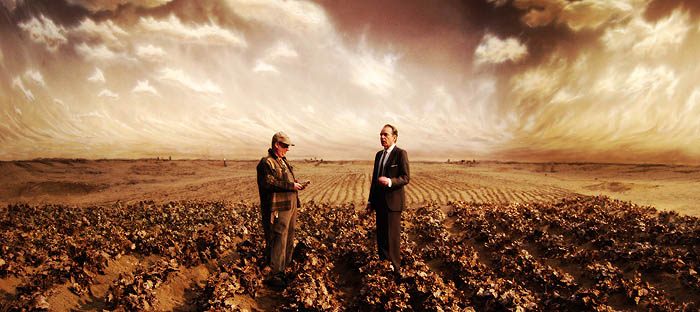
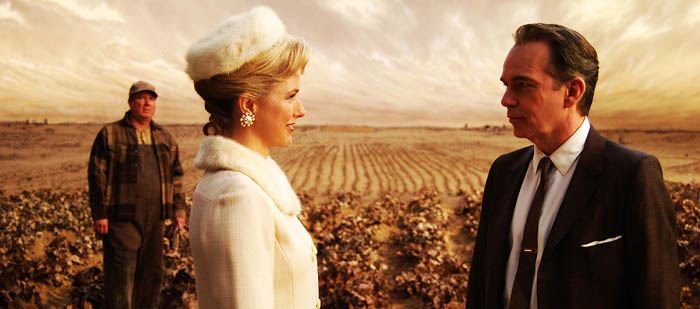
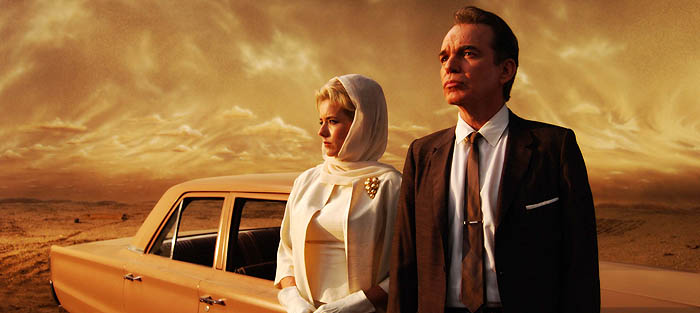
Monday started out on a “potato farm” on Stage C (the main stage), where Rosemary (Tea Leoni) pulls up in a car when she sees Fitzpatrick (Billy Bob Thornton) in a field doing a sales pitch to a farmer. We had a similar scene later on Wednesday when Rosemary and Fitzpatrick pull up in their car and see a bean farm and a distant farmer on a tractor. The problem is that both scenes call for more distance than we can achieve with a car on the stage, since the outer six feet of the landscape set is a sloped wooden platform/ramp that cannot take the weight of a car. So in order to increase the distance, both from the background and the travel of the car, we had to shoot the background behind the foreground car or car window with the camera near the top of the ramp, which means we’ll have to shoot the foreground car against a bluescreen later. On Wednesday we went further and shot from a higher angle on top of the ramp as if the car were on a hill looking down into the farm, with the idea to extend the background in post beyond the patch of farming with more crops, etc.

I lit the potato farm with half-orange 18K’s for a warm hard sunlight look, softened with frames of diffusion for closer shots. I have some ability to keep the look backlit, so the question always becomes whether I want to have reverse angles front-lit if the opposite direction was backlit, and whether leave the front light hard, or soften it, as I might do outside. So this scene is an example where in the wide shot, the scene is hard lit from the side, but high, so if two people are facing each other in profile in the wide shot, one would be backlit in their close-up and the other person front-lit. In this case I decided to soften the hard light in the medium shots so that they would be softened in the close-ups, but leave the wide shots hard lit – as if I were on location flying large frames of diffusion when I moved in tighter.

Please excuse my crude Photoshop color-correction skills...

Here is a Nikon snapshot of the wide shot:
manure67.jpg


Here is a closer two-shot where I softened the light:
manure68.jpg


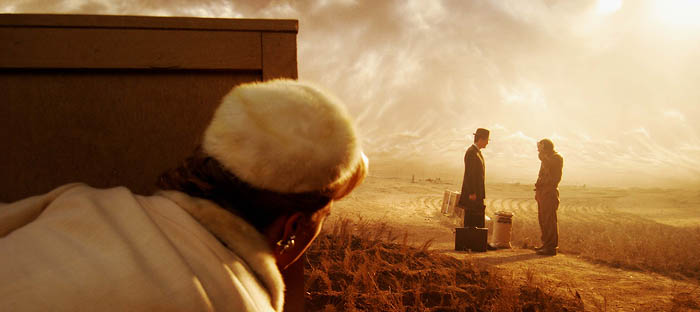
Then we turned half of the farm into a carrot farm and looked the other direction in the afternoon, to shoot a scene where Fitzpatrick and Rosemary, hiding behind a crate of fertilizer, see “Jimmy” (Kyle MacLachlan) selling the new “Milagro” mixture to a farmer:
manure69.jpg


This was the last scene of a sequence before a night hotel scene, so I lit it with tungsten (essentially full-orange on the RED set to 5600K) from the 12-lights above the cyc, for a late afternoon look. Because the look of the movie is somewhat desaturated, I’ve had to increase the saturation of the warm backlights, etc. to keep the effect visible, so half-orange looks more like quarter orange, full-orange looks more like half, etc.

Some scenes have some light haze added, mixed with the unavoidable clouds of dust that the farm sets seem to send upwards all day long while shooting.
 
(cont.)
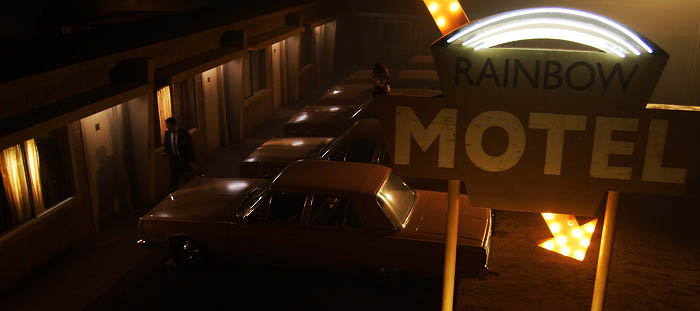
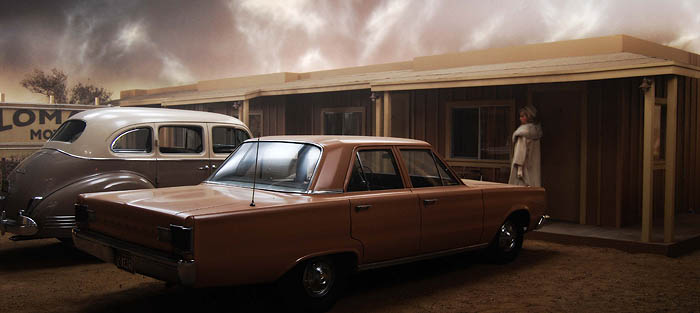
On Tuesday we were in Stage B shooting two motel scenes, one night and the other day, two different motels build next to each other in an “L” formation, making it hard to frame one without seeing the other, due to space limitations on the sets. We did a high-angle shot of the night motel set (in this Nikon snapshot, you can see some missing rooftop in the top left corner which we hid in the RED shot with some black tape on the mattebox of the camera.) I set the camera to daylight balance and used a tungsten backlight for a warm streetlamp look. In the background, you can barely make-out the other motel set running at a right angle:
manure70.jpg


We shot an interior scene in the motel room, the first tungsten-balanced scene of the movie, but I didn’t really see much increase in noise on the monitors from the 3200K setting.

After that, we shot the other motel set, removing the last room of the previous motel structure to create some separation between the two sets, but even then, this set actually ends only one-foot from the backing, which was a problem for a day scene. I had to hide a Kinoflo behind the wall to get rid of the shadow of the building on the backing. I used the overhead Lumapanels, three in a row, each through a 12’x20’ frame of quarter grid cloth, for an overcast look. Generally I haven’t been able to do a hard sunlight effect on Stage B’s sets because I can’t back away enough for a single 18K HMI to light the length of the sets evenly, so it has been safer and faster to go with the overcast look, almost a dusk feeling in this case. Here is the other motel set (you can see the overhead Lumapanels reflected in the car.)
manure71.jpg


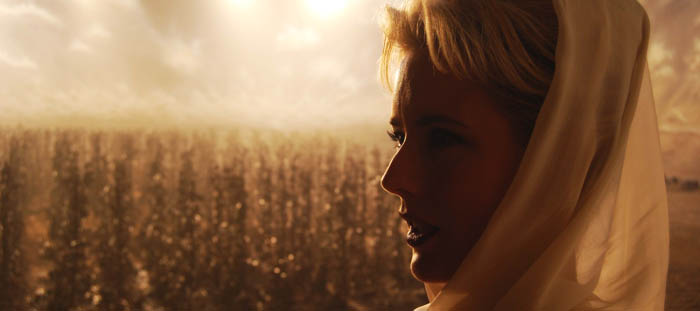
We went back to Stage C on Wednesday for a bean farm set, consisting of six-foot high poles of beans in rows. I lit it for late afternoon with the tungsten 12-lights. As I said, we put the camera on the top of the ramp to suggest a small hill from which the main characters look down across the farm. I snapped this shot of Tea Leoni turning to camera (the shot in the movie is wider, of the two backs of the leads looking out at the farm):
manure72.jpg


Tea is a wonderful person to work with, by the way. Very down to earth, funny.

The reverse angle was shot in three-quarter frontlight, partly because I thought it looked good to see the characters staring into the setting sun, but also because we were too close to the backing to get a good backlight effect (it would have been too close and too toppy from the top of the set wall.) While I normally would have softened the light, I thought here that the actors looked good in the hard light:
manure73.jpg


The back end of the car is only about eight feet from where the ground meets the sky backing...
 
Back
Top