

- Thread starter
- #81

David Mullen ASC
Moderator
(cont.)
Art department then plowed the entire set over to create prairie where some Milagro agents are kidnapped by Rose’s manure salesmen dressed as Indians. I went for an overcast look in that case.
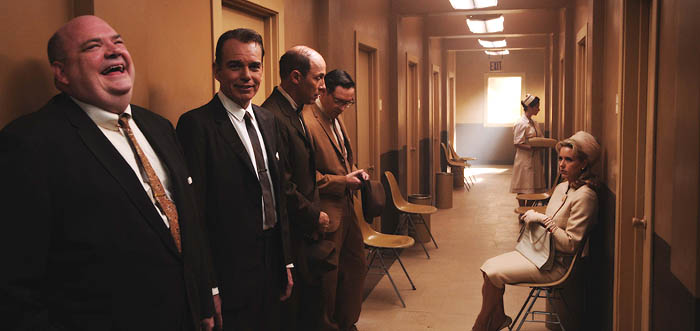
Thursday was spent on Stage B shooting a small scene in a hospital hallway, lit with the overhead fluorescent fixtures plus a shaft of light at the end of the hallway from a 2K Xenon combined with an HMI Source-4:
Then there was an interrogation scene, again lit with the overhead fluorescent fixtures and a backlight through the window from the HMI Source-4 (which I used when possible instead of the Xenon because of the fan noise of the Xenon.)
We went outside near sunset to shoot a scene against a 60’ bluescreen stretched across the wall of the building, in the shadow side, in natural skylight. We had to add two 20’x20’ and one 12’x20’ bluescreen on the sides of the 60’x60’frame to contain all the action. In post, we are creating a huge factory building in the background.
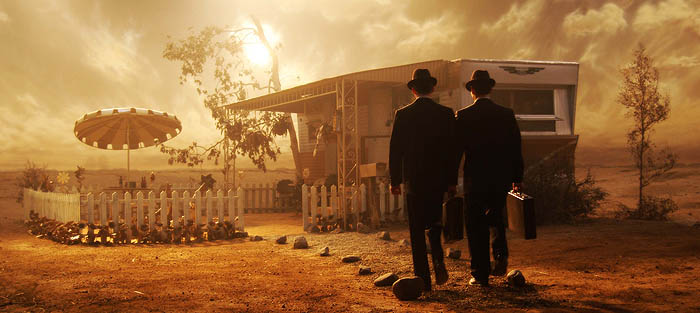
Friday began on Stage C shooting a mobile home parked in a field. Since there was a tree on this set, I decided to try out an idea, which was to mount a 2K light to the top of the tree as if it were the sun peeking out from behind:
We also shot some incredibly cramped scenes inside the trailer. We ended the day shooting a fight scene in a brussel sprout farm (created quickly on the same spot once the trailer was removed) where the Milagro men show up in vegetable masks to beat up our main characters.
And we did that bluescreen scene that I already mentioned.
I have so many photos but decided to cut them down a bit in this post.
I’m pretty beat-up myself, after some long, hard days this week. We’re basically trying to do a seven-week movie in five-weeks, on scenes that require huge amounts of lighting and grip work to pull off, not to mention all the art department chores to get the sets ready multiple times per day. And despite all the discussions on how we will shoot some of these scenes, some aspects cannot be worked out in advance until we see the final set and start to stage scenes on it. This creates some tension as one shot becomes three shots or the camera ends up looking somewhere we said we weren’t going to look, etc.
For the most part, the RED cameras have been fine to work with. Everyone loves the image on set, and that’s just 720P. The boot-up times are still annoying but the camera crew have gotten a lot better about timing the battery swaps and digital mag swaps during moments of downtime. We did have a couple of problems. On Friday, the EVF kept acting up and while trying to get the camera to send a picture to it by re-entering the commands, the camera somehow managed to reset itself to Build 14 instead of Build 15. We shot four set-ups that way, on Build 14, until the script supervisor noticed that the clip numbering system had changed. We had no time to reshoot the scene so we’ll have to deal with some minor image differences in post later, plus warn the post house about the different file labeling or whatever (I’m not sure of all the differences.) So in the meanwhile, we switched from that camera (A-camera) to B-camera, which finally arrived after we sent it back on Week One for repairs.
Then I noticed again something I noticed the day before, that by the end of the day, it seems that the image on C-camera (our main “B” camera for the shoot since Day One) is slightly yellower than A or now-returned B camera. We thought it was just a monitor/output/cabling issue but at the end of Friday, Conrad looked at the RAW files and we saw that the yellowish difference is in the original recordings. It’s a simple color-correction fix but the question is what is causing it. We’ve been doing a black shading every morning but we may try doing it twice a day to see if that helps. It’s like the old days when you used a lens that was warmer than another lens, annoying in color-correction later when you’ve got a lot of intercuts in a scene, but workable. Maybe there are slight differences between digital cameras of the same model that only become visible when doing RAW recording where you don’t have a lot of electronic adjustments happening to the recording to match signals between multiple cameras.
Another minor problem is just data management related. We make two back-ups in the office on RAID-5 drives, and send a shuttle drive to editorial (which just started) to copy and create the master recordings which will be use in post, along with whatever back-ups the post house makes. But I guess they are still trying to smooth out the workflow in editorial room because they have not copied over all the files before erasing the shuttle drive and sending it back to set, so then they called the camera department asking them to resend select files from our back-up RAID’s. There was some talk of having the camera department make four back-up copies instead of just two and keeping them in the camera room. We’re just trying to get the point across to the production office and editorial that once all the footage gets copied and sent to the post house and the editorial room, the primary archiving of the data stops being the burden of the camera department – we just keep a back-up, as does editorial and the post house. Otherwise it’s like asking the camera assistants to vault the negative on the camera truck…
I’m glad I’m able to experiment with a new camera technology on this movie because the Polish Brothers are brave enough to try new things out, just as they have been willing to take a risk on bleach-bypass, or more risky, negative flashing, not to mention difficult formats like anamorphic. On most other movies, I’m less likely to propose anything riskier or more complicated because I don’t know the people I’m working for well enough to take risks, so there is a tendency to take the easy and tried-and-true path (usually Super-35 these days). I did one of the first 24P F900 movies thanks to the Polish Brothers and now I’m doing my first RED movie with them, giving me a chance to learn new things that I can apply in the future. Plus what I love about working for them is that they are visual filmmakers, and they love classic wide shots, unlike the close-up obsessed directors of today.
Art department then plowed the entire set over to create prairie where some Milagro agents are kidnapped by Rose’s manure salesmen dressed as Indians. I went for an overcast look in that case.
Thursday was spent on Stage B shooting a small scene in a hospital hallway, lit with the overhead fluorescent fixtures plus a shaft of light at the end of the hallway from a 2K Xenon combined with an HMI Source-4:
Then there was an interrogation scene, again lit with the overhead fluorescent fixtures and a backlight through the window from the HMI Source-4 (which I used when possible instead of the Xenon because of the fan noise of the Xenon.)
We went outside near sunset to shoot a scene against a 60’ bluescreen stretched across the wall of the building, in the shadow side, in natural skylight. We had to add two 20’x20’ and one 12’x20’ bluescreen on the sides of the 60’x60’frame to contain all the action. In post, we are creating a huge factory building in the background.
Friday began on Stage C shooting a mobile home parked in a field. Since there was a tree on this set, I decided to try out an idea, which was to mount a 2K light to the top of the tree as if it were the sun peeking out from behind:
We also shot some incredibly cramped scenes inside the trailer. We ended the day shooting a fight scene in a brussel sprout farm (created quickly on the same spot once the trailer was removed) where the Milagro men show up in vegetable masks to beat up our main characters.
And we did that bluescreen scene that I already mentioned.
I have so many photos but decided to cut them down a bit in this post.
I’m pretty beat-up myself, after some long, hard days this week. We’re basically trying to do a seven-week movie in five-weeks, on scenes that require huge amounts of lighting and grip work to pull off, not to mention all the art department chores to get the sets ready multiple times per day. And despite all the discussions on how we will shoot some of these scenes, some aspects cannot be worked out in advance until we see the final set and start to stage scenes on it. This creates some tension as one shot becomes three shots or the camera ends up looking somewhere we said we weren’t going to look, etc.
For the most part, the RED cameras have been fine to work with. Everyone loves the image on set, and that’s just 720P. The boot-up times are still annoying but the camera crew have gotten a lot better about timing the battery swaps and digital mag swaps during moments of downtime. We did have a couple of problems. On Friday, the EVF kept acting up and while trying to get the camera to send a picture to it by re-entering the commands, the camera somehow managed to reset itself to Build 14 instead of Build 15. We shot four set-ups that way, on Build 14, until the script supervisor noticed that the clip numbering system had changed. We had no time to reshoot the scene so we’ll have to deal with some minor image differences in post later, plus warn the post house about the different file labeling or whatever (I’m not sure of all the differences.) So in the meanwhile, we switched from that camera (A-camera) to B-camera, which finally arrived after we sent it back on Week One for repairs.
Then I noticed again something I noticed the day before, that by the end of the day, it seems that the image on C-camera (our main “B” camera for the shoot since Day One) is slightly yellower than A or now-returned B camera. We thought it was just a monitor/output/cabling issue but at the end of Friday, Conrad looked at the RAW files and we saw that the yellowish difference is in the original recordings. It’s a simple color-correction fix but the question is what is causing it. We’ve been doing a black shading every morning but we may try doing it twice a day to see if that helps. It’s like the old days when you used a lens that was warmer than another lens, annoying in color-correction later when you’ve got a lot of intercuts in a scene, but workable. Maybe there are slight differences between digital cameras of the same model that only become visible when doing RAW recording where you don’t have a lot of electronic adjustments happening to the recording to match signals between multiple cameras.
Another minor problem is just data management related. We make two back-ups in the office on RAID-5 drives, and send a shuttle drive to editorial (which just started) to copy and create the master recordings which will be use in post, along with whatever back-ups the post house makes. But I guess they are still trying to smooth out the workflow in editorial room because they have not copied over all the files before erasing the shuttle drive and sending it back to set, so then they called the camera department asking them to resend select files from our back-up RAID’s. There was some talk of having the camera department make four back-up copies instead of just two and keeping them in the camera room. We’re just trying to get the point across to the production office and editorial that once all the footage gets copied and sent to the post house and the editorial room, the primary archiving of the data stops being the burden of the camera department – we just keep a back-up, as does editorial and the post house. Otherwise it’s like asking the camera assistants to vault the negative on the camera truck…
I’m glad I’m able to experiment with a new camera technology on this movie because the Polish Brothers are brave enough to try new things out, just as they have been willing to take a risk on bleach-bypass, or more risky, negative flashing, not to mention difficult formats like anamorphic. On most other movies, I’m less likely to propose anything riskier or more complicated because I don’t know the people I’m working for well enough to take risks, so there is a tendency to take the easy and tried-and-true path (usually Super-35 these days). I did one of the first 24P F900 movies thanks to the Polish Brothers and now I’m doing my first RED movie with them, giving me a chance to learn new things that I can apply in the future. Plus what I love about working for them is that they are visual filmmakers, and they love classic wide shots, unlike the close-up obsessed directors of today.


