Welcome to our community

Be a part of something great, join today!

  • Hey all, just changed over the backend after 15 years I figured time to give it a bit of an update, its probably gonna be a bit weird for most of you and i am sure there is a few bugs to work out but it should kinda work the same as before... hopefully :)

Manure

But I assume you will shoot with normal to tele if that backdrop is used?

But at the same time I like the surreal feeling that image has :)
 
Hi David,

strange and happy coincidence--I just watched Northfork last night. Weird seeing this post today! I really enjoyed the look for Northfork, I thought it worked really well with the story.

Looking forward to seeing what you do with 'Manure'. Thanks for sharing the knowledge.

p
 
Thank you David for being so giving with your experience and knowledge.

I worked 1st AD on my first RED project this past weekend and the footage from the shoot looks amazing. Good luck on your shoot, I'm sure it'll be awesome.
 
Since Monday was a holiday, we just finished a four-day first week.

We basically have three soundstages at Melody Ranch to work with. Stage C is taken up with the big farm landscape set. Stage B is filled with structures, wall to wall, from houses to motels to diners, sort of bumping into each other. Stage A is empty for now and will end up as our bluescreen set for shooting driving interiors. We are alternating between stages C and B more or less to give the art department a little time to swap out or alter sets on the opposite stage. It’s a relatively small crew and equipment package to handle all of these sets and movements between stages.

Because the RED prefers daylight-balance, I’ve been lighting all the day scenes with HMI’s, daylight Kinos, a Xenon, plus some tungsten lamps for a warm late afternoon color. It’s a little unusual to be lighting a soundstage shoot this way and while on the one hand, using HMI’s has given me more stop than I’m used to for stage work, the soundman isn’t necessarily happy to have a stage full of singing and buzzing lampheads and ballasts… not to mention the fan on the 2K Xenon whenever I use that. Doesn’t help that most of the interior sets have only partial to no ceilings. And because the RED has a pretty decent color HD monitor image on set, I’m seeing all the subtle color variations between HMI heads and Kino tubes on these hot sets. When everything is painted in shades of tan and brown, you can see any green creep into a light.

Speaking of working stop, most of the time I’ve been around an f/4, which is nice. The sharpness of the HD output of the RED combined with 35mm depth of field means -- like with the Genesis and other 35mm-sensor cameras -- everyone on set gets to see every focus mistake, so it’s very frustrating for the focus puller. I can see the focus, even at an f/4, on a close-up drift through different eyelashes, so I can definitely see when it is even an inch off. Which is good and bad, good in the sense I can catch mistakes when shooting and not later in post. Bad in that it makes life hell for the AC while shooting close-ups. The operator isn’t much help in these circumstances because the image on the onboard monitors and isn’t big enough to see these problems, not like I can see on the 17” HD monitors I have back at video village.

The RED ONE has behaved pretty well so far, though not problem-free. We lost time on Day One dealing with the battery swapping and constant powering down. It seemed after lighting these big sets with the camera on, so I could see an image, and then doing a rehearsal, the camera battery would die or begin to fade on Take One, requiring a time-consuming battery swap and rebooting. Plus our occasional B-camera suffered a bug that never went away, a tendency to not record when you hit the record button, or even shut itself down when you hit the record button. We had to switch to our C-camera, which seems to work fine, just as the A-camera does, and send the B-camera back for servicing. By Day Two, we seemed to have the timing of the battery swapping much better timed, and I rarely even noticed when they had to switch RED drives on the cameras after they shot thirty minutes or so of footage. But I can’t wait for our hot-swappable 2-battery rig that we purchased to show up. The camera really should have some sort of internal power that allowed you to swap batteries without powering down, not when it takes 90 seconds to reboot plus then rejam the slates.

Seeing an HD image on set is wonderful for me. And judging from how I’m lighting and exposing, the dynamic range is pretty decent actually, better than the F900 but not as good as film. But how it burns out is much more graceful and less artifacty than most HD cameras look when something clips. The live 720P debayered image does have some noise and pattern problems that’s not in the recordings. And looking at the RAW files, which have a somewhat flat and murky look before color-correction, the impression I get is that the camera really isn’t faster than 320 ASA; in other words, the sensor seems to like more exposure as long as you don’t go nuts with the clipping at the other end. It’s a little like film in that respect; giving the recording more shadow information helps lift low-end detail out of that murky noisy bottom. So I go back & forth everyday in regards to exposure. I use my light meter for a base reading and then adjust the f-stop based on the highlights, but I keep questioning whether to go up or down a little to either protect highlights or pull up the shadow detail above the noise floor. The AC’s are getting used to me changing my mind on the final f-stop by one-third of a stop all the time.

When shooting film, one aspect I have noticed is that it seems to constantly have buried areas of information in color and exposure that you can dig up or pull down when fiddling with the image in post. With digital, you see what you recorded when looking at the converted RAW files or a Log image, and there’s nothing there hidden, you see what you’ll have to work with in post. So on the one hand, you have greater control with digital images all through shooting and then in post, but on the other hand, you don’t have the same flexibility to work around mistakes as you do with film. Films constantly saves your butt, digital requires that you get things right more or less. But digital also allows this to happen because of how you can look at images on the set. However, when you are rushed, film does tend to give you the comfort factor of knowing that there’s stuff on the negative that can be played around with in post if you accidentally misexposed. This is mostly due to the greater dynamic range of film combined with a lack of data compression; as digital cameras get better in this regards, the more and more shooting digitally will be similar to shooting on film.

But I digress…

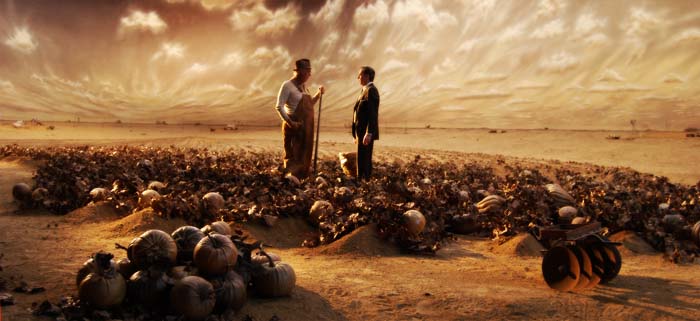
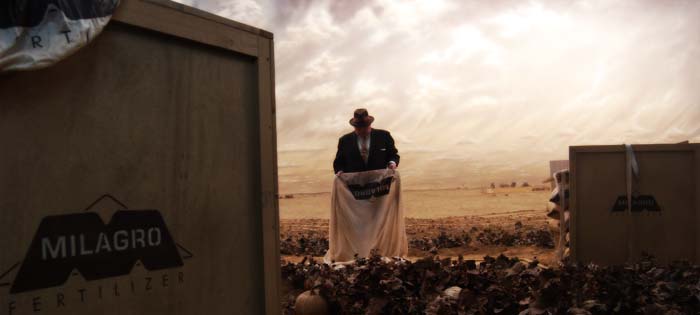
Day One was spent on Stage C shooting a montage of “Rose Manure” salesmen visiting different farms, and in one scene, discovering the invasion of the evil “Milagro Fertilizer” salesman. Many scenes were backlit with the tungsten 12-lights I had hung at the top of the backing, for a late afternoon look. The soft overhead fill came from the daylight Kino blanket lights. Sometimes the actors were deeper in the stage than the 12-lights could really reach, so I used a 5K Molebeam projector to backlight them and let the 12-lights backlight the ground beyond them. But since the sets actually touch the cyc painting, the transition from ground to sky always went a little dark, partially because I discovered that the more I burned out the sky backing, almost to the clip point, the more realistic the effect was, as if the sky were the brightest thing on stage (otherwise, the sky is painted in almost the same shade of brown as the sky.) So I ended up using HMI’s from off camera to try and punch up the sky. And by gelling the HMI’s, I could give the sky a warm bias if I wanted. Those HMI’s were flagged off of the bottom of the cyc, and I tried to rake the edges of the landscape with small PAR’s, but it was hard to not hit the cyc at the same time. I did the invasion scene without backlights for more of an overcast day look.

Day Two and Three was spent on Stage B shooting a montage of the Rose Manure salesmen now trying their hand at selling other products in suburbia. Then at the end of Day Three, we moved back to Stage C to shoot a small scene in a farmhouse kitchen set.

Day Four was on Stage C shooting a long sequence around one farmhouse, in front and then inside the house. I decided it might be interesting to play the sequence as starting in late afternoon and ending right after sunset when the characters re-emerge from the farmhouse. So the sky backing started out being lit with half-orange color and then full-orange for the sunset, plus I backlit the first part but went with only a soft glow from the sky on the ground for the last part, plus played the foreground darker against the sky by the end.

We’re using Zeiss Ultra Primes plus a few Optimo zooms on rare occasion (I’m not much of a fan of zooms.) Everything is composed for cropping the 2:1 4K image to 2.39. The final look will be quite diffused, though I’m using fairly light diffusion filters on the camera and planning on augmenting the effect in post. The wide shots are softened with only a Smoque #1. Then the medium wides are softened with a Classic Black #1/8, and the closer shots with a Classic Black #1/4, the most common filter we are using. For our leading actress, I’m sometimes using the Classic Black #1/2 to glamorize her a little more. I really like the look of the Classic Black filters, which is a #1/8 Black Frost mixed with whatever degree of Classic Soft you want. We’re using some smoke on our interior scenes. I want the overall effect to have something of a storybook quality, a warm fable of Americana.
 
(cont.)

The RED footage is being backed up to RAID’s in the production office and then backed up again at the post house (PlasterCity Digital), I believe to RAID’s and an LTO tape. So far, no problems, the footage seems to be traveling down the pipeline fine.

I’ve discovered that a RAW shooting and workflow process is different than both film and videotape. I guess that should be obvious, but it does have some advantages and disadvantages, just as film does and videotape does. Full daily 4K rendering just isn’t possible with large amounts of footage when shooting a feature, so we’re seeing the images at different levels of resolution and different qualities of debayering. On set, we see a temporary 720P image; editorial will get ProRes HD images. We’re also trying to get some DVD dailies made but the quality so far hasn’t been impressive, partly because you get used to looking at HD quality on the set. My main concern always is if I’m exposing properly and whether I should be altering my contrast ratios at all because I try to push myself to be more bold and striking with contrast when possible – the safe thing would be to just use a lot of soft light all the time.

Here are some Nikon snapshots I took, softened in Photoshop using a Gaussian Blur overlay.

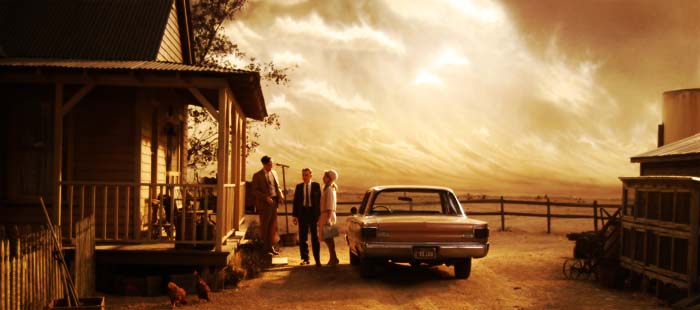
The first shows the warm backlit field look:
manure27.jpg


This is the field lit for a hazy overcast look:
manure28.jpg


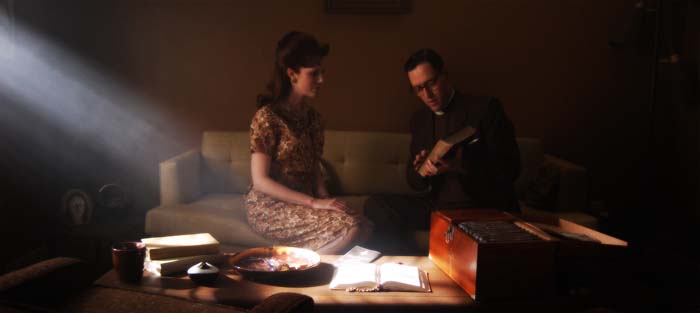
This is an interior scene where Mark Polish pretends to be a priest selling bibles to suburban housewives (the shaft of light is from a 2K Xenon):
manure29.jpg


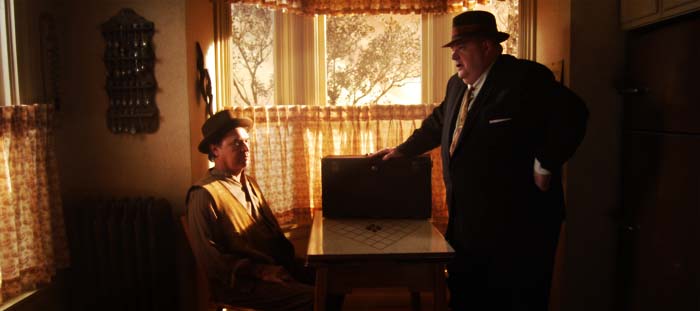
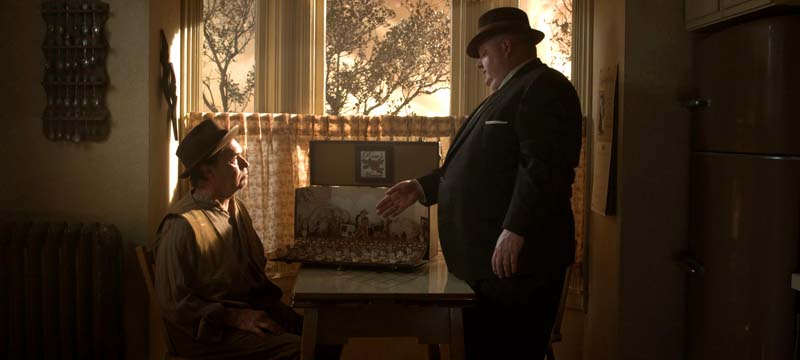
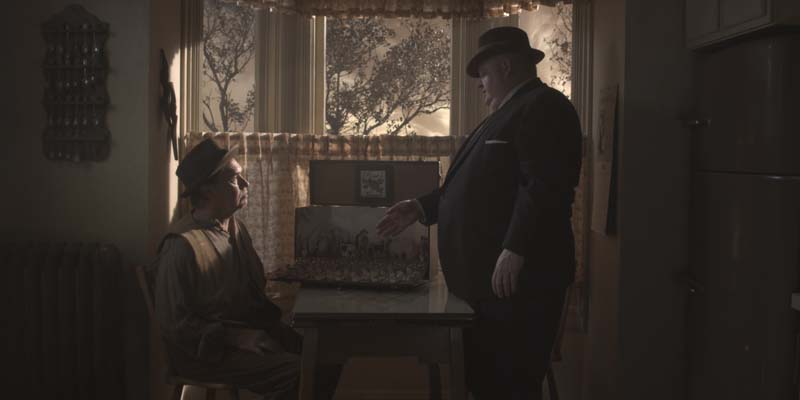
This is the farmhouse kitchen interior scene:
manure30.jpg
 
(cont.)

Here is a wide shot of the farmhouse lit for late afternoon:
manure31.jpg


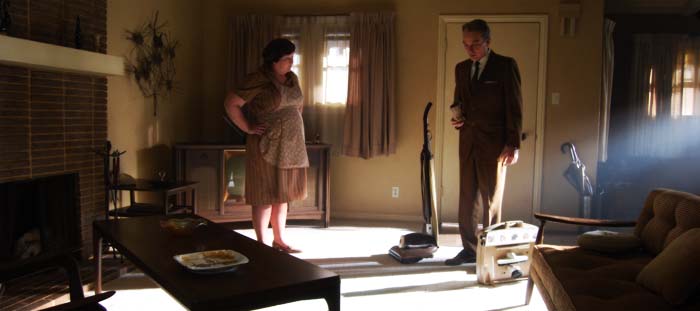
This is another scene with Billy Bob Thornton trying to sell vacuum cleaners to housewives (the shafts of light are from two HMI Source-4's -- the joke is that he dumps manure on her carpet to demo the vacuum cleaner so I wanted the floor to glow with whiteness):
manure32.jpg


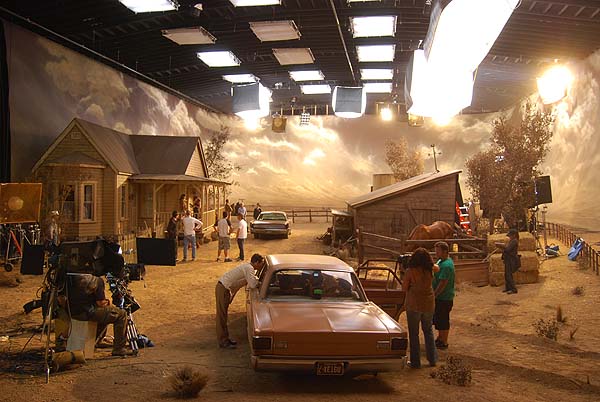
Here is a shot of the soundstage, showing the lights being used. Some of the Kino blanket lights overhead are turned off to kill the worst offending reflections in the car windshield, a major problem:
manure set1.jpg
 
Thanks for all the information and updates David.

Your artistry is truly inspirational, to-say-the-least.
 
Ha, I love it.

This may be a stupid question, but why are you shooting on batteries rather than AC?
I was wondering that myself. Seems like in a controlled environment it wouldn't be too much of an issue, unless the camera could not be tethered for a particular shot.
 
Well, I'm not sure AC power would be as convenient for the cameras -- yesterday there was a brown-out in Los Angeles that caused some of our stage lights to go out (we're not using generators).

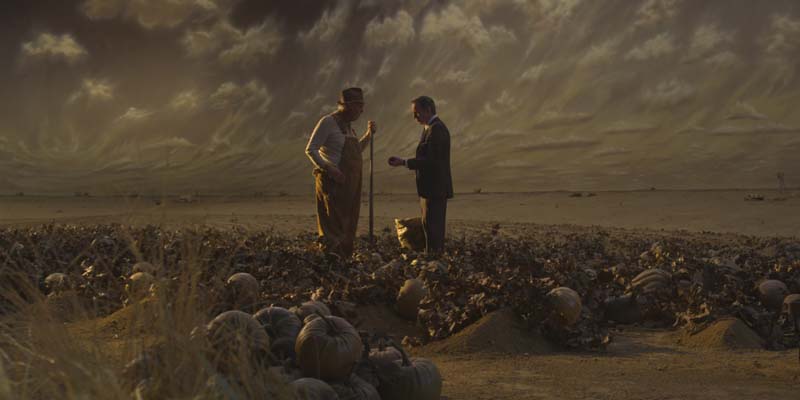
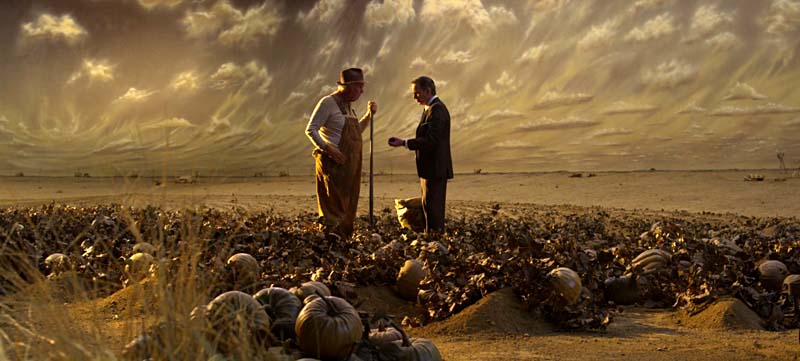
Here are some RED frames, reduced & compressed for the web unfortunately, with some corrections I did quickly with my crude Photoshop skills:

manure33.jpg


manure34.jpg


manure35.jpg


manure37.jpg


The Photoshop diffusing in my snapshots is just a simple way of showing the final look -- as you can see in these real frames, the filtering is pretty subtle. The wide shot of the kitchen just has a #1/8 Classic Black (plus smoke in the air) and the wide shot of the field has a #1 Smoque (similar to a #1/8 Double Fog, let's say) -- I'm leaving the option open for more softening in post.
 
Hi David. Your work is absolutely stunning! What a joy it is to see these images and know that the person behind them is a great human being. Kudos. Keep these paintings coming our way. As far as the photoshop work? It looks like you are using a glamour glow. You may as well build an action for it if you are going to continue that look. It will save you time. I also liked what James had to say about using the digital blue against the blonde hair. Always learning. F
 
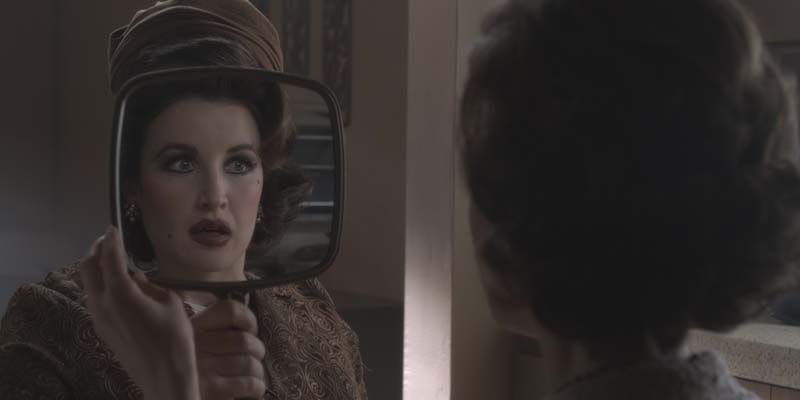
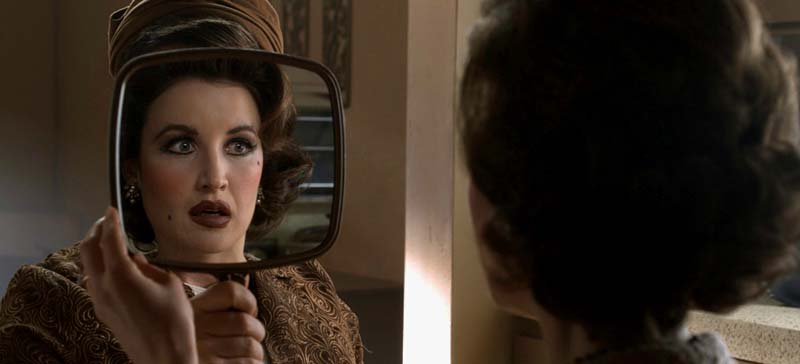
Here is another RED frame and a quick Photoshop correction I did (again, rather compressed unfortunately for web forums):

manure39.jpg


manure38.jpg


Story-wise, what's happening here in this scene is that a manure salesman (Ed Helms) dressed as a woman selling cosmetics, does a mediocre make-up demo for a woman and then holds the mirror in front of his face, revealing her face. I like the weird composition it creates...
 
I saw one of your production's signs on Placerita Canyon Road today (on my way to Sable Ranch).

I bet there were a lot of passing drivers scratching their heads about the sign with "MANURE" in big letters and an arrow!
 
I was wondering that myself. Seems like in a controlled environment it wouldn't be too much of an issue, unless the camera could not be tethered for a particular shot.

Any professional set is hardly a controlled environment!

A perfect example of this is when the B camera was sent over to the C stage while A camera was working on the B stage (I know, the letters are confusing). Since we were just shooting plates of the painted clouds for later CGI work, we were given one electric and one grip - both of whom were not completely familiar with the stage. During the setup the electric tripped the wrong breaker, causing not only all of our lights on the stage to go out, but all the emergency stage lights as well. If it were not for the main stage door being open, we would be in complete darkness.

Now if the camera was on AC power, it would have been dead along with the lights. This may have caused file corruption on the fat32 filesystem of the Red Drives we are using, potentially causing lost shots or hours of hard drive scanning, trying to find all the zeros and ones of R3D files. In addition, Im not exactly sure how the power went down and how it came back up, but the potential for surges on the line during a situation like this is greater than normal, and not a risk for one of the few Red cameras currently released to the world.

Beyond all of that, David likes to work very fast, and his crew is extremely competent and on the ball. So placing the cameras and working with exact frames is a must for the camera department to help ensure that the set flows well. If we have to constantly wait to plug into AC, move AC cables, or wait for power to be run to us, that slows the entire production down. It truly is not like David keeps the camera on one part of the set - but the whole stage is open for David to place a camera at any time. So waiting for AC to get there would be a major detriment to time and on-set workflow.
 
Are these shots actual shots from the camera? What I mean is if the majority of the shots in each scene plays out in these total shot framings?
Because I really love these wide total shots!
 
Story-wise, what's happening here in this scene is that a manure salesman (Ed Helms) dressed as a woman selling cosmetics, does a mediocre make-up demo for a woman and then holds the mirror in front of his face, revealing her face. I like the weird composition it creates...

Great shot... interesting composition......it had me confused for a while.
 
Back
Top