Welcome to our community

Be a part of something great, join today!

  • Hey all, just changed over the backend after 15 years I figured time to give it a bit of an update, its probably gonna be a bit weird for most of you and i am sure there is a few bugs to work out but it should kinda work the same as before... hopefully :)

Low Light Optimised OLPF thoughts

What kind of tests do people want?

What should the shot/lighting setup look like?

Battistella

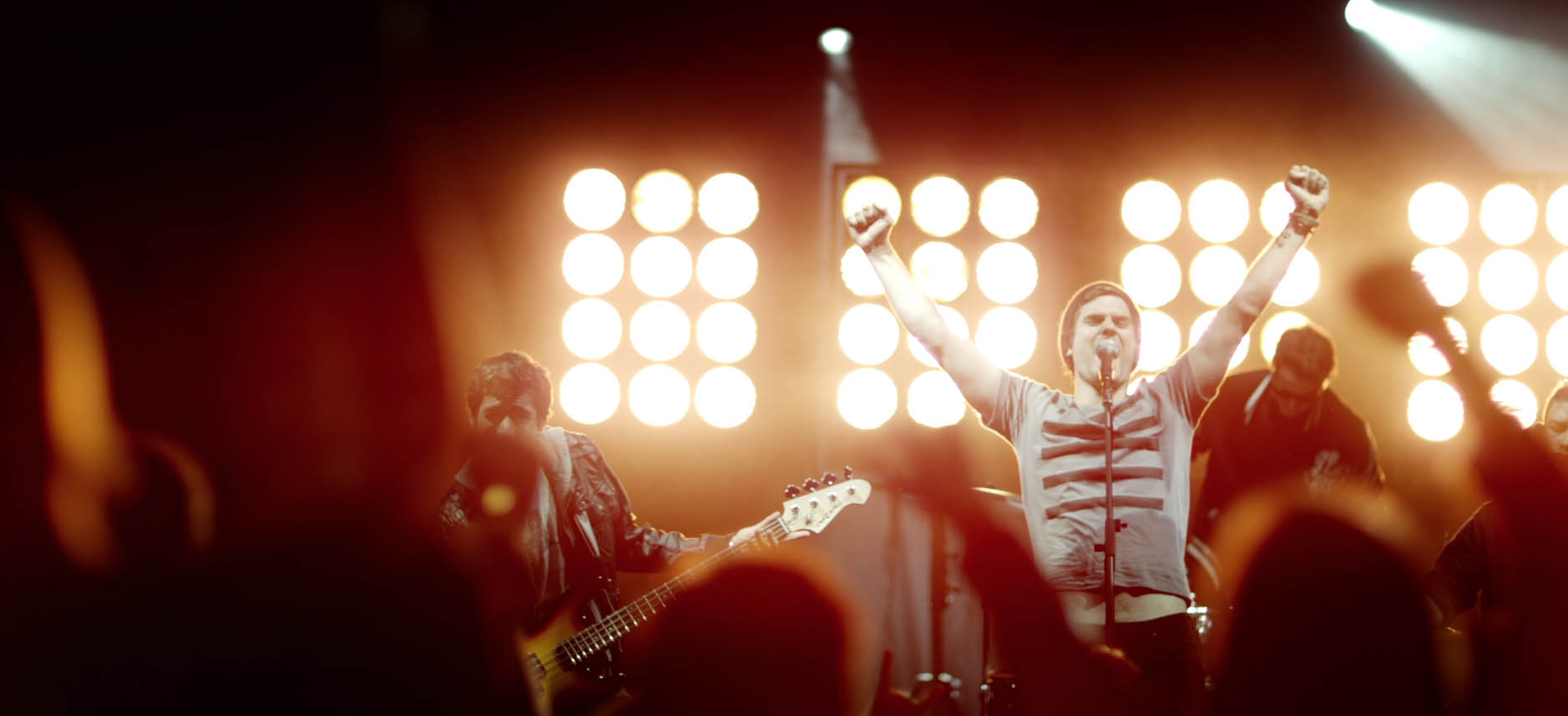
Maybe talent center stage, with some fresnels pointing directly into camera from behind (exposed for talent letting lights go hot, music video style). Then with camera, pan left to right to see when and if the orbs show up and varying focal lengths from wide to closeup of talent.

These are situations where the orbs would definitely show up if an issue. Like these conditions:
lights_dinettes.jpg

1484162_10153511088095276_1333543298_n-360x240.jpg

AndrewDrozPalermo03.jpg

imgres

Colour-Bomb-2.jpg

Lady%2Bgaga.JPG

picture-1.jpg
 
There seems to be no real stress tests of how New LL OLPF handles this pink soft orb issue.

I wish there were some clear info about this somewhere

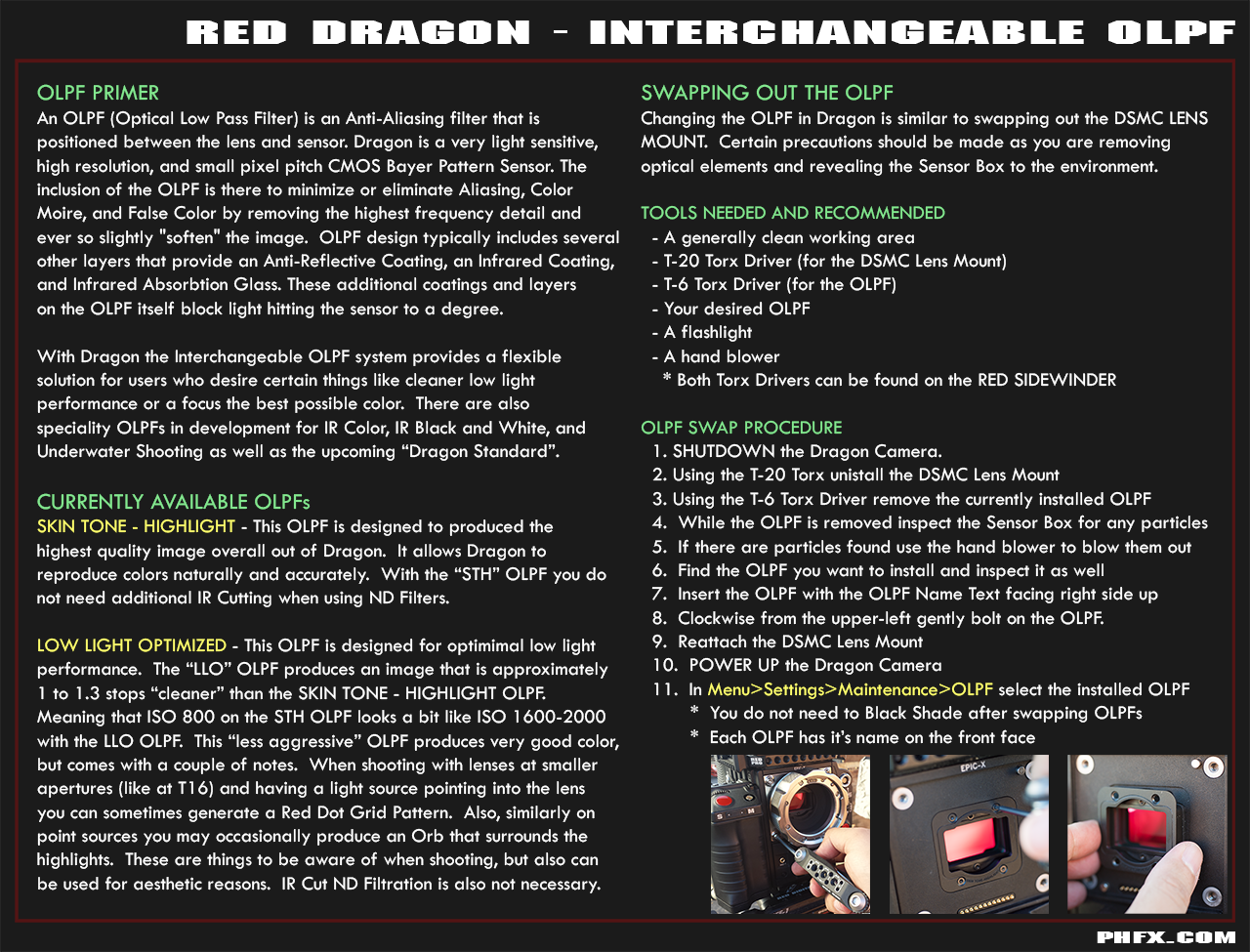
Not to hijack David's thread, but for people asking for it here are two of the more useful posts with many images regrading the new Interchangeable OLPFs and the history of the OLPFs during Dragon'a release:


I've been asked to make a big summary post by a user with all the useful test images in there as the Interchangeable OLPF System is now making it's way out into cameras.


Color Consistency

The color difference between the Low Light Optimized OLPF and the Skin Tone - Highlight OLPF is fairly minimal:


OLPF Texture Comparison

Below is a sample video showing the texture comparison between both the STH and LLO OLPFs:


There are a few 100% crops from that video here:
http://www.reduser.net/forum/showthread.php?122074-First-Look-Interchangeable-OLPF-on-Dragon&p=1420118&viewfull=1#post1420118

And here:

http://www.reduser.net/forum/showthread.php?122074-First-Look-Interchangeable-OLPF-on-Dragon&p=1423024&viewfull=1#post1423024

As well as some of the "pretty shots" here:

http://www.reduser.net/forum/showthread.php?122074-First-Look-Interchangeable-OLPF-on-Dragon&p=1420342&viewfull=1#post1420342


Notes on Improvements and Artifacts

The general concept is that the texture/noise/grain is 1 to 1.3 stops cleaner on the Low Light Optimized OLPF versus the Skin Tone - Highlight OLPF. Meaning the general "energy" and characteristics of the noise is about 1 to 1.3 stops better. So essentially if you like the Skin Tone - Highlight OLPF at ISO 400, you'd likely feel the same way about the Low Light Optimized OLPF at ISO 800-1000.

Red's recommended "cinema ready" ISO range is ISO 250-2000. However, I've found under some circumstances that ISO 4000-5000 is rather usable in certain situations with the Low Light Optimized OLPF:


A note on potential artifacts.

The LLO OLPF produces this Red Dot Grid at smaller apertures like T16, which is similar to what Mysterium-X does:


Where as the STH OLPF eliminates the undesirable qualities of the Red Dot Grid with it's own unique look:


Additionally and occasionally on super hot sources pointed into the lens you may get Highlight Orbs around the source, which is almost like an extreme lens flare when it happens:


OLPF Swap Process

A quick overview of the OLPF Swap Process, which are now apart of my Dragon Data Sheets:


So my overall assessment here. If you are interested in the "highest quality image" out of Dragon and understand the texture that comes along with the ISO ratings of the Skin Tone - Highlight OLPF it produces the best image. The Low Light Optimized OLPF has pretty damn good color and still fairly nice highlight roll-off, but with the potential to produce certain artifacts under specific conditions. If you are familiar shooting with Mysterium-X you'll be familiar when those artifacts arise and also get the benefits of having a cleaner image across your ISO range.
 
And the small story of how we got to here:

Cheers and thanks Bjorn. And just to chime in as I've been following this discussion as well as having some similar conversations in the last few months with other shooters.

I've been exceptionally fortunate to see Dragon along it's way. Big thanks to Jarred and Mr. Probst for getting that real, real early look. I still think back to that first day out in the harsh sun pointing that prototype Dragon at a junkyard car with the sun glaring right off the windshield with a heavy shadow coming off to one side. I looked real closely at that image. That particular moment was where I saw that Dragon was different than Mysterium-X in the ways that I was hoping it was.

Then along the way seeing it a couple of times leading up to being able to shoot "It's Just Paint" things became a bit clearer. That shoot I did lots of things that weren't ideal and was trying to hit Dragon with some skin, texture, shadow, clipping, etc.... This was back during the V1 OLPF. The images I got out of it were gorgeous.


- click for UHD 4K resolution


That V1 OLPF is what many of the early Dragon shooters had and it was giving us the cleaner higher ISO performance we were impressed by. Breaking into some uncharted territory if you remember some of the other guys test footage. ISO 3200 and even 4000 were very reasonable, heck further too. The color was there, the dynamic range was a pretty tremendous, the highlight roll-off was smooth, and of course the resolution and sensor size was there for those who wanted to explore 6K. The added benefit of not needed additional IR cutting when using Neutral Density Filters was also tremendous from a practical shooting perspective.

However, some folks wanted a bit more in terms of wrangling some of the optical artifacts that the V1 OLPF produced, which were/are some similar artifacts that many of us experienced Mysterium-X shooters were also shooting around.

The V2 OLPF, which is also what we now call the Skin Tone - Highlight OLPF became the gold standard as it produced the "highest quality image" out of Dragon. However, the greater protection against those artifacts using either coatings or layers chewed up some of that amazing low light performance we were getting.

However, the Skin Tone - Highlight OLPF for those who understand it's strengths produces some of the best (if not the best) color I've seen out of a digital cinema camera:

phfx_SK_UHDRDW_SKGrabs_0013.jpg


phfx_redEpicDragon_gnomonSummer_sej03.jpg


Having the Skin Tone - Highlight OLPF was "enough" for some, but not for all. Some yearned for what "was" with the V1 OLPF. And I personally think Red came through in a unique way with the Interchangeable OLPF concept. And it was a bit surprising to see that the V1 graduated into a very slightly improved Low Light Optimzed OLPF Filter. That nets us about 1 to 1.3 stops "cleaner" texture with a hair more highlight detail retention when compared to the Skin Tone - Highlight OLPF.

The good news is there's no really big visual color difference between both of those OLPFs. Meaning the calibration/profile for both of them is fairly matched. So we're still getting that pretty damn good color with very good skin tones, which is to me one of the best things about Dragon:

phfx_redEpicDragon_IOLPF_daylightKinoCompareISO800.jpg


phfx_redEpicDragon_IOLPF_daylightCompareISO800.jpg


The good news for Mysterium-X shooters is that MX rocks and has/will make some tremendous images for years to come. However, I've shot my share of footage on Scarlet and Epic Mysterium-X. I know personally what I was looking for in terms of getting "more" out of the overall image quality. Dragon has that. The resolution/format relevance is pretty crucial for some using Super 35mm lenses, where 5K lands that is. The Dynamic Range and Highlight Roll-Off really impressed the hell out of me. But for day to day shooting it's the color and IR performance that really push Dragon into the realm of something I prefer. I also do like the size of 6K and using that as a capture format. Big fan of larger formats in general. Having the option to go between those formats in one camera is wonderful to me.

From my perspective the color, dynamic range, and IR Cut performance was worth the upgrade. For me it's a different medium in that way and it's allowing me to create images I couldn't capture with Mysterium-X. That's not going to be the answer for everybody however. And that's totally okay.

Outside of all this craziness and more from an image maker's perspective I want tools that can help me capture beautiful and vibrant images. I'm getting that with Dragon. I'm certainly excited for what the next few years may have to offer and I can think of a couple handfuls of things that can improve/advance the DSMC system further. But right now Dragon technology is state of the art and it's performing extremely well in the categories that I value the most.

I recommend all who grab the new Interchangeable OLPFs to test them out. I've now swapped them over 50 times, which is nuts but that's the nature of stress testing. David's findings are pretty much exactly in line with what I've found. I'm outside of the honeymoon stage of testing the hell out of them and back to the happy shooting marriage stage over here :)
 
I guess the good news is swapping them out isn't a killer in terms of cost. I am getting ready to send in for an upgrade before the price increase and am going to try the low light. I think that one of the things that catches my eye in Phil's test is the way the noise looks in the shadows - even with bad vimeo compression the Low light seems to hold a bit better at high ISO. It seems to pull a bit greener but that seems easily graded out. The orb issue os my only concern but we can always swap if we need to. I'd like that extra sensitivity push.

Love to see whatever tests anyone is willing to shoot.
 
Swappable OLPF's oozes flexibility, and has the potential to be a breakthrough moment for RED. It's essentially like getting multiple cameras for price of one:

Want an OLPF with superb colors and ideal for shooting outdoors (rated 320)? Skintone is AWESOME.

Need an OLPF with more depth in shadows for lowlight (Rated 800-2000)? Lowlight is AWESOME.


And to think...there are MORE OLPF's ON THE WAY! The possibilities are truly inspiring...


As a side note - I don't think the 320 ISO of the SKINTONE OLPF gets enough kudos for how it simplifies a lot of shooting outdoors.

Consider - most cameras are trending towards LOWLIGHT. Meaning their "native ISO" is inching ever higher towards 800 to 1280. For bright shots outdoors, the ND requirements are starting to get more and more complicated as these sensitivities are pushed.

Having a camera system that can easily jump between 320 ISO and 800/2000 is clearly a huge boon for production.

Much like 4K and RAW workflow have become industry standard 7 years after the RED ONE came out, I can see OLPF swapping becoming "standard" in several years as well.

OLPF swaps appear to exist with Sony cameras now too, but that seems more of a "minor" adjustment to the image (ie sharpness at 2K vs 4K) - not a sizable leap in ISO and sensitivity (ie a brand new camera).

I have a feeling many of us may look back at this OLPF SWAP as a watershed moment in RED's development, and possibly the industry's too.
 
Last edited:
Thanks for the links Phil - and pointing out some info Nick. I was in a hole for most of September and Oct doing a CGI project (that ended up in a 3 week crunch with literally 48 hours on and 4/5 hour off in the last week), so I'd missed a lot of this info.

Maybe a sticky is called for to make it easier to find? The results look great and push me towards Low light (and skintone as a second option). The orbs were a big issue in quite a few things I'd seen, but I have to say, after watching the Knick recently, the show looked great and the orbs were really minimal, so they can be controlled.

I presume there's been a bit of Red tinkering on the LLO OLPF that's part of the interchangeable system, so things are certainly progressing :)
 
Much like 4K and RAW workflow have become industry standard 7 years after the RED ONE came out, I can see OLPF swapping becoming "standard" in several years as well.

This is interesting. If olpf swapping can be integreated into cameras, where it can be changed with the switch of a button, like switching the ND on an ENG camera.
 
Thanks for posting in here phil. It's a great help and your work gives a ton of examples and context.

Battistella
 
This is interesting. If olpf swapping can be integreated into cameras, where it can be changed with the switch of a button, like switching the ND on an ENG camera.

LOVE THIS IDEA
 
This is interesting. If olpf swapping can be integreated into cameras, where it can be changed with the switch of a button, like switching the ND on an ENG camera.

Jason I think you envisioning a very likely future yes. This is one of MANY reasons I find the swappable OLPF system so interesting. In a couple of years, we may all be owning "multiple" cameras for the price of one. And camera manufactures may soon become judged not just on their sensors - but also the quality and range of their OLPFS (much like DSLR's are judged on their sensors, and lens availability...ie Nikon glass vs Canon glass, etc).
 
Last edited:
What kind of tests do people want?

What should the shot/lighting setup look like?

Battistella
I'll have the LLO OLPF in my camera when comes back at weeks end. I'll try to get on a mountain to shoot on the snow with it during a sunny day ASAP!
 
I'm in two minds about both OLPF's...

The Low Light I personally prefer only because it gives me what I need in most conditions... dark, light etc...

The high light OLPF is great I consider this a OLPF if I wanted to get a bit more artistic with fashion, accurate colour, beauty etc....

It is a bummer that the High light OLPF can't be pushed past 2000 iso, because that would be my ultimate setup if it could.

Im sure RED would if they could... so it must mean they are at the limit of Dragons sensor technology. So I'm sure a better sensor wont be to far away.

But till then... Im more than happy with having the choice of both in my kit.
 
I like that there are options and those options let you tailor a look. That's taking things one step beyond "normal" filtration.

battistelka
 
Last edited:
I'm in two minds about both OLPF's...

The Low Light I personally prefer only because it gives me what I need in most conditions... dark, light etc...

The high light OLPF is great I consider this a OLPF if I wanted to get a bit more artistic with fashion, accurate colour, beauty etc....

It is a bummer that the High light OLPF can't be pushed past 2000 iso, because that would be my ultimate setup if it could.

Im sure RED would if they could... so it must mean they are at the limit of Dragons sensor technology. So I'm sure a better sensor wont be to far away.

But till then... Im more than happy with having the choice of both in my kit.

Mark I believe RED are in development of a THIRD OLPF, which way well end up giving you the performance you seek...(ie an OLPF that splits the diff btw Lowlight and Skintone)...
 
Back
Top