Welcome to our community

Be a part of something great, join today!

  • Hey all, just changed over the backend after 15 years I figured time to give it a bit of an update, its probably gonna be a bit weird for most of you and i am sure there is a few bugs to work out but it should kinda work the same as before... hopefully :)

Lomo 70mm format lenses + other 65mm/70mm format lenses

Cristina Kowalska

Well-known member
Joined
Jul 13, 2017
Messages
52
Reaction score
0
Points
0
Location
PL / UK
Hallo to all.
I have another inquiry / problem / topic.
We would like to re-house Lomo 70mm format lens set, as we bought rare Kino-Russar 28mm optical block last week. Other lenses (like 40mm, 56mm and 75mm) were easy topurchase, but we still miss some other focal lenght. I believe i'm a good searcher and found set should contain:

Kino-Russar-10 F = 28mm
OKC4-40-1 F = 40mm
OKC1-56-1 F = 56mm
OKC4-75-1 F = 75mm
OKC2-100-1 F = 100mm
OKC1-125-1 F = 125mm
OKC2-150-1 F = 150mm

Can someone confirm it ? Did i miss any focal lenght from 70mm set ? I mean 200mm and 300mm lenses, we are not interested in them very much. Other thing is - because i still can't use market here - does someone have for sale 100mm, 125mm and 150mm focal lenght optical blocks or lenses ?

Another thing. Maybe You know other lenses for 65mm and 70mm format cameras. We are more interested in prime lenses set than zooms, but we can also look for zooms if there ius something interesting on the market.
I will be grateful for any help in this subject. Thanks !
 
Hi, Cristina.

Good job done, you list if full. For 200 and 300mm do not hesitate and find the regular ones, namely OKS1-200-1 f2.8 and OKS1-300-1 f3.5, they cover just fine and officially were recommended for wide format usage. A full 28 to 300mm set is a full set, a value, and very few have it (yet there was Kinorussar 22mm).

Though, there were late 80-s superspeed (sic!) lenses for 70mm. They are ultrarare to find:

70OKS16-75-1 75mm f1.4
70OKS10-100-1 100mm f1.4

Other late fast designes :

70OKS8-40-1 40mm f2
70OKS7-56-1 56mm f2

There were also more 56mm like OKS2-56-1, OKS3-56-1 with minor design improvements but they are again hard to find since only little prototype batches were produced.

Lucky you got the Russar 28mm! Hope your one is OKAY since all of them I'd seen had glass surface degradation of the lens just in front of the iris. It looks like plain white scratched lens.

Others foci are OKAY usually.

I think you've read it already, but for others it may be helpful, so here 70mm / 65mm Soviet Cine Gear Book, it is bilingual (in Russian and in English), it has info on the soviet wide format cinematography mass-produced lenses of the 1960-s:


http://drive.google.com/file/d/0B_9Rua4iG1MraDV5UVZWVHZFaDQ/view?usp=drivesdk

As for the zoom, I have CKBK 70OPF5-1 40-240mm f/4.5-5.6 for sale here.
 
Last edited:
Ilya, amazing post ! Thank You very much ! This is what i wanted to know. Now, we just have to buy 100, 125 and 150 to have full set ;) About Kino Russar - our Tech said it is in really good shape.
 
hope it helps.

those 100 125 150mm if optically centered (read good lens sample) are super duper lenses, they are nearly perfect sharp and corrected classic Lee Opic / Planar lenses, top of the top.

The more I service Lomos and test them on the bench, the more I see that actually if you ever find an unopened lens (no signes of dismantling after the factory, lacquer on the screws and rings) than you get the perfectly optically adjusted lens (chance is high)!

They WERE adjusted to give the perfect Airy disk at LOMO despite the myth of bad quality control.
 
those 100 125 150mm if optically centered (read good lens sample) are super duper lenses, they are nearly perfect sharp and corrected classic Lee Opic / Planar lenses, top of the top.

Ilya, to be honest we do not know history of those blocks, but if they were opened, is it possible to center them in Your service ? Or they have to be sent to some lens factory ? Remember we have just optical blocks, not full lenses with focusing helicoid, etc.
 
Yes, that's what I usually do since test projectors and charts are of too low sensitivity and just not suited for lens optical adjustment. While star test gives me insane sensitivity so that I see up to 0,5 nanometers aberrations (0.1 of light wavelength). Further read here.

As of today, I do not know a facility or factory who does this type of adjustment as a regular service for reasonable money.

Have you already got 100 125 150mm? I can serve as an escrow and at the same time as lens check and adjustment (if the lenses are in a bad shape) service. The process needs the optical unit only, so no housing involved.
 
Following Cristina's thread title, let's put here all 70mm / 65mm (52.5 x 23mm frame size) lenses info.

Plz participate, guys, big sensors are at the gates let's make the database here.

I start with Zeiss 60x60 still glass for Hasselblad medium format reflex mirror camera, mid-late 1950-s designs, manufactured between 1957 and the late 1970s. NASA used them in the many space missions of 1960-s including Apollo 11 Lunar landing with the Biogon 60mm f5.6.

The list incorporates C Lenses — single coated, integrated Synchro-Compur shutters, mostly chrome finished barrels (black ones appear in the early 1970-s).
Also C T* lenses included, meaning the addition of six-layered T* mutlicoating to the base C lens (by the 1977 most of the C series lenses had T*). Some Chrome finished C lenses feature T* coatings, but otherwise all C T* are in black housings.

Frankly, I know very little, so please correct and add.

ZEISS

The superfluous set consists of 30 (fish-eye), 38, 40, 50, 53, 60, 80, 100, 150, 250, 350, 500. Lenses are superb. The only downside is that they are mainly relatively slow compared to LOMO's and Cooke's.

Ludwig Bertele's 38 & 53mm Biogons are groundbreaking (no severe vignetting for that angle, distortion free, superb contrast and resolution). This design is based on Mikhail Rusinov's (father of Russar family) discovery of the 'aberrational vignetting' and some principles incorporated in Russar designes like strong negative menisci, — that make possible to radically decrease the vignetting at such a wide angles.

Distagons were made to allow larger than Biogon back focal distance to free the mirror, at a price of distortion, vignetting and astigmatism.

— F-Distagon (fish-eye) 30mm f3.5 datasheet (MTF, Relative illuminance (vignetting), Distortion graphs):
ibHyfKIl-hbMC89wwwe1PzIGeJPfa-CSEenZcTPqXrB8JkTcDmYbyju1BrQYKk0i39bsZnFjx9LrYiGClhE7RCnDoH9JGoz4WG7M9q0REgCUCJfMWQ1XaDG4za6RIzYA5Rvzlgv6E7AXFY-frR4ie8VkI_RIzhkJMrbcE-XtPsGFb63pZaMYXVtqvX3I7NR6h7y7_VX7_DVXYmXONRuHnrWzdQJ03V4pwS4REeg8a3Kr26duxYmvTypNSyXUzTxJ4z6PHCfJ1rrIUCsCmM2NNXD7S5aIf0iD6vAqNB0MQ0Vg_lkMLBObORFx2S3-kThPc6iO5J3AAWdAjJnpJeVQEANlYWVFAHtMpluFNeyczGPMcifHhkyAXY-YffwqkaY8hcPyWdxKLlF27lP0FT31Y7GS9IAhbJLvR-jFQ2y3uQ10K3vEisDKPSlIfHd-ofsl65aj8YITI1L5RfCxOMxkSxrN9qo8UJHlFpaIq9kHQtD6l3aLsfrCw7gOTRYWZKUfNVGrlUAOREtU34wRaXNFZC5X430GMeVkgurJsKe-Wt-Tc9a1W--ZXo_JbT41btQulPxYn6s2huBynoShlpd9O5m7lb_aCt71e7j5z-4SbfxnXRxl6Jds=w5456

s35L4W


Biogon 38mm f4.5 datasheet:
cahXGZ


Distagon 40mm f4 datasheet:
no2Qw2


Distagon 50mm f4 datasheet:
B6E8HL


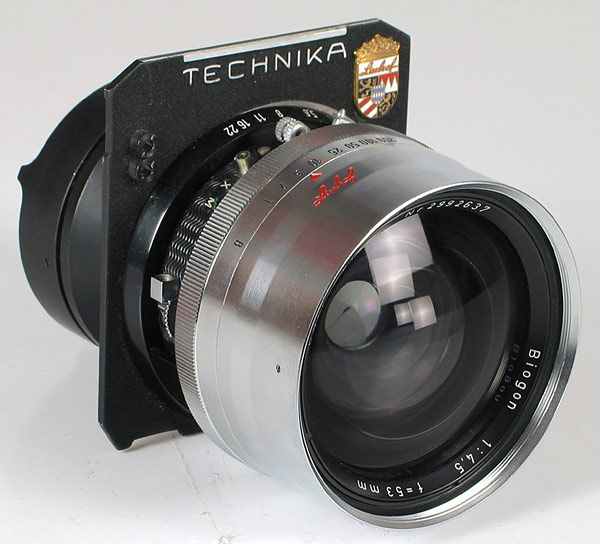
Biogon 53mm f4.5 — this one was made for Linhof 60x90, lens always (?) goes with built-in shutter like this:

32.jpg


Biogon 60mm f5.6:
HpW84y


Distagon 60mm f3.5:
tivvvC


Planar 80mm f2.8:
psQpuM


Planar 100mm f3.5:
4Cvugc


Sonnar 150mm f4:
JXhoyi


Sonnar 250mm f5.6:
nknFnB


Sonnar SuperAchromat 250mm f5.6:
rJCj4d


Tele-Tessar 350mm f5.6:
oZfrXx


Tele-Tessar 500mm f8:
Kx5bRV
 
Last edited:
LOMO 70mm (52.5x23mm)​

Did you have the feel that Zeiss Hassy line was massive? Well, lo an behold, I present now all Soviet 70mm lenses and you you'll be lost:-)

The excess set of USSR wide-format lenses include: 12.5, 15, 22, 22.5, 28, 40, 56, 75, 100, 125, 200, 300mm. Ultra-wides 12.5, 15, 22, 28 are all non-fisheye, this is simply crazy!
Though, huge 12.5, 15mm and 22.5mm barrel distortion of -10% to -12% at the edge limits the usage to some special shots of exaggerated strange space / psychological thriller :-( Though, for wide shots where the objects are far and there's no geometry, it is said that the Russar's look is OKAY and edge distortion is hardly noticeable by an average viewer.

Besides, these wides are extremely rare, were made only once in small prototype batch at CKBK and LITMO, so I doubt anyone would face these monster in the wilds...

So more common set includes 28 (non fish-eye!), 32, 40, 56, 75, 100, 125, 150mm + 200 and 300mm (these are regular 35mm lens units, but they easily cover 6x6 due to the design; one should possibly remove the back shade of the unit to better the coverage). F-stops are 2.8 to 3.5. It was massively produced at LOMO in the 1950s and 1960s. Here's the table of main optical numbers for the common set:
FDY7Lh


Wide format cinematography was of a special interest to the USSR authorities, so the lenses have extremely good IQ and they quite fast for the format.

Behind the wides, Kino-Russar family name, was Mikhail Rusinov, ingeniuos and original lens designer who was mainly prolific not in the he cine field, but for the military (wide angle Russar lenses for aero photography).

Pre-Rusinov large format orthoscopic wideangle lenses exhibited a huge drop in relative illuminance at the edges of the image field, namely it could reach a value of 10%, ten per cent brightness in the corner, can you imagine? Fighting with that, Rusinov discovered so called aberrational vignetting phenomena back in 1938. Using it, he was able to overcome uneven distribution of illumination. Aberrational vignetting uses aberrations, introduced by the front part of the lens system, to significantly increase the entrance pupil area of oblique rays compared to the axial ray. That's why in the front part of any Russar there are huge strong negative menisci (often aspherical) and a nearly spherical positive components in front of the iris.

Kino-Russar-6 12.5mm f3.5, diagonal image field 2ω=132°

Kino-Russar-8 15mm f3.5, 2ω=124°

Both have front aspherical menisci (inner radius is elliptical) and the optical diagram (+astigmatisim and distortion graphs) for both is:
adCHvs

(Astigmatism and Distortion charts)

Again, do not try find any of these, both were made only in several samples at LITMO and then used in a 70mm feature "The Court of the Madmen" ("Sud sumasshedshikh"), 1961, for deliberate optical distortion shots. I found a VHS rip only, some extraordinary footage by Russars is at 00:23:40 and at 01:08:07:


Back to the wides.

Please note for any charts below: if ЛИТМО (LITMO, Leningrad Institute of Fine Mechanics and Optics) is put under 'Produced by' in main lens data table that means that the lens was produced as a prototype only, maybe dozen of samples were made for actual testing in cine shoots, so no LOMO mass-production was undertaken and you'll hardly ever see or find one of this Kinorussars live or for sale.

Kino-Russar 22mm f3.5 T4.8, diagonal image field 2ω=115°47'. This one was calculated to cover Vario-70 USSR film format, 52.5x46.5mm frame size, NIKFI project of mid 1960-s. Negative is near square, when printing and projecting the image dimensions and the aspect ratio of the frame are changed accordingly to best composition. Aspect changing is achieved by masking and anamorphing. Immersive experience, a dream of DP.
Datasheet of Kinorussar 22mm:
7b7joe

(Resolution, Relative illuminance (Vignetting), Spherical and Chromatic aberrations, Astigmatism, Distortion graphs)

Here I found how this monster looks like, it is just of enormous size, petal shape UFO style aluminium hood:

FGKntu

[Kinorussar 22mm f3.5 outer look]

Kino-Russar-7 22.5mm (actually 22.7) f3.5 T4.5, diagonal image field 2ω=103°42' (USSR Pat. 141655, applied by M.M. Rusinov & M.I. Kuzmina on 14 Dec 1960). Here is NIKFI test charts / lens datasheet:
H6wFS3


Contrary to Kinorussars-6/8, Kino-Russar-7 is simplified: it uses 2 spherical negative menisci instead of one huge aspherical menisci as a front lens. That is cheaper, makes the lens smaller smaller and more technological and it occurs that these 2 front elements replace 1 aspherical lens more or less satisfactory if a system has ~100° image field.

Kino-Russar-7 has an original asymmetrical design and consists of the outer (to the left) and inner (small Gaussian 5-element lens to the right) group. The outer group is of 4 lenses: it is a telescopic system with an magnification ratio of 0.5X, consists of two negative menisci (gives high field of view and increase the back focal distance) and a positive achromatic lens (corrects the lateral chromatic aberration). The inner group is a 5-element Double Gauss type, similar to Russar-3 aerial lens (one difference is that the last positive component is of two cemented lenses to correct spherical and chromatic aberration).

Kino-Russar-43N 28mm f6.8 T8.2, diagonal image field 2ω=91°20'. Tiny quasi-symmetrical Russar lens of perfectly corrected distortion, astigmatism and CA, nice edge illumination for such an angle, with quite impressive resolution across most of the image filed, at a price of a speed — hence no mass-production, too slow for the cinema. Here is the datasheet:
BH6dTc


Kino-Russar-10 28mm f3.5 T3.8, diagonal image field 2ω=91°20'. Finally a mass-produced LOMO lens! The lens provides OK overall IQ with an impressive 50% image corner illumination. MTF performance is top even wide open, see MTF charts where it has ~50 contrast at 40lp/mm at both T3.8 and T5.6.
There's gradual resolution fall-off, down to 20lp/mm at 27mm from the center. Notice uneven distortion chart: it is within okay 3% at 30degrees image angle, and then - bum! - skyrockets to 4-5% at the image edge. That is called high order distortions, it is mainly noticeable more towards the image edge. Besides, such a wideangle lens introduce perspective distortion of its own character. The datasheet for Kinorussar-10:
tYnLmZ

(Resolution, Relative illuminance (Vignetting), MTF, Spherical and Chromatic aberrations, Astigmatism, Distortion graphs)

Here's how Kinorussar-10 looks like:

P2qzBx

[Image courtesy of Black Garry of http://lens-club.ru]

The lens is often prone to degradation of the inner cemented doublet lens surface, look thoroughly at the lens which sits just in front of the iris. You'll see lines, matte white or something in between. Though, some little to middle amount of this flaw does not have any major effect the footage.

OKS2-28-1 28mm f4.5 T5.2, diagonal image field 2ω=91°20'. It was produced at LOMO at some early 1960-s. OKS2-28-1 is a compact symmetrical lens, 61mm (2.4inch) lens unit length and only 49mm (1.93in) max barrel diameter. It has high and even resolution distribution across the frame, lack of distortion and astigmatism, high edge illuminance level.
This lens is a kind of USSR Biogon design version, look at the lens diagram below the pics (left click opens G-gallery):


[OKS2-28-1 28mm f4.5 T5.2 lens view, in the housing]

Here is the datasheet of OKS2-28-1:
Xep8bL


OKS3-28-1 28mm f3 — there seems to be a prototype of OKS3-28-1 (only one sample(?), but I have no datasheet or any info on it. Just a picture, it's in the middle, compared to the size of OKS2-28-1 (on the left):

oMAf2t


And this is not the end of 28mm lenses!
Here you are
OKS5-28-1 28mm f4.5 T5.3 lens, diagonal image field 2ω=102°47', made to cover square wide format frame of 46.5x52.5mm size, Vario-70 cinema. It's like enlarged Kino-Russar-7 22.5mm lens, compare the lens design diagrams. Only a small batch made by CKBK. Datasheet:
5qX4P2


OKS2-32-1 32mm f3 T3.6 lens, diagonal image field 2ω=83°40'. This one is a modified MIR-1 / Flektogon design: it has a huge front component made out of 2 cemented elements to correct for lateral color. Seems that only a small batch made by CKBK. Datasheet:
eN2oMx


OKS2-40-1 40mm f3.5 T4 lens, diagonal image field 2ω=71°14'. This 2-40-1 giant has front diameter of 132mm (5,19inch)! Luckily, it WAS produced at LOMO till 1968-1969 when it was replaced by regular OKS4-40-1 which is significantly smaller and a bit faster (f3, T3.6), take a look on OKS2-40-1 compared to OKS4-40-1:

rdkhA4


*[end of part I of USSR 70mm wide format lenses compendium]*​
 
Last edited:
Ilya, this is amazing ! How many info You have. I was serching internet, but didn't find so much... but maybe because i do not know Russian :/ About our 70mm Lomo format blocks - first we would like to collect them all (need 1-125-1 and 2-150-1 now) and than we can talk about proper collimation / callibration. Out Tech can fly to You to Moscow to talk to You doring thechecking / collimating progress if it is possible.
 
Hi, Timo.

Good you're here. Nice project, I've heard about it. It's not clear whether you use sales or rental only model?

Why did you choose Zeiss for Hassy C (T*) lenses? They are rather slow.

Did you manage to somehow incorporate Biogons 38, 53, 75 in your sets? Or it's impossible due to short clearance?
 
Hi, Timo.

Good you're here. Nice project, I've heard about it. It's not clear whether you use sales or rental only model?

Why did you choose Zeiss for Hassy C (T*) lenses? They are rather slow.

Did you manage to somehow incorporate Biogons 38, 53, 75 in your sets? Or it's impossible due to short clearance?

Hi Ilya. We have to think about 38mm to do (Hassy). Basically, Hassy's glasses are not slow, because they have a much larger angle of view than traditional 35mm glasses. The glasses make the peak of the fine Bokeh even though the T value is in the range of 3.5 to 4.0 In addition, the light collecting capability in the glasses is top of the range.

So and we sell lenses. So if you want, you can buy or rent lenses from us.
 
*[part II of USSR 70mm wide format lenses compendium]*​

OKS2-40-1 has high resolution even at the border, nice microcontrast, very good corner illuminance of 50%, absence of astigmatism, as for distortion, well, it's very reasonable 2% at edge. Datasheet for OKS2-40-1:
FszVjQ


By the way, OKS2-40-1 is an upscaled version of OKS1-18-1 18mm f2.8 T3.2 (35mm format) lens design, compare lens diagrams:
jSLc8w

[OKS1-18-1 Datasheet: Resolution, MTF, Vignetting, aberrations]

OKS4-40-1 40mm f3.5 T4 lens, diagonal image field 2ω=71°14'. This is a lens from the Soviet mainstream 70mm set. Relatively widespread because of production in line at LOMO. Meant to be a replacement for OKS2-40-1 — well, I agree it's more practical to use a smaller and faster OKS4-40-1 lens on set, but strictly speaking OKS2-40-1 is optically superior: just compare every plot of both lenses and you'll see the newer 4-40-1 is a bit worse, besides, the distortion rose to 3-4% at the edge...Do not get me wrong, it is a good lens (it's better than Cooke DuoPanchro 40mm f2.8 T3.2 for instance), it's just a step back optically. Though, lens design is always a compromise of size/price to performance and Prof. D. Volosov, a chief soviet lens designer, the author of both 40mm-s, writes that 4-40-1 is a huge leap forward.
OKS4-40-1 datasheet:
AbUuwm


Compare 2-40-1 and 4-40-1 lens designs: both use advanced MIR-1 lens design: basic 5-element Gauss lens as a core component and a negative 3-element attachment at front. Prof. D. Volosov writes that pretty high distortion of 3-4%, edge, was intentionally introduced to the OKS4-40-1 so that the awkward unusual border perspective of such a wide lens at such a wide format became less prominent. Well, I do not know, one need to test to understand what he means, but now that seems a very poor excuse making...Tell that to Bertele's Zeiss Biogon 38mm with ~0.3% distortion!

WOW just missed the last 40mm, the OKS5-40-1. It is one more (on par with OKS2-28-1) USSR Biogon! Though, Distortion is much worse than in Biogon 38mm, it is ~1.6% at image edge, — on the other hand it is considered OK number for cine lenses in USSR (below 2%):
OKS5-40-1 40mm f4.5 T5.3 lens, diagonal image field 2ω=82°29', made to cover square wide format frame of 46.5x52.5mm size, Vario-70 cinema. Again only a CKBK production, small quantities. Datasheet:
R9hURG


[update] It occurs OKS5-40-1 is not the last 40mm lens! Please welcome:
OKS8-40-1 f2.0 T2.3 (sic!) lens, 2ω=71°14'. It's late 1980-s design, quite complex computer involved design optimization, 11 lenses in 10 groups, multi-coated, was produced in very little quantities at CKBK NPO Ekran, St. Petersburg. So here the simplified datasheet with no charts on resolution, etc, sorry, the empire fall was at the gates:
DQQsqE


OKS1-56-1 56mm f3 T3.4 lens, 2ω=54°12'. This lens is widely spread, it's from mainstream set. Tiny lens with impressive overall IQ, mild contrast, very pleasant creamy bokeh and high center sharpness (fall-of is also minimal since the edge is 37 lp/mm). The lens has 7 elements in 4 components Double-Gauss formula, known as Aero-Ektar of George Aklin of Kodak (US Pat.2,343,627 military aerial lens). Prof. D. Volosov, a OKS1-56-1 designer, though, did not use radioactive Thorium and rare earth Lanthanum crown glass (as it was with Aero-Ektar), but employed regular optical glass with no IQ degradation.
Datasheet of OKS1-56-1:
kmJCng


OKS2-56-1 56mm f2.5 T~3 lens, 2ω=54°12'. This lens was calculated to improve OKS1-56-1 with the faster f-stop and a higher IQ — yet, it has worse egde resolution, namely 26 lp/mm vs 37 lp/mm of 1-56-1. OKS2-56-1 incorporates 5/7 lens design formula, if I'm not mistaken some Leica 50-75mm glass of the mid 1970-shas the same design. Seems it is not widely spread, being replaced by OKS3-56-1 and OKS5-56-1 lenses. Though, it was produced for some little time.
Datasheet of OKS2-56-1, taken from GOI Lens Catalogue of 1970, part I:
vr2Wmh


OKS3-56-1 56mm f3 T3.4 lens, 2ω=54°12'. This lens incorporated some new glass types so it was also meant to be an improvement over OKS1-56-1 with the higher overall IQ — well, in some aspects (egde illuminance is shocking 70% vs 45-47% of OKS1-56-1) it is, in others, it's not (edge resolution). Compare the charts. OKS3-56-1 has the same lens design formula of 5/7 as the OKS2-56-1 whilst the details like curvatures and glass are obviously different.
Seems 3-56-1 is more widespread than OKS2-56-1 since it was at run at LOMO factory, and I have one with the serial number 660474. Yet, the "Prototype" is engraved on mine and I do not know whether it went farther to the large scale prodcution.
Datasheet of OKS3-56-1 with all the nice nerdy charts:
H3M2yX


Prof. Volosov was not quite happy with both 2-56-1 and 3-56-1 as he was planning (at late 1970-s) to reach more at 56mm with the design which uses extra heavy crown thorium glasses (like in the Aero-Ektar of Kodak). I have no data if that happened or not.

OKS5-56-1 56mm f2.5 T2.8 lens, 2ω=54°12'. Early 1970-s calculation by CKBK (later known as EKRAN), this lens is a final OKS1-56-1 upgrade with the separated last component so the formula is 5/7, see the lens diagram. Beside the speed (I also see 84% transmission which means, for a 5/7 lens, a multicoating applied) they say that way OKS5-56-1 received higher egde resolution, but actually I do not see that at the resolution chart...
Was in production at LOMO.
Datasheet of OKS5-56-1:
6Ft2nz


And finally the top point of Soviet 56mm:
OKS7-56-1 56mm f2.0 T2.3 lens, 2ω=54°12'. Early 1980-s calculation by CKBK, USSR Patent 1027665, applied 17.02.1982. This lens boasts impressive speed of f2.0, the T-stop is 2.3 due to MC. Advanced and original 6/8 lens design, the patent said the goal was to make a better lens than oks5-56-1, namely to get 1.5x more speed and far better field performance while retaining compactness. The lens is supposed to have high resolution and contrast with almost zero diffusion. On the other hand, edge illuminance is as low as 30%, — there's always a price for speed in Opic / Planar deriviatives. Was in production at CKBK / EKRAN since maybe 1982 (the pic on the Datasheet shows the lens and the number on the barrel is 820001, together with "Prototype" designation). I myslef have one OKS7-56-1, serial is 870003. I found an image of one more 7-56-1 here, it is #870001. That means CKBK had been making maybe a dozen of lenses per year in the 80-s. How many of them survived? Ultra rare no bullshit.
Datasheet of the speedy OKS7-56-1:
PBNkQh

There's Flickr album of funglaukim full of OKS7-56-1 shots mounted on Sony A7RII (photo full-frame sensor 35,9x24mm):


***

OKS4-75-1 56mm f2.8 T3.2 lens, 2ω=41°50'. This lens is widely spread, plenty of them pop up on Ebay. Lomo production. OKS4-75-1 has the same as OKS1-56-1 lens formula of 7 elements in 4 components (Kodak Aero-Ektar). At 75mm this design shows its peak and the lens is very solid performer. See the resolution graph: 4-75-1 has very flat field with almost no fall-off. This lens rocks on portraits having comfortable shooting distance, the smoothest bokeh ever, a bit of spherical aberration, absolute lack of distortion, and a touch of 50% vignette at the edge.
Datasheet of the OKS4-75-1:
C66Cq6

[OKS4-75-1 charts: Resolution, Vignetting, aberrations]

Welcome wide format SUPERspeed!
OKS16-75-1 75mm f1.4 T1.6 lens, 2ω=41°49'. It's CKBK made and as rare as OKS7-56-1 56mm f2.0. 7/6 Double-Gauss formula.
Datasheet of the OKS16-75-1:
ZmnBEZ

Funglaukim luckily has another 70mm album shot with OKS16-75-1 on Leica S2-P body (30×45mm sensor):

And one more with a girl wide open ehhe e heh h
 
Last edited:
***

OKS2-100-1 100mm f2.8 T3.4 lens, 2ω=31°58'. This lens is (relatively) widespread, it's from the mainstream set. Produced at Lenkinap / LOOMP / LOMO in late 50-s and 60-s. Even CKBK produced it in 70-s cause I have one by CKBK #720003). OKS2-100-1 is the max you can get from symmetrical OPIC / Planar 6/4 design — its IQ is superb, take a look at the charts: pretty even field, achromatically corrected, top micro-contrast at center and edge, zero astigmatism and distortion.
Datasheet of OKS2-100-1 100mm:
8FN9nc


There was one more 100mil, it's superspeed, can you believe?!
OKS10-100-1 100mm f1.4 T1.6 lens, diagonal image field 2ω=31°58'. Hell rare as other late 80-s - early 90-s CKBK EKRAN lenses. I've seen a couple of photos in the net, the serials are always 1 digit like 900009 meaning not more than ten per year were produced;-( Original unusual mod of the OPIC / Planar design — it has 2 elements in front of the first positive doublet (which is huge and thick). High center and edge resolution from the papers.
Datasheet of OKS10-100-1 100mm:
WDeVB5

Outer look of this giant:
Dg9VJN


OKS1-125-1 125mm f2.8 T3.2 lens, 2ω=25°48'. This lens occurs here and there, it's from the regular set. Again symmetrical 6/4 design.
Datasheet of OKS1-125-1 125mm:
Tsv1Vf


OKS2-150-1 150mm f2.8 T3.2 lens, 2ω=21°40'. The last lens in the set, one more bullet-proof Planar. OKS2-150-1 is a king of a hill of distortion control, any Zeiss lens included.
Datasheet of OKS2-150-1 150mm:
zVGL9n


For longer focal lengths, one can use regular OKS1-200-1 f2.8 and OKS1-300-1 f3.5, they cover 65/70mm just nice.

Friends, see my previous posts, I've updated the thread with plenty of USSR 70mm glass. Browse up, guys, save fast. Never published before info.

PLZ join and put any other 6x6 / 65mm / 70mm glass you know here!!!
 
Last edited:
It's not widely known, but Cooke (Taylor, Taylor & Hobson or just TTH as it's written on the nice lens caps) was also participating in the wide format race back then at 1950 to 1960-s. Yet, as far as I know (and probably I'm mistaken), there were only 5 lenses purposely built for 65/70mm format: 30mm, 40mm, 50mm, 55mm, 75mm — those made in 1950-s were f/2.0, others, like 30mm, 40mm and 55mm from the 1960-s were f/2.8. They are named Double Speed Panchros or, after getting the trademark in the 1962, DuoPanchro lenses. Though, some lens samples taken by NIKFI, Russia, for the testing, are not labeled as DuoPanchros, but have 'Dev.Model' engraved on the front ring, I do not not what that means).

UPDATE: Here's what Barbara Lowry, the archivist for Cooke Optics Limited, kindly shared about 70mm format Cookes:

"I have limited information on the Duo Panchro / Double Speed Panchro and am happy to share it with you. Here is the extent of what we know:

There were a limited number of them made in the 1950s. They are 70mm format. Focal lengths: 40, 50, 75mm, f/2.0, T2.3.

1.698 back focus.
All were supplied with bayonet mount.

Fifteen 55mm f/2.8, T3 were made in 1971.

The Duo Panchro trademark was issued in 1962.

There is at least one 30mm f/2.8, T3.

That's the extent of what any of us know."


According to Barbara's info, I conclude that any Cooke DuoPancro is hell rare lens, much rarer then any Zeiss or Lomo / CKBK 70mm ones.

Please guys share any info on Duopanchros! There's lack of it in the net including Cooke's website.

DuoPanchro 30mm f/2.8 T3.2 lens, 2ω=87°22'. This extremely rare and wide Cook lens has one aspherical surface (!), yet I do not know the complete lens diagram. As for aberrations, Cooke made a top lens: no CA, complete lack of astigmatism and shockingly low distortion (below 2%) — this is quite an achievement in optics! Though, that is not the whole story: this lens has insufficient overall IQ. Take a look at the resolution and vignetting graphs: whilst the center resolution is cool is 60 lp/mm, as soon as you move little outwards it drops dramatically and you have poor 10 lp/mm at the edge. Second, relative illumination is also poor: the edge is as dark as 20 and less per cent.
Datasheet of the DuoPanchro 30mm, taken from NIKFI lens review of 1969:
edfRQ5

[DuoPanchro 30mm charts: Resolution, Vignetting, MTF, aberrations]

Double Speed Panchro 40mm f/2.0 T2.3 lens. Made in 1950-s. NO info, plz share what you find.

DuoPanchro 40mm f/2.8 T3.4 lens, 2ω=71°14'. As for IQ, the lens was quite ok with good distortion, astigmatism and vignetting control. Though, overall impression is spoiled — as with 30mm — by the drastic resolution fall-off, the lens has mediocre 20lp/mm already at 15mm distance from the center...Besides, CA are not so well controlled, you'll see orange-red outlines. Maybe DuoPanchros were designed for smaller VistaVision frame size, and were not intended to properly perform within the whole 52.5x23mm 65/70mm gate?
Datasheet of the DuoPanchro 40mm, taken from NIKFI lens review of 1969:
SzUDpD

[DuoPanchro 40mm charts: Resolution, Vignetting, MTF, aberrations]

Double Speed Panchro 50mm f/2.0 T2.3 lens. Made in 1950-s. NO info, plz share what you find.

DuoPanchro 55mm f/2.8 T3.1 lens, 2ω=55°02'. Finally, a superb wide format Cooke! Pristine and sharp definition from black to white both center and edge, high center resolution and relatively low fall-off with impressive 40lp/mm at the edge. Top astigmatism and distortion control. Though, vignetting could be less (it has ~35% brightness at the edge) and purple-blue fringing around high contrast objects is the price for high sharpness.
Datasheet of the DuoPanchro 55mm, taken from NIKFI lens review of 1969:
BGc9XJ

[DuoPanchro 55mm charts: Resolution, Vignetting, aberrations]

There's an album of DuoPancro 55mm on Flick, though, it's shot on Sony aps-c sensor:


Double Speed Panchro 75mm f/2.0 T2.3 lens. Made in 1950-s. NO info, plz share what you find.
 
Last edited:
What about USSR 70mm wide format zooms? There were!

Back then at early 1970-s CKBK started with the 70OPF1-1 60-240mm f/3.5. Shifra Shakhnovich was the lens designer (with David Volosov as a chief optical consultant). The design itself was good (for a first bird) yet not optimal due to very short terms given for lens design and manufacturing the first sample.

70OPF1-1 60-240mm f/3.5 T4.6, 2ω=54°-13°30'. This 'bird' is actually a huge turkey with impressive 12.1kg (26.68 lbs) weight. Or you can call it an old canon on a carriage:-) Other than that, the resolution is ok for a zoom (at 60mm it has 45 lp/mm center and ~22-25 lp/mm edge). Vignetting and most aberrations are also pretty well under control. What is bad is barrel distortion of ~7% at 60mm, and a pillow one of ~4% at 240mm. Besides, huge and thick glass pieces with only the basic coating lets only 64% of light to pass by, that's why T4.6 at f/3.5.
Extremely rare, CKBK made. I doubt if there's any survived.
Datasheet of the 70OPF1-1, taken from NIKFI Lens Review of 1973:
KcMuXX

[70OPF1-1 charts: Resolution, Vignetting, aberrations]

— I do not have any info on 70OPF2-1 which was probably done since the next zoom is the third model:

70OPF3-1 40-160mm f/3.5 T4.3, 2ω=71°14'-20°18'. Year ~1969 CKBK calculation, early samples could be with 72-73 as a first digits of the serial number. Despite the huge front being square (and measuring 265mm / 10.43'') it's not an anamorphic zoom lens. The lens cut was done to decrease the weight (10.3kg or 22.71 lbs). After 1973 this zoom went further from CKBK (which usually do the design and first prototype batch) to LOMO for production, so was the producing factory so expect some rare samples to appear. The resolution curve is quite similar for the wide and tele ends, which is quite a rare in optics if we take zooms. Center resolution is nice (45-50 lp/mm), while the edge is much worse with only 15 lp/mm. Astigmatism is pretty remarkably controlled what we see rare even with modern zooms. As for relative illuminance, it's as high as 60% at edge at 40mm — 40mm LOMO / Zeiss / Cooke primes are ~10-20% worse! Again, huge glass pieces eat 33% of light so T4.3 at f/3.5.
Datasheet of the 70OPF3-1, taken from NIKFI Lens Review of 1973:
7S9dTg

[70OPF3-1 charts: Resolution, Vignetting, aberrations]

70OPF4-1 50-106mm f/3.5 T5.2, 2ω=59°38'-30°15'. Year ~1970 CKBK calculation and prototyping, after 1973 was made by LOMO in some little quantities. This 2x zoom was designed for hand-held work, it weighs only 1.67kg or 3.68 lbs. As for 50mm, the IQ is more or less acceptable (yet the barrel distortion is way too high ~6% at edge), while at 'tele' end of 106mm this zoom is, well, pretty poor performer since the quality drops down quick and at the edge you have: resolution is 10 lp/mm, 30% brightness, ~7% pillow distortion.
Datasheet of the 70OPF4-1, taken from NIKFI Lens Review of 1973:
TXeahr

[70OPF4-1 charts: Resolution, Vignetting, aberrations]

70OPF5-1 40-240mm f/4.5-5.6 T4.4, 2ω=71°14'-13°30'. USSR Pat. 455309, applied 10th of Apr. 1973 by I. Neginskaya, E. Teryaeva, S. Shakhnovich of CKBK:
kKnKKe


At wide end, 40mm, this 6x zoom has pretty good IQ: 55 lp/mm center and 25 lp/mm edge resolution, impressive 70% edge illuminance, all main aberrations are well controlled, including CA control which is quite close to APO level (three basic colors focus at the same plane). Though, there's no elements for lateral color correction, notice orange-blue vertical outlines on the contrast objects which rise the more you go towards the edge (left click - new tab for 6.5k):

UBEqqp

[70OPF5-1 test shot at 40mm f/4.5 6.5K, image size ~55x15.6mm]

The NIKFI plot says there's 6-7% of barrel Distortion at the edge, and that level I considered severe before, but now I see it's not so (yet, the test shot is not 23mm tall but only 15.6mm). Subjectively, it's okay number, just see the upper shot.

An extreme tele end of 240mm is not the best spot of 70OPF5-1 since I think the basic calculation was optimized for the wide and normal angles. The zoom shows mediocre resolution, vignetting, CA, and a pillow distortion. See the test shot:

vdhHi2

[70OPF5-1 test shot at 240mm f/5.6, 6.5K, image size ~55x15.6mm]

Still, the upper shot seems not as bad actually as it goes from the aberrations description.

This 6x zoom closes the aperture when zooming (so it reaches f/5.6 at 240mm) to rise IQ, see the 3rd component, it is hard connected to the iris gearing. I think the first prototype was done as early as at 1974 by CKBK, #740001:
em9O8Z


— and it is for sale here on RedUser. More images here (optical bench tests, chart 14K tests): http://goo.gl/CGM4pc

Finally, the Datasheet of the 70OPF5-1, taken from NIKFI Lens Review of 1978:
11JBc8

[70OPF5-1 charts: Resolution, Vignetting, Image Shift, Spectral transmission, aberrations]

70OPF7-1 50-100mm f/3.5 T4, 2ω=47°47'-30°19'. Late 70s - early 1980s CKBK calculation, was in production at CKBK / EKRAN in the 1980-s with the serial numbers like 810001 or 840001 (real ones) — that means no more than dozen or less per year were made. RARE. The zoom is 2x and weighs only 1.2kg (2.65lbs) so it was made for handheld work as a replacement for 70OPF4-1. Multi-coating applied, so high light transmission and impressive (for a 15-element zoom lens) T4 at f/3.5. Yet, gives warm picture due to poor indigo/blue transmission. Center resolution is as high as 60 lp/mm, while the edge is not so with 20-15 lp/mm. Relative illuminance at the edge is also not top, only 30-25% so consider that as an effect giving more dimension:-).
Reduced Datasheet of the 70OPF7-1, taken from NIKFI Lens Review of 1989:
ZdFoCd


The last and latest USSR zoom for 70mm was big and complex 20-element lens
70OPF9-1 45-200mm f/3.5 T4, 2ω=51°22'-15°43'. Mid 1980-s (?) calculation and production of CKBK / EKRAN. Later, at 1990-s, known as Vario-Optar 3.5/45-200mm zoom lens made by JSC Optika (it became JSC Optica Elite a bit later) — the successor of CKBK.
Reduced Datasheet of the 70OPF9-1 | Vario-Optar 3.5/45-200, taken from NIKFI Lens Review of 1989, notice the 2-iris design and very complex front groups:
aXNv3H
 
Last edited:
Here's what Barbara Lowry, the archivist for Cooke Optics Limited, kindly wrote me about 70mm format Cookes:

"I have limited information on the Duo Panchro / Double Speed Panchro and am happy to share it with you. Here is the extent of what we know:

There were a limited number of them made in the 1950s.

They are 70mm format. Focal lengths: 40, 50, 75mm, f/2.0, T2.3.
1.698 back focus.
All were supplied with bayonet mount.

Fifteen 55mm f/2.8, T3 were made in 1971.

The Duo Panchro trademark was issued in 1962.

There is at least one 30mm f/2.8, T3.

That's the extent of what any of us know."
 
Back
Top