Welcome to our community

Be a part of something great, join today!

  • Hey all, just changed over the backend after 15 years I figured time to give it a bit of an update, its probably gonna be a bit weird for most of you and i am sure there is a few bugs to work out but it should kinda work the same as before... hopefully :)

Litepanels Sola LED lights

I got to play with the small fresnels, the 30w version, at Infocomm. Wonderful light. Roughly equal to a 250w tungsten for output but daylight balanced. Very smooth even beam spread and good throw for its output. Built in dimming with no color shift. Cheaper than the tungsten versions if one factors in a dimmer and lamp costs over the expected 20,000 hour life. They had a prototype of the 6" 650w equivalent version for display, but it wasn't operational.
 
I think the 6" and 12" are just coming out this week or so. My biggest concern is that the larger models have a fan in the back. I will be very interested to "hear" these fresnels as well as see the beam quality. I noticed that litepanels has yet to release any photometrics or discuss the CRI. LEDs have low CRIs. If they have solved all the hurdles, this will be a truly revolutionary product. The price is high. Rental houses would be an ideal market. Perhaps in a year, Cool Lights and others will have emulated the design and bring the prices down. Anybody try these yet?
 
According to the factory rep I talked with CRI is in the mid 80% range.
Initial purchase price may be expensive, but if you factor in power consumption and lamp costs for the alternatives for the more than 20,000 hour lamp life they come out much cheaper for total cost over time. Initial cost seems pretty comparable to similar HMI's.
 
I emailed Litepanels about their CRI and photometrics. They replied that nothing is available as the product is still in development.
 
Anyone using the Litepanels Sola 12" or 6" LED Fresnel Lights? Any thoughts?
I have been following the development of the Sola Fresnels with interest. While they are definitely a step in the right direction in developing a production LED light, they still don’t quite combine the advantages of LED illumination (cool-burning, energy-efficient) with the versatility and control of traditional Fresnel fixtures. If the history of film style Fluorescent lighting offers any lessons, the manufacturers of High Power LEDs will have to address several key issues before LED lighting can replace incandescent and HMI lamps in studios and on location sets powered by generators (particularly small portable generators.) For LEDs to be widely used, manufacturers must overcome their poor color rendering, poor power quality, and lack of versatility. Progress is being made, however, on many of these fronts.

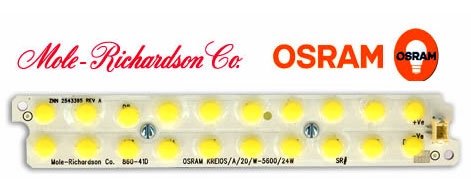
LED_Mole_board_main.jpg

The OSRAM Kreios stage light LED module ​

Until the recent development by OSRAM of their KREIOS® LED technology, the color rendering of LED fixtures was generally pretty poor (they exhibit significant green output.) The new OSRAM KREIOS® stage light module (pictured above) uses remote phosphor technology to produce light in two exact color temperatures, Tungsten and Daylight. While, remote phosphor technology has been used for years to extend the short wavelength of Blue LEDS to create a fuller color spectrum, OSRAM was the first LED manufacturer to use remote phosphor technology to exactly match the spectral sensitivity of Tungsten and Daylight balanced film stocks. Unfortunately, the new OSRAM KREIOS® stage light module is only available in the Mole LED 12 Pack light panel (use this link for more details.)

A second problem inherent in LEDs that manufacturers will have to address is the relatively poor power quality generated by the Switch Mode Power Supplies (SMPSs) they use to power their lights on AC power. The SMPSs used in LED AC power supplies can draw a very distorted current, and result in current that is significantly phase-shifted with respect to the sinusoidal voltage waveform. Although values vary widely, the SMPS used in the AC power supplies of LEDs generally have a Leading Power Factor around 0.54 (Litepanel 1x1s) and high harmonic distortion (THD upwards of 68.1%). As such, the AC power supplies of LEDs can have an adverse effect on power quality similar to that of CFLs (use this link for more details.)

Finally, before LEDs will be widely accepted in motion picture production, manufacturers will have to engineer a fixture that has the versatility and control of traditional Fresnel fixtures. The drawback to existing LED light panels is that their light falls off very rapidly and is hard to control. These characteristics make LED light panels only suitable as Key sources in documentary interview set-ups where the Keys are typically positioned close to the interview subject. In that capacity LED light panels (with heavy diffusion) can generate a wonderful soft light that wraps around the interview subject without wilting them. However, in dramatic set lighting, where Key sources must be capable of throwing a distance, LED light panels have only limited applications as fill sources. The broad soft light they put out drops off too rapidly, and is too difficult to control, for them to be effective as a Key or Backlight source in dramatic set lighting.

As far as I am concerned, Litepanels has not overcome these problems with the Sola fixtures. Litepanels doesn’t give CRI ratings for the Sola Fresnels on their website, but when asked they say the CRI is in the 80s – which is still rather anemic compared to other light sources. The Power Factor of the Sola has been improved. But, at .85 it could stand further improvement (a Power Factor Corrected HMI has a Power Factor of .98 or near unity power.) They claim the 75W Sola 6 has the output equivalent to a 650W Tungsten, but comparing the photometrics published on their website to those of an Arri 650 Fresnel, the Arri has nearly three times the output of the Sola. And, while the Sola 6 has an impressive spot to flood range (10 to 70 degrees), spot/flood capability is not the only characteristic that makes a Fresnel light versatile. Of equal importance is the ability to render clearly defined shadows and cuts. The ability of Fresnels to render crisp shadows make them ideal for creating gobo effects like window or branch-a-loris patterns. The ability of Fresnels to render clearly defined cuts enables their light to be precisely cut to set pieces and talent. And, simply by adding one of a variety of diffusion material you can vary the softness of a Fresnel’s output. These are the characteristics of traditional Fresnels that make them extremely versatile, that the Sola “Fresnels” have not been able to emulate.

ArriLED_PS.jpg

However, progress is being made in the development of a true LED Fresnel. In September 2010, Arri introduced a prototype for their L-Series LED Fresnel at the European trade show, IBC 2010. As is evident in a demo video that was recorded at the show (available at www.screenlightandgrip.com/html/emailnewsletter_generators.html#anchorLED%20Fresnel ), Arri may have finally engineered a fixture that combines the cool-burning, energy-efficient advantages of LED illumination with the controllable versatility of traditional Fresnel fixtures. Not only is the beam of the Arri L-series Fresnel continuously focusable from spot to flood; but it is also easily controlled with barndoors and flags. Just like conventional Fresnels, the light of the L-Series Fresnels can be precisely cut to set pieces and talent. And, while CRI ratings are not available (the L-Series Fresnels are still in the prototype stage), Arri promises on their website “broad spectral output (such that), skin tones, costumes and scenery will appear vivid and lifelike.” With the clear and defined shadow rendering, excellent field homogeneity, and smooth continuous flood to spot focus demonstrated in the IBC 2010 show video, Arri has clearly engineered the first true LED Fresnel. And, if they can deliver on their promise of “broad spectral output”, Arri may well have the first true production LED light (use this link for more details.)

For more detailed information on the Power Quality generated by LED power supplies and to see the demonstration video of the new Arri L-Series LED Fresnels, use this link to an article I wrote for our company newsletter on the use of portable generators in motion picture lighting. In it I cover some of the basic electrical engineering principles behind LED drivers, the harmonic distortion they can generate, and how it can adversely affect generators. This article is cited in the just released 4th Edition of Harry Box's "Set Lighting Technician's Handbook" and featured on the companion website "Box Book Extras." The article and video are available online at http://www.screenlightandgrip.com/html/emailnewsletter_generators.html.

Guy Holt, Gaffer, ScreenLight & Grip, Lightng & Grip Rental in Boston
 
Guy, as always thank you for your knowledgable posts. You talked a lot about LitePanels use of power in the form of SMPS in their upcoming Sola Fresnel line, but you didn't mention anything about how Arri is using power in their L-Series LED Fresnel. Do you know if they have also made strides towards PFC power in their line of LED fresnels?
Cheers!
 
Thanks Guy Bryan for your great post.

I'm also looking close to LED technology for studio and puppet animation shooting, where low consumption, small factor and low heat is key. Great to see the Arri developments.

Patrick
 
Mid-80s CRI? That's equivalent to a fluorescent fixture about 1990.

I suspect that, in the end, LEDs will be the light of choice, but not until they get the CRIs up into the mid 90s. There's a reason we love HMIs and halogen globes: They just plain look gorgeous!

Stephen
 
...you didn't mention anything about how Arri is using power in their L-Series LED Fresnel. Do you know if they have also made strides towards PFC power in their line of LED fresnels?

I haven’t seen the actual fixture yet (all the prototypes are in Europe and we won’t see them till NAB), but I had the opportunity to speak to Ryan Fletcher, the LED Project Manager for Arri, this last Friday and was able to glean new information from him since my last posts.

Since L-Series Fresnels are still in the prototype stage, they have not yet settled on a power supply. But, Ryan says they are acutely aware of the benefits to be derived from Power Factor Correction when it comes to operating LEDs on portable power generators (use this link for more details.) Since the first LED Fresnel they will release will be a 200W lamphead (with the output of a 1000W Fresnel) it will most likely have to incorporate Power Factor Correction to meet EU guidelines. Litepanels has been able to use less expensive power supplies because their lampheads (including the Sola 6 “Fresnel”) are 75W or less and so are exempted from this requirement under EU guidelines.

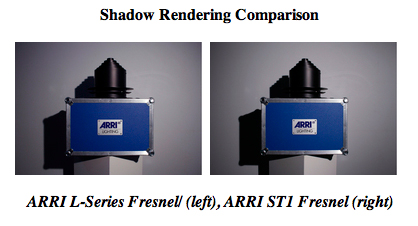
When I asked Ryan Fletcer how they achieved the excellent field homogeneity and Fresnel quality light demonstrated in the IBC 2010 show video and evident in the pictures below, he demurred that, for obvious reasons, he could not divulge that information until the official product release at NAB 2011.


Arri_LED_Shadow_Comp.jpg

​

As you can see in the pictures above, that compare the output of the L-Series Fresnels to the Arri ST-1 Quartz Fresnels, the L-Series Fresnels have clear and defined shadow rendering capability like that of the ST-1 Quartz Fresnels. And, the pictures below show that the L-Series Fresnel have a spot to flood range similar to that of the ST-1 Quartz Fresnels and excellent field homogeneity in both flood to spot.


Arri_LED_L-Series.jpg

​

And, just like the ST-1 Quartz Fresnels (pictured below), the beam of the L-Series Fresnel (pictured above) is easily controlled with barndoors - enabling the light to be precisely cut to set pieces and talent (see far right photos above & below.)


Arri_LED_ST-1.jpg

​

And, given the discernable amount of light the L-Series Fresnel prototypes throw in the show demonstration video, on what appears to be a 6x6 Ultrabounce rigged 20’ overhead, and under the high ambient light levels of the show hall, seems to suggest that L-Series Fresnels have more than enough output to waste some to diffusion and color gel if one so desires (use this link to see the IBC 2010 demonstration video of the new Arri L-Series LED Fresnels.)

I also learned that Arri is using color blending with a multi-emitter LED engine to overcome the generally poor color rendering capabilities of LED fixtures (use this link to see how poor the color rendering capacity of LED fixtures has been.) In our conversation Ryan Fletcher confirmed that they will achieve full spectrum 3200 and 5500 Kelvin color output with CRIs in the 90s. There is no reason to doubt that they won’t be able to deliver the goods on color; after all Gekko has made great strides in that direction with their color tuneable ”Kleer Colour” multi-emitter LED light engine. The technology is out there, it's just a matter of finally bringing it all together in one fixture. To my mind, the Arri L-Series Fresnel may be that fixture.

Given the output demonstrated in the video, the clear and defined shadow rendering and excellent field homogeneity in both spot and flood evident in the pictures above, if Arri does in fact deliver on their promise of broad spectral output, so that skin tones, costumes and scenery will appear vivid and lifelike, they will have engineered the first true production LED Fresnel light. And, since their 200W LED Fresnel will use 80% less power than their comparable ST-1 Quartz Fresnel fixture, the 200W L-Series Fresnel will be a real game changer when it is released this summer. For one thing, they will take what can be done with a portable generator to a new level. Imagine what you will be able to accomplish with a 200W LED Fresnel, that has the output of a 1000W Quartz Fresnel. With digital SLR camera systems that have a sensitivity of ASA 1000, you won’t need any more lights than can be operated on the enhanced 7500W output of a modified Honda EU6500is Gen-set, or on wall outlets, in many situations (use this link for more details.)

Guy Holt, Gaffer, ScreenLight & Grip, Lightng & Grip Rental in Boston

In the interest of full disclosure I should mention that we sell and rent Arri products along with the products of most major manufacturers of lighting and grip, and Honda portable power generation equipment.
 
Back
Top