Welcome to our community

Be a part of something great, join today!

  • Hey all, just changed over the backend after 15 years I figured time to give it a bit of an update, its probably gonna be a bit weird for most of you and i am sure there is a few bugs to work out but it should kinda work the same as before... hopefully :)

Life-like colours?

Henri H

Active member
Joined
Dec 10, 2009
Messages
43
Reaction score
0
Points
0
How to get life-like colours? Should there be four or more color channels in the camera? Now there are only red, green, and blue.

How can I shoot my film with the best available colours?

What colour spaces are used in film industry?
What differences are there between XvYCC and ProPhoto RGB? Which one is "better"?
 
Please Please!!!! don't make movies, just buy tickets and go watch them at the theater. Filmmaking is not for everyone there are enough morons out there who have know clue. Please don't join them.
 
Now there are only red, green, and blue.

How can I shoot my film with the best available colours?

What do you define as "the best available colours"? Are they those that your eyes can or cannot see?

Why would you record "other" colours considering that humans normally have three kinds of cones? The three types have peak wavelengths near 564–580 nm, 534–545 nm, and 420–440 nm. The difference in the signals received from the three cone types allows the brain to perceive all possible colors (that a human can see).
 
It is not that simple.. Here is my view as stills photographer.
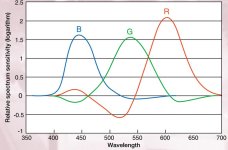
The cones have a "negative" effective sensitivity at some wavelengths, so the actual gammut is like this:
http://upload.wikimedia.org/wikipedia/commons/8/82/CIE1931xy_sRGB.svg (top view, triangle = sRGB space)

Camera colors are not that bad though (in raw). Some are of course better than others.
They often exeed prophotoRGB in some colors, witch itself is a huge space.
Generally, the problem is rather that it's not easy to view them properly.
Aside: New cameras often have slightly different "green" colors in the Bayer Array to extend the color gamut.

Regards, Matt
 
Please Please!!!! don't make movies, just buy tickets and go watch them at the theater. Filmmaking is not for everyone there are enough morons out there who have know clue. Please don't join them.

I don't like unrealistic films with lots of CGI.

Please, name at least one hard science fiction film that is realistic.

Yup, that's what I thought. No one has done any.

The biggest mistake in film making is trying to pleasure the masses. Films today: lots of explosions, lots of bare skin, lots of CGI, no plot, lack of innovativeness.

No one has to watch my films. I'm going to make them only for myself.
 
Last edited:
What do you define as "the best available colours"? Are they those that your eyes can or cannot see?

Why would you record "other" colours considering that humans normally have three kinds of cones? The three types have peak wavelengths near 564–580 nm, 534–545 nm, and 420–440 nm. The difference in the signals received from the three cone types allows the brain to perceive all possible colors (that a human can see).

http://www.fujifilm.cz/cs/download/kinematografie/Reala_500D.pdf
http://www.fujifilmholdings.com/en/pdf/investors/annual_report/ff_ar_2000_001.pdf
http://www.fujifilm.com/products/consumer_film/color_negativefilms_35mm/superia_xtra400/
http://www.fujifilm.com/products/consumer_film/pdf/superia_xtra400_datasheet.pdf
 
Please Please!!!! don't make movies, just buy tickets and go watch them at the theater. Filmmaking is not for everyone there are enough morons out there who have know clue. Please don't join them.

Oh, so you were born with all the knowledge you ever needed to make films?

This guy doesn't know that much about colour theory yet, but none of us did at some point. Everyone has to start somewhere.
 
Please, name at least one hard science fiction film that is realistic.

I'm not sure I entirely understand this question, but in my mind, District 9 is a good example. It does have CG, a lot of it, but it's shot in a documentary style with very natural looking lighting and run'n'gun camera movement.

Shoot RAW and then experiment, is the best advise I can give you for achieving life-like colors.

I hope you don't take this the wrong way, but why would you just make films for just yourself? Do you mean that you want to do practice pieces, or that you only ever want to be your own audience for the duration of your filmmaking career?
 
I just want the film to support Deep Color (http://en.wikipedia.org/wiki/Deep_Color) right from the beginning.

Well, the RED ONE and the new DSMC cameras can all shoot in 12 bits per channel if I remember correctly, which qualifies as deep colour (at least according to the Wikipedia article. I had not heard of the term before).

Remember though that your final product (if you're going to DVD, Blu-Ray or a web video format) will be converted down to 8 bits per channel, given the limitations in those formats. I'd say that those look close enough to being life-like, apart from some banding occasionally (but this can usually be minimised or even eliminated by good dithering).
 
I'm not sure I entirely understand this question, but in my mind, District 9 is a good example. It does have CG, a lot of it, but it's shot in a documentary style with very natural looking lighting and run'n'gun camera movement.

Shoot RAW and then experiment, is the best advise I can give you for achieving life-like colors.

Thanks for the tips.

I hope you don't take this the wrong way, but why would you just make films for just yourself? Do you mean that you want to do practice pieces, or that you only ever want to be your own audience for the duration of your filmmaking career?

I think that trying to appeal everybody makes films bad. At least, I know what I want to see myself...
 
Henri,

RED in it's raw state allows for the capture of about 68 Billion colour combinations per pixel (2 ^ 12) X (2 ^ 12) X (2 ^ 12)... Much of this is oversample, in that you will never see that many colours in your final product, which will vary in the number of colours displayed based on the final format, as Stephen points out.

The actual look of your final film will be determined by various factors, original exposure levels and the grading or "look" that you apply to the final master. You have many options available to you, e.g. desaturating the colour or greatly enhancing the saturation. Enhanced saturation would make your film look more "colourful", if this is what you are looking for.

Most film negatives in their freshly developed state do not in any way resemble what the final print looks like. This is because all sorts of factors (contrast, gamma, saturation, colour balance etc. etc.) are adjused to produce the final "look". In fact, a film exposure tends to be quite "flat" and disappointing in appearance when it is first developed.

RED, being a form of digital negative, (and depending on the exposure), can also be fairly flat straight off the camera. However, there is enough depth of information in the 12 bits per channel to be able to adjust the image to what you want it to resemble. A skilled colourist/grader will be able achieve the look you want from a well exposed frame. A competent DP will get you a well exposed image.

These issues are more or less relevant depending on what point of view you are approaching this from. If you are more interested in the story telling (directing) side, then having a good DP on your team will allow you to realise your vision to the full and then you need not be too concerned about the technical side.

A RED One in the hands of a good DP should be all the camera you ever need.
 
It's one thing to have deep color to start. but most if not all of the distribution mechanisms that exist today work in a color space that is a subset -

Michael
 
I don't like unrealistic films with lots of CGI.

Please, name at least one hard science fiction film that is realistic.

Yup, that's what I thought. No one has done any.

The biggest mistake in film making is trying to pleasure the masses. Films today: lots of explosions, lots of bare skin, lots of CGI, no plot, lack of innovativeness.

No one has to watch my films. I'm going to make them only for myself.

2001: A Space Odyssey.
 
@Martin
A fourth color does indeed help, e.g. because our cones can have a negative sensitivity at some wavelengths.
This is often mitigated by using two different green channels in the bayer array.
Look at this graphic from the document the OP postet.
It shows the effective sensitivity of the human cones.
Regards, Matt
 

Attachments

  • eye.jpg
    eye.jpg
    67.3 KB · Views: 0
Back
Top