- Thread starter
- #21

Navigation
Install the app
How to install the app on iOS
Follow along with the video below to see how to install our site as a web app on your home screen.

Note: this_feature_currently_requires_accessing_site_using_safari
More options
Welcome to our community
Be a part of something great, join today!
You are using an out of date browser. It may not display this or other websites correctly.
You should upgrade or use an alternative browser.
You should upgrade or use an alternative browser.
Let's make STAR LENS TESTER to get best lens copy easily (Airy disk-PSF-point source)
- Thread starter Ilya O.
- Start date

Forrest S
New member
- Joined
- Jul 8, 2009
- Messages
- 1
- Reaction score
- 0
- Points
- 0
Ilya! Brilliant work. 
As Dan and everyone else has expressed, this would be some amazing and indispensable test equipment. Very exciting!
As Dan and everyone else has expressed, this would be some amazing and indispensable test equipment. Very exciting!
- Thread starter
- #23

Ilya O.
Well-known member
Forrest, glad to hear you! And thanks for support at the time where the perspective seems to go nowhere
I think Dan could have told you or forwarded my letter concerning a compensator in the current or some v.2 design of your Atlases. This is CRUICIAL if we want fast and price friendly optical service of your babies. Please please provide the easy reach and mechanical means for the compensator element to precisely tilt, rotate and x-y positioning so that the service man can effectively fight the whole optical system aberrations which inevitable appear due to the assembly and tolerances.
I've seen some pics of your lens prototype from the front, there are internal masks and shades used inside. It's glad to realize that there's a place for lens improvement or lets say not to over-bulk the 40mm design, I mean there's a way to decrease the weight and light scatter and rise the contrast by cutting the glass to more square shape like this:
Last edited:
- Thread starter
- #24
Ilya O.
Well-known member
Additional read here http://www.reduser.net/forum/showth...rvival-Guide&p=1735367&viewfull=1#post1735367 — a test of Mir-10A 28mm f3.5 versus OKS7-28-1 28mm f2.0, based on star test analysis.

- Thread starter
- #25
Ilya O.
Well-known member
...I'd like to see you produce your Star Lens Tester, but I don't actually need one...
I would use one though, just out of curiosity and to learn more about lenses with, if such a thing were affordable and easily obtainable. I don't think it would be cheap to make such a device though,..
I think also something like your Star Lens Tester would be of most value to someone who could use it to help make adjustments to a lens...
I think when it comes to assessing lenses, people in general just rely on what their eyes see on the screen and leave it at that, not caring too much why the lens makes the pictures look like it does.
Some time had passed, I believe we saw mediocre interest, so now I find Les Hillis is right:-(
Or not?!
I still believe pro's need proper device to choose a best lens. I'm gonna make the prototype draft and then find the money.
I really hope for your support, guys.
- Thread starter
- #26
Ilya O.
Well-known member
What a support from the Roger Cicala's findings in this brilliant cine lens frequency/variation tests here!
Why We’re Going to Start Testing Cinema Lenses. And Why We Haven’t Before.
By Roger Cicala Published July 31, 2017
His results are nicely coherent with what I wrote here promoting the urgent (since high res video sensors of 8k+) need for StarLensTester device. Here you are some abstracts:
...cameras with higher resolutions began to see flaws…Test charts and lens test projectors just didn’t cut it anymore...
...what if we look at individual copies of that lens? Well, that’s where it gets interesting.
Here are the same nine lenses ... at 30 lp/mm...it’s apparent the lenses are not all identical, although all are acceptable. But on a couple, the very edge is getting unacceptably soft (red areas) and in one (upper right) the center isn’t quite as sharp as the others.
If we look at them at 50 lp/mm we see there’s even more variation.
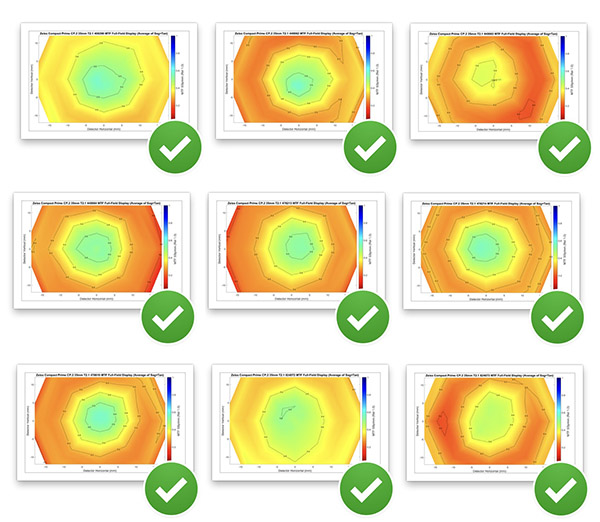
[Zeiss Compact Prime CP.2 35mm T2.1 copy variation at 50 lp/mm]
Does this variation at higher frequencies matter at all? If you’re shooting 1080p video, absolutely not, you can’t see it. If you’re shooting 4k, you probably still wouldn’t notice it. But at 6K or 8K you certainly could.
This piece says about cine vs photo lens copy-to-copy variation differences:
Generally Cine lenses are near-perfect at 20 lp/mm, which isn't quite true with photo. At 30 lp/mm they aren't any better (as far as variation) than photo, or perhaps just slightly better. But by 40 lp they vary just as much as photo lenses. It makes sense given that they are almost always adjusted using charts and projectors. Higher resolution is less apparent in that kind of testing.
This one is especially funny:
Now 72,934 cinematographers are all going to assume that those more expensive video lenses aren’t going to have the problems that cheaper photo lenses have because they haven’t seen it (yet). And 643 places that test video lenses on charts and projectors are going to tell them they don’t need to worry about it because their tests show the lenses are perfect (so far). And then, one day soon, a cinematographer somewhere is going to look at his high-resolution footage, shot with a lens he’s used many times before at lower resolution, and scream because one side of the image is blurrier than the other.
Why We’re Going to Start Testing Cinema Lenses. And Why We Haven’t Before.
By Roger Cicala Published July 31, 2017
His results are nicely coherent with what I wrote here promoting the urgent (since high res video sensors of 8k+) need for StarLensTester device. Here you are some abstracts:
...cameras with higher resolutions began to see flaws…Test charts and lens test projectors just didn’t cut it anymore...
...what if we look at individual copies of that lens? Well, that’s where it gets interesting.
Here are the same nine lenses ... at 30 lp/mm...it’s apparent the lenses are not all identical, although all are acceptable. But on a couple, the very edge is getting unacceptably soft (red areas) and in one (upper right) the center isn’t quite as sharp as the others.
If we look at them at 50 lp/mm we see there’s even more variation.
[Zeiss Compact Prime CP.2 35mm T2.1 copy variation at 50 lp/mm]
Does this variation at higher frequencies matter at all? If you’re shooting 1080p video, absolutely not, you can’t see it. If you’re shooting 4k, you probably still wouldn’t notice it. But at 6K or 8K you certainly could.
This piece says about cine vs photo lens copy-to-copy variation differences:
Generally Cine lenses are near-perfect at 20 lp/mm, which isn't quite true with photo. At 30 lp/mm they aren't any better (as far as variation) than photo, or perhaps just slightly better. But by 40 lp they vary just as much as photo lenses. It makes sense given that they are almost always adjusted using charts and projectors. Higher resolution is less apparent in that kind of testing.
This one is especially funny:
Now 72,934 cinematographers are all going to assume that those more expensive video lenses aren’t going to have the problems that cheaper photo lenses have because they haven’t seen it (yet). And 643 places that test video lenses on charts and projectors are going to tell them they don’t need to worry about it because their tests show the lenses are perfect (so far). And then, one day soon, a cinematographer somewhere is going to look at his high-resolution footage, shot with a lens he’s used many times before at lower resolution, and scream because one side of the image is blurrier than the other.
- Thread starter
- #27
Ilya O.
Well-known member
Meanwhile, it's time to come to prototyping phase.
To start up it's okay to somehow build a proto device just on the table, out of the spare pieces at hand to check the dimensions and try different optical scheme designs. So, according to the basic design:

I need to source at least a reticle holder, a tube lens, a 45Deg prism, a microscope infinity lens, and an optical flat.
Lucky me, some days ago I was given a unknown optical piece and kept it for no reason...Now I see it is a head of quite pricey industrial measuring / microscope like this:

It has an optical path / design of such:

Just from the draft, I'm sure it has half of the needed parts. So let's sacrifice this head

Well well well, what we have here is, first, a little light source with its mount, will do very well. Then, a prism, but this is not the type in need. Next, the yellow tube, is a cool 5x infinity telecentric microscope lens. Green scale is seen through an eyepiece and a regular microscope lens. Good.
Let's move on.

A 45Deg prism is there!!! Its even coated, superb. Though, the size is a bit too much, nevertheless it'll work. To the bottom, on the left, is a superb base for dot reticle holder! Upper right could serve as a holder either, it has two rotating slots. I could put a siemens star for rough centering and a dot for star test, and change it with ease when needed. Nice. The last, bottom right, a violet lens in a tube, — is literally a lens tube for infinity corrected microlenses!!!
Next time I need to build or find holders and mounts for all these parts on a bench and try to test everything together.
As for optical flat, I think some thick non-consumer mirror out of the movie camera, or viewfinder or some test device will do.
To start up it's okay to somehow build a proto device just on the table, out of the spare pieces at hand to check the dimensions and try different optical scheme designs. So, according to the basic design:
I need to source at least a reticle holder, a tube lens, a 45Deg prism, a microscope infinity lens, and an optical flat.
Lucky me, some days ago I was given a unknown optical piece and kept it for no reason...Now I see it is a head of quite pricey industrial measuring / microscope like this:
It has an optical path / design of such:
Just from the draft, I'm sure it has half of the needed parts. So let's sacrifice this head
Well well well, what we have here is, first, a little light source with its mount, will do very well. Then, a prism, but this is not the type in need. Next, the yellow tube, is a cool 5x infinity telecentric microscope lens. Green scale is seen through an eyepiece and a regular microscope lens. Good.
Let's move on.
A 45Deg prism is there!!! Its even coated, superb. Though, the size is a bit too much, nevertheless it'll work. To the bottom, on the left, is a superb base for dot reticle holder! Upper right could serve as a holder either, it has two rotating slots. I could put a siemens star for rough centering and a dot for star test, and change it with ease when needed. Nice. The last, bottom right, a violet lens in a tube, — is literally a lens tube for infinity corrected microlenses!!!
Next time I need to build or find holders and mounts for all these parts on a bench and try to test everything together.
As for optical flat, I think some thick non-consumer mirror out of the movie camera, or viewfinder or some test device will do.
Last edited:
Jake Wilganowski
Well-known member
love this thread
- Thread starter
- #29
Ilya O.
Well-known member
I decided to simplify the prototype so no collimating lens, no tube lens and no infinity microscopic lens — the regular biological one with 160mm flange will do for now. So I now build according to this draft:

So here's the optical rail. Let's find the light source and the power supply.

Shit, the light and supply both have female sockets Political correctness won't work here aha ha. Some say that at least you need one man to connect two females

Where's there that nice prism from measuring microscope? Seems it'd be better fit and spare surface if its mounted into a original square housing.

Here's the mirror. It could be bigger and thicker to look like a real optical flat, but let's leave the pricey pieces for later phase. At least, I found something and it's not from the girlfriend's beauty bag Besides, it is square, that's good for mounting. Second, the mounting base is as important as everything else, this one has cool knobs for precise tilt and skew regulation. Third (lower right, to the left), there's a stand for microscope lens, and it is crucial to have 3-axis move adjustment on it.

It turned out it's better to flip the whole piece. So now it corresponds to the draft directly with the mirror on the left. I mount OKS7-28-1 28mm f/2.0 #770009 which we saw few posts earlier as a good sample of OKS 28mm, with a nice Airy disk. Lower row: I knew it! The prism cube has a round hole, and the housing is rather thick so it'll serve as an 5x eyepiece mount socket. The diameters are close but not equal, so again and again the tape saves the cinema world! (it fitted very tight by the way, better than some bad China m42 to canon adapters ahahah)

From left to right. Now I put the prism with an eyepiece behind the 10x microscope lens (chrome white tip), and upon the biological microscope stand. The square side of the prism stays at 0 angle because of the flat base of the stand, though, it's not fixed and hence not safe and always trying to fall off, but I need to be able to move it freely at first adjusting-the-axis attempts. Than I put 0.3mm (0,012'') pinhole reticle (it's in black housing) just at the top of the prism mount, free laying, not fixed. Off course it will fall down, what do expect?! And this drama helps to build fast and accurate

the bottom row: I dare to put very hot light source with its heavy perforated housing upon the reticle. No tape now and voila — coincidentally, the reticle fits into the light source barrel and all stand quietly (and way too filmsy aha ah).
So, the overall setup looks like that, connected to the draft:

After that I played russian optical roulette for a couple hours: it is hard to get and recognize the dot object I need with all the reflections and all parts movable. I have nobody to help with the adjustments of all elements after my commands while I'm watching the dance of reflections in the eyepice. And here literally every part is tiltable and x-y free. Finally, I got it, can you see that 0.3mm dot image reflected back through the OKS lens? It's inside the red circle mark.

That was preliminary setting, just to get the axis.
Than I put 20x lens and a 10x eyepiece to get 200x, and — a really small dot of ~ 0.03mm (0,0012'') to finally had the diffraction happen and tell us everything about the lens' misalignment and aberrations. Otherwise, as we saw with 0.3mm dot, you only have a circle image like a regular world object, it is not small enough to interfere with the light waves. Feels close!:

Now I remove my cell phone from the eyepiece and put the photo camera to make nice shots of the diffraction pattern. IT WORKS GUYS!!! I got the Airy disk captured!!!

Upper disk is taken via traditional way with the help of the aberration free 1600mm/150dia collimator projecting the tiny dot reticle from the infinity to the OKS lens, and after that to the microscope lens which fills the photo cam sensor with the magnified image.
Lower row is a Airy disk taken with the prototype 1.
Both rows show the same exact OKS 28mm lens under test.
Now to the point why the images are not similar (they should be in a way) — what you see is a huge astigmatism, it gives this oval defocused image and these teared apart pieces in the center of the focused Airy disk. Besides there's risen spherical aberration. As for the different scale, it's okay since the distances are rough in the prototype.
Well, this astigmatism and spherical aberrations are mainly introduced by:
- the prism (it's too big and thick, besides, glass type is not optimal)
- the mirror which is not up to the high optical flatness standard
- the microscope lens which is working with the prism within the back focal distance — that's not how it was calculated to work.
All in all, I'm very happy since the Frankenstein showed its eye and all the above points could be eliminated by the proper elements design and positioning.
Now I'm scratching my head about how to gather the money for the real draft and making a proper CNCed protoype 2 with all the proper parts.
Can we guys make something like group buy for the proto v2?
Or maybe the KickStarter way? Who whishes to be my partner since its closed for Russians?
So here's the optical rail. Let's find the light source and the power supply.
Shit, the light and supply both have female sockets
Political correctness won't work here aha ha. Some say that at least you need one man to connect two femalesWhere's there that nice prism from measuring microscope? Seems it'd be better fit and spare surface if its mounted into a original square housing.
Here's the mirror. It could be bigger and thicker to look like a real optical flat, but let's leave the pricey pieces for later phase. At least, I found something and it's not from the girlfriend's beauty bag
Besides, it is square, that's good for mounting. Second, the mounting base is as important as everything else, this one has cool knobs for precise tilt and skew regulation. Third (lower right, to the left), there's a stand for microscope lens, and it is crucial to have 3-axis move adjustment on it.It turned out it's better to flip the whole piece. So now it corresponds to the draft directly with the mirror on the left. I mount OKS7-28-1 28mm f/2.0 #770009 which we saw few posts earlier as a good sample of OKS 28mm, with a nice Airy disk. Lower row: I knew it! The prism cube has a round hole, and the housing is rather thick so it'll serve as an 5x eyepiece mount socket. The diameters are close but not equal, so again and again the tape saves the cinema world! (it fitted very tight by the way, better than some bad China m42 to canon adapters ahahah)
From left to right. Now I put the prism with an eyepiece behind the 10x microscope lens (chrome white tip), and upon the biological microscope stand. The square side of the prism stays at 0 angle because of the flat base of the stand, though, it's not fixed and hence not safe and always trying to fall off, but I need to be able to move it freely at first adjusting-the-axis attempts. Than I put 0.3mm (0,012'') pinhole reticle (it's in black housing) just at the top of the prism mount, free laying, not fixed. Off course it will fall down, what do expect?! And this drama helps to build fast and accurate
the bottom row: I dare to put very hot light source with its heavy perforated housing upon the reticle. No tape now and voila — coincidentally, the reticle fits into the light source barrel and all stand quietly (and way too filmsy aha ah).
So, the overall setup looks like that, connected to the draft:
After that I played russian optical roulette for a couple hours: it is hard to get and recognize the dot object I need with all the reflections and all parts movable. I have nobody to help with the adjustments of all elements after my commands while I'm watching the dance of reflections in the eyepice. And here literally every part is tiltable and x-y free. Finally, I got it, can you see that 0.3mm dot image reflected back through the OKS lens? It's inside the red circle mark.
That was preliminary setting, just to get the axis.
Than I put 20x lens and a 10x eyepiece to get 200x, and — a really small dot of ~ 0.03mm (0,0012'') to finally had the diffraction happen and tell us everything about the lens' misalignment and aberrations. Otherwise, as we saw with 0.3mm dot, you only have a circle image like a regular world object, it is not small enough to interfere with the light waves. Feels close!:
Now I remove my cell phone from the eyepiece and put the photo camera to make nice shots of the diffraction pattern. IT WORKS GUYS!!! I got the Airy disk captured!!!
Upper disk is taken via traditional way with the help of the aberration free 1600mm/150dia collimator projecting the tiny dot reticle from the infinity to the OKS lens, and after that to the microscope lens which fills the photo cam sensor with the magnified image.
Lower row is a Airy disk taken with the prototype 1.
Both rows show the same exact OKS 28mm lens under test.
Now to the point why the images are not similar (they should be in a way) — what you see is a huge astigmatism, it gives this oval defocused image and these teared apart pieces in the center of the focused Airy disk. Besides there's risen spherical aberration. As for the different scale, it's okay since the distances are rough in the prototype.
Well, this astigmatism and spherical aberrations are mainly introduced by:
- the prism (it's too big and thick, besides, glass type is not optimal)
- the mirror which is not up to the high optical flatness standard
- the microscope lens which is working with the prism within the back focal distance — that's not how it was calculated to work.
All in all, I'm very happy since the Frankenstein showed its eye and all the above points could be eliminated by the proper elements design and positioning.
Now I'm scratching my head about how to gather the money for the real draft and making a proper CNCed protoype 2 with all the proper parts.
Can we guys make something like group buy for the proto v2?
Or maybe the KickStarter way? Who whishes to be my partner since its closed for Russians?
Last edited:
- Thread starter
- #30
Ilya O.
Well-known member
Read a superb article about pure lens MTF and system (lens+sensor) MTF; how OLPF degrades the lens MTF; 8K and PSF / Airy disk importance:
System MTF "The 8K Conundrum – When Bad Lenses Mount Good Sensors" By Brandon Dube of LensRentals.com
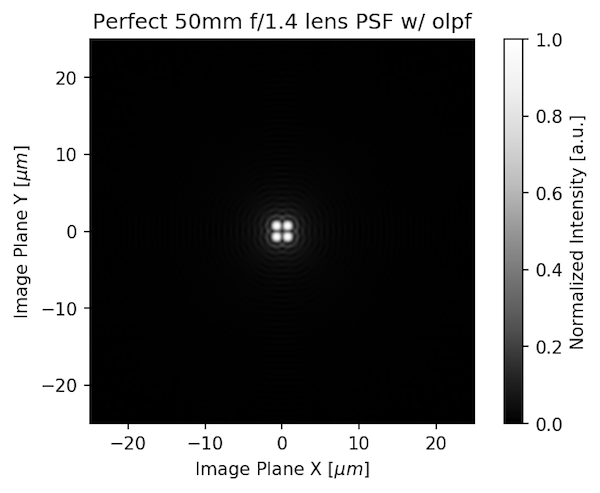
Some abstracts:
"Pure lens MTF (the optical bench) shows you the upper limits of what the lens is capable of.
System MTF shows you how the whole system resolves the image.
For an exceptionally good lens stopped down a bit, then the system MTF is almost entirely dependent on the camera. Raise the resolution of the camera and the image improves dramatically.
For average and poor lenses, the system MTF is limited by the lens. Changing cameras makes only a small difference.
For most lenses the system MTF changes significantly with different sensors, but at higher resolutions a diminishing return is seen.
Optical low pass filters are necessary on low-resolution sensors, but not as necessary on high-resolution sensors. If you do see aliasing on a high resolution sensor, you can bet that lens is damned good.
...
System MTF on a low resolution sensor (1080p for example) is not a good predictor of how that lens will behave on a high resolution sensor. For video folks this means a lens that was great for 1080p may not be very good at 4k. For photo folks, don’t look at system MTF tests on lower resolution sensors."
System MTF "The 8K Conundrum – When Bad Lenses Mount Good Sensors" By Brandon Dube of LensRentals.com
Some abstracts:
"Pure lens MTF (the optical bench) shows you the upper limits of what the lens is capable of.
System MTF shows you how the whole system resolves the image.
For an exceptionally good lens stopped down a bit, then the system MTF is almost entirely dependent on the camera. Raise the resolution of the camera and the image improves dramatically.
For average and poor lenses, the system MTF is limited by the lens. Changing cameras makes only a small difference.
For most lenses the system MTF changes significantly with different sensors, but at higher resolutions a diminishing return is seen.
Optical low pass filters are necessary on low-resolution sensors, but not as necessary on high-resolution sensors. If you do see aliasing on a high resolution sensor, you can bet that lens is damned good.
...
System MTF on a low resolution sensor (1080p for example) is not a good predictor of how that lens will behave on a high resolution sensor. For video folks this means a lens that was great for 1080p may not be very good at 4k. For photo folks, don’t look at system MTF tests on lower resolution sensors."

Aaron Lochert
Well-known member
I just saw this post on Reddit and thought of this thread.
Accidental airy disc due to rangefinder focusing on itself.

Accidental airy disc due to rangefinder focusing on itself.
- Thread starter
- #32
Ilya O.
Well-known member
Wow, thanks for posting here in a forgotten thread
I wonder highly what's that since I'm almost confident that is not an Airy disk (only lazer beam Airy disks look like that depicted phenomena, while regular and ir light disk has just a core and only a couple of rings at best, not many and many).
If only Michael Tiemann was here to guess what is that.
I think it could be flare reflected from tiny aspherical lenses of a cell phone.
Marian Munteanu
Member
Ilya, did you finished the project?
- Thread starter
- #34
Ilya O.
Well-known member
Dear Marian, I'm stuck at the prototying stage. It was okay, works, but I now need funds for making the CNC works to make a proper build 1.0 device
U really find that device can have the demand among lens lover and nerds?!
U really find that device can have the demand among lens lover and nerds?!
Paul Jonathan
Well-known member
- Joined
- Mar 3, 2013
- Messages
- 98
- Reaction score
- 0
- Points
- 0
Just stumbled across this thread and just wanted to reiterate that I'd be super interested in a device like this provided that pricing isn't through the roof. So Ilya I wish you all the best with prototyping!
- Thread starter
- #36
Ilya O.
Well-known member
Thanks, Paul, I will try my best.
The other side is that with a device like that I will be every manufacturer's enemy number one. As well as of the lens services
Do you consider yourself as a potential crowdfunder for this project?
The other side is that with a device like that I will be every manufacturer's enemy number one. As well as of the lens services
Do you consider yourself as a potential crowdfunder for this project?