


Ilya O.
Well-known member
Photo and cine lens sample variation is reality. And there's even more copy-to-copy variation if we look at vintage or used / serviced lenses. More so with any zooms.
The second part of the bitter truth is that nearly every real-world lens (especially those after service) is facing centering/tilt/rotational errors to some extent which lead to on-axis coma, astigmatism, spherical aberration...Meaning you have bad lens copy with mediocre picture.
High resolution video sensors of 8K and above do see all these flaws clearly.
How do we cope with that? We try to do the chart/trees-on-the-sky/brick wall testing of the several lens (3 to 5 at best) copies before purchase. Well, guys, that is just not the way we all deserve to have...Besides, this generally helps only to distinguish between the very bad copy and the moderate one but not between the best and the average. And what to do if you want the good copy of costly cine prime or zoom, or some vintage classic — when there's no easy way to plug&test, compare, return and proof the bad sample?
All in all, this approach needs several samples or reference lens to choose the best, but what to do if you do not have one? So, how can we know for sure if the lens is optically OKAY or not by itself, without the reference? I think we need a device to check any lens objectively.
So what I suggest for all us lens passionates is to crowdfund STAR LENS TESTER device, portable and easy to use so we can take it to the shop or rental to choose the best of the pack. It can also check the lens before/after service optical performance.
Star test (aka Airy disk, or point source, or PSF pattern test) is rather simple yet extremely sensitive to many lens aberrations and even glass molding defects. It is well-known and widely used in optical labs and by astronomers but what is strange I find no such device for sale for us! The basic draft of such tester we see like this:

The test uses visible light to go through a tiny pinhole, then into a collimating lens to get rays parallel, then into a prism and to the tested lens forth to the mirror and back to the prism and an eyepiece (that is why AUTOcollimation) — and you see the result: aberration free lens renders point as an nice Airy disk:

This disk is a basic element of good image forming process on our sensors. The better it is the higher MTF would be, the better the overall picture IQ. You can not expect good picture performance out of bad disk, and if you have aberrated disk on axis, imagine it would get much much worse off axis and towards the image edges. So what would we face in real-world lens examples? On-axis coma plus a bit of misalignment is very common and looks like this when software generated:

Here you are the same aberration but as Star tested out of OKS1-100-1 100mm f2 lens:

Star test shows clearly other typical aberrations of a bad copy/wrongly assembled lens:
astigmatism:

spherical aberration:

pinched optics:

and a bunch of all aberrations which are actually the case with real lenses when many of them are mixed together:

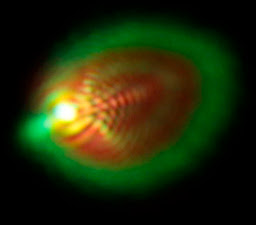
Despite the beliefs, the bunch is very common, and here is a Star test of Zeiss Pancolar 50mm f1.8 for you to quest out what aberration types are present :
:
***
So, do you guys need such a device?
The point is not in aberration guess games, but to choose a lens which renders point as close as possible to Airy disk pattern.
Important note: if you find a nearly ideal lens with this Star Tester, that does NOT mean the lens looses its character and look! It just means that the lens is optically aligned, all elements are centered on one axis and you can expect max IQ, sharpness and resolution for this particular lens design. As for the lens look it'll be all there since star test shows little of vignetting, bokeh, CA, of-axis aberrations etc...
I consider this post as STAGE 1: market demand inquiry. It will last till we see some numerical response.
If OK, I go to STAGE 2: R&D and prototyping.
For the sake of easy analysis I strongly recommend everybody to post using this guide:
NEED? YES or NO
PRICE EXPECTATIONS: just put plain numbers here
COMMENTS: any input is welcome!
If you are not registered on RedUser, just send me email to StarLensTester@gmail.com with StarLensTester in subject and YES/NO in the text body.
The second part of the bitter truth is that nearly every real-world lens (especially those after service) is facing centering/tilt/rotational errors to some extent which lead to on-axis coma, astigmatism, spherical aberration...Meaning you have bad lens copy with mediocre picture.
High resolution video sensors of 8K and above do see all these flaws clearly.
How do we cope with that? We try to do the chart/trees-on-the-sky/brick wall testing of the several lens (3 to 5 at best) copies before purchase. Well, guys, that is just not the way we all deserve to have...Besides, this generally helps only to distinguish between the very bad copy and the moderate one but not between the best and the average. And what to do if you want the good copy of costly cine prime or zoom, or some vintage classic — when there's no easy way to plug&test, compare, return and proof the bad sample?
All in all, this approach needs several samples or reference lens to choose the best, but what to do if you do not have one? So, how can we know for sure if the lens is optically OKAY or not by itself, without the reference? I think we need a device to check any lens objectively.
So what I suggest for all us lens passionates is to crowdfund STAR LENS TESTER device, portable and easy to use so we can take it to the shop or rental to choose the best of the pack. It can also check the lens before/after service optical performance.
Star test (aka Airy disk, or point source, or PSF pattern test) is rather simple yet extremely sensitive to many lens aberrations and even glass molding defects. It is well-known and widely used in optical labs and by astronomers but what is strange I find no such device for sale for us! The basic draft of such tester we see like this:
The test uses visible light to go through a tiny pinhole, then into a collimating lens to get rays parallel, then into a prism and to the tested lens forth to the mirror and back to the prism and an eyepiece (that is why AUTOcollimation) — and you see the result: aberration free lens renders point as an nice Airy disk:
This disk is a basic element of good image forming process on our sensors. The better it is the higher MTF would be, the better the overall picture IQ. You can not expect good picture performance out of bad disk, and if you have aberrated disk on axis, imagine it would get much much worse off axis and towards the image edges. So what would we face in real-world lens examples? On-axis coma plus a bit of misalignment is very common and looks like this when software generated:
Here you are the same aberration but as Star tested out of OKS1-100-1 100mm f2 lens:
Star test shows clearly other typical aberrations of a bad copy/wrongly assembled lens:
astigmatism:
spherical aberration:
pinched optics:
and a bunch of all aberrations which are actually the case with real lenses when many of them are mixed together:
Despite the beliefs, the bunch is very common, and here is a Star test of Zeiss Pancolar 50mm f1.8 for you to quest out what aberration types are present
:***
So, do you guys need such a device?
The point is not in aberration guess games, but to choose a lens which renders point as close as possible to Airy disk pattern.
Important note: if you find a nearly ideal lens with this Star Tester, that does NOT mean the lens looses its character and look! It just means that the lens is optically aligned, all elements are centered on one axis and you can expect max IQ, sharpness and resolution for this particular lens design. As for the lens look it'll be all there since star test shows little of vignetting, bokeh, CA, of-axis aberrations etc...
I consider this post as STAGE 1: market demand inquiry. It will last till we see some numerical response.
If OK, I go to STAGE 2: R&D and prototyping.
For the sake of easy analysis I strongly recommend everybody to post using this guide:
NEED? YES or NO
PRICE EXPECTATIONS: just put plain numbers here
COMMENTS: any input is welcome!
If you are not registered on RedUser, just send me email to StarLensTester@gmail.com with StarLensTester in subject and YES/NO in the text body.
Last edited:


