Welcome to our community

Be a part of something great, join today!

  • Hey all, just changed over the backend after 15 years I figured time to give it a bit of an update, its probably gonna be a bit weird for most of you and i am sure there is a few bugs to work out but it should kinda work the same as before... hopefully :)

LED Lights - any worthy fresnel and/or kino replacements?

Adam C Lubkin

Well-known member
Joined
Dec 28, 2006
Messages
641
Reaction score
0
Points
0
Location
Maryland, USA
I meant to research this at NAB but it slipped through the cracks. Have any of you seen or used any LED lights that you consider worthy replacements for traditional fixtures - hard or soft?
 
There was a post around here (from right after NAB) reporting very favorable results about the forthcoming Arri's. I think I'm gonna pick up maybe 4 to start with. ETA September.
 
Depends what for. LEDs are great for ENG work and closeups/mediums but in terms of raw power for big shots they are not nearly as powerful as the really big tungsten and HMI units out there. though those ARRIS do look very promising.

Noah
 
I made a point to check out LED lighting and was really impressed with the zylight. Besides being bi color and dimmable with no balance shift, it also had a cc green shift control which would be huge. They also had a seperate active diffusion panel that caught my eye.

http://www.zylight.com/servlet/Page?template=p_i_is3
 
Arri had their LED fresnel's on display. http://www.arri.com/l-series/

Est. price is around $2800. They were targeting release around October.

Wow... I am in love.

L7-C: Color Tuneable, 2700 K - 10000 K,
Green - Magenta Adjustment, Full Gamut Color Mixing
(...)
Beam Angle 15 - 50°, Continuously Focusable
(...)
Dimming Integrated, 0 - 100% Continuous, 16-bit
(...)
Passive Cooling -20 to +35°C
Active Cooling -20 to +50°C

Nine ARRI L7 Fresnels can be run off a single 20 A

And they are comparing them to 1000W tungsten fresnels.

I remember seeing something like this a couple of years ago, but small, an on-camera solution.

This can't hurt either:

watertest.jpg


Sounds like some sectors of Arri are doing things the right way already ;)

We all know the pace at which LED efficiency is improving, so the L7 is an expansible platform designed to adapt with the latest enhancements in LED chip performance. The light engine is fully upgradeable, ensuring that the fixtures can take advantage of technology advances as and when they happen.

The firmware is also upgradeable through the USB port on the rear of each unit, accommodating future control protocols such as ACN and incorporating other system enhancements that may become available in due course.

In addition, future optic accessories will bring new levels of functionality to the platform, further expanding the L-Series versatility.

Just teasin'...
 
LitePanels has been touting their SOLA series LED fresnels...

I have been following the development of the Sola Fresnels with interest. While they are definitely a step in the right direction in developing a production LED light, they still don’t quite combine the advantages of LED illumination (cool-burning, energy-efficient) with the versatility and control of traditional Fresnel fixtures. If the history of film style Fluorescent lighting offers any lessons, the manufacturers of High Power LEDs will have to address several key issues before LED lighting can replace incandescent and HMI lamps in studios and on location sets powered by generators (particularly small portable generators.) For LEDs to be widely used, manufacturers must overcome their poor color rendering, poor power quality, and lack of versatility. Based upon the latest crop of LEDs shown at NAB, progress is being made on many of these fronts, but not by the Litepanels Sola “Fresnel.”

The biggest problem of LED lights in the past was their poor color rendering (use this link - http://www.oscars.org/science-technology/council/projects/ssl/index.html - to the Academy of Motion Picture Arts & Sciences’ “Solid State Lighting Project” for details.) In addition to having poor CRIs, LED output and color decays with age, making their color rendering capability inconsistent at best. A second problem inherent in LEDs that manufacturers have had to address is the relatively poor power quality generated by the Switch Mode Power Supplies (SMPSs) they use to power their lights on AC power. With Leading Power Factors around 0.54 (Litepanel 1x1s) and high harmonic distortion (THD upwards of 68.1%) the AC power supplies of LEDs have generally drawn a very distorted current that is significantly phase-shifted with respect to the sinusoidal voltage waveform. As such, the AC power supplies of LEDs have had an adverse effect on power quality similar to that of CFLs (use this link for more details.)

Finally, another drawback to LED fixtures until now is that the "light panel" design creates a light that is hard to control and falls off very rapidly. These characteristics have made LED light panels only suitable as Key sources in documentary interview set-ups where the Keys are typically positioned close to the interview subject. In that capacity LED light panels (with heavy diffusion) can generate a wonderful soft light that wraps around the interview subject without wilting them. However, in dramatic set lighting, where Key sources must be capable of throwing a distance, LED light panels have only limited applications as fill sources. The broad soft light they put out drops off too rapidly, and is too difficult to control, for them to be effective as a Key or Backlight source in dramatic set lighting. For LEDs to be widely used, manufacturers had overcome these shortcomings - their poor color rendering, poor power quality, and lack of versatility - to previous LED light designs. As I said at the outset, progress has been made on many of these fronts in the fixtures being introduced at NAB this year. Particularly in the case of the Litepanel Sola 6 Fresnel and the Arri L7 Fresnel.


ArriLED_Litepanel_Sola6sm.jpg


The Litepanels Sola 6 LED Fresnel​

While the Sola 6 Fresnel is definitely a step in the right direction in developing a production LED, far as I am concerned, Litepanels has not completely overcome all of the shortcomings outlined above with the Sola fixtures. Litepanels doesn’t give CRI ratings for the Sola Fresnels on their website, but when asked they say the CRI is in the 80s – which is still rather anemic compared to continuous spectrum light sources like quartz and HMI lights. The Power Factor of the Sola has been improved. But, at .85 it could stand further improvement (a Power Factor Corrected HMI has a Power Factor of .98 or near unity power.) They claim the 75W Sola 6 has the output equivalent to a 650W Tungsten, but comparing the photo-metrics published on their website to those of an Arri 650 Fresnel, the Arri has nearly three times the output of the Sola. And, while the Sola 6 has an impressive spot to flood range (10 to 70 degrees), spot/flood capability is not the only characteristic that makes a Fresnel light versatile. Of equal importance is the ability to render clearly defined shadows and cuts. The ability of Fresnels to render crisp shadows make them ideal for creating gobo effects like window or branch-a-loris patterns. The ability of Fresnels to render clearly defined cuts enables their light to be precisely cut to set pieces and talent. And, simply by adding one of a variety of diffusion material you can vary the softness of a Fresnel’s output. These are the characteristics of traditional Fresnels that make them extremely versatile, that the Sola “Fresnels” have not been able to emulate. Arri, on the other hand, may have finally engineered in their new 200W L7 LED Fresnel a fixture that combines the cool-burning, energy-efficient advantages of LED illumination with the controllable versatility of traditional Fresnel fixtures. Where I am out of space, I will have to pick up with my review of the new Arri L7 LEDs Fresnels in my nest post.
Guy Holt, Gaffer, ScreenLight & Grip, Lighting and Grip Rental and Sales in Boston.
 
Where I am out of space, I will have to pick up with my review of the new Arri L7 LEDs Fresnels in my nest post.

Arri, on the other hand, may have finally engineered in their new 200W L7 LED Fresnel a fixture that combines the cool-burning, energy-efficient advantages of LED illumination with the controllable versatility of traditional Fresnel fixtures.

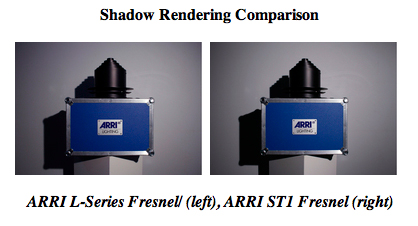
Arri_LED_Shadow_Comp.jpg

As you can see in the pictures above, that compare the output of the L7 Fresnel to an Arri ST-1 Quartz Fresnel, the L7 Fresnel has clear and defined shadow rendering capability like that of the ST-1 Quartz Fresnel. And, as the pictures below demonstrate, the L7 Fresnel has a spot to flood range similar to that of the ST-1 Quartz Fresnel and excellent field homogeneity in both flood and spot.


Arri_LED_L-Series.jpg

​

And, just like the ST-1 Quartz Fresnel (pictured below), the beam of the L7 Fresnel (pictured above) is easily controlled with barndoors - enabling the light to be precisely cut to set pieces and talent (see far right photos above & below.) And, given the discernable amount of light the L-Series Fresnel prototypes threw in a show demonstration video from IBEC last fall, on what appears to be a 6x6 Ultrabounce rigged 20’ overhead, and under the high ambient light levels of the show hall, it seems the production model L7 Fresnel has more than enough output to waste some to diffusion and color gel if one so desires (a shortcoming to most LED panels is that they have barely enough.)


Arri_LED_ST-1.jpg

​

The L7 line of LED Fresnels introduced at NAB consists of three models: the L7-D, L7-T and L7-C. All share the same basic housing and the same 7" Fresnel lens, and all have output comparable in intensity to a conventional 1K Fresnel. They differ in terms of color temperature, with the D model outputting a daylight-equivalent 5600 K, the T model a tungsten-equivalent 3200 K, and the top-of-the-range C model offering total color control. In my opinion, the Arri L7s finally deliver the true-to-life color rendition, previously achievable only with full-spectrum tungsten sources. By color blending with a multi-emitter LED engine, the L7 is able to overcome the generally poor color rendering capabilities of other LED fixtures. Both the 3200 K and 5600 K color temperature models offer a CRI and CQS greater than 90 so skin tones, costumes and scenery will finally appear life-like under LED light.

The L7-C’s fully tuneable white light can be adjusted for different skin tones, camera sensors and mixed-light environments, while specific color shades can be matched through full gamut color mixing. Unlike other LED fixtures, this level of color control does not involve compromising the quality of the light field: the L-Series is unique in combining uniform light and single shadow rendition with absolute control of color attributes.


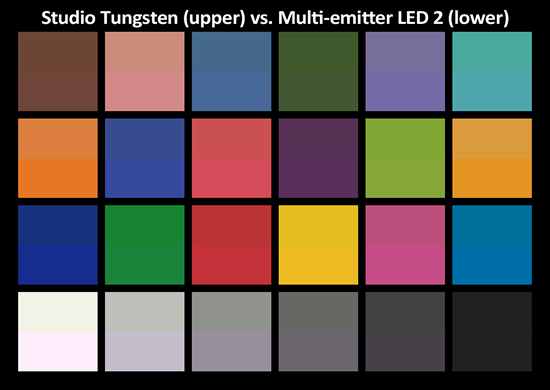
Arri_L7_Macbeth_Chart.jpg


Split Macbeth chart: each color patch shows the visible effects of studio tungsten light in the top half of the patch, and a representative multi-emitter LED lighting instrument in the bottom half. Note: this is not the L7 but results typical of the multi-emitter LED approach ​

An added benefit to using a color blending multi-emitter LED engine is that the L7’s firmware can calibrate the blend of different color emitters to compensate for the inevitable color shift of the LEDs with age. This approach assures consistent realistic color rendition throughout the fixture’s life.

There are two alternative cooling systems: one passive and the other active. The passive cooling system was designed for broadcast studios. It incorporates no moving parts or fans and is therefore completely silent. The active cooling system was designed to provide a more compact and lightweight option for location work. It uses an extremely quiet (<20 dB) fan and weighs 10lbs less than the studio version.


ArriL7_Active_Cooling.jpg

​

The location fixture carries an IP54 rating for weather resistance which means that it is protected from falling rain and splashing water, and that the internal electronics, optics and LEDs are protected from dust, dirt and humidity – making it a very robust fixture that will stand up to the rigors of location production.


ArriL7_watertest.jpg

​

All the L7s feature Power Factor Correction with a near unity Power Factor of .91. Which means that the 200W fixtures will draw no more than 1.98A at 120V (220W) and cause virtually no Harmonic Distortion. Since it creates virtually no line noise, you will be able to power nine 200W L7s on the 20A circuit of a portable generator without a problem. And since the L7-T has an output comparable to a 1k Quartz Fresnel, and the L7-D has an output comparable to a 575W HMI Fresnel, the L7 series takes what you can do with a portable generator to a new level. For example, with the enhanced 7500W output of our modified Honda EU6500is, you will be able to operate a lighting package consisting of a 30 L7s. I think you would have to agree that is an incredible step-up in production capability.


ArriL7_upgrade.jpg

​

At a price around $2’800, the L7s are one of the more expensive LED fixtures at NAB. But, to assure that they are not quickly rendered obsolete by the rapid advances being made in LED chip efficiency, Arri has designed them to be an expansible platform that can incorporate future developments in LED technology. Not only, do the heads allow for the incorporation of more efficient LED chips when they become available, but the light engine is also fully upgradeable, ensuring that the fixtures can take advantage of technology advances as they happen. To accommodate future control protocols (such as ANC), their firmware is also upgradeable through the USB port on the rear of each unit. They will also be compatible with planned future optic accessories that will expand the L-Series versatility. Able to incorporate future developments in LED technology, the expansible platform of the L7s ensures that they will have a long useable life and so will assure a return on investment in them. Given the rapid pace of LED chip development, I can’t think of another LED fixture that won’t be obsolete in a year or two. The scheduled release for the L7 LED units is September 2011.

With the same clear and defined shadow rendering, excellent field homogeneity, and smooth continuous flood to spot focus as a 1kw Quarts Fresnel, these first production models of the L-Series LED Fresnels may well be the first true LED Fresnel lights (use this link for more details.) For more detailed information on the Power Quality generated by LED power supplies and to see a demonstration video of the new Arri L-Series LED Fresnels, use this link to an article I wrote for our company newsletter on the use of portable generators in motion picture lighting. In it I cover some of the basic electrical engineering principles behind LED drivers, the harmonic distortion they can generate, and how it can adversely affect generators. The article and the demonstration video are available online at http://www.screenlightandgrip.com/html/emailnewsletter_generators.html.

Guy Holt, Gaffer, ScreenLight & Grip, Lightng & Grip Rental in Boston
 
Guy,

Let me start by saying how much I appreciate your posts. Invariable I find them to be unbiased and informative.

While a convention show floor is about as bad a circumstance to evaluate lighting as one can imagine, it was still apparent to me the Arri's L series had a significant lead in the "quality of light" issues you raise when compared to the Sola.

I asked about the power supply and got vague reassuring words, so I'm in no position to comment, but the Arri instruments appeared to be quite a bit closer to quality of a traditional fresnel.

I look forward to your input on those instruments, as they look promising to me. Not as a direct replacement for the fine brush strokes you can paint with say a Dedo, but an acceptable substituent where limited shore power or heat are significant issues. If they play well with others on an inverter generator, that would be a huge plus.

Thanks again,

Steve

(edit, well thanks again, your post on the Arri went up while I was writing this)
 
Thank you for posting that Guy. I bet they will come out with par lenses, it is a given, right? Or would the multiple bulbs prevent that without a bit of a multiple-shadow being cast? I would guess they are using few high wattage LEDs like the brutes do, right? Or are they lots of small bulbs?

If you can use them as pars, this is a 200W draw with 1000W tungsten equivalent with every single bell and whistle you could dream of... (well, at least that I know about ;) And with the upgrade-ability of the lamp... sick. Kelvin and green-magenta control! 0-100% dimmable! (with green-magenta control!) Sick!

That color chart worries me a tinie bit, because looking at the gray scale you can see some magenta and I wonder why that wasn't dialed out completely... I guess I would need to test these myself, see what I can get it to do, bring home some samples to check out with grading tools. But at first glance I didn't notice the top-bottom split in each box, I must admit. But I am not a DP.

Once these systems match light quality 100%, it is game over man. Game over! This is the future. High output, virtually no heat, full control... They are a touch too big (compared to my dreams) but I am definitely in love. I would love to see what David Mullen thought of them after a close inspection.
 
What, plasma? Isn't that kinda like taking a giant step back to burning stuff inside lamps to make light? ;)

I'd like to know more about that.

Found this Adam Wilt article here: http://provideocoalition.com/index....11_-_plasma_lights_and_the_problem_with_leds/

It’s unlike any other lighting instrument we use—other than the sun—in that it doesn’t pass electricity directly through the light-giving element (tungsten filament, diode junction, rarefied gas surrounded by phosphors, carbon arc, etc.).
Instead, it focuses a whole lot of RF energy onto a tiny glass capsule containing a mixture of gases. The gases, thus energized, become a plasma (the fourth state of matter), and emit a whole lot of broad-spectrum, high-CRI light.
(...)
Think of a 20,000-hour lamp outputting the equivalent of a 2K tungsten lamp on 273 watts of power, and you’ll get the idea.
:eek6:


NAB11AWP1000322.jpg


The result is that scenes lit with “white” LEDs that look to be perfectly color balanced, and under which your scene’s subjects, makeup, clothing, and props look perfectly natural, may photograph surprisingly differently than they appear.

I highly recommend that you go to the AMPAS Solid State Lighting Project page and watch the videos, which include the same presentation that AMPAS made at NAB, and the test clips that were shot to illustrate the problems. Be afraid. Be very afraid…
...or just be forewarned, and thus forearmed: if you understand the issue, you can test for it, and avoid unpleasant surprises.
 
I hope prices drop soon.

LED lighting seems to be the way of the future in all senses.

Less heat, less energy, smaller crews.

For the no budget/low budget crowd this will be revolutionary.

Just plug the lights on any regular socked and shoot away.

Hopefully they will also find a way to make the gear lighter and smaller.
 
Last edited:
I hope prices drop soon… For the no budget/low budget crowd this will be revolutionary.

Given the complexity of getting a color output with consistently high CRIs over the life of the LEDs (it requires microprocessor control), I don’t know how much the “professional” grade LED fixtures, like the Arri L7s will come down in price. For that reason, Arri realized they had to offer additional benefits or savings to justify the additional cost of buying or renting the fixtures.

The benefit in the broadcast studio market is compelling: when you take into account the savings in power consumption (not only by the lights but also air-conditioning), lamp longevity (no need to replace burnouts), and gel longevity (no need to replace burned through gels), the benefits clearly outweigh the additional cost. On their website, Arri estimates that a studio with 50 1kw instruments will save approximately $148,000 over a five year period by using the L7 LED Fresnel instead. The “green” benefit is also compelling. Using L7s in place of 1kw Quartz Fresnels would save 450 tons of Co2 emissions and 964 barrels of oil. Or to put it another way, the use of 1kw Quartz Fresnels would require the planting of 10,600 trees to offset the additional carbon footprint. Without a doubt, the saving to be gained in the Broadcast Studio market more than offsets the additional expense of an LED Fresnel fixture. But since the same cost/benefit analysis isn’t as compelling in location production applications, Arri added several features not necessary for studio applications, that would make the benefits outweigh the additional costs for small production companies and low budget indie productions.

One feature that Arri has included in the L7s to benefit low budget indie productions is Power Factor Correction (PFC.) Without a doubt, the even greater reduction in power consumption, and particularly line noise, that Arri achieves (that other LED manufacturers don’t) by incorporating PFC into their L7 Fresnels offers location productions a great cost benefit: not having to rent a movie blimped tow generator, with all of its’ hidden costs, in order to obtain decent production values.

Until recently, to power a lighting package sufficient enough to get good production values required a large diesel tow generator. Movie generators are not only expensive to rent, but they come with hidden costs that usually break the budget of modest indie HD projects. Movie generators require special tow equipment not found on Ryder or Penske rental trucks. For that reason, movie generators require that you rent a more expensive grip truck from a lighting and grip rental company in order to tow them. Lighting rental companies will not send out a grip truck without a company driver - further adding to the expense of renting a movie generator (in this market driver rates run about $500/10hrs with overtime after 10hr). Taking into account the hidden costs, it is usually not in the budget of indie projects to rent a diesel tow generator. But, by incorporating PFC into their L7 Fresnels, Arri makes it possible to power more lights, and even larger lights, on portable gas generators than has ever been possible before. Between the greater light sensitivity and exposure range of camera systems like the Red Epic and Arri Alexa; the power efficiency of PFC HMI, Kino, and now LED fixtures; and the enhanced output and production capability of modified Honda Inverter genertors; indie productions are now able to get great production values with what they can operate on a portable gas generator. What makes this possible is that the Arri L7 Fresnels are one of only a few LEDs available with PFC circuitry (and the only Fresnel near unity power.)

The only LED Fresnel with near unity power, the L7 Fresnels will create virtually no power waveform distortion when operating on portable gas generators. For this reason, the generator will be capable of operating larger, or more smaller, lights than it could otherwise. With PFC in all your heads, you can load an inverter generator to capacity (use this link for details.) Which, in the case of our modified Honda EU6500is means the ability to operate up to 30 Arri L7s. Think of what can be accomplished with the equivalent of 30 1kw Fresnels or 575 HMI Fresnels with camera systems like the Red Epic or Arri Alexa that are capable of a fourteen stop exposure range and ASA sensitivities of 1600 without grain – you will no longer need the additional output of a diesel generator in many production situations.

Even when you require a bigger gun like a 4k Par, the low line noise and power consumption of the Arri L7s make it feasible to operate an entire location package from a single Honda EU6500is. For instance, you can operate up to 10 L7s in addition to a 4k Par on the enhanced 7500W power output of our Honda EU6500is, if the 4k ballast is also Power Factor Corrected. And, since, Arri plans to introduce the ARRIMAX reflector technology to the 4k HMI power class (resulting in a head with the output and light quality close to that of a 12kw Fresnel that will draw only 37 Amps), what can be accomplished with a portable gas generator will be tremendous when used with the latest generation of light sensitive HD camera systems like the DSLRs, the Red Epic, and the Arri Alexa.

With Power Factor Corrected L7 LED Fresnels, ARRIMAX reflector HMIs, and Kino Flo Parabeams, you won’t need anything more than can be operated on the enhanced 7500W output of a Honda EU6500is to get decent production values in most production situations – effectively eliminating the need for a large diesel tow generator, with all its hidden costs. This is what has Harry Box so pumped about our HD Plug & Play Gen-set and why he has included it in the 4th Edition of his “Set Lighting Technician’s Handbook” ( use this link for details.) When you start to use the new math of not only lower power consumption, but also of lower line noise, to calculate what can be operated on a portable gas generator, you quickly realize that the savings of not having to rent a large diesel tow generator to get good productions values starts to outweigh the additional cost of the Arri L7s. And, when you factor in the hidden costs of renting a large diesel tow generator – the rental house grip truck, truck driver to tow it, and the extra electrical crew to distribute the power – the cost savings more than offsets the additional cost of the L7 LED Fresnel.

I have posted more detailed information on the Power Quality generated by LED power supplies and a demonstration video of the new Arri L-Series LED Fresnels, at my website at www.screenlightandgrip.com/html/emailnewsletter_generators.html#anchorHigh Output AC LEDs.

Guy Holt, Gaffer, ScreenLight & Grip, Lighting and Grip Rental and Sales in Boston.
 
I hope prices drop soon.

LED lighting seems to be the way of the future in all senses.

Less heat, less energy, smaller crews.

For the no budget/low budget crowd this will be revolutionary.

Just plug the lights on any regular socked and shoot away.

Hopefully they will also find a way to make the gear lighter and smaller.
Need an inexpensive fill light? This was on the Newegg ShellShocker email list today. Ordered a couple of them myself. I suspect they are more like tungsten (yellow bulbs) since they did not advertise as being the brighter white light versions. Rechargeable battery power and everything.
http://www.newegg.com/Product/Product.aspx?Item=9SIA040000HWW4
 
Last edited:
I hope prices drop soon.

LED lighting seems to be the way of the future in all senses.

Less heat, less energy, smaller crews.

For the no budget/low budget crowd this will be revolutionary.

Just plug the lights on any regular socked and shoot away.

Hopefully they will also find a way to make the gear lighter and smaller.

Not sure I like the smaller crew thing....larger crews means more work, which means more people are getting paid, which is pretty awesome. I'm just a permit within IATSE so the more category members working, the more work I'll get.

LED light's don't necessarily make crews smaller anyway. They are good as fill lights in CU's and as detail lights in wide shots, but for lighting a scene, they need to be there simply to compliment the bigger lights. LED's will never really reach the output of an 18k Fresnel.

Different tool for a different job. You wouldn't shoot a big budget feature on the 5D, so why show up to light a night exterior with an LED?
 
Back
Top