Welcome to our community

Be a part of something great, join today!

  • Hey all, just changed over the backend after 15 years I figured time to give it a bit of an update, its probably gonna be a bit weird for most of you and i am sure there is a few bugs to work out but it should kinda work the same as before... hopefully :)

LED Lights - any worthy fresnel and/or kino replacements?

CoolLights.biz has a 1200 bi-color panel that is a worthy replacement for a Kino, but obviously not for a spot. Their 500 model uses Red bricks and has come in mighty handy, many times. Put in a 1/4 minus green and you get very nice CRI (we do fashion here, after all, so if we think it looks OK...) but still quite a lot of punch.
 
Not sure I like the smaller crew thing....larger crews means more work, which means more people are getting paid, which is pretty awesome. I'm just a permit within IATSE so the more category members working, the more work I'll get.

While I agree with you and the ideal is that everyone can get jobs all the time, as a still unknown and independent director if I can get professional results with less money and less people all the better.

Too much people on set poses many problems for small productions: transportation, food even space on the location.

At the present moment in my career the ideal is a crew I can fit in two cars and gear I can fit on two trunks.
 
The other new lighting technology is plasma lighting. More efficient than LEDs.

Light emitting Plasma, or LEP, is getting a lot of press lately. However, you have to be wary of all the claims made by head manufacturers. Whenever a new lighting technology comes on the market, the manufacturers put a little spin on the scientific data (LED manufacturers do this still), which has a tendency to cloud issues. For this reason, to pick the right LEP luminary for a particular job it helps to have a little knowledge of the technology. For our company newsletter I have put together an overview of the technology and what products are available for motion picture lighting (available at http://www.screenlightandgrip.com/html/emailnewsletter_generators.html#anchorHigh%20Output%20LEPs.) In this newsletter article I have tried to cut through some of the hype. Here is a quick summary of a few of the issues.

Plasma_STA40_Features.jpg

Yes, LEP bulbs are capable of intense light output. One manufacturer, Luxim, claims their technology can produce 144 lumens per watt. In contrast, Tungsten Halogen bulbs produce 15 lumens per watt, LED emitters produce between 65 to 85 lumens per watt (in practical applications), and HMI bulbs produce 90 Lumens per watt. While there is truth in this claim as it pertains to an LEP bulb in isolation, as with LEDs, manufacturers have not realized anything close to that kind of lumen efficiency within the framework of a practical light that will burn in all lamp orientations.

Plasma_Helio270LG.jpg

The Helio 270 LEP​

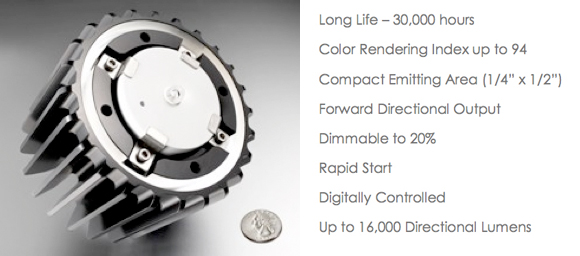
When the pill sized LEP bulb in mounted in the “puck” so that it will burn in all head orientations, the emitting area is no more than 1/4" x ¼." In this configuration, the 273W LEP bulb will deliver 16000 lumens or 57 lumens per watt. While much less than the 37’000 lumens the bulb will generate fully exposed in a horizontal position, it cannot be tilted up in that orientation. On the plus side, mounted so that it will burn in all orientations, all of its’ output is forward directed within a 60 degree angle so it doesn’t require a reflector. Such a highly localized forward directed light is ideal for Fresnel type instruments. As close an approximation to the ideal point source that exists today, its light output favors the central portion of the Fresnel lens. Since, this part of the lens has greater transmittance, LEPs are a more efficient source for Fresnel type heads than tungsten filaments, LED arrays, and even HMI arcs. For this reason you get more of those lumens transmitted through the lens in a highly collimated light that is very clean and crisp making it great for cutting shadows or gobo effects. The 273W LEP bulb in a Fresnel type instrument has an output comparable to a 575W HMI Fresnel.

Plasma_Forward_Projection.jpg

Forward directed output of Helios 270 LEP​

LEP head manufacturers also claim that LEP lamps provide a CRI of 94+. While impressive, CRI ratings published by manufacturers can be misleading. Where the CRI index indicates the ability of a light source to reproduce to the eye only 8 colors faithfully (a different 8 colors are used in Europe) they should be taken with a certain amount of skeptism. In the case of LED luminary manufacturers, for instance, it is possible to tune their output to the limited color range of the CRI color scale and deliver good color rendering to the eye while delivering generally poor color reproduction on the screen.

Plasma_vs_Mole_LED.jpg

More important than their high CRI ratings, is the fact that LEP lamps generate light with a continuous color spectrum. If you compare the spectral power distribution graphs (above) of natural daylight and LEP lamps (available at http://www.screenlightandgrip.com/html/emailnewsletter_generators.html#anchorHigh%20Output%20LEPs) you see that, except for very brief drop outs at approximately 425 nm and again at 475 nm, the light output of LEP lamps is almost identical to natural daylight.

And, as also can be seen in their spectral distribution graphs above, Plasma lamps have a much more continuous color spectrum than even the best LED luminaries on the market today. For instance, LEP lamps, unlike LED lamps, generate light at wavelengths shorter than 425nm - which means that violet colors will render better. And, unlike LED lamps, LEP lamps also output in the medium blue-cyan-turquoise range from about 465-510nm so aqua-type colors render well by comparison. Skin tones and warm, amber-yellow colors stand out better under LEP lamps because of the strong presence of their complementary colors. And, since the output of LEP lamps extend all the way out on the long-wavelength end (well beyond the 600 nm cutoff of LEDs), pinks, reds, oranges, and other long wave-length colors look vibrant under LEP light where they tend to look a little dull under LEDs. As a continuous spectrum source, colors not only appear more natural and vibrant under LEP lamps than under LED lamps, they also reproduce more accurately on the screen since, as is also evident by their spectral distribution graph, the output of LEP lamps is almost an exact match to the spectral sensitivity of daylight film emulsions and digital sensors. Plasma lights will deliver the same true-to-life color rendition previously achievable only with full-spectrum Daylight or HMI sources. As an added bonus, color meters, like the Minolta III F, that make their calculations of the Color Temperature (CT) based on a light sources continuous spectrum, are able to generate accurate reading of the CT and Green/Magenta of LEP lamps where they are almost completely useless with LEDs.

Another feature of LEPs that has been overblown is their purported 20-30’000 hr lamp life. But, where I am out of space here, I will pick up with that issue in my next post.

Guy Holt, Gaffer, ScreenLight & Grip, Lighting Rental & Sales in Boston
 
Another feature of LEPs that has been overblown is their purported 20-30’000 hr lamp life. But, where I am out of space here, I will pick up with that issue in my next post.

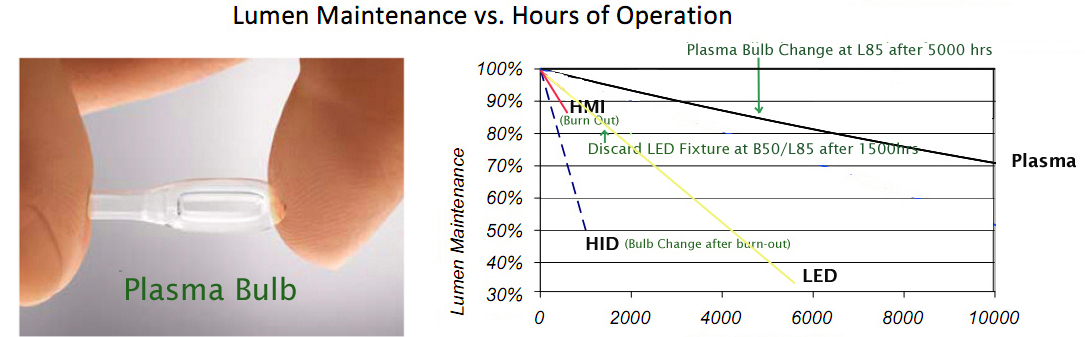
What is the “lamp life” of an LEP bulb is up for debate. Peter Daffarn of Photo Beard wrote in the Cinematographer’s Mailing List (CML): “Lamp life as quoted by Luxim is 30,000 hours but we are saying 20,000 to be sure.” Such claims of 20'000 – 30’000 hr lamp life made by manufacturers like Photon Beard should be taken, I think, as nothing more than marketing hyperbole. Determining the "life" of an LEP, like that of an LED, is a very complex matter because LEPs have no filament or electrodes to burn out and thus will keep on producing light, although at declining levels and with a gradual shift in color, beyond their useful life. And, since a LEP (like an LED) has a comparatively very long life (as conventionally defined), over which its' lumen output drops continuously, it also has an appreciatively greater lumen depreciation over that life than does an HMI lamp. Given their continuous lumen depreciation and color shift over time, it is clear that there comes a time when a LEP bulb has surpassed its’ working life and should be retired. Since it won't burn out in its' prime, like an HMI lamp, how do we determine when a LEP has surpassed its' useable life.

Plasma_Color_Shift_Alt.jpg


Clearly, this new technology requires a new approach to determining useable "lamp life" than that used for conventional lamps like HMIs. For instance, how useful is Photon Beard’s "lamp life" of 20'000 hours when according to Luxim’s specifications the bulb’s lumen output will depreciate as much as 60% with a color shift of 1000K (from 5300K to 4300K) in that time. Whatever the stated lifetime of any emitter technology, it must reflect a meaningful statistical measure of the performance of it in a given fixture design for a specific application. Clearly, in the case of LEP luminaries to be meaningful "lamp life" must be defined as the point of unacceptable lumen depreciation and color shift for our particular application rather than complete failure to light. And, whatever level of lumen depreciation is chosen for “low-light failure”, to be meaningful to it's users, it should be in line with existing lamp technologies used in that industry.

Plasma_Decay_Alt.jpg

In the case of motion picture lighting, I would argue that nothing short of a L85 criteria would be appropriate and meaningful, since that has been our experience with both HMI and Tungsten Lamps (where the “rated life” is the interval in which 50% of lamps fail and with an average lumen depreciation of 80-85%.) If we adopt this criteria for motion picture lighting applications of LEPs, their rated lamp life would still be an unparalleled 5000 hrs (compared to 500-750 hrs for HMIs and approximately 1500 hrs for LED fixtures.) In other words, the interval in which the output of an LEP drops-off of to 85 percent of its’ original value (L85) is 5000 hrs. Unlike an LED fixture that has no replaceable parts, the bulb of an LEP can be replaced after reaching this “low-light failure”, so the fixture does not have to be thrown away as is often the case with LEDS (see newsletter article for details.)

Where we are a long way off from having a single-die LED with sufficient output and correlated color temperature to match HMIs, LEP lamps are a cost effective alternative to expensive HMI Fresnel systems when it comes to generating daylight balanced light. In fact there is one LEP head that we are looking at (not the Photon Beard Nova 270 – it’s too expensive) because it has a Power Factor of .99 making it a near linear load. As a result, it uses power more efficiently, minimizes return current, and generates virtually no line noise. Where, it is as much the Harmonic Noise that non-PFC HMI, Fluorescent, and LED power supplies kick back into the power stream, as it is their higher Apparent Power, that limits the total number of them that can be reliably operated on conventional portable generators; the efficiency and near unity Power Factor of this LEP head means that you can operate more of them on portable gas generators. For instance, you can operate four 575W HMIs on a 6500W portable AVR generator, where you should be able to operate 23 of these 270W LEP heads (each with an output comparable to a 575W HMI).

Plasma_PowerWaveform.jpg

Oscilloscope shots comparing the current and voltage waveforms of the PFC Helio 270 with an equivalent wattage of non-PFC LEDs​

Where LEP is radically new technology there is a lot to get your head around. One way to think of a LEP bulb is as a tiny discharge lamp. But, unlike an HMI bulb it does not have electrodes. Instead of applying a voltage and drawing a current through the lamp to create light as does an HMI, the energy that creates light in an LEP comes via a high frequency RF transmitter. The RF waves heat the materials inside the lamp and bring those materials to a plasma state so that the lamp emits a "flicker-free" light. Besides better color rendering, light quality, and lamp life, this different method of transforming electricity into light has other benefits as well. For more details about LEPs see our newsletter article at http://www.screenlightandgrip.com/html/emailnewsletter_generators.html#anchorHigh%20Output%20LEPs.

Guy Holt, Gaffer, ScreenLight & Grip, Lighting Rental & Sales in Boston
 
Back
Top