
Navigation
Install the app
How to install the app on iOS
Follow along with the video below to see how to install our site as a web app on your home screen.

Note: this_feature_currently_requires_accessing_site_using_safari
More options
Welcome to our community
Be a part of something great, join today!
You are using an out of date browser. It may not display this or other websites correctly.
You should upgrade or use an alternative browser.
You should upgrade or use an alternative browser.
Latitude VS Dynamic Range
- Thread starter SUNILPREM
- Start date
- Moderator
- #2

- Joined
- Apr 19, 2007
- Messages
- 13,392
- Reaction score
- 796
- Points
- 113
- Location
- Los Angeles
- Website
- www.phfx.com
Generally speaking, and there is some nuance it seems in some people's terminology and definition, though not really when it comes down to it.
Total Captured Dynamic Range - A measurement of tonal range between absolute clipping white and crushed black that an imaging system can record.
Exposure Latitude - The measurement of the amount of over and under exposure range you have before clipping and crushing.
In photography, analog or digital, depending on your exposure method and ISO/ASA rating you have some control over how many stops of Latitude you may have above and below 18% Gray (Middle Gray).
Generally a Higher ISO Rating will provide more stops dedicated to highlight information. Thus a Lower ISO Rating will favor cleaner shadows at the cost of highlight latitude.
Other terminology worth understanding.
Base ISO - This is the ISO Rating that the manufacturer recommends as a "good starting place", a good balance between Highlight and Shadow Latitude while still being a fairly pleasingly clean image. Often you'll find that this rating has about the same amount of stops above and below 18% Gray, give or take 1-3. Just depends.
Recommend or Default ISO Range - This is the general Recommend ISO Range by the manufacturer and is a fairly safe usable range for a variety of shooting conditions. For instance in the RED ecosystem that is commonly ISO 250-3200.
Extended ISO Range - Often in cameras you have access to an Extended ISO Range for higher and even lower ISO Ratings. Ideally you should know the pros and cons of working at these ranges.
Highlight Clipping - When highlight information exceeds the exposure range, it is over exposed and usually there is no data to recover.
Crushed Shadow - When shadow information is under exposed and crushed into the Noise Floor, it remains just noise with no information to recover. i.e. the Base Fog of film.
Usable Stops - This one will vary on the filmmaker or DP's perspective on what they view a Usable Stop is. Mostly this relates to a tolerance for image noise, texture, or grain.
You'll note that the first two terms are finite measurements. One being a total count and the other being relative to 18% Gray on where you choose to rate your exposure. A Usable Stop will have a lot of "range" among filmmakers and likely reveals much of what sort of image they enjoy creating as well as what sort of safety net they may like to have in regards to their chosen exposure method or technique.
General rule of thumb, if you want to see it, keep it well exposed. Clipping in particular with digital can look pretty bad, though on quality digital cinema cameras we've done a lot to create a more pleasing highlight roll-off through well implemented algorithms and gamut mapping. It's most offensive to viewers as well as the filmmaker when something that should be exposed well is in fact over exposed and not recoverable. This can equally be said for a crushed black, though depending on what you are after, both might be fine to do if you understand where and what is lost. For instance, clipping on little specular highlights that will be very small in frame may not distract much from the overall image. Similarly a small corner of a crushed shadow in a an area that is generally "black" won't likely distract much.
However, I would say in the era of HDR Cinematography you want to stay much more on top of things (honestly just in general too). Both in terms of Crushing or Clipping, but also where your may rate your exposure. HDR in general can have rather dynamic contrast ranges which will reveal more image noise depending on how you expose and grade an image. You also might see very deep into the shadows, you might also really want to protect against a clipped highlight too as it might become rather "toxic to the eye" in an HDR finish. These are tips from my personal experience.
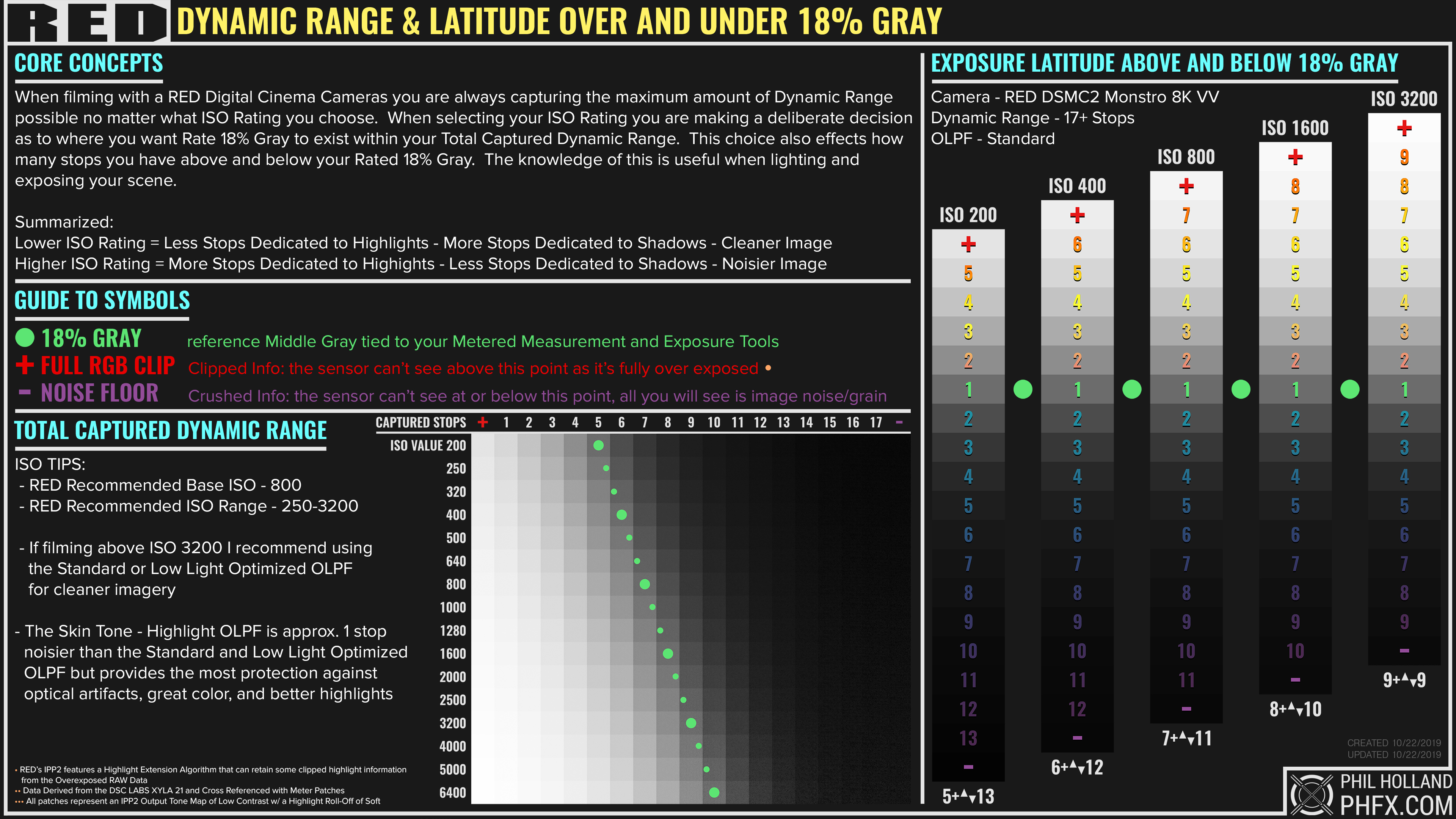
This is a useful chart that plots the Total Captured Dynamic Range of Monstro with actual measured and captured Gray Patches, which should help visualize much of this:
Total Captured Dynamic Range - A measurement of tonal range between absolute clipping white and crushed black that an imaging system can record.
Exposure Latitude - The measurement of the amount of over and under exposure range you have before clipping and crushing.
In photography, analog or digital, depending on your exposure method and ISO/ASA rating you have some control over how many stops of Latitude you may have above and below 18% Gray (Middle Gray).
Generally a Higher ISO Rating will provide more stops dedicated to highlight information. Thus a Lower ISO Rating will favor cleaner shadows at the cost of highlight latitude.
Other terminology worth understanding.
Base ISO - This is the ISO Rating that the manufacturer recommends as a "good starting place", a good balance between Highlight and Shadow Latitude while still being a fairly pleasingly clean image. Often you'll find that this rating has about the same amount of stops above and below 18% Gray, give or take 1-3. Just depends.
Recommend or Default ISO Range - This is the general Recommend ISO Range by the manufacturer and is a fairly safe usable range for a variety of shooting conditions. For instance in the RED ecosystem that is commonly ISO 250-3200.
Extended ISO Range - Often in cameras you have access to an Extended ISO Range for higher and even lower ISO Ratings. Ideally you should know the pros and cons of working at these ranges.
Highlight Clipping - When highlight information exceeds the exposure range, it is over exposed and usually there is no data to recover.
Crushed Shadow - When shadow information is under exposed and crushed into the Noise Floor, it remains just noise with no information to recover. i.e. the Base Fog of film.
Usable Stops - This one will vary on the filmmaker or DP's perspective on what they view a Usable Stop is. Mostly this relates to a tolerance for image noise, texture, or grain.
You'll note that the first two terms are finite measurements. One being a total count and the other being relative to 18% Gray on where you choose to rate your exposure. A Usable Stop will have a lot of "range" among filmmakers and likely reveals much of what sort of image they enjoy creating as well as what sort of safety net they may like to have in regards to their chosen exposure method or technique.
General rule of thumb, if you want to see it, keep it well exposed. Clipping in particular with digital can look pretty bad, though on quality digital cinema cameras we've done a lot to create a more pleasing highlight roll-off through well implemented algorithms and gamut mapping. It's most offensive to viewers as well as the filmmaker when something that should be exposed well is in fact over exposed and not recoverable. This can equally be said for a crushed black, though depending on what you are after, both might be fine to do if you understand where and what is lost. For instance, clipping on little specular highlights that will be very small in frame may not distract much from the overall image. Similarly a small corner of a crushed shadow in a an area that is generally "black" won't likely distract much.
However, I would say in the era of HDR Cinematography you want to stay much more on top of things (honestly just in general too). Both in terms of Crushing or Clipping, but also where your may rate your exposure. HDR in general can have rather dynamic contrast ranges which will reveal more image noise depending on how you expose and grade an image. You also might see very deep into the shadows, you might also really want to protect against a clipped highlight too as it might become rather "toxic to the eye" in an HDR finish. These are tips from my personal experience.
This is a useful chart that plots the Total Captured Dynamic Range of Monstro with actual measured and captured Gray Patches, which should help visualize much of this:
Last edited:
- Thread starter
- #3