Welcome to our community

Be a part of something great, join today!

  • Hey all, just changed over the backend after 15 years I figured time to give it a bit of an update, its probably gonna be a bit weird for most of you and i am sure there is a few bugs to work out but it should kinda work the same as before... hopefully :)

Kinoflo Vistabeam 300 experience

Jeremy Wiles

Well-known member
Joined
Nov 17, 2008
Messages
601
Reaction score
0
Points
16
Location
West Palm Beach, FL
Website
www.kingdomworks.com
Hi,

I was wondering if someone can tell me about the Kinoflo Vistabeam 300 and give a short review. I'd like to know how it compares to the Parabeam 400 and what would be a better choice for film lighting. Two Parabeam 400's or one Vistabeam 300?

I want a versatile light that can be used on film sets, interview lighting and studio lighting (grid).

Thanks,

Jeremy
 
I haven't worked with the Vistabeam yet but I do have two Parabeam 400's and have been very happy with the versatility they have provided me. Although most recommend them for in Studio, I have brought them to many locations and find their size very manageable especially when you consider the benefits they offer from an output to power consumption ratio.
 
I was wondering if someone can tell me about the Kinoflo Vistabeam 300 … I'd like to know how it compares to the Parabeam 400 …..
on film sets, interview lighting and studio lighting (grid).

Both the Vistabeam & Parabeam fixtures are going to be better than conventional fluorescent movie lights (the Kino T12 fixtures included) to serve as key sources on film sets and studio sets. Conventional fluorescent movie lights don’t make good key sources for dramatic scenes because they have a very broad light output that is hard to control. These lights also tend to drop off rapidly which means that to serve as a Key source, the units need to be positioned close to the subject they are lighting. These characteristics make them best suited to serve as Key sources in documentary interview set-ups where the Keys are typically positioned close to the interview subject. In that capacity conventional fluorescent lights like the Divas can generate a wonderful soft light that wraps around the interview subject without wilting them. But, given these characteristics, conventional fluorescent movie lights have only limited applications as fill sources in dramatic set lighting.

The Vistabeam & Parabeam lights incorporate features that make them a much better key source than conventional fluorescent lights. But, first in the interest of full disclosure, I should say at this point that in addition to being a gaffer, I own and operate ScreenLight & Grip. If what I am about to say sounds like I’m hyping the Kino Flo product line it is not because we rent and sell them. We are dealers and rental agents for just about all the major brands. As a professional Gaffer of a lot of tight budgeted historical documentaries for PBS’ American Experience and The History Channel (see my “credit-entials” on Imbd), I think it is worth noting that these fixtures have features that make them a better key source than just about any other fluorescent light.

If you are lighting a movie, you will be better served by a Vista or ParaBeam fixture than other fluorescent lights because they use computer aided designed (CAD) parabolic reflectors to focus their light output where it is needed most for lighting dramatic scenes - at a medium distance – making them a better key source. If you compare the photometric tables of either the Parabeam 400 or Vistabeam 300 with those of a Kino Flo Diva 400 (which uses the same four lamps as the Parabeam), you will notice that at 16’ both the Parabeam 400 and Vistabeam 300 puts out almost three times the light level (28FC) than the Diva 400 (10FC) even though they both use the same tubes.

Not only do the Vistabeam & Parabeam fixtures have more throw than other fluorescent lights but they are also more easily controlled – an essential requirement in a key source. Vistabeam & Parabeam fixtures fixtures are controlled by interchanging Kino Flos’ innovative Honeycomb Louvers. Louvers are available in 90, 60 and 45 degrees. Swapping louvers provides beam control similar to that of swapping lenses on an HMI Par. These features enhance the production capabilities of the Parabeam fixtures and make them suitable to serve as a key or backlight source where conventional fluorescent fixtures will spill all over a set and are therefore only suited to serve as fill sources.

Since, many dramatic scenes take place outdoors at night, how well a fluorescent light operates on portable generators is another consideration one should take into account. This is where you find a difference between the Vistabeam & Parabeam fixtures. The Parabeam fixtures use ballasts that include Power Factor Correction (PFC) circuitry, where the Vistabeam fixtures do not. As it does in HMI ballasts, this advanced electronics contributes to a more economical use of power than conventional electronic ballasts. For example, a Kino Flo Parabeam 400 draws less than half of the power (2 Amps) of a Vistabeam 300 (4.8 Amps), yet has roughly the same output. While this nearly 3 amp difference is not a major consideration when using studio power, it can make a difference when your power is coming from a portable generator because you can use two Parabeam 400s for the same power as a Vistabeam 300.

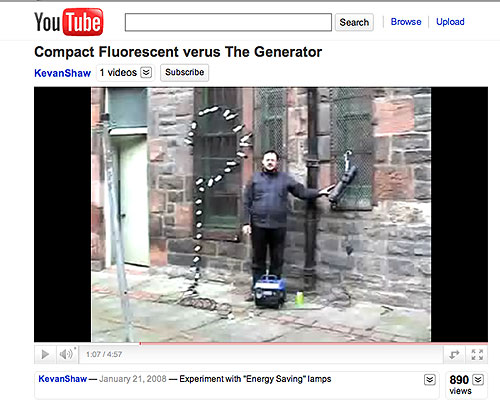
The greater Apparent Power of the Vistabeam lights is not the only consideration when operating them on portable gas generators. When you use light sources like HMIs, Kinos, CLF lamp banks, and even LEDs, on generators it matters what type of ballasts the light uses because of the Harmonic Noise that ballasts with poor Power Factor kick back into the power stream can have a severe adverse effect on the power waveform of some generators. There is a video on You-Tube by a Lighting Designer by the name of Kevan Shaw that illustrates just this.

CFL_vs_Gen_Dem.jpg

In his You-Tube Video, “Compact Fluorescent verses the generator,” (available at http://www.youtube.com/watch?v=LeCqreRMzKM) Kevan Shaw compares the effect of equal wattages of CFLs and Incandescent lights on a small portable generator. In his test, he first operates a 575W ETC Source Four Leko with Quartz Halogen bulb on an 850W two stroke conventional gas generator without problem. However, when he tries to operate an equivalent wattage of CFLs (30-18W bulbs) the generator goes berserk. Only after turning off half the CFL Bulbs does the generator operate normally with a remaining load of 15 - 18W CFLs (270 W.) What accounts for the erratic behavior of the generator in this video under a smaller load of CFLs? It is a combination of the poor Power Factor of the CFL bulbs and the harmonic currents they generate.

Even though the 15 CFL bulbs have a True Power of 270W (15 x 18W = 270W ), the Watt indicator on Kevan's generator indicates that they draw twice that in Apparent Power (535W), or have a Power Factor of .5 (270W/535W =.504.) The fact that CFL bulbs consume double the energy (Apparent Power) for the 18 Watts of light (True Power) they generate, is only half the story here. Kevan Shaw’s video also clearly demonstrates the severe effect that loads - like CFLs, HMIs, Kinos, & LEDS - with leading power factor can have on the governing systems of conventional AVR generators.

When Kevan turns off the 18W CFL bulbs one at a time until the generator stabilizes, he is not only demonstrating that 15 – 18W CFL bulbs has roughly the same Apparent Power (535W), according to the generator’s Watt meter, as a 575W incandescent light; but, also that the maximum Leading Power Factor load a 850W conventional generator can operate satisfactorily is 270 Watts (15 – 18W CFL bulbs). Looked at from another angle, 576 Watts of Apparent Power with a Leading Power Factor (16 - 18W CFL bulbs) overloaded the generator, while 575 Watts of Apparent Power with a Unity Power Factor (the 575W Quartz Leko) did not. What accounts for this difference? Since the load is almost the same (576 & 575 Watts of Apparent Power respectively), the only factor that can account for the generator going berserk with the equivalent load of CFL lights is the harmonic currents that they generate, that the Quartz Leko does not. Without a doubt, Kevan Shaw’s video is a clear demonstration of the adverse effect that harmonic currents have on the governing systems of conventional AVR generators. Where I am out of space on this post, I will pick up with another why the Kino Flo Parabeam is better for generator operation than the Vistabeam lights.

- Guy Holt, Gaffer, ScreenLight & Grip, Lighting and Grip Rental in Boston
 
Where I am out of space on this post, I will pick up with another why the Kino Flo Parabeam is better for generator operation than the Vistabeam lights.

In the studio applications for which the Vistabeam lights are designed to be used, harmonic currents are less of a concern than they are in location production applications. Put simply, when you plug a Vistabeam light into a wall outlet you need not be concerned about harmonic currents. As is the case with non-PFC HMI ballasts the impedance of the electrical path from the power plant is so low, the distortion of the original voltage waveform so small (1-3%), and the plant capacity so large in comparison to the load of the one light, that the inherently noisy load of Vistabeam lights will not affect the voltage at the distribution bus.

wwaveform_no-load.jpg

Left: Grid Power w/ no load and a THD of less then 3%. Center: Conventional Generator w/ no load and a THD of 17-19%. Right: Inverter Generator w/ no load and a THD of 2.5%.​

As is evident in the oscilloscope shots below, it is an all together different situation when plugging the same fixture into conventional portable generators. The non-pfc ballasts of Vistabeam lights, as well as the older style Kino fixtures that use T-12 ballasts (the Single, Double, & 4 Bank Fixtures, the Wall-o-Lite fixture, as well as the Image 20, 40, & 80 fixtures) return harmonic currents into the power stream that can generate voltage distortion. Given the large sub-transient impedance of conventional portable generators, and the fact that the original supply voltage waveform of conventional generators is appreciably distorted (a THD of 17-19%) to begin with, you have a situation where the return of any harmonic currents, whether by a non-PFC electronic ballast (HMI or Kino), results in significant waveform distortion of the voltage in the distribution system. The generation of harmonic currents by production equipment should be eliminated whenever possible, otherwise, as we saw in Kevan Shaw’s video, it can build to a point where it will have an adverse effect upon not only the generator but also on other equipment running on the same power.

wwaveform_kino.jpg

Left: Grid Power w/ Kino Flo Wall-o-Lite. Center: Conventional AVR Power w/ Kino Flo Wall-o-Lite. Right: Inverter Power w/ Kino Flo Wall-o-Lite.​

For example, for an article I wrote for our company newsletter on the use of portable generators in motion picture production, I ran a package consisting of two Arri 1200 HMI Par Pluses (with standard Arri non-PFC electronic ballasts) in addition to a 4’ – 10 tube Kino Flo Wall-o-Lite (with T-12 Ballasts) on a Honda EX5500 (a conventional generator). And, for the sake of comparison, I ran a comparable package but with power factor corrected electronic ballasts on our modified 7500W EU6500is (an inverter generator.) The difference between the resulting waveforms was startling.

The adverse effects of the severe harmonic noise generated by non-pfc light fixtures (exhibited below left), can take the form of overheating and failing equipment, efficiency losses, circuit breaker trips, excessive current on the neutral return, and instability of the generator’s voltage and frequency. For these reasons it has never been possible to reliably operate more than a couple of 1200W HMIs along with non-pfc Fluorescents on conventional portable gas generators.

wwaveform_pkg_comp_AVR_In.jpg

Left: Conventional generator power w/ pkg. of non-PFC Elec. HMI Ballasts & Kino Flo Wall-o-Lite. Right: Inverter generator power w/ Pkg. of PFC Elec. Ballasts & Kino Flo Parabeam 400.​

By comparison the distortion of the voltage waveform is considerably less in the case of the inverter Honda EU6500is generator (far right) than that of the conventional Honda EX5500 generator (left.) The reason for this is that, as discussed at length in my article, the original waveform of the power generated by the EU6500is (an inverter generator) has less harmonic distortion at the outset than that originally generated by a EX5500 (conventional generator.) For this reason, when your lighting package consists predominantly of light sources, like HMI and Fluorescent lights, it is important to have power factor correction (PFC) circuitry in the ballasts (HMI & Kino) and operate them on inverter generators like our modified Honda EU6500is.

HD_PP_DemoWS.jpg

Wide Shot of Night exterior scene lit with our HD P&P Pkg.​

For example, the substantial reduction in line noise that results from using the PFC Parabeams and HMIs with PFC ballasts on the nearly pure power waveform of an inverter generator creates a new math when it comes to calculating the load you can put on a generator. In the past we had to de-rate portable gas generators because of the inherent short comings of conventional generators with AVR and Frequency governing systems when dealing with the harmonic noise of non-PFC HMI and Fluorescent fixtures like the Vistabeams.

HD_PP_Demo_SetUp_Night.jpg

The PFC 2.5 & 1.2 HMI Pars, PFC 800w Joker HMI, Kino Flo Flat Head 80, 2 ParaBeam 400s, and a ParaBeam 200 of our HD P&P Pkg. powered by our modified Honda EU6500is through our 60A Full Power Transformer/Distro​

But now, that inverter generators have virtually no inherent harmonic distortion or sub-transient impedance and power factor correction (PFC) is available in both small HMI and the Kino Parabeam fixtures, this conventional wisdom regarding portable gas generators no longer holds true. Where before you could not operate more than a couple 1200W HMIs with non-PFC ballasts on a conventional generator because of the consequent harmonic distortion, now according to the new math of low line noise, you can load an inverter generator to capacity. And if the generator is our modified EU6500is inverter generator, you will be able to run a continuous load of up to 7500W as long as your HMIs and Kinos are Power Factor Corrected.

HD_PP_Demo_Transformer-Distro.jpg

A Distro System consisting of a 60A Full Power Transformer/Distro, 2-60A GPC (Bates) Splitters, 2-60A Woodhead Box distributes power from a modified Honda EU6500is. Even though the generator is 100' away to reduce noise, plug-in points remain conveniently close to set.​

According to this new math, when you add up the incremental savings in power to be gained by using only PFC Lights, and combine it with the pure waveform of inverter generators, you can run more lights on a portable gas generator than has been possible before. For example, the 7500W capacity of our modified Honda EU6500is Inverter Generator powered a lighting package for a recent Red shoot (see production stills above) that consisted of a PFC 2.5kw HMI Par, PFC 1200, & 800 HMI Pars, a couple of Kino Flo ParaBeam 400s, a couple of ParaBeam 200s, and a Flat Head 80. Given the light sensitivity of HD cameras, this is all the light needed to light even a large night exterior.

BoxBookForumLinkGenSetMed.jpg

If you haven't already, I would suggest you read the article I wrote for our company newsletter on the use of portable generators in motion picture lighting. In it I cover some of the basic electrical engineering principles behind harmonic distortion and how it can adversely affect generators. Harry Box, author of “The Set Lighting Technician’s Handbook” has cited my article in the just released Fourth Edition of the handbook. In addition, he has established a link to it from the companion website for the Fourth Edition of the Handbook, called “Box Book Extras.” Of the article Harry Box states:

"Great work!... this is the kind of thing I think very few technician's ever get to see, and as a result many people have absolutely no idea why things stop working."

"Following the prescriptions contained in this article enables the operation of bigger lights, or more smaller lights, on portable generators than has ever been possible before."​

Use this link for more details on the advantages to be gained by using Parabeam fixtures on portable gas generators.

Guy Holt, Gaffer, SceenLight & Grip, Lighting and Grip Rental in Boston.
 
Thank you very much. I appreciate the time everyone took to respond.

I'm going to go with two Parabeam 400's and a few Image Bank 45's for the green screen.
 
I'm going to go with two Parabeam 400's and a few Image Bank 45's for the green screen.

Is the green screen a studio cyc wall. If so what are the dimensions of the studio and what kind of clearance do you have?

- Guy Holt, Gaffer, ScreenLght & Grip, Lighting and Grip Rental & Sales in Boston
 
Guy
I am extremely grateful for the amount of information and time you are giving us, but :) if I see those parabolas again, I'll shoot myself !
 
Is the green screen a studio cyc wall. If so what are the dimensions of the studio and what kind of clearance do you have

I have two areas I need to light. One is a 26 ft wide cyclorama, which will be a hard set. I plan to use 5 Ellipsoidals and two Parabeams on the cyc. The greenscreen is 20 ft wide and 11 ft high and I was planning to use 2 Image 45's. However, I need about 5 Image 45's to light this whole area, but will add lights later on.
 
If you're in the LA area I have a Vista Beam 600 you can try. Of course it can be dimmed to 3 bulbs.
 
Back
Top