Welcome to our community

Be a part of something great, join today!

  • Hey all, just changed over the backend after 15 years I figured time to give it a bit of an update, its probably gonna be a bit weird for most of you and i am sure there is a few bugs to work out but it should kinda work the same as before... hopefully :)

Kinefinity MAVO Edge

Here is a link to more Mavo Lf sample footage to grade


https://www.dropbox.com/sh/9jhlqmxt4gtdlfb/AACp4qQ-M14H2AgPh7F78NsYa?dl=0

Screenshot-1856.png
 
Dan,


I think I read the disclaimers at the bottom of Kinefinity's website


"ALL SPECIFICATIONS SHOWN ARE PRELIMINARY AND SUBJECT TO CHANGE WITHOUT NOTICE."

"Above complete functions can be realized by firmware update."


So who knows what Features the Mavo Edge will have when it becomes available and what Features will be enabled later with a future firmware update.

So this could just be a kinefinity " Wet Dream".
 
Last edited:
Here's a Video made from the Mavo LF sample clips above. I tried a couple different ways to Stabilize the first clip in this video. However, it either zoomed in too much to compensate or gave some weird artifacts so I just said fuck it.


here's a link to 4KUHD 344 MB original video before youtube compression.

https://we.tl/t-6AY6w8tC20


Last edited:
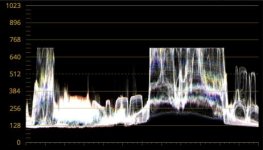
Why the hell do the manufacturer map the whole dynamic range in a such small usuable range? They could use the whole range from 0 to 1023 (or 64 to 940).
Would lessen banding problem and use a less harsh curve and gain (130%) to "unlog" it.
 

Attachments

  • MavoEdge.jpg
    MavoEdge.jpg
    20.8 KB · Views: 0
Why the hell do the manufacturer map the whole dynamic range in a such small usuable range? They could use the whole range from 0 to 1023 (or 64 to 940).
Would lessen banding problem and use a less harsh curve and gain (130%) to "unlog" it.


Patrick,


I always thought the same thing the first time I came across log footage which was Sony S-Log and Panasonic V-Log lite. Why did the Log Lut, for whatever the color space it was transforming to, have to stretch the log image so much. With S-Log and V-Log lite, I never really liked using Luts at all when I was using Avid Media Composer. When the IPP2 Luts came about , I never really wanted to use them either. But I realized that if I wanted the develop the Red R3D image correctly I would be better off processing the Red image as Red had intended for it to be processed.
 
Why the hell do the manufacturer map the whole dynamic range in a such small usuable range? They could use the whole range from 0 to 1023 (or 64 to 940).
Would lessen banding problem and use a less harsh curve and gain (130%) to "unlog" it.

Ideally Log or raw camera footage should be converted to the display color space you will grade or deliver in using a mathematically correct transform before you apply LUTS or other grades. Directly grading camera log footage or raw footage in a display colorspace doesn’t produce the best results.
Learn to use Resolve’s color managed conversion processes.
If you use creative third party LUTS, you first have to convert the camera native colorspace to the specific intermediate colorspace the LUT is written for. Most IQ issues with LUTS are a result of applying them in the wrong colorspace.
Your reference monitor should be calibrated for the colorspace your footage will be delivered in, still typically REC709 for web and TV most of the time, though BT.2020 and various HDR gammas are becoming more prevalent for 4k deliveries.

But Do you understand why they map it to Cineo log type of signal instead of using all the 10bit values? It still could be encoded in a lof format. Or is it so that log in a 14 stop DR image will allways give you this kind of signal mapping?

As a side note, I was never happy with any technical transform lut I've seen made by Sony. I've created my own to make the prores proxies. With Red footage it's different. I do make a one pass color grade in RCX for whole sequences to give the rushes to the director.
 
Zhiyun Crane 3S Example Footage using the Kinefinity MAVO LF


By Newsshooter

Article
https://www.newsshooter.com/2020/05/25/zhiyun-crane-3s-review/


Some example shots using the Zhiyun Crane 3S and the Kinefinity MAVO LF at 75fps.


Zhiyun Crane 3S Example Footage


By Newsshooter


Some example shots using the Zhiyun Crane 3S and the Kinefinity MAVO LF at normal speed


Last edited:
Carlos,

Thanks for thinking so! But I promise you I have seen better. I personally just like an image where blacks , greys and whites are as neutral as possible. I also like an image where skintones are as close to natural looking as possible and where colors are saturated but not "Out Of Gamut" I try to bring that same methodology to grading all footage from all cameras. There's nothing really magical or special about that it's just that some people don't agree with me on that approach.
Strange looking it's not worse. Solid exposure and you can do what ever you like, probably fun camera.

qjIxP33.jpg
 
David,

I was trying to wrap my head around the benefits of using the EI mode over the ISO mode. I believe you just cleared that up for me, thanks. Yeah, to my knowledge I've never heard of anyone else using that Arri method.

The upcoming Canon C300iii is the first one (other than Arri) to incorporate it. Canon are calling it "dual gain output", the tests of it posted so far aren't very useful, but the improvement in shadow quality appears to be quite exceptional (they've definitely gained at least a stop).
 
Thanks for the Grade Alex!, and thanks for info about the canon C300iii Mark!
 
Full frame test


By Kenneth Ishii


Full Frame Test

Specs:
Alexa Mini LF
ProRes 4444
UHD 16x9 (3840 x 2160)
Sensor area: 31.68 x 17.82 mm

5600 Kelvin / 25 fps / 180 degree shutter
LogC to Rec709 LUT

Sigma FF High Speed Prime 35mm / 85mm
Leica Thalia 35mm / 70mm
Zeiss Supreme Prime Radiance 35mm / 85mm
Whitepoint Optics WPO TS70 series 40mm / 80mm
Kinefinity Mavo Prime 35mm / 75mm
Arri Signature Prime 35mm / 75mm
Leitz Prime 35mm / 75mm
 
Thanks Jerome for posting! I'm sure like myself others here will be appreciative of any additional info you can provide about the Mavo Edge! And thanks also for the links!


My first question is will ProRes 4444XQ be available at both Open Gate and DCI 8k?
 
Back
Top