Welcome to our community

Be a part of something great, join today!

  • Hey all, just changed over the backend after 15 years I figured time to give it a bit of an update, its probably gonna be a bit weird for most of you and i am sure there is a few bugs to work out but it should kinda work the same as before... hopefully :)

Issues

Graeme has mentioned that the compression, although 12:1 is very efficient (not sure if that is the right term) and that compared to images out through the raw port is very difficult to tell the difference by eye.

This is a very interesting thread, but we may not have an instant answer here for a number of reasons.

1. Redcine and Red Alert are still beta
2. Firmware is still being tweaked. Those under NDA can't say much about this.
3. Although a lot has been shot, the camera is constantly evolving and it makes comparisons tough unless you are comparing exact revisions, settings, etc.
4. LART may provide us some interesting results. That was quite a team working out there and I have high expectations on their thorough analysis of what the camera is capable of at this point in time.

I think we need to be patient. I know people have money on the line with some of their shoots and no one wants to look bad to their clients, but this camera is not a final production model yet. If someone were to take a F900 off the shelf and experience all kinds of problems with it, well they would throw a fit because it's a production model, released as a finished product. I don't think REd is ready to call their cameras production models just yet. First 100 took a huge leap of faith and are leading the way for the rest of us. All we can do is thank them for everything they have provided to those of us waiting in the wings.

Steve
 
As for blue filters... a blue filter might result in less noise, but it'll also lower your effective ASA to something around 100. If you have the lighting budget to light to 100 ASA... you have enough amperage to light a scene properly to the point where you don't see noise to begin with.

But it's not that simple and it's not as simple as a "5000k color balanced sensor" (Something which I don't think is entirely accurate. It's probably closer to a 5k color temperature than anything else but with a strong color cast due to the bayer filtration.)

This whole question of noise is more complex than "are you properly exposed". With a bayer pattern each color is being exposed differently with a gap of easiliy 2 stops between blue and green.

If you can expose for 100 asa you may now be exposing the green for 100 asa, but your blue might still be a 25 ASA! Pushing the footage just one stop to 600 ASA means your poor blue channel is now underexpose by 3 stops. Shoot a sodium vapor street lamp (most night scenes) and your blue channel could under very poor conditions be 4 stops under.

The worst imagineable condition would be to shoot under a sodium vapor street lamp onto skin tones that you want to look reasonably white. That's a worst case scenario but it's also an extremely likely one if you're shooting existing light at night.

If you want all 3 colors firing on all cylinders you probably need to filter.
 
I start shooting some dramatic work on Friday morning. I ordered an 80b. We'll see if I have time to experiment with it.

I agree that ASA shift is likely not the way to get pretty images. There are other ways to bring up the intensity of a dark image, while still pinching the noise floor. I think this may be the main source of the woes.

Ibloom
 
or enough light. For any tungsten location besides a stage its not practical. I would definately maybe open the shutter to 270 to get more light in. Ive noticed on many digital cameras that this shutter angle even makes it look more "filmic" than 180. And its a half a stop to print down from as well.
 
It depends on the scene. If you are moving the camera, your actors, lenses, exposure. What is the intent of the scene, realistic or not ?

You will get motion smear if you change the shutter; that may or may not work for you.
And if you are panning, and there is a building in the shot...

I'd like to see the same shot with diff. asa's to see how acceptable it is. If you are only shooting with natural light or practicals (city street) then the difference is what the shot is trying to accomplish.

I agree with Mr. Mullen, though.

:beer:
 
People should watch out being overly anal-retentive about their cinematography in some attempt to get perfect results technically.

I'm sure you could use a blue filter and end up lighting your night interiors and exteriors to 100 ASA levels to compensate and get really clean results, but at the risk of having a very artificially-lit look. I mean, you could also get a very clean look by shooting on 100 ASA 35mm film if that's the look you want.

Most modern lighting is pretty low-key and minimal for night scenes, and often shot on 500 ASA tungsten-balanced stocks. You turn on a practical tungsten lamp in a living room and you bounce an additional, little weak tungsten unit into a white card or ceiling, dimmed down to match the warmth of the practical and not overpower the natural ambience, you shoot at a fairly wide-open stop... and you get a very natural "unlit" look. Just look at what Roger Deakins does for his night interior scenes, like in "No Country for Old Men", "In the Valley of Elah", "Assassination of Jesse James" -- he lets the practicals do most of the work in the scene and augments as little as he needs to.

So while I can see jumping through hoops to get the cleanest-looking image for a greenscreen shot or something, or a super-slick commercial or music video where higher-key lighting can be justified... but for your typical dramatic scene at night where you want as much low light-level naturalism as you can get, blue filters and blue gels and HMI's for some intimate bedroom scene, etc. is not going to work.

I'm not saying whether a tungsten-lit scene at 500 ASA on the RED camera is "too noisy" in the blue channel or not, since I haven't shot a lot of tests for that, but I wondering if some of you are being too picky about the level of noise. Some low level of noise is not the worst thing in the world, if it's not distracting.
 
The "chicken scratch" in the blue channel happened under certain circumstances with early builds but was fixed over a month ago.

Jim - is the "chicken scratch" you're referring to the kind of thing that's visible in the pictures posted here:

http://www.reduser.net/forum/showpost.php?p=115595&postcount=8

I'm seeing the same artifacts in footage shot with build 10 v1.6.3, as of this week. Unfortunately, it's unlikely that I'll be able to convince the production to move up to build 11 mid-shoot. (However, build 10 is only a couple of weeks old, so I'm assuming it contains the fixes you mentioned.)

(And just for legitimacy's sake, before people start having kittens: the footage in question is [properly] exposed for 320 [or in one case 640], tungsten-lit, viewed directly in RedAlert/Cine with no significant processing, save for the color space lut and/or contrast adjustment. I'd post some, but I'd have to clear it with the boss first.)
 
People should watch out being overly anal-retentive about their cinematography in some attempt to get perfect results technically.

I'm sure you could use a blue filter and end up lighting your night interiors and exteriors to 100 ASA levels to compensate and get really clean results, but at the risk of having a very artificially-lit look. I mean, you could also get a very clean look by shooting on 100 ASA 35mm film if that's the look you want.

Most modern lighting is pretty low-key and minimal for night scenes, and often shot on 500 ASA tungsten-balanced stocks. You turn on a practical tungsten lamp in a living room and you bounce an additional, little weak tungsten unit into a white card or ceiling, dimmed down to match the warmth of the practical and not overpower the natural ambience, you shoot at a fairly wide-open stop... and you get a very natural "unlit" look. Just look at what Roger Deakins does for his night interior scenes, like in "No Country for Old Men", "In the Valley of Elah", "Assassination of Jesse James" -- he lets the practicals do most of the work in the scene and augments as little as he needs to.

So while I can see jumping through hoops to get the cleanest-looking image for a greenscreen shot or something, or a super-slick commercial or music video where higher-key lighting can be justified... but for your typical dramatic scene at night where you want as much low light-level naturalism as you can get, blue filters and blue gels and HMI's for some intimate bedroom scene, etc. is not going to work.

I'm not saying whether a tungsten-lit scene at 500 ASA on the RED camera is "too noisy" in the blue channel or not, since I haven't shot a lot of tests for that, but I wondering if some of you are being too picky about the level of noise. Some low level of noise is not the worst thing in the world, if it's not distracting.

A great post. Your incite is much appreciated.
 
Since everyone is getting new cameras, it will be important to note which footage was shot with "original" cameras and which with "new" cameras. A full blown test would be good...

Jim
 
Mark,

Really? That doesn't make a lot of sense to me... can you outline render settings in SCRATCH vs. REDCINE?

Tx,

Lucas
-----
ASSIMILATE, Inc.
LA, CA, USA

Well ... it doesn't make a lot of sense to me either as I have been told that the code for processing the actual image is the same if both apps, so, yeah, it's a "settings" thing - but let me just say this -

in defenese of REDCINE -

a) BETA (and IMHO build 60 was ALPHA)


b) We have much more experience working with Scratch (over a year) - so it is "easy" for our colorist to get the result we want quickly using a tool he uses every single day

I think that fact that REDCINE can NOT output to a monitor is the single biggest thing holding back that app. and causing BAD PROECSSING. (lack of coffee causes bad SPELLING)

Now, it doesn't matter if every single expert out there (there are a few on this board including mmost) tells me you can get pro results off of a "standard" LCD or laptop screen as long as you calibrate it correctly etc. -

I am sorry - I have seen enough, and done enough to say - it just doesn't cut it. Period.

Further, we have done some testing CineTal an eCinema and Luma - I am impressed with CineTal, much less impressed with eCinema and surprisingly impressed with the new Sony Luma's - didn't buy ANY of them becuase I have information that I can't disclose without getting into LOTS of trouble that there will be some pretty exciting stuff in LCD land at NAB2008 - buy what you need NOW, but try to hold off until April for significant investments -

back to what I started saying - processing footage looking at an LCD that does not have some additional enginering behind it for color processing will lead to "inconsistant" results a best.

Luki and Redcine team - we are 100% committed to helping you guys with feedback and testing - to be honest, we are just a bit slammed at the moment betwen delivering a film we produced last year that we just sold and grading and finishing a feature we co-produced that got into competition in Sundance and shooting an another Red-feature - we have to pick our battles - every time we try to use Redcine on a project - we break it, or hit one basic feature we need, so we jump back to RedAlert & Scratch and custom, automated Compressor scripts that Pliny creates in-house.

I PROMISE we will carve out more time and resources to get you specific feedback re: settings, etc. after we wrap the feature on the 19th. By then, I bet many more kinks will be out.

Not sure if I said anything constructive here - I haven't had my coffee yet ...
 
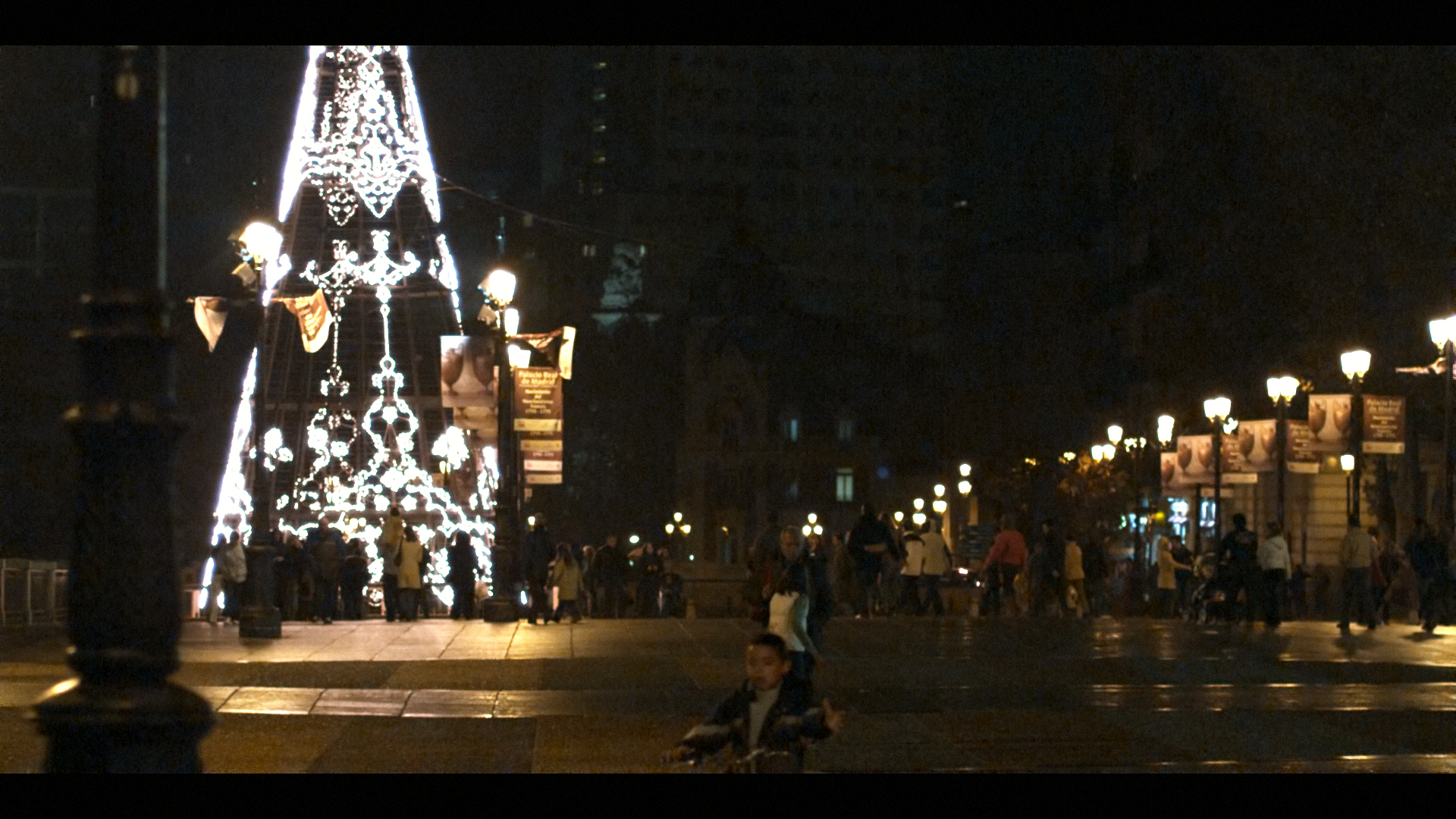
I did a quick and dirty colour correction in Photoshop with the worst image and managed to make it look quite a bit better, IMHO.

I actually ADDED a little bit of noise to the image in order to increase the perceptual sharpness of it, but I think when in motion this image would appear quite similar to normal 35mm film shot in a natural light night exterior situation.

I'm keen to see what OffHollywood can produce with the native R3D file, since I was only using the original noche3 shot that Macgregor posted with its inherent 8bit JPG limitations.

noche3_cc_visceralpsyche_sRGB.jpg


Cheers,

Paul
 
I'm keen to see what OffHollywood can produce with the native R3D file, since I was only using the original noche3 shot that Macgregor posted with its inherent 8bit JPG limitations.
Cheers,

Paul

I have the files now. I will ask our colorist Yohance, if he can stay a bit late today and take a whack at 'em - we are in the middle of a feature that has the suite tied up until the end of next week - if in fact, we get decent results - we'll spit out an H264 and up 'em -
 
Nice Paul....

Just on the lcd thing...it always worries me when I calibrate my lcd monitors and the calibration software asks me to adjust my blue channel to 60-70% and the red/green to 40%. That's gotta screw with the visable gamma range of the monitor, doesn't it?
 
Emphasis on the word experiment. It's likely that the $10 filter will sit in the case. I took it so I'd have a chance to tell you guys about it. Otherwise I wouldn't even consider it, I think the small amount of noise balancing back to tungsten on Red is fine. But I have on occasion dropped an ND on an interior believe it or not, especially with a 10 ton package. And thats when I think dropping a blue and gray carding through it might be better option. I'm not going to open my shutter or shoot at a 1.4 just so that I can balance to daylight. That's crazytalk.
 
Back
Top