Welcome to our community

Be a part of something great, join today!

  • Hey all, just changed over the backend after 15 years I figured time to give it a bit of an update, its probably gonna be a bit weird for most of you and i am sure there is a few bugs to work out but it should kinda work the same as before... hopefully :)

Is it worth it?

They don't mention CRI because it is an issue with daylight LEDs as we've said many times. They either push the color temperature higher into the 7000K to 8000K range to avoid the abundance of green--pushing it into more bluish output, use RGB or bi-color LEDs or incorporate minus green as a filter somehow. Some use vague terms like "high CRI" and some don't mention it at all hoping no one will notice. I think Jean noticed ;-).
 
  • Thread starter
  • Banned
  • #5
If I am not wrong, The bug 800 is actually about ten times stronger comparing to quad fixture.

Hi Richard; I am still happily enjoying your LEDs :)
 
At this point, I have to agree that HMIs are a better alternative--when you need throw, power and also a single point light source is hard to beat sometimes. For instance, throwing a "cookie" pattern up on the wall is so much more "defined" with a good 6000K hmi bulb. And 800 really is a great size too. A good compromise between the 1200w and 575.
 
Get the Jokers.

I have a simple policy: If I can't rent it, then I don't buy it.

Wait until some rental houses you can get to have them available- then try them out as rentals and make up your mind that way.

That probably won't be for a while so... get the Jokers.
 
Good advise:)
I Did work with the 400 and I liked it for many reasons.
I Will get the Jokers then.

Jokers are great. They can be hard light, or with a nice chimera attachment, a powerful soflight. I don't know if the Nila's would provide the same kind of hard light - and therefore flexibility - as the Jokers.
 
Is it worth it?

I am about to spend $12.000 on two Jokers 800 kit. Any input would be great.

A gaffer/rental house owner/operator I work with in Boston by the name of Guy Holt has just compiled for his company news letter what is probably the best information regarding HMIs that I have seen anywhere. In the researching of his article on the use of portable gas generators in motion picture production he discovered a very important consideration regarding the use of HMIs on portable generators that you should consider when purchasing your Joker lights.

To paraphrase what he found, harmonic distortion of set power by HMI electronic ballasts like the Joker 800’s is an increasing problem in HD production. It is becoming an issue because portable generators were not designed for the abundance of non-linear loads, like the electronic HMI and Fluorescent lighting, that make up lighting packages today. The problem is being further compounded by the increasing prevalence on set of sophisticated electronic production equipment like computers, hard drives and HD monitors which require clean power, but are themselves sources of harmonic distortion.

Normally, when you plug an HMI light into a wall outlet you need not be concerned about the current harmonics generated by HMI ballasts producing voltage distortions. The impedance of the electrical path from the power plant is so low, the distortion of the original voltage waveform so small (1-3%), and the plant capacity so large, that inherently noisy loads like HMI ballasts placed upon it will not affect the voltage at the load bus.

However, it is an all together different situation when plugging HMIs into conventional portable generators. Given the large sub-transient impedance of conventional portable generators, even a small degree of harmonic noise being fed back into the power stream will result in a large amount of distortion in its’ voltage. Add to that, the likely hood that the percentage of the generator’s capacity taken up by electronic HMI & Kino ballasts will to be very high given its small size relative to typical lighting packages, and given the increasing prevalence of these types of light sources in production. Finally, add that the original supply voltage waveform of a conventional generator is appreciably distorted to begin with, and you have a situation where the return of any harmonic currents by an HMI ballast will result in significant waveform distortion of the voltage at the power bus.

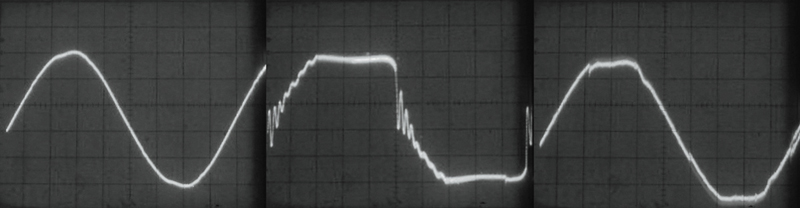
The power waveform below left is from his article and is typical of what results from the operation of a couple of 1200W HMIs with non-power factor corrected ballasts on a conventional portable generator. The adverse effects of the harmonic noise exhibited here, can take the form of overheating and failing equipment, circuit breaker trips, excessive current on the neutral wire, and instability of the generator’s voltage and frequency. It is for these reasons, he argues, that it has never been possible to reliably operate more than a couple of 1200W HMIs with electronic ballasts on a conventional 6500W portable gas generator. Harmonic noise of this magnitude can also damage HD digital cinema production equipment, create ground loops, and possibly create radio frequency (RF) interference.

waveform_AVR-Inv_Pkg.jpg


In the past, attention was given to generator features such as automatic voltage regulation and crystal speed regulation. But, given the rise in production problems associated with harmonic noise, an increasingly more important feature today is the quality of the generated power waveform and how well it interacts with the lighting units predominantly used today. For that reason, he did a series of tests that he summarizes in the article.

His tests have resulted in some rather startling conclusions. They show that when your lighting package consists predominantly of non-linear light sources, like HMI and Fluorescent lights, it is essential to have power factor correction (PFC) circuitry in the ballasts and to operate them on an inverter generator. The combination of improved power factor and the nearly pure power waveform of the inverter generator creates clean stable set power (like that in the power waveform above right) that is capable of reliably operating larger lights (HMIs up to 6kw or Quartz lights up to 5kw), or more smaller lights, off of portable gas generators than has ever been possible before.

To maximize the number of lights that you can run off their modified Honda EU6500is generator, ScreenLight & Grip pairs all the HMIs in their HD P&P Pkg. with the new PFC Power-2-Light ballasts. Power-2-Light is the only ballast manufacturer to include Power Factor Correction (PFC) as standard in their 800w, 1200w, 2.5kw/4kw electronic ballasts. Formerly only available in the larger ballasts of other manufacturers, this advanced electronics reduces current spikes and harmonics in the power line and contributes to a more economical use of power than typical electronic ballasts, K5600’s included.

Where the K5600 Joker 800 ballast draws about 12.4 Amps, the power factor corrected Power-2-Light 800/1200W electronic HMI ballast will draw 8 Amps running a Joker 800 at 120 Volts. The 4.4 Amp difference will make it more likely that you will be able to put another light, like a Joker 400, on the same circuit. While not a huge advantage when plugging into house power, the added efficiency of a PFC 800 ballast can make a huge difference when powering a lighting package off of a portable generator. For example, when you consider that a Kino Flo Parabeam 400 draws only 2 amps, the 4.4 Amp difference between using the PFC Power-2-Light 800W ballast and the standard non-PFC K5600 Joker 800W electronic ballast, can mean the difference between running two additional Parabeam 400s on a portable generator or not – I think you would have to agree that is a major boost in production capability.

I highly recommend that anyone planning to buy HMIs read his article. While the power factor corrected lighting package he has developed as a result of his tests is new (introduced Jan 09), the set power issues caused by non-PFC HMI ballasts have been vexing electricians for years. The article explains the electrical engineering principles behind these issues, and how his lighting package resolves them, in a way I have not seen elsewhere. In fact his tests will be cited in the upcoming 4th edition of the “Set Lighting Technician’s Handbook.” The article is posted on their website at:
http://www.screenlightandgrip.com/html/emailnewsletter_generators.html

Eileen Ryan, Gaffer, Boston
 
Thanks Eileen for the information.
Basically what you say is that whenever I use the Joker 800 with it's original ballast, powered from the Generator I may encounter inconsistent performance ?
Thus his (screenlightandgrip) offering is a redesign ballast, that not only improves the consistency, but also saves few amps?
The reason I am going for the jokers is low power requirement and flexibility.
I want to use mainly home outlets. Saving 4-5 amps is definitely beneficial as I can add some LED or Kino on the same circuitry and have less chance of blowing the fuses.
I checked his site but can't find a clear product description or price.
I am a bit confused:)

thanks
 
is it worth it?

is it worth it?

Thanks Eileen for the information.
Basically what you say is that whenever I use the Joker 800 with it's original ballast, powered from the Generator I may encounter inconsistent performance ? Thus his (screenlightandgrip) offering is a redesign ballast, that not only improves the consistency, but also saves few amps?

You may encounter more than just inconsistent performance. The adverse effects of the harmonic noise exhibited in the waveform above can damage HD production equipment. It can lead to overheating of equipment, voltage spikes that can cause erratic circuit breaker trips, burn outs of neutral wires, and the creation of ground loops. Where there is appreciable voltage waveform distortion created by operating HMIs & Kinos with non-pfc ballasts on conventional generators, other electrical devices operating on the same power are unable to use the distorted waveform effectively.

For example, circuits that depend on the peak value of the voltage waveform to operate effectively (the diode-capacitor power supplies in computers, hard drives, and electronic HMI ballasts), will work sporadically, if at all, on the squared off wave form caused by harmonic currents. Common symptoms are computers locking up and other operational malfunctions that are unexplainable. On top of that, the excess part of the distorted waveform must be dissipated somehow. This comes in the form of heat. The bigger the current draw from the unit, the more it produces excess heat within the unit that was not factored for in its’ original design. Extended exposure to power with harmonic distortion, and the heat it generates, may eventually cause premature component level failures.

Why are harmonics suddenly an issue in motion picture electrical distribution systems? First, one must appreciate that the power generation and electrical distribution systems developed for motion picture production were never designed to deal with an abundance of non-linear loads like electronic HMI and Kino Flo ballasts. It’s a problem that has only recently begun because of the increasing use of these types of non-linear lighting loads.

You mentioned that you also want to incorporate fluorescent lighting fixtures into your lighting packages. Did you know that the ballasts of inexpensive Biax fixtures, as well as those of the older style Kino Flo fixtures (that use the T-12 tubes, i.e. the Single, Double, and 4 Bank Fixtures, the Wall-o-Lite, Flathead 80, and the Image 20, 40, & 80 fixtures) are not power factor corrected and return harmonic currents into the power stream. With power factors between 0.5 and 0.65, non-power factor corrected fluorescent ballasts can be the cause of a considerable amount of harmonic distortion in a power stream.

wwaveform_no-load.jpg

Left: Grid Power w/ no load and a THD of less then 3%. Center: Conventional Generator w/ no load and a THD of 17-19%. Right: Inverter Generator w/ no load and a THD of 2.5%.​

You probably are not aware of this because, for all practical purposes, when you plug a single 4’ - 4 Bank Kino into a wall outlet you need not be concerned about harmonic currents. It is, however, an all together different situation when plugging Kino Flo T-12 fixtures into conventional portable generators. As a comparison of the oscilloscope shots above and below from Guy’s newsletter article clearly indicate, the return of harmonic currents by conventional Kino Flo T-12 ballasts can generate voltage distortion in the power stream. Given the large sub-transient impedance of conventional portable generators, and the fact that the original supply voltage waveform of conventional generators is appreciably distorted (a THD of 17-19%) to begin with, you have a situation where the return of any harmonic currents by a non-PFC electronic ballast (HMI or Kino) will result in significant waveform distortion of the voltage in the distribution system.

wwaveform_kino.jpg

Left: Grid Power w/ Kino Flo Wall-o-Lite. Center: Conventional AVR Power w/ Kino Flo Wall-o-Lite. Right: Inverter Power w/ Kino Flo Wall-o-Lite.​

Where you may have no problem operating a lighting package of a couple of Joker 800s with the K5600 ballasts and a couple of 4’ 4 Bank Kinos on standard grid power because the impedance of the electrical path from the power plant is so low, the distortion of the original voltage waveform so small (1-3%), and the plant capacity so large in comparison to the size of this load, that the inherent noise generated by this load will not effect the voltage. The accumulative effect of the harmonic noise of this same load on a conventional generator can cause severe voltage waveform distortion.

For instance, in his article Guy Holt describes how he ran a package consisting of two Arri 1200 HMI Par Pluses with standard Arri non-PFC electronic ballasts in addition to a Kino Flo Wall-o-Lite on the Honda EX5500 (a conventional generator). And, for the sake of comparison, He ran the same package but with power factor corrected electronic ballasts on a modified EU6500is (an inverter generator.) The difference between the resulting waveforms below (from his article) is startling.

waveform_pkg_comp_AVR_In.jpg

Left: Conventional generator power w/ pkg. of non-PFC Elec. HMI Ballasts & Kino Flo Wall-o-Lite. Center: Scope time base adjusted to bring elongated waveform back on screen. Right: Inverter generator power w/ Pkg. of PFC Elec. Ballasts & Kino Flo Parabeam 400.​

As these oscilloscope shots clearly demonstrate, a lighting package that works flawlessly on grid power can be the cause of problems on generator power. These problems can be further compounded by the use of sophisticated electronic production equipment like computers, hard drives and HD monitors, which are themselves sources of harmonic distortion, on the same power. As more and more electronic components, like lap top computers, hard drives, and HD monitors, which are themselves sources of harmonic distortion (but of a lower amplitude than solid state lighting ballasts) are integrated into the typical location production package along with non-PFC HMI & fluorescent ballasts, harmonic currents can begin to combine with unpredictable consequences. In fact, a viscous cycle can get started. The more harmonic orders that are generated, the more distorted the power supplied by the generator becomes. The more distorted the power waveform becomes, the more harmonic currents are thrown back into the electrical distribution system, which in turn, creates additional voltage distortion. In this fashion, something akin to a feedback loop can get started. Very often, the operation of electrical equipment may seem normal, but under a certain combination of conditions, the impact of harmonics is enhanced with unpredictable results.

I checked his site but can't find a clear product description or price. I am a bit confused:)

While a great guy and very knowledgeable, Guy is more of an old school Gaffer/Rental House owner operator in the sense that he builds custom equipment for specific production applications. For example, check out the inverter rig he devised for the feature “Shuttle” (production stills available website at http://www.screenlightandgrip.com/html/shuttlemailintro.html.)

If you want the same old thing, he would even tell you himself, you should buy your equipment on-line. But, if you appreciate the added value that comes from a working understanding of production equipment and craft, he has a lot more to offer than the B&H Photos or Film Tools of the world. I once asked a Film Tools salesman what the power factor of a Kino fixture was and he was clueless about power factor all together. Even though they don’t publish pricing, and you can’t put together an electronic shopping cart, I have always found that their pricing has been competitive and better still, they make sure you aren’t missing anything.

Where it is nearly impossible sometimes to figure out what accessories you should get with a light on the B&H website, Guy makes sure that you are not only fully aware of all the options but also that you have the right tools for the job. For example, if you are going to be shooting an independent film on remote locations where you will be relying on generated power he will make sure that you have the new Kino Flo Biax fixtures (the Diva, Parabeam, Vistabeam, and Barfly) because they have Power Factor Correction circuitry built into them. As it does in HMI ballasts, this advanced electronics contributes to a more economical use of power than conventional electronic ballasts and reduces the return of harmonic currents into the power stream. With a Power Factor Rating of over .9, the Kino Flo Biax fixtures are especially well suited for use in large quantities, and along side HMIs, on small portable generators. That is the kind of value added service you will get from him that you won’t get from B&H or Film Tools.

Eileen Ryan, Gaffer, Boston
 
Eileen,
I much appreciate all this information you are sharing!
You just saved me some cash actually as I was supposed to pick up some old 4'4 kinos...

Is that "problem" generated by faulty ballast design on the side of K5600?

I will definitely give Guy a call or send the email.
Thank you.

Albert
 
Albert,

I would call K5600 to see if their ballast is or isn't power factor corrected. Cool Lights newest HMI ballasts are power factor corrected so I am having more than a little trouble believing that K5600s aren't in the price range they are. I know our 55w biax flos are high power factor as well in the range of .98 so its a little hard to believe that most of the current generation of Kino Flo's aren't as well. Older ones, maybe not.
 
Is it worth it?

… I am having more than a little trouble believing that K5600s (HMI ballasts) aren't (power factor corrected) in the price range they are.

Eileen has asked me to step in here because she feels that she can not adequately address the questions Richard raises. The ballast design of the K5600 ballasts is easily ten years old. K5600 can continue to sell non-PFC ballasts because of the small size of their heads and because PFC is not a major consideration in the production applications they are typically used. This has been true, until recently, of all HMIs under 2500 Watts. Where PFC circuitry is mandatory in all HMI ballasts sold in the EU, it is not in the US. While it is true that all major manufacturers include PFC circuitry in HMI ballasts in the 6-18kw range, it is more by necessity (to reduce heat, returns on the neutral, and to increase reliability) than by choice. Because of the added cost, weight, and complexity of PFC circuitry, manufacturers have offered PFC circuitry in the US as an option on medium-sized ballasts (2.5-4kw); and, not until very recently, have they even offered PFC circuitry in HMI ballasts smaller than 2.5kw. Except for one notable exception, when manufacturers do offer PFC circuitry in smaller ballasts it is at a premium, adding as much as a $1000 to the cost of a 1200W ballast for instance. The new ballast manufacturer Power-2-Light, on the other hand, is including PFC circuitry in their ballasts at the same price point as other manufacturer’s non-PFC ballasts. But where Power-2- Light is still very new to the market, it is still the case that almost every 575 - 1200 W ballast that you will find in a rental house in North America will be a non-PFC electronic ballast.

… its a little hard to believe that most of the current generation of Kino Flo's aren't (power factor corrected) as well. Older ones, maybe not.

For the record, please note that Eileen was quite specific that the older style Kino Flo fixtures that use the T-12 tubes are not power factor corrected, while the newer Biax fixtures (the Diva, Parabeam, Vistabeam, and BarFly) have a Power Factor Rating of over .9.

… the older style Kino Flo fixtures (that use the T-12 tubes, i.e. the Single, Double, and 4 Bank Fixtures, the Wall-o-Lite, Flathead 80, and the Image 20, 40, & 80 fixtures) are not power factor corrected and return harmonic currents into the power stream… the new Kino Flo Biax fixtures (the Diva, Parabeam, Vistabeam, and Barfly) … have Power Factor Correction circuitry built into them.

In fact, Kino Flo cautions users on their website: “Kino Flo ballasts are generally not power factor corrected. They will draw double the current on the neutral from what is being drawn on the two hot legs. On large installations it may be necessary to double your neutral run so as not to exceed your cable capacity.”( FAQ “Why is the neutral drawing more than the hot leg” at http://www.kinoflo.com/FYI/FAQs.htm#2)

Don’t assume however from what Eileen and Richard say that all newer fluorescent fixtures are power factor corrected. For instance the non-dimmable ballasts used by Lowell in the Fluo-Tec Studio, E-Studio, Caselite fixtures have a power factor similar to that of a non-pfc electronic HMI ballast of .7 (http://www.lowel.com/fluotec/technical.html.) And, of their compact fluorescent (CFL) fixture, the Lowel Ego, Lowell warns: “The lamps may cause interference with radios, cordless phones, televisions, and remote controls. If interference occurs, move this product away from the device or move to a different outlet”( http://www.lowel.com/ego/lamp_info.html.)

Where they have not been mandated, as in the EU, to incorporate PFC into their products, many manufacturers of HMI and Fluorescent lighting equipment in the US do not include PFC circuitry for two reasons. The first is the reason I cite above: the added cost, weight, and complexity of PFC circuitry adds substantially to the cost of the ballast - as much as a $1000 to the cost of a 1200W ballast for instance. The second reason is that there is a legacy of successfully operating non-PFC fluorescent and HMI ballasts on portable gas generators in the past. But, given the increase in problems caused by harmonic currents, we need to scrutinize the quality of the power waveforms of generators and how well they interact with the type of loads we put on them. But since I am out of space I will have to pick up this larger subject in a subsequent post.

Guy Holt, Gaffer, ScreenLight & Grip , Boston
 
But, given the increase in problems caused by harmonic currents, we need to scrutinize the quality of the power waveforms of generators and how well they interact with the type of loads we put on them. But since I am out of space I will have to pick up this larger subject in a subsequent post.

We need to scrutinize the quality of the power waveforms of generators and how well they interact with the type of loads we put on them, because we are engaged in a dynamic interplay between production technologies that is still evolving and an awareness of the effects of increased harmonics will help us to build systems that avoid or mitigate problems on set.

It was the case that the inductive reactance of magnetic HMI ballasts created harmonics, but because it caused current to lag behind voltage (a lagging power factor), inductive reactance did not cause the same degree of problems for generators as the leading power factor (current leads voltage) of the capacitive reactance created by the electronic square wave HMI ballasts prevalent today.

wwaveform_mag_ballast.jpg

​

As is evident in my oscilloscope shots (above) of a 1200W magnetic HMI ballasts on grid power, power generated by a Honda EX5500 (a conventional AVR Generator, and a Honda EU6500is (a inverter generator), the lagging power factor caused by the inductive reactance of magnetic ballasts had only a moderately adverse effect on power waveform. Outside of causing a voltage spike in the inverter power, magnetic ballasts actually show a positive effect on the already distorted power waveform of the EX5500 conventional AVR generator. It was for this reason that, yes, magnetic ballasts worked reasonably well on conventional AVR generators with frequency governors for years until the introduction of electronic square wave HMI ballasts.

Because they are not frequency dependent and will tolerate voltage fluctuations, at first it was thought that electronic square wave ballasts would operate more reliably on small portable generators – even those without frequency governors. For this reason, as soon as electronic square wave ballasts appeared on the market, many lighting rental houses replaced the more expensive frequency governed Honda EX5500 generator with the less expensive non-synchronous Honda ES6500 generator. The theory was that an electronic square wave ballast would operate reliably on a non synchronous generator and allow filming at any frame rate, where as a magnetic HMI ballast operating on a frequency controlled synchronous generator allowed filming only at permitted frame rates. In practice, electronic square wave ballasts turned out to be a mixed blessing.

wwaveform_elec_ballast.jpg

​

As is evident in my oscilloscope shot of a 1200W non-PFC HMI ballast (above) operating on power generated by a Honda EX5500 (a conventional AVR Generator), the leading power factor caused by the capacitive reactance of the new electronic square wave ballasts has a more severe effect on the power waveform of conventional AVR generators than did the old magnetic ballasts. To quote the Caterpillar Application and Installation Guide for "Electric Power Applications, Engine and Generator Sizing":"Self-excited, synchronous generators are not designed to operate with leading power factor load …. the additive excitation from a leading power factor will cause the terminal voltage to rise and will not be controlled by the voltage regulator."

Voltage regulation problems caused by the leading power factor of electronic square wave ballasts is just one of several very real problems non-linear loads can cause operating on conventional portable generators (see my article on the use of portable gas generators in motion picture production available on-line.) These problems have become more common in the last few years because of a very recent trend toward lighting packages that consist almost entirely of non-PFC electronic HMI and Fluorescent ballasts. The problem has been further compounded recently by the increasing prevalence on set of sophisticated electronic production equipment like computers, hard drives and HD monitors which are themselves sources of harmonic distortion. We find ourselves in a situation where the increasing use of microprocessor-based equipment in production is creating an unprecedented demand for clean, reliable power on set, at a time when the trend in lighting is to use sources that dump more and more noise into the power stream. As Eileen correctly notes in her post above:

As more and more electronic components, like lap top computers, hard drives, and HD monitors, which are themselves sources of harmonic distortion (but of a lower amplitude than solid state lighting ballasts) are integrated into the typical location production package along with non-PFC HMI & fluorescent ballasts, harmonic currents can begin to combine with unpredictable consequences. In fact, a viscous cycle can get started. The more harmonic orders that are generated, the more distorted the power supplied by the generator becomes. The more distorted the power waveform becomes, the more harmonic currents are thrown back into the electrical distribution system, which in turn, creates additional voltage distortion. In this fashion, something akin to a feedback loop can get started. Very often, the operation of electrical equipment may seem normal, but under a certain combination of conditions, the impact of harmonics is enhanced with unpredictable results.

Where in the past, much attention was given to portable generator features such as automatic voltage regulation, speed regulation and AC Frequency. Given the increasing prevalence of harmonic currents and the problems they cause, an increasingly more important feature today is the quality of the generated power waveform and the type of load they operate. This is especially true of the systems to be used in low budget independent production because these productions are increasingly embracing the use of HD digital cinema production tools, like inexpensive HD camcorders, laptop computers and hard drives, that require cleaner and more reliable power on set to operate effectively.

As more and more electronic components, like lap top computers, hard drives, and HD monitors are integrated into the typical location production package along with non-PFC HMI & fluorescent ballasts, harmonic currents can begin to combine with unpredictable consequences. Where you may have no problem operating a lighting package of a couple of Joker 800s with the K5600 ballasts and a couple of 4’ 4 Bank Kinos on grid power (for the reasons I explain in my article available on-line), the severe voltage waveform distortion caused by the harmonic noise of this same load on a conventional generator can cause trouble.

For this reason, when your lighting package consists predominantly of non-linear light sources, like HMI and Fluorescent lights, it is important to have power factor correction (PFC) circuitry in the ballasts and operate them on inverter generators. The combination of improved power factor and the nearly pure power waveform of inverter generators makes it possible to power larger lights, or more smaller lights, than has been possible before on a small portable gas generator. And, if the generator is one of our modified EU6500is inverter generators, you will be able to run a continuous load of up to 7500W on it as long as your HMI and Kino ballasts are Power Factor Corrected.

Guy Holt, Gaffer, ScreenLight & Grip , Boston
 
Back
Top