Welcome to our community

Be a part of something great, join today!

  • Hey all, just changed over the backend after 15 years I figured time to give it a bit of an update, its probably gonna be a bit weird for most of you and i am sure there is a few bugs to work out but it should kinda work the same as before... hopefully :)

IR Pollution Fix

Daniel Kunz

Well-known member
Joined
Aug 14, 2010
Messages
202
Reaction score
0
Points
0
Location
Switzerland
Hi everyone,

i was wondering if there was a possibility to create a permanent IR Fix for RED Epic and Scarlet-x.
The idea would be to place a high-quality UV/IR-Cut Filter just in front of the AA-Filter.

This would eliminate the need of expensive IR-Cut Filters in front of the lenses.

Same thing goes with ND Filters. Would it be possible to set them in the "bellow"-area just behind the lens?

99124106.jpg


Of course the ND's would need to have practical gripping points to be able to put them in and out easely. But imagine doing an outdoor shot where you constantly don't want to use a cumbersome Mattebox or Filter in front of your lens.

What do you guys think?
I have inquired prices for the production of such a filter, maybe someone else is interested?
 
As long as it's an optional accessory I'd be fine with because I absolutely don't want that in front of my sensor when it isn't necessary. I'd rather put my own filtration on there when I'm NDing. To each his own I guess.
 
Why not put the filter in a mattebox? This way you dont have to have extra filters on permanently. Its always good with more options thoe.
cheers
 
I'd never fuddle around in front of the open sensor more than abolute necessary .... just my 2c
 
It would be a third party Option that fits and holds by itself in the sensor box. Removable of course.
 
if there is enough space there between the rear of the lens (and some are pretty long) and the sensor, why not.
 
if there is enough space there between the rear of the lens (and some are pretty long) and the sensor, why not.
With Canon Lenses that is no problem, since they never go past the point where the electronic contacts are. (afaik) PL i don't know.
 
IR is a problem for me on the EPIC. When I use IRND I allays have IR spill in the blacks (cutting 7 to 9 stops...) and when using Hotmirror you get the strange red flair that travels with the light contrast.

Did any one have a better solution as the one proposed here : behind the glass.

Have you solved in an other way?

Thanks

Pat
 
Hi everyone,

i was wondering if there was a possibility to create a permanent IR Fix for RED Epic and Scarlet-x.
The idea would be to place a high-quality UV/IR-Cut Filter just in front of the AA-Filter.

This would eliminate the need of expensive IR-Cut Filters in front of the lenses.

Same thing goes with ND Filters. Would it be possible to set them in the "bellow"-area just behind the lens?

I doubt this would be practically feasible. Due to high reflectance IR filter should always be the first hit by light. I.e. Light should first hit IR filter and then ND filters.
If you would put IR filter directly in front of AA filter you would loose the possibility to put ND filters "on top" as there would be to much reflections.
Taking of the lens and exchanging filters would be cumbersome to not to mention to much fidling inside the camera body - fingers, dust etc...

Even if only IR filter would be used on top of AA filter there would be reflections from the IR filter hitting lens elements and reflecting back to the sensor.
When the IR filter is the first filter hit by light (in a matte box) reflections are not trapped in the lens system.
 
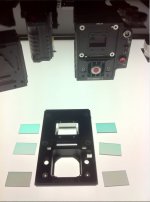
RED showed small ND's last year that were meant to work Panavision style right where you want them small in front of the sensor/OLPF.

I'd imagine this year at NAB that concept will be more fleshed out with a delivery or completion timeline.
 
I doubt this would be practically feasible. Due to high reflectance IR filter should always be the first hit by light. I.e. Light should first hit IR filter and then ND filters.
If you would put IR filter directly in front of AA filter you would loose the possibility to put ND filters "on top" as there would be to much reflections.
Taking of the lens and exchanging filters would be cumbersome to not to mention to much fidling inside the camera body - fingers, dust etc...

Even if only IR filter would be used on top of AA filter there would be reflections from the IR filter hitting lens elements and reflecting back to the sensor.
When the IR filter is the first filter hit by light (in a matte box) reflections are not trapped in the lens system.

+1. Hot mirrors aren't as effective unless they're the first filter (forward-most) in your mattebox. Putting one in front of the sensor and then stacking NDs wouldn't be ideal.
 
According to my understanding there are infrared absorbing filters included in sensor technology. Problem is IR absorbing filters cannot be made with a sharp cutoff at cca 680nm. Below is IR, above are red wavelengths. Therefore there is a tradeoff between some IR absorption and preservation of red (so the red wavelengths don't get filtered out).
But IR reflecting filters can be made with a much more sharp cutoff so the most of IR is reflected while preserving red colors. If the reflective filter would be placed between the sensor and a lens I would expect a lot of reflection buildup in the lens system that would be reflected back to the sensor. This is the reason why reflective IR filters should be the first hit by light and ND filters should always be behind.
I.e. if two filters, IRND 0.3 and 0.9, would be placed in a matte box it wouldn't look nice! IRND 0.3 and ND 0.9 on the other hand should work fine.
 
FYI, Red showed this stuff at last years NAB...

I googled, but couldn't find an image of it online.

I snapped a picture with my phone of their display...

I'll see if I can find time to dig it up on my laptop later today.

*Edit* Found it on my Facebook album:
attachment.php
 

Attachments

  • Red OLPF Drop in Filters.jpg
    Red OLPF Drop in Filters.jpg
    67.5 KB · Views: 0
Thanks Jason, my reasoning doesn't seem far off then.

Concerning internal reflections: what about cameras that have built-in ND Filters? they would also have inner reflections to the sensor, heck even the sensor the AA and the OLPF have a very reflective surface that would bounce light back into the lens, a IR filter wouldn't do much difference in my opinion. Am i missing something?

A perfect sensor would be one that absorbs 100% of the light thus be completely black like that nano-tube stuff. but if you look at sensors, they have an incredibly "glossy" surface:

3-13-11-red-epic-m-2.jpg
 
FYI, Red showed this stuff at last years NAB...

I googled, but couldn't find an image of it online.

I snapped a picture with my phone of their display...

I'll see if I can find time to dig it up on my laptop later today.

*Edit* Found it on my Facebook album:

Well we should define "this stuff". Title of the picture reveals that those are different flavors of OLPF filters. I assume there are no IR filters in the picture.
 
There is an IR filter already in the filter arrays in front of the sensor. But the Mysterium sensors have what we'll call mysterious origins, from which IR light absorption might have been helpful. This is why the Red requires a stronger cut then other CMOS based recording systems.

The problem with these arrays is that you're asking the light to travel through a thick sandwich of adjusting elements before they reach the sensor. This is fine if you've got a 4K sensor that outputs 1080--you can afford to loose a bit of resolution. But when you're trying to squeeze every nanometer of detail out of that small surface, you're forced to be very choosy in how much filtration you can stick in there.

Leica is also a bit of a minimalist when it comes to filter arrays, whereas other manufacturers cram in as much as possible so the end user doesn't have to worry about it.
 
Well we should define "this stuff". Title of the picture reveals that those are different flavors of OLPF filters. I assume there are no IR filters in the picture.

No, But I thought it was relevant to the discussion since the picture shows that the folks at Red are taking rear filtration into consideration.
 
I doubt this would be practically feasible. Due to high reflectance IR filter should always be the first hit by light. I.e. Light should first hit IR filter and then ND filters.
If you would put IR filter directly in front of AA filter you would loose the possibility to put ND filters "on top" as there would be to much reflections.
Taking of the lens and exchanging filters would be cumbersome to not to mention to much fidling inside the camera body - fingers, dust etc...

Even if only IR filter would be used on top of AA filter there would be reflections from the IR filter hitting lens elements and reflecting back to the sensor.
When the IR filter is the first filter hit by light (in a matte box) reflections are not trapped in the lens system.

Marko, you seem highly knowledgeable, when stacking a polariser with ND's, is there any preference of forward position that I may not be aware of?

Best

Lliam
 
Back
Top