Welcome to our community

Be a part of something great, join today!

  • Hey all, just changed over the backend after 15 years I figured time to give it a bit of an update, its probably gonna be a bit weird for most of you and i am sure there is a few bugs to work out but it should kinda work the same as before... hopefully :)

Interesting Conversation tonight

Tom Chase

Well-known member
Joined
Oct 27, 2012
Messages
362
Reaction score
0
Points
0
Location
San Antonio, TX
Website
www.tomchasefilms.com
So, I got into an interesting conversation with an AC buddy of mine. We got on the topic of shooting on 5d's vs t3i (I know they aren't RED's). But the convo went to FULL FRAME - and how he wanted to rent my 5d soley because it was Full Frame. I was surprised to learn that he (he's been AC'ing for a few years) thought all cinema camera's were full frame. When I told him that my Epic (didn't get into the Dragon to avoid confusion) was a Super35 which was different that than a still camera 35mm he was blown away.

The reason why I bring this up is it seems DSLR's have added a level of confusion. I started out on a 5d, and still consider myself as a baby in the cinema world, but I think it's important to understand that 35mm Full Frame really is a photography term we as in the cinema world a Super35 would be considered full frame for the Film motion camera world.

Am I wrong? ready set go.....


Tommy
 
Tom Chase said:
but I think it's important to understand that 35mm Full Frame really is a photography term we as in the cinema world a Super35 would be considered full frame for the Film motion camera world.

Sometimes people also get confused over REDs use of the term "Full Frame" when they talk about the full frame of the sensor itself vs. FF 35mm in the DSLR world.
 
There is absolutely confusion about this. I talk to a lot of relatively new shooters and I'd say that most of them don't really know there is a difference. They are more likely to think that a 5D is the "standard" size in shooting motion rather than something like a 7D which is, of course, closer to s35 and, thus, to motion image standards. Education is hard.
 
Last edited:
It's a beautiful chaotic world we live in. This mainly came up during the earlier years of DSLRs, specifically the cameras before and around the original Canon 1Ds. The proper term for the format is 135 Still Film, but that doesn't have a lovely ring to it. Quickly "Full Frame" became the quick way for still photographers to discern APS-C and APS-H sensors from Full Frame 135 as those other sensors reflected "a crop" of the negative size that many professionals were used to. I recommended to Kodak sometime in the early 2000s to add an APS-F format to describe this, but that never seemed to happen.

A while ago I started promoting the use of S35 and FF35 to sort of serve as middle ground between the adopted term and a more reasonable description that had a bit of separation from Full Frame.

RED's nominclature on FF and how it relates to each format/resolutions maximum frame size is closer to the motion picture industry's definition of Full Frame, or at least what it should mean. In the S35 world Full Frame would be Super 35mm Full Aperture 4-Perf to describe the maximum imaging plane on the negative.

Personally, when it comes to motion pictures, I'm a bigger fan of describing things as S16, S35, and VistaVision for anything around the 135 Still Frame format.

The general description of VistaVision film is the negative is two times as wide as two S35 Full Ap 4-Perfect is as tall. Which makes a lot of sense as VistaVision is indeed 8-Perf.
 
Last edited:
you are right and phil explains it best, the reason 5ds became so popular is because full frame gave that instant cinema style look because the focus falls off so fast, compared to other video cameras that were out there that had 2/3 chip sensors and had a hard time making them feel cinematic.

its funny to me that people entering the industry in the past 8 years think reds, especially the new raven sensor is a crop when they are both close or over exceed standard 35mm motion picture format.
thank god 5ds and dslrs in general are falling from grace, maybe we can get the people coming up in the business now to actually know what's going on, the past 8 years have been a mess!
 
Am I the only person who's more concerned that an (I assume professional) 1st AC wouldn't know the difference? It would suggest that they've never even looked at a set of focus tables... personally, that lack of such a basic fundamental of the job is a little unsettling.

I hope it's not becoming the norm.
 
Am I wrong? ready set go.....
No. You are correct.

you are right and phil explains it best, the reason 5ds became so popular is because full frame gave that instant cinema style look because the focus falls off so fast, compared to other video cameras that were out there that had 2/3 chip sensors and had a hard time making them feel cinematic.
Interesting comment. Do you, yourself, think that movies shot with deep focus are not cinematic? And do you think that shallow DOF is therefore more cinematic than more DOF? Or are you saying that that's what other people were saying?

Am I the only person who's more concerned that an (I assume professional) 1st AC wouldn't know the difference? It would suggest that they've never even looked at a set of focus tables
Focus tables or no focus tables - it is curious that a professional doesn't know that rather basic fact. Okay, you don't need to know everything to be a good professional. I'll grant you that. I'd rather you be a good focus puller than a walking library of photographic facts.

Some people still don't know that high octane fuel burns more slowly than low octane fuel. Fortunately, it doesn't matter in a lot of cases. Sometimes, getting facts completely wrong doesn't affect the final product.

It does annoy me somewhat when people spout nonsense, such as the photographer who thought that the 12Mpx S35 sensor from his DSLR could out-resolve a 6x4.5 negative. I mean, please.
 
I'm surprised that an AC wouldn't know basic facts about sensor sizes and film format sizes. It would come up even in simple things like order a director's finder with a groundglass that matched the shooting camera's view.

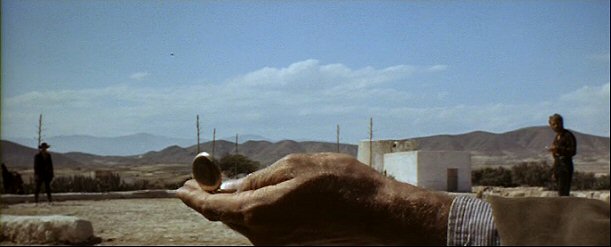
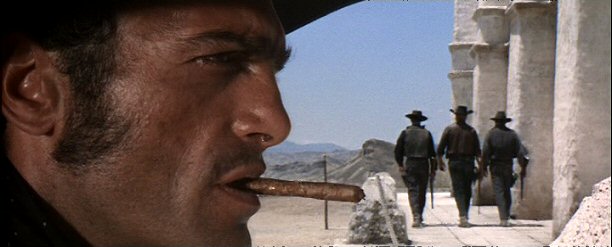
And while certainly the majority of Hollywood movies over decades often were shot around an f/2.8 in the standard 35mm cine format, with that typical depth of field characteristics, that doesn't mean that movies that shot with a deeper focus were less cinematic. I mean, what about Sergio Leone's 2-perf 35mm movies, often shot outside at deep stops for maximum depth of field?

ffdollarsmore1.jpg


ffdollarsmore2.jpg


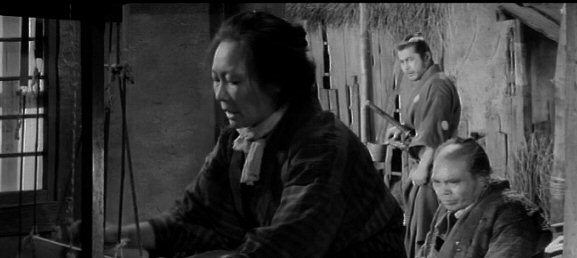
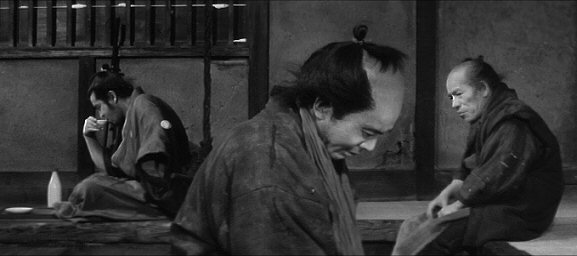
What about "Citizen Kane"? What about Kurosawa's scope movies like "Yojimbo", "High and Low", "The Bad Sleep Well", and "Red Beard"?

yojimbo1.jpg


yojimbo3.jpg
 
I once worked with what I thought was a professional photographer who thought f2.8 was a half stop between f2.0 and f4.0, lol. About half the photos came out too dark and I looked at the meta data and asked what was going on.
 
be interesting to know why Kurosawa or Leone made those choices.
 
Last edited:
I didn't know this. This is why I absolutely LOVE posts by David Mullen. Thanks for sharing your knowledge!

I'm over-generalizing a bit but f/2.8 is pretty common for interior scenes over the decades. When b&w was faster than color stocks you'd see f/4 and higher being used in b&w, and even deeper stops for those deep focus movies. And by the 1960's when zoom lenses became popular, it was common advice to try and light for a f/4 because you never knew when the director would call for the zoom. And for anamorphic movies, it was also common advice to try and stop down to a f/4 at least. But we keep drifting back to f/2.8 especially as zooms have gotten that fast. Of course people will shoot even wider in low light and stop down more in sunlight, I'm just talking about the typical interior scene with lighting.
 
Thanks for the amazing and educational feedback! I know both buddy and I came into the cinema world at two different times but both post digital and my cinema experience has always been around the 5d, then the Epic and now Dragon. Being self taught I concede that I had that misconception about FF - but as someone in the thread pointed out - it's all FF just horizontal vs vertical in principal.

Thanks again for the great feedback.
 
Am I the only person who's more concerned that an (I assume professional) 1st AC wouldn't know the difference? It would suggest that they've never even looked at a set of focus tables... personally, that lack of such a basic fundamental of the job is a little unsettling.

I hope it's not becoming the norm.

Sadly, from what I've observed this is becoming increasingly common among young AC's. I don't even see how this is possible given the nature of job, but well there you go. I am now officially a grumpy old man.
 
Back
Top