Welcome to our community

Be a part of something great, join today!

  • Hey all, just changed over the backend after 15 years I figured time to give it a bit of an update, its probably gonna be a bit weird for most of you and i am sure there is a few bugs to work out but it should kinda work the same as before... hopefully :)

I can buy only 2 anamorphic lens - which ones??

Emilian Dechev

Well-known member
Joined
Sep 2, 2015
Messages
125
Reaction score
2
Points
18
Age
40
I have been drooling over anamorphic lens for the last couple of years.

At this point, I am looking at the Xelmus Apollo 2X, but I can afford only 2 lens.

Since I am new to anamorphics, I wonder, which 2 lens would complement for the most useful set:
40mm + 60mm or 40mm + 100mm ?

Will be shooting mostly with S35 sensor size.
 
That seems great, but I am looking at Xelmus.
I was also looking for Atlas, but it seems their preorder time will be more than 1 year.
 
Depending on what s35 camera you have I actually skip the extender. The result using a extender and cropping in on the sensor is quite equal in terms of image quality loss.

If you crop in you loose sensor resolution / get a little bit more noise.

If you use an extender then you loose exposure and ”lens resolution” / your lens becomes softer.

So its not a given whats the best option of the two. If you shoot helium for example then croping down to 6k is as I see it a better option than adding a extender if you aim for a 4k finnish.

I did a test for a client using monstro and my 40,65,100 atlas lenses shooting 8:9 2xana (final image is 16:9 anamorphic) using each lens at 8k,7k,6k 8:1 x2 ana at 10:1 compression.

The cool thing with the above is that you get a nice of 9 different FOVs out of just 3 lenses and dont have to swing lenses as much.

Another fun fact with that test... The files including a 2k prores LT proxy on the side weights about 1/3 of alexa LF open gate prores 4444.

Here is a link to tge test, not the best footage but you get the idea of the different zoom factors. The file is a prores uhd so if downloading you can inspect the difference in image quality when bumping around between the crop factors wich is not much as monstro over delivers on resolution.
https://app.frame.io/f/290e36f6-6242-49c4-865b-cff932439aa8
 
Björn, thanks for the great information and comparisons.

After giving it much thought, maybe I will get the 40mm + 60mm and leave the 100mm for now. Of course that range is small and I will have to get the 100mm some time in the future, but I am prone to believe, that shooting anamorphic looks cool in the wide range anyway. Even for close-ups.

So, will I get to a scene, that requires me to get a close-up portrait with the 100mm? Yeah sure, but why not take it with the 60mm and crop in, if need be. For now at least. These beasts are expensive...
 
Are you shooting indoor narrative? If so, you might want to test the 40mm first. You might want something wider around 24mm.
 
I was in the same position you are and went with the 40mm and 80mm from Atlas. I’ve had them for almost a year. Very pleased with the 2 focal lengths. I’ve used all 6 of their lenses and these were the two that I thought were the most versatile out of the whole set. Beyond occasionally wanting something wider (maybe even wider than the 32mm) it’s doing the job great. For the wider shots I just use a spherical lens.
 
Yes that makes sense, but the widest Xelmus offers is the 40mm.
Lets note that 40mm in "2X anamorphic" should give the field of view of a 20mm normal lens. So 40mm might be alright, of course the 32mm offering from Atlas will be even better.
 
In most cases the 40mm will be wide enough. I’m not particularly fond of too many wide shots. And the 40mm still looks great on faces close up. But Eventually there will be times when the vertical field of view won’t be wide enough. Not the horizontal. Good example would be if you’re in a smallish room and you need a full body shot of person. Not very common but I guess all I’m saying is sometimes it’s that vertical field of view that won’t be wide enough that you might need to have a spherical lens for.
 
In standard 4-perf 35mm anamorphic, 40mm was the classic wide-angle lens -- 35mm was occasionally used for very wide-angle shots with some barrel distortion (the 40mm often has barrel distortion too). The 35mm anamorphic is like shooting with a 17.5mm or 18mm in Super-35 but with more distortion. "Mad Max" was shot mostly on the Todd-AO 35mm anamorphic, which gave it a very dynamic look, but that choice was partly due to necessity, they bought the Todd-AO's from Sam Peckinpah and found that the 35mm was the most usable, the least beat-up!

Of course, sometimes Michael Bay would shoot on a super-wide 28mm Panavision anamorphic...

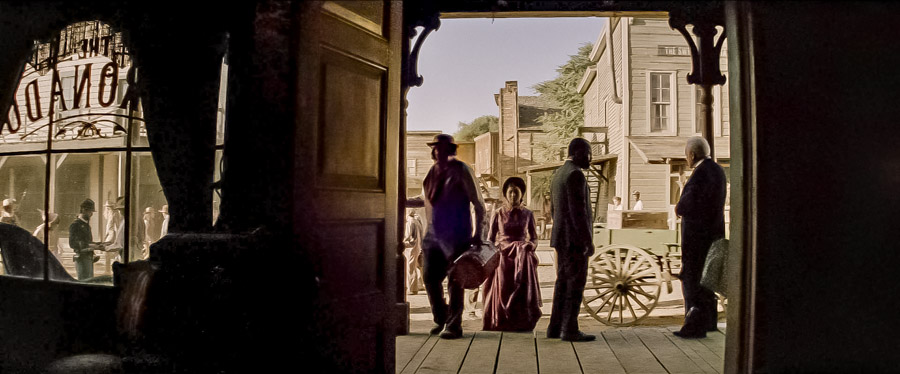
Here is a shot I did on the 35mm Todd-AO anamorphic, on 35mm film, for "Westworld":

westworld3.jpg


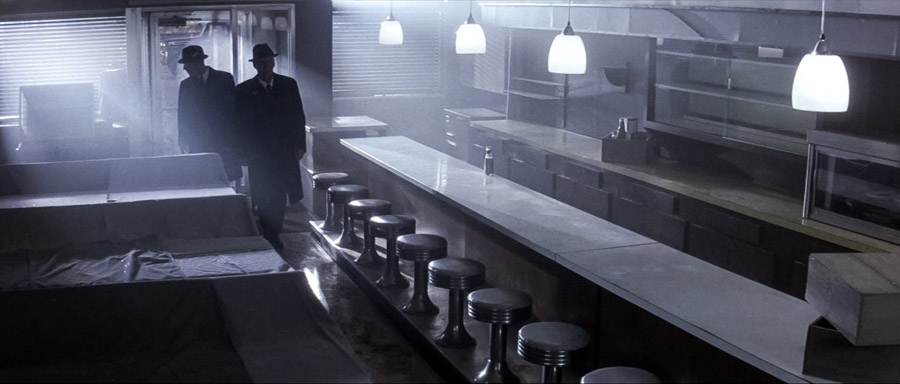
Here is a shot I did on a 40mm Panavision Primo anamorphic, on 35mm, for "Northfork" (2003):

northfork41.jpg
 
Last edited:
Thanks for the good input, Mr. Mullen, by the way Westworld is a favourite show, incredible set pieces and shots! :)

Would you consider a 60mm X2 to be good enough for portrait shots MCUs and CUs?
 
I have a question about the use of extenders... please forgive me if this is a bit basic, I have very little first-hand experience with them.

I understand that it will affect your FOV (similar to cropping the sensor), but does it also affect the image compression? I don't mean codec compression, but rather the optical characteristic.

So, taking the 40mm example for portraiture: with a 1.6x extender, you'd have a FOV of approx. 65mm, but do you have the more pleasing facial feature compression of a true 65mm lens?
 
Yes it looks the same as a 65mm but you’d have more depth of field probably than with a 65mm because you’d have a slower lens, if you had been shooting near wide-open before, so you have to plan to deal with the light loss of the extender. I could be wrong about the extender light loss creating a defacto effective narrower aperture.
 
Thanks for the input, again, my whole dilemma about choosing between the 60mm or 100mm would be a lot easier, if I could get my hands on such extender.
But Xelmus do not offer extenders. Would it be possible to use the Atlas extender on the Xelmus, like is it something "sdandart" for all PL anamorphics ?
 
I think the problem isn't between a 60mm and a 100mm, it's because you only want to use two lenses. 40mm and 100mm is an impractical jump and 60mm is practical but it might not be long enough for every situation. You really need a 40mm, 60mm, and 100mm. The issue has nothing to do with anamorphics, it would be the same problem for a spherical movie.

Of course, there are filmmakers who have made a style out of only using one or two lenses - Ozu and his 50mm for example. But then you'd have to design your directing style around your two lenses. Again, I think 100mm is too big a jump from 40mm if you are inside and don't have a lot of freedom to back up on the 100mm. On the other hand, maybe that jump becomes your style.

I also think that a 75mm would be better than a 60mm to pair with the 40mm.
 
Back
Top