Welcome to our community

Be a part of something great, join today!

  • Hey all, just changed over the backend after 15 years I figured time to give it a bit of an update, its probably gonna be a bit weird for most of you and i am sure there is a few bugs to work out but it should kinda work the same as before... hopefully :)

How to shoot from Helicopter/Airplane

AndreasOberg

Well-known member
Joined
Oct 30, 2011
Messages
1,674
Reaction score
31
Points
48
Location
Leicestershire, United Kingdom
Website
www.obergwildlife.com
Hello.
I found a few companies that look promising for helicopter shooting in Costa Rica.
However we have never shot before from a helicopter.
1 of the helicopter has a robotic arm that sits beneath the helicopter and you remote control it from the inside.
The other helicopter looks like a more normal helicopter where you sit inside and film out. Probably much cheaper but surely not as good.

Questions
- What lenses do you think we should use? A wide angle? 18mm RPP maybe, or a 35mm? If I'm inside then we could of course switch. I guess our 300mm wouldn't work very well from a helicopter, or? What about canon lenses?
- Does anyone have any experience with remote controlling in situations like this. Would I just hook up a Redmote and control exposure etc?
- What shutter speed would you use. I'm considering using a shorter shutter speed so I can stabilize the images better in post. Ideas?
- Is it possible to shot from inside a helicopter if you are just as a passenger?
- If you are forced to shoot through the glass. Is there anything you can do to avoid reflections in the glass or other distortion effects. Maybe moving the lens close to the glass and shading it?

Any particular angles that seem to work best. I'm imagyning going fairly close to mountains when the sun is rising. Maybe flying in a circle around tall mountains or trees to get a rotational parrallax feel in the image.

Any experience or thoughts would be great to have!
Oh, and did I mention they got active volcanoes there.... cant wait!
/Andreas
 
Hey Andreas


i've done a few aerial shoots but I'm no expert, here is what I have found:

- forget the robotic arm, especially if its some self made or non branded solution chances are your camera will vibrate like hell...I know people who even have issues with tyler mounts on the front of a heli. You will get better results holding the camera inside the heli cabin and brace it against your body...never the helicopter frame.

- go with the fastest shutter speed you can as it decreases motion blur and helps you stabilise the footage afterwards. I found anything over 1/300 of a second to give very good results. if you can go even higher exposure permitting, go as high as you can.

- wide lenses work better, a 300mm lens handheld is a guarantee for big problems.

- if you can afford it, get a gyro stabiliser, there are systems like the Kenyon 3 axis which take 12v power and can be mounted on the bottom plate of your camera, they are not overly expensive. I can hire a Kenyon here in Australia for about 400$ a day and they make one hell of a difference.

- if you have to shoot through glass make sure neither lens or camera actually touch the heli frame or window itself...vibration !!! if you shoot through the glass and there is enough space in the heli...see if you can shade off the window from inside with a black cloth to avoid reflections from inside the cabin.

Try and find out what the minimum height is they are allowed to fly...here in Australia its 300m I believe...minimum flight height plus camera resolution (eg the Epic where you can punch in and magnify the footage a couple of times later on in post) should give you a good idea what maximum width lens size you can get away with.
 
I don't want to be a killjoy but this can happen if a pilot is distracted into trying too hard to please.

http://www.youtube.com/watch?v=1B3aUWSG0KE


The less experienced you are, the more experienced and qualified in aerial vision work the pilot needs to be.

However, I am envious. Enjoy.
 
Hey Andreas


i've done a few aerial shoots but I'm no expert, here is what I have found:

- forget the robotic arm, especially if its some self made or non branded solution chances are your camera will vibrate like hell...I know people who even have issues with tyler mounts on the front of a heli. You will get better results holding the camera inside the heli cabin and brace it against your body...never the helicopter frame.

- go with the fastest shutter speed you can as it decreases motion blur and helps you stabilise the footage afterwards. I found anything over 1/300 of a second to give very good results. if you can go even higher exposure permitting, go as high as you can.

- wide lenses work better, a 300mm lens handheld is a guarantee for big problems.

- if you can afford it, get a gyro stabiliser, there are systems like the Kenyon 3 axis which take 12v power and can be mounted on the bottom plate of your camera, they are not overly expensive. I can hire a Kenyon here in Australia for about 400$ a day and they make one hell of a difference.

- if you have to shoot through glass make sure neither lens or camera actually touch the heli frame or window itself...vibration !!! if you shoot through the glass and there is enough space in the heli...see if you can shade off the window from inside with a black cloth to avoid reflections from inside the cabin.

Try and find out what the minimum height is they are allowed to fly...here in Australia its 300m I believe...minimum flight height plus camera resolution (eg the Epic where you can punch in and magnify the footage a couple of times later on in post) should give you a good idea what maximum width lens size you can get away with.

I might be wrong here but I think the shutter speed only removes your motion blur. Yes it makes it easer to stabilize but you will still have the same rolling shutter issues, as it still takes a frame for the sensor to read. So if you up your framerate (even if slomo is not wanted) and then timewarp back to realtime in post you will also get less rolling shutter. So for example if you can loose half your exposure then go for 48fps (if you finnish for 24p) and if you got enough exposure for 69fps then shoot that and remove 3/4 frames in post. If you got even more exposure you could narrow your shutter a bit aswell but then also if you fly close by things you might have strobbing issues as you are then down on a very limited motion blur.... still if you got 100fps you can probably post process some.

I would also recommend holding the camera instead of using gyros mounted on the helicopter body... I been to quite a few arial shots and frankly I never experienced a gyro head that did not cause trouble, I know they now exist but they cost more than the actual helicopter itself. We been without success even when bringing in a profesional "film pilot" from south africa and a professional helicamera mount guy and gear from london... the problems differ each time... badly working stabilazors, so the camera is rolling/tilting and not holding the horizon, bad focus, reflections from the head in the footage... vibrations... etc, etc. So shooting out of a open helicopter door with hands on camera is to me a very workable solution. And as stated above keep camera as far away from the actual body of the copter as possible. Wide lenses are ofcourse easier to shoot with then telephoto lenses.
 
Youre right Bjoern, I forgot to mention a high frame rate in conjunction with the shutterspeed.

The great thing about the Kenyon gyros is that they can be mounted directly onto the camera and wont need to be affixed anywhere on the helicopter, so you only have to hold the camera body with the gyro underneath. They're about the size of a rugby ball.
 
My only advice is Be Safe, filming from helecopters can be a dangerous thing to do.
 
This might be obvious but....If you shoot through the helo glass don't forget to clean it inside and out. I agree a Kenyon gyro and hand held is the best low cost solution. Remember your body is the shock absorber...the only part of your body touching the airframe should be your butt in the seat. It can also be helpful to mount a small monitor for your pilot so they can see what you are shooting.

Years ago a friend gave me this advice about flying in a helo... "You only have so much helicopter flying time before you crash. Don't use it up." So far I have done more than a 100 hours of helo work. I think about that advice every time I agree to another flight.

Be safe and have fun!
 
Shooting though the glass is the same as getting pretty bad reflections so open door and safety harness is the way to go and a also do not forget a secured safety leash to the camera. And quite important... a DP that does not get flight sick or freeze up / starts to make odd decision because he is scared of heights or such. Some pilots talented pilots can fly sideways and such so you got the side window facing forward or backwards but due to wind and other things it likely that it's a lot easer for them to make a steady flight in one direction or the other so talk things over before you get in air and get those headsets on.
 
Great advice. It sounds like maybe the best way to go is to hold it in our hands. One of the helicopter we looked at had a Tyler mount so the setup looked pretty serious but handheld sounds like it would give more freedome for quickly changing what you shoot and of course less problems.

How risky is it actually to fly a helicopter. I looked at statistics and what I found was that out of 100.000 there would be 7 accidents (3 fatal). For air traffic the number was 0.18 so the risk seems about 35 times higher. However considering that flying is quite safe it didn't sound super bad.
Once again, great advice!
/Andreas

/Andreas

Given the amount of helicopters that fly around the globe at any given minute I'd say its quite safe and certainly as safe if not safer than driving a car....but...its a bit like asking "how long is a piece of string?"....in general helicopter flying is quite safe if the machine is decent, properly serviced, your pilot is sober, has his proper licenses and understands how to interpret the weather forecast and wind situation.
All the aerial work I do HAS to be done with twin turbine, twin pilot machines, this is contractually asked for by my clients, otherwise they wont give me the job. these machines are solid, but as with anything there is never a 100% guarantee for anything.
An EC10 Eurocopter is a different story to a tiny, two seater bell or robinson...you wouldn't catch me dead in one of those.
 
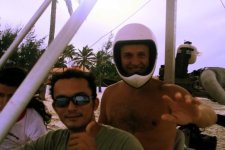
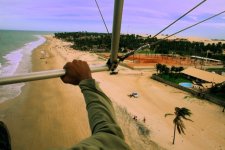
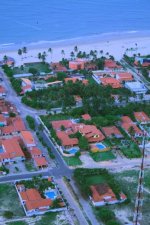
I would say taking a few drinks is probably more risky than getting into a helikopter.... Here is another option that might be a bit more risky. however it's totally vibration free and can fly super low and not ruin everything with the downforce like a helikopter does.

The one on the pictures was made by the pilot himself... he had an old jet ski motor with a propeller strapped on to a tandem hanglider with some old car seats with seatbelts. He could turn off/on engine in mid air and by doing so glide through the air close to ground with close to zero vibrations. The pictures I took of my house does not give it justice (small pocket camera was used) but sitting there with an epic would have be fantastic. As this hangglider does not have the downforce/wind you can fly over the water without making a ripple etc. The guy flew low, as low as I got my feet wet from the breaking waves underneath us, touching palm trees etc. I do not think he had a license to fly, and probably not taken any flight courses, but I have seen him flying on the beach for a few years so with simple math I could convince myself that the risk of a fatal crash where quite slim.

So if you find a propelled hanglider thingy I would see it as an option. Super fast and steady.
 

Attachments

  • 5013_95003183042_1187304_n.jpg
    5013_95003183042_1187304_n.jpg
    40.5 KB · Views: 0
  • 5013_95003213042_4799855_n.jpg
    5013_95003213042_4799855_n.jpg
    49.6 KB · Views: 0
  • 5013_95003263042_7847229_n.jpg
    5013_95003263042_7847229_n.jpg
    64.3 KB · Views: 0
I have gotten some good results hand held with the Kenyon gyro attached to the camera then some stabilizing in post also. But even so, it can be pretty bumpy and if you need the pilot to fly sideways so you can get those forward looking shots, there tends to be a lot of slewing side to side as the pilot fights to keep it going straight. If one of the helos has a tyler mount, it might be worth a look. That is not a home-made device (if its the real thing) and might give you better results. Also, I would skip shooting through the glass, it is not worth your time. They are always full of scratches and you will never get a clean, professional looking shot.
 
Please forgive my portents of doom posted earlier. I think the message should be that aircraft are inherently safer than cars from a mechanical reliability standing. It is the humans who operate them that sometimes paint themselves into a corner. Pilots have to deal with high workloads. There may be periods during a flight when everything is apparently cruisey and laid back. The workload changes to intensity during a flight may not be readily apparent to the layman. A well experienced and confident pilot should have the confidence and focus to ignore you or tell you to siddown and shuttup when the workload rises to almost total. A lesser mortal who tries too hard to please and agrees too easily to requested changes in the mission after take-off may become entrapped into an escalating mess. It is very important to become aware of how much of a distraction you may become without knowing it.

On a lighter note, here is a link to a blog by a local here who is a still shooter who has moved into motion imaging and has recently played with the RED camera family. If you continue to scroll down his blog page past the calender comments you will run into his brief encounters with the RED Scarlett.

http://www.brodiebutler.com/blog/
 
Last edited:
Given the amount of helicopters that fly around the globe at any given minute I'd say its quite safe and certainly as safe if not safer than driving a car.

This is true for commercial aircraft, but debatable for GA (general aviation) ie non scheduled flight in light aircraft.
In general helicopters have a worse fatality rate than fixed wing.


Please forgive my portents of doom posted earlier. I think the message should be that aircraft are inherently safer than cars from a mechanical reliability standing.
I would not include GA.

An EC10 Eurocopter is a different story to a tiny, two seater bell or robinson...you wouldn't catch me dead in one of those.

For clarity, there isn't an EC 10 helicopter. Eurocopter EC 20, EC 130 EC 135 and eurocopter AS350 and AS355 variants are light utility class helis commonly used for aerial filming.


Outside of war zones, filming from helicopters is the most dangerous activity for cameramen, in particular filming from an open door accounts for the vast majority of these fatalities.
Most of us know one or two cameramen who have been killed in helicopter accidents, I don't know any that have been killed on the job filming from the ground (outside of war zones).

Without accurate data of trips and hours flown it is not wise to speak of probabilities.

The bottom line is the cameraman coffin count.
The majority of insurers exclude flights in non scheduled flights for a reason.

At least three cameramen have died in aerial filming misadventures since this thread began.


Mike Brennan
 
Andreas

I shot a lot for the Red Bull air race stuff, a lot of air to air aerobatic flying, shooting from planes and helicopters. You can see some of it here - https://vimeo.com/66419006

Zooms are the way to go, a 15mm or 18mm at the widest, then if you can go to at least 85mm at the zoom end then thats the ticket. Depends on how close you are flying to the subject, but you should be safe.

Be careful, lost of guys perrish with shooting in aircraft. I am a certified skydiver with hundreds of jumps, so i always had my chute should anything go wrong. Pick your pilots well, and carefully!

Good luck with it all!

Jon
 
I know this thread is old but thanks for all the advise here guys. Got my first heli shoot this week (shoulder mounting in an EC120) and feel as prepared as I can be. We'll be opening the door and harnessing me in. I'll be shooting with a Sigma ART 18-35mm f1.8 with the sunshade off and everything, including me, tethered. We've got a lot of time to play in the air (shooting wilderness) so I'll try a few settings but I'll start out with something close to 60fps and 1/300 shutter or faster.

One question... I don't plan on flying sideways but wouldn't it be safer to fly sideways so you're facing the back direction then reverse speed post to get it to look forward? I would think that that would be safer and less turbulent.
 
Last edited:
One question... I don't plan on flying sideways but wouldn't it be safer to fly sideways so you're facing the back direction then reverse speed post to get it to look forward? I would think that that would be safer and less turbulent.

Flying sideways in unfavourable winds can reduce the safety margin to nil.

I wouldn't recommend trying reverse shots on your first flight.
Understand that if there is a wind, that some directions of track and orbit will be safer than others.
The most favourable direction for the shot may not coincide with the direction of sun and wind.
Discuss the shot with pilot before you decide which side to sit.

Don't sit in the front next to pilot.
If there is no back seat I personally wouldn't fly.

Remember that carabiners are designed so that they will not release under load, i.e. if you are hanging upside down.

Have a 5 -10 minute test flight, then land and review the footage.

Keep cool, don't get yourself to the pilot excited.

Search reduser for more info and tips.


Mike Brennan
 
Back
Top