PatrickFaith
Well-known member
- Joined
- Nov 4, 2011
- Messages
- 2,560
- Reaction score
- 0
- Points
- 36
- Location
- California
- Website
- www.pudls.com
I have been wandering around the GTC (gpu conference) in san jose a couple of days, here's some of the stuff I found interesting:
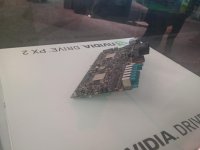
New Nvidia camera processor for Cars - This is like a super computer that is designed to fit in the trunk of a car. It can take 12 camera inputs and convert them into a point cloud. This real time point cloud was amazing, millions of points at very high frame rate. I could see this used onset (or with some modifications), so complete point clouds of a scene can be done realtime. I think this would hugely speed up vfx oriented films, and/or anything with VR.
New Nvidia Data center in a server - basically they have a new chip that is more like a board, and they can fit 8 of these boards into server. It for sure required a server room (the heat and noise was significant), but I could see this replacing a double server rack (i.e. 40 servers). Also since it's one server, the network bandwidth is included in the box, so you just connect into to a extremely fast SAN. This will easily be able to deal with 24k frames.
Vulcan - Vulcan is real now and it took me a bit longer then I expected to really understand what this is doing. Long of it is they have changed the level of the primary interface to GPU's. With Vulcan the thread control of the card is placed at the application level, so the GPU now is fully thread safe. What this also does is create a new ecosystem of products that sit as middleware between the card and most higher level applications.
Boxx - there was a real nice area for BOXX tech, I was amazed how much power they put in their boxes yet how small and quite they were. For artists I really like the APEXX 4, but they have beefy servers too. I think for the specific requirements of post for RED users, the boxx was pretty interesting.
quadro line - pny explained the quadro line really well to me, I also didn't know about the new 24GB M6000. Anyone doing vfx with the new RED 8k frames should do testing with these and not just buy the titan-x. The bandwidth/memory characteristics combined with Vulcan processing and the new ray tracing algorithms are creating a lot of opportunities for high pixel count vfx.
GLTF - I hadn't heard of this file format, is more of a distribution format for vfx/post that includes all the 3d stuff (i.e. kind of like a prores of 3d, has all the mesh and skeleton info). I think of it as a distribution format that is much lighter weight then alembic format, but for streaming and/or downstream user(consumer) client processing. I will be digging into this format in detail.
10G latency - I heard a couple of people randomly talking about large differences in 10g speeds in post that are effected by the latency in some 10g switches. Also the extremely high speeds SAN's connected to GPU farms are going real fast, but weird latency issues can occur. Anyway I'm steering away from the cheaper 10g switches, but I was not able to find a quiet yet low latency 10g switch for local offices/workgroups.
New Nvidia camera processor for Cars - This is like a super computer that is designed to fit in the trunk of a car. It can take 12 camera inputs and convert them into a point cloud. This real time point cloud was amazing, millions of points at very high frame rate. I could see this used onset (or with some modifications), so complete point clouds of a scene can be done realtime. I think this would hugely speed up vfx oriented films, and/or anything with VR.
New Nvidia Data center in a server - basically they have a new chip that is more like a board, and they can fit 8 of these boards into server. It for sure required a server room (the heat and noise was significant), but I could see this replacing a double server rack (i.e. 40 servers). Also since it's one server, the network bandwidth is included in the box, so you just connect into to a extremely fast SAN. This will easily be able to deal with 24k frames.
Vulcan - Vulcan is real now and it took me a bit longer then I expected to really understand what this is doing. Long of it is they have changed the level of the primary interface to GPU's. With Vulcan the thread control of the card is placed at the application level, so the GPU now is fully thread safe. What this also does is create a new ecosystem of products that sit as middleware between the card and most higher level applications.
Boxx - there was a real nice area for BOXX tech, I was amazed how much power they put in their boxes yet how small and quite they were. For artists I really like the APEXX 4, but they have beefy servers too. I think for the specific requirements of post for RED users, the boxx was pretty interesting.
quadro line - pny explained the quadro line really well to me, I also didn't know about the new 24GB M6000. Anyone doing vfx with the new RED 8k frames should do testing with these and not just buy the titan-x. The bandwidth/memory characteristics combined with Vulcan processing and the new ray tracing algorithms are creating a lot of opportunities for high pixel count vfx.
GLTF - I hadn't heard of this file format, is more of a distribution format for vfx/post that includes all the 3d stuff (i.e. kind of like a prores of 3d, has all the mesh and skeleton info). I think of it as a distribution format that is much lighter weight then alembic format, but for streaming and/or downstream user(consumer) client processing. I will be digging into this format in detail.
10G latency - I heard a couple of people randomly talking about large differences in 10g speeds in post that are effected by the latency in some 10g switches. Also the extremely high speeds SAN's connected to GPU farms are going real fast, but weird latency issues can occur. Anyway I'm steering away from the cheaper 10g switches, but I was not able to find a quiet yet low latency 10g switch for local offices/workgroups.
Last edited: