Welcome to our community

Be a part of something great, join today!

  • Hey all, just changed over the backend after 15 years I figured time to give it a bit of an update, its probably gonna be a bit weird for most of you and i am sure there is a few bugs to work out but it should kinda work the same as before... hopefully :)

Filming the Solar Eclipse

Joined
Oct 10, 2013
Messages
13
Reaction score
0
Points
1
Location
Baltimore, MD
Just curious to see who else is filming the upcoming full eclipse on the 21st of this month.

I plan on filming it with a Red Dragon on a 100-400mm Canon lens on a 2x Extender, and a Thousand Oaks Silver-Black Polymer filter attached. Unfortunately I don't have anything in terms of sky tracking. Also, I've heard of people removing the solar filter after the moment of full eclipse, I'm still trying to decide how easy that will be depending on how I attach the sheet filter to the matte box.
 
I'm planning to give it a shot on Epic-W with a Leica 400mm F2.8 APO-Telyt-R Modular and 1.4x apo extender. Could use a 2x apo extender instead but without sky tracking I'd rather have the extra coverage. Plan to use a solar filter from a telescope but will need to test the setup well beforehand, make sure I can secure it quickly/effectively etc. And I'm also planning to remove the filter during the full eclipse – that's the part I'm most interested in capturing. Will use a very low frame rate with low compression so more of a timelapse than straight filming and will probably capture in HDR too.

Taking the day off to do it, should be fun!
 
I was thinking about it, but gave up because I don't have any experience filming the sun and don't want to damage the sensor. I might try a DSLR, but don't see a risk/reward scenario that makes it worth it.
 
I was thinking about it, but gave up because I don't have any experience filming the sun and don't want to damage the sensor. I might try a DSLR, but don't see a risk/reward scenario that makes it worth it.

Linda - don't be afraid of the sun. Actually shooting the sun with tele lenses makes the light spread out over much bigger area of the sensor. It is wide angle lenses that will work like a magnifying glass and focus the light from the sun on a small spot on the sensor. But even then - how many times we catch the sun in our shots on wide angle lenses and no damage occurs. Even normal ND will do the trick. But proper solar filters are not expensive. You can make your own easily from a standard A4 sheet (http://agenaastro.com/baader-astrosolar-visual-filter-film-nd-5-a4-sheet-2459281.html). But then again - with a long telephoto lens you can just use normal ND and adjust your exposure accordingly. If you have the time and opportunity - filming eclipse can be very enjoyable experience...

:sifone: Peter
 
I'm planning to shoot it on my Epic-W Helium. I have a Thousand Oaks solar filter and a Canon 70-200 with a 2x converter. Driving to Nebraska, about 6 hours away. No tracking gear here either. Should be amazing!
 
Having sold my Epic, I'm resorting to the iPhone. Did a couple tests today, not too bad, at least you can see the sun spots.

kCkUZeo.jpg


GjKlgok.jpg
 
Filming it in HDRx on a Raven, Scarlet-W, and an Epic-W with some friends in a campground in Oregon. LEE and Thousand Oaks Solar filters all around. The lens setups are: 70-200 2.8 IS L + 2x, 400mm L prime, 150-600mm Sigma sport.

We'll also have a Takahashi telescope with an ASTRO-PHYSICS Mach1GTO equatorial mount. That will track the sun throughout all eclipse phases.

We will also have a few GoPros around capturing the BTS, and a drone up and behind us capturing the shadow racing across the landscape.

We may get incredible footage. We may get crap. But we've planned the best we've could, and will give it our best shot.

My iPhone can shoot both horizontal and vertical. And I can use the headphones volume switch as a trigger. Eat your heart out.:wink5: Hope you guys get some GREAT images and share them here. Do you have some form of a camera mount for the telescope?
 
Having sold my Epic, I'm resorting to the iPhone. Did a couple tests today, not too bad, at least you can see the sun spots.

I'm very curious how you shot those Mark? I assume you had a filter of some sort? Then you just cropped to have it fill the frame?
 
I'm very curious how you shot those Mark? I assume you had a filter of some sort? Then you just cropped to have it fill the frame?

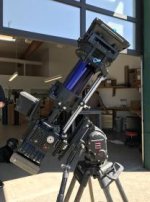
Andy, very simple. I have an old beat up Meade EXT RA90 telescope, 1250mm. I bought a solar filter from B&H, the cheapo one from Daystar. I actually did not crop it whatsoever, that's how big it was in the viewfinder. I have several different viewing lenses and this one is a run-of-the-mill Meade Super Plossl 26mm.

I'd bought one iPhone holder off of Amazon that was pure crap, so I sent it back. Did some looking around on the astronomy sites and found the Orion SteadyPix EZ that had good reviews. Got it yesterday and it's a winner. It clamps onto the viewing lens and aligns the iPhone just right. http://www.telescope.com/Orion-Stea...ope-Photo-Adapter/p/115230.uts?keyword=iphone

Since my telescope also has an equatorial motor, it tracks the sun.

That's all there is to it.
 
Here's my test from yesterday: https://vimeo.com/230164921
Test was with Epic-W, 8k resolution, 4 frames per second, but sped up in Premiere Pro to 400%. Some cropping to output to 1080 from 8k. Lens was Canon 70-200 MkII with a 2x Converter Mk III. Filter was a Thousand Oaks Optical white light solar. I could see the sunspots while shooting, so that's getting me pretty excited for Monday! And to have the ability to crop for only having 400mm to work with is also a big help.
 
Andy, very simple. I have an old beat up Meade EXT RA90 telescope, 1250mm. I bought a solar filter from B&H, the cheapo one from Daystar. I actually did not crop it whatsoever, that's how big it was in the viewfinder. I have several different viewing lenses and this one is a run-of-the-mill Meade Super Plossl 26mm.

Similar setup here but using the Epic-W with the ETX90 optical tube and a mirror filter clamped into the front of our crappy matte box, with an addl. ND 2.1 in the box.
 

Attachments

  • Screen Shot 2017-08-18 at 6.46.23 PM.jpg
    Screen Shot 2017-08-18 at 6.46.23 PM.jpg
    12.9 KB · Views: 0
Similar setup here but using the Epic-W with the ETX90 optical tube and a mirror filter clamped into the front of our crappy matte box, with an addl. ND 2.1 in the box.

Looking sharp! Can't wait to see what you get.

BTW, I found two days ago my ETX has two open screw holes in the bottom of the tube along with another area that I had to use some cinefoil and gaff tape to seal and make the telescope leakproof. You'd think this was never an issue, that a telescope had light leaks and it wouldn't be if it were nighttime, but not so much in the daytime looking directly at the sun. I was finding some weird stray light coming in the viewfinder and couldn't figure out where it was from. Crazy.
 
Trying to figure out how to properly polar align the tripod head... Thinking use the tilt axis locked at 45º since we're roughly on the 45th parallel with the "top" surface of the plate (where the camera would attach to) aiming north. Then theoretically I should be able to just use the pan axis to track the sun... right? I feel like I'm probably missing something.
 
Trying to figure out how to properly polar align the tripod head... Thinking use the tilt axis locked at 45º since we're roughly on the 45th parallel with the "top" surface of the plate (where the camera would attach to) aiming north. Then theoretically I should be able to just use the pan axis to track the sun... right? I feel like I'm probably missing something.

You're going to love this. One of the hardest things to do is polar alignment in the daytime. Can't be done, right? The answer is you need to find the South Pole and align to it. Say again?

You'll need your smartphone for this.

First, get an app for your iPhone that allows for polar viewing. There are a few, I have SkySafari Plus. It's not my favorite app, that would be Star Walk, but SkySafari has a compass setting that will allow you to set your alignment. Basically you want to find a flat place on your tripod/telescope and place your phone on it using the app. Since the app assumes you're pointing towards the sky, it'll show you where it is pointed. But we're going to point it the opposite direction, thus we're looking for the South Pole.

Watch this video for a good explanation: https://www.youtube.com/watch?v=c4q2WGSdC88

And here's another great explanation: http://www.skyandtelescope.com/observing/daylight-polar-alignment/

As the video says, you can set your polar alignment in 30 seconds using this method. And it works! Here's what the screen will look like when you're aligned:

Not aligned:
JUcI5wpi.jpg


Aligned: (notice you can pinch zoom the app image to get a better/more accurate alignment)
o7RA4CUG.jpg

Great info, thanks.
 
You're going to love this. One of the hardest things to do is polar alignment in the daytime. Can't be done, right? The answer is you need to find the South Pole and align to it. Say again?

You'll need your smartphone for this.

First, get an app for your iPhone that allows for polar viewing. There are a few, I have SkySafari Plus. It's not my favorite app, that would be Star Walk, but SkySafari has a compass setting that will allow you to set your alignment. Basically you want to find a flat place on your tripod/telescope and place your phone on it using the app. Since the app assumes you're pointing towards the sky, it'll show you where it is pointed. But we're going to point it the opposite direction, thus we're looking for the South Pole.

Awesome info! I'll practice today and then check it against Polaris tonight (we've got a perfect N facing window). Assuming it's done correctly then we can just track along the pan axis, correct?
 
Awesome info! I'll practice today and then check it against Polaris tonight (we've got a perfect N facing window). Assuming it's done correctly then we can just track along the pan axis, correct?

Yep.
 
Maybe a dumb question, but a solar filter is just a really strong ND filter right? Would I be safe shooting with my Epic-W @ 200mm by stacking some RHOdium IRND's to 10 (2 filters) or 12 (3 filters) stops and just stop down the rest of the way? I didn't prepare by buying any special filters but would like to photograph it if it doesn't run the risk of damaging the sensor of course.
 
Maybe a dumb question, but a solar filter is just a really strong ND filter right? Would I be safe shooting with my Epic-W @ 200mm by stacking some RHOdium IRND's to 10 (2 filters) or 12 (3 filters) stops and just stop down the rest of the way? I didn't prepare by buying any special filters but would like to photograph it if it doesn't run the risk of damaging the sensor of course.

I don't think that'll be a problem? The sun might still clip - we're using a mirrored solar filter (15 stops?) with 2.1ND and found that to be a sweet spot for full sun - 1.2ND looks blown on the monitor but technically doesn't seem to be clipping... I plan to test that theory a little more tomorrow before deciding which one to go with. Telescope is fixed at ƒ13.
 
Back
Top