Welcome to our community

Be a part of something great, join today!

  • Hey all, just changed over the backend after 15 years I figured time to give it a bit of an update, its probably gonna be a bit weird for most of you and i am sure there is a few bugs to work out but it should kinda work the same as before... hopefully :)

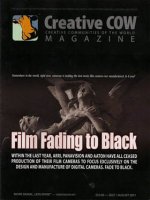
Film fading to black

Frank Weeks

Well-known member
Joined
Apr 19, 2007
Messages
1,483
Reaction score
0
Points
36
Location
Johnson City, TN
There is an interesting article in the Creative COW I received today. It's not their proclamation that film is slowly fading from the high end production field. We have been aware of that for some time. It's the fact that, in the article, Red Digital is almost totally ignored.

I relies the bulk of the cover story is about company's like Arri, Panavision and Atton ceasing production of their film cameras but it would seem that Red Digital had tremendous influence on the speed at which this transition occurred. Red has forced the main players to up their game IMHO far earlier than they would have liked.

It just seem that Red deserves a little credit where credit is clearly due. Just saying.
 

Attachments

  • Fade to black 3.jpg
    Fade to black 3.jpg
    41.8 KB · Views: 0
Eastman is the one really hurt by this.
 
Digital definitely blows film out of the water in low light, but film is still king in maintaining highlight details..but for how long? It's only a matter of time.

I'm guessing you haven't shot an Epic in HDRx mode then?

Because Epic is the king of highlight details today.

Even without HDRx though, Epic and Alexa both are very close to handling highlights as well as film ...

now if you mean overexposed highlights, which a lot of people seem overly concerned with, then yeah film handles that better. I don't mean a highlight that's within reasonable exposure (4-5 stops), but like 8-12 stops over key. (with HDRx Epic can handle up to 18 stops DR safely.)

So, if you plan on shooting something with a lot of intentionally overexposed highlights ... or if you really suck at exposure, then film remains better.
 
Yeah but HDRx is a bit of a hack. I don't think you can say digital outperforms film in highlights until that's native, 99.9% glitch free dynamic range.

Well, arguable if its a hack ... but I'll agree its not 100% glitch free and native DR.

So, that leaves my assertion that both Alexa and Epic handle highlights well unless they are overexposed.

If you want to create a style like that of Robert Richardson ... well then shoot film.

If you have no clue what you are doing and want the lab to save you ... well I'd still actually recommend Red because you can get immediate feedback and have a chance to learn on set and the DIT/Colorist can still do a lot of saving, but in reality if you screw up film is more forgiving.

Of course ... these days I would expect anyone shooting film to first earn their chops on digital before being entrusted with a film process.
 
I think colour is the last dragon that needs to be slayed in the digital realm. Red still lacks in reproducing the same subtle palette as film. It might be the best in digital but it's still missing something. There have been some good posts which i feel have discussed this quite succinctly.
 
Van I totally agree - especially when it comes to very subtle hues of green and brown as found in landscapes, although Redcolor 2 has really moved things forward.
 
I just sold my second-to-last film camera today. :( The only one left in my inventory is a 435, and it works a heck of a lot less than the Epic and Alexa. Thanks film, it's been fun...farewell.
 
I will desperately miss film but I want miss the cost associated with it (raw stock, processing and transfer).
 
Kodak denies it is readying for bankruptcy. Article says it hasn't made a profit since 2007. Not bankrupt but also not profitable.
http://www.bbc.co.uk/news/business-15141421

The company currently has a market value of $210m. This compares with $31bn at its height in February 1997.

Not far fetched to consider that 15 years in the future, the reverse of these figures could be true of REDs rise in fortune?

Mike Brennan
 
Agreed about the color reproduction but would also add that the way a digital camera shutter and a film camera shutter display motion is also the other obstacle digital must overcome. Film is not a dinosaur it's a choice and would be sad if that choice was not available any longer. It would not be a gain to the filmmaking community if film were gone people, it would most certainly be a loss.
It's strange to read people waiting for films demise for what reason?
 
Agreed about the color reproduction but would also add that the way a digital camera shutter and a film camera shutter display motion is also the other obstacle digital must overcome.

That's one reason for the mechanical shutter option on the Sony F65 and the Alexa Studio.
 
I am not surprised that RED is not getting the credit it is due. It is as RED says on their website "Disruptive, revolutionary, game changing, paradigm shifting, visionary, challenging, rule breaking, irreverent."

RED Digital Cinema has been and continues to be a very Disruptive in the market place. With the entire digital cinema process from capture via the RED One, EPIC and SCARLET to distribution and display via the REDRAY and the RED LASER PROJECTOR it really is a game changer.

Think of how many business and individuals are going to be affected by this paradigm shift. Film companies, film camera companies, film labs, telecine companies, film recorder companies, projector companies, distributors and retailers of cameras and lens.

I am sure that there are a lot of people who have invested a lot of money in equipment and technology that is quickly becoming obsolete as the revolution to digital takes place at a pace and price point they could never have dreamed of.

RED is the clear leader of the revolution and as such many of the effected parties will continue to try and deny what we already know. RED is the frontrunner with the highest quality, most affordable and upgradable products in the world.
 
Actually when working on projects that were film before and now digital, I don't really see that many differences. There are still the usual staff on the crew and aside from the camera all the gear, matte box, lenses etc....most all the gear remains the same with the exception of a few pieces. Drives, DIT's, and more on set monitors. Most labs are now serving the digital world along with film so the transition won't be as drastic as most think or thought.. Its already there and most have seen the writhing on the wall and made the necessary changes to continue in their field.
And if your really in love with the film look after shooting your digital camera there is software when your deciding what your whit balance should be that will make it have the grain and color of film.
http://www.filmconvert.com/
 
Hi people

Heres the link to the article . Interesting reading. Sad in many ways but we work in an industry at the pointy end of the stick in terms of technology. I reckon the killer isn't in the production end though it's all those theatrical release prints that are no longer required because of digital theatre projection & the corresponding decline in demand for labs & film stock. I think there will still be film shot but somewhere along the post production pipeline it will be digitally converted, never to be shown in film sprocket form on the big screen.

http://magazine.creativecow.net/article/film-fading-to-black
 
Back
Top