Welcome to our community

Be a part of something great, join today!

  • Hey all, just changed over the backend after 15 years I figured time to give it a bit of an update, its probably gonna be a bit weird for most of you and i am sure there is a few bugs to work out but it should kinda work the same as before... hopefully :)

FCPX, on set post, and studio level workflows

Things they don't teach you in college #127

Things they don't teach you in college #127

(snip) I have been bugged lately by an annoying colleague who is blathering :willy_nilly: inquiries about how/where FCP-X stores its metadata; separate from, or embedded within, the actual media files. (snip)

Let me know how that goes Terry. I've been called an "annoying colleague" so many times I finally figured I'd just look for it in the job postings, but no luck. Murphy's Law, the one thing I'm good at... ;-)

Cheers - #19
 
Trust me, Blair, you could not be in this league of "annoying." :smiley: There's nothing worse than a guy who thinks he is 5 times smarter than he actually is.
 
Last edited:
Sam just got back from the studio level movie he's been working on in Bulgaria .... great write up in FCP.CO on his experiences:

For some reason, I feel like someone needs to play devil's advocate on this stuff. I have nothing to sell and no reason to advocate anything over anything else. What I do have is a lot of experience with those who use all of these things as well as being a user of them myself, and views that are shaped by years of observation as to what "professionals" look at, use, consider for use, and gravitate towards. That said, I would offer the following comments, section by section:


1. No Transcoding: You don't have to transcode in either FCPX or Avid, but it makes for much more fluid editing if you do. Importing R3D files into FCPX is exactly the same as bringing them in via AMA on Avid. The only difference is the ability to switch between the proxies and the original files with a single button in FCPX (in Avid you would need to relink, which is only slightly more involved). But that is assuming that your original files, in all of their 3-4 TB per day glory, are going to live on the editorial SAN. That is not usually the case because, we'll there's 3-4 TB a day. That's a lot of space, a lot of material to manage, and a lot of responsibility to do it. In most cases on longform shows, you're going to cut with either proxies on FCPX, or DNxHD transcodes on Avid. Both can be made in the background on the latest versions of each program, so there's no real difference there. And neither one plays 4K or 5K files directly - they both use wavelet pulls at half resolution - or, in the case of Avid, at whatever resolution you specify. FCPX decides that for you, you don't have a choice. So I don't really see a difference here except in terms of the writer's philosophy as to how to do it. As for enforcing where the files "have to " live, Avid allows you to use any drive on the system to store material. If you're using AMA, you can directly access them from whatever folder they're in. If you're transcoding, they will be placed in a specific directory structure at the root directory level of whatever drive you specify, regardless of whether that drive is internal, external, or shared storage. Not only that, but if you happen to remove then reattach the drive, it not only scans the drive, it reevaluates every clip and rewrites the database so that the system automatically knows what's there. That is hardly restrictive.

2. ExaSAN: I have nothing bad to say about Accusys products. We use them, we've had good success with them.

3. SyncNLink: You don't need this $200 tool with Avid because the functionality is already built in. Sam talks about syching automatically and in record time, but what he doesn't say is that this only works if all time codes are perfect on both picture and sound. That's almost never the case in the real world. Sound sync based solely on time code is generally unacceptable on most high end projects because the editors expect sync to be spot on for every shot. Unless you manually check each shot and make the small frame adjustments (or, in some cases, large ones) necessary when you "blind sync" using only time code, you won't have that. That takes time, regardless of what you're using. In fact, I would argue that it's quicker to slip sync in Avid subclips than it is in FCPX because you can do it without going into the timeline and manually moving the tracks. As for multi cam, while I like FCPX's multicam functionality and think it's very well done (especially for cameras that stop and start), the fact is that you have to make all of those multicam clips manually, by figuring out what goes with what, and then create them each individually. With Avid, you can select every shot in a bin and use a function called Multigroup, which automatically makes group clips of any shots that have common time code. So in one step, you create all of your multicam clips for an entire bin's worth of material. That's pretty darned efficient. Now, it is true that you can't make group clips in Avid from AMA materials. But if you're transcoding anyway, that really isn't an issue. So the real difference here is not how quickly you can do these things, it's whether you choose to use the huge original camera files for your offline cutting - something that is rarely practical on longform work for a multitude of reasons.

4. Metadata: Avid has been the industry leader when it comes to storing and recovering metadata in a way that's most useful to the overall post process. While FCPX clearly has a lot of metadata capabilities, most of it is only useful while you're in FCPX, in part because the program does not produce a number of industry standard lists and reports that other programs do. As a quick for instance, I've yet to see any way to save and recover CDL values from dailies and pass them on to a color grading system using FCPX. This is trivial in Avid because the metadata is stored in the bin (and in the MXF file header if you consolidate) and is made available in a simple, standard EDL you can generate for that purpose. In Avid, you've always been able to move or copy clips to bins for organization in whatever style you want. Also, you've always been able to make custom bin columns in Avid, it's just that most editors don't because they don't really see a use for them. FCPX practically forces you to use these metadata based functions as a matter of course, which if you look at it from Sam's point of view makes the program better and easier to use, but if you look at it from an established editor's point of view just makes it different. So the importance of these things really depends on your level of experience and familiarity.

5. Training: Synching, renaming, and making group clips in Avid would take even a novice about 2 hours to learn. These are some of the simplest and most automated features of the program. I would argue that what might take a bit less training is the actual editing part (assuming the person you're teaching already knows how to edit and it's just the software that's being taught). I do find actually cutting in FCPX to be fast and fluid (assuming I've already made proxies on a Red originated project), so I have no argument with that part of this.

I think what I'm getting at is that when something comes along that has a different philosophy of operation, it's not a question of this vs. that. Many of the things that have been pointed out regarding FCPX are simply things that are different, and not necessarily better or worse. And other things that are cited as "new" are really not new, they're just enforced so you have to use them to get the program to function correctly. I understand those who have an interest in selling something praising its features and extolling its virtues. But a slightly deeper evaluation usually reveals that it's not quite as revolutionary as it might seem, and a number of things that are pointed out as "new" have in fact been available on Avid for quite some time. Whether people have used them is another issue.
 
Indeed

Trust me, Blair, could not be in this league of "annoying." :smiley: There's nothing worse than a guy who thinks he is 5 times smarter than he actually is.
 
What makes you think any of us have "something to sell?"

Neil and Sam are the principle owners of LumaForge, which configures and sells Final Cut X based systems as well as other things, and has been heavily promoting training and use of that software through presentations at trade shows as well as at their own location, which is prominently mentioned in most of their posts. I included that statement so that I wouldn't be accused of trying to steal thunder, discredit statements, or promote some competing product for my own gain - none of which was my intent.
 
Mike - from what I understand, you are the "go-to guy" for post on this forum - or at least one of them. So, it is with great respect for your skill and reputation that I comment at all. Insofar as everyone has a favorite workflow or favorite apps with which they prefer to work, and each of us has a reputation to protect and burnish, we all, I guess have "something to sell." Even you. Seems, however like this argument abut NLEs is taking on the tone of the old Mac vs. PC wars; an argument that no longer is worth serious discussion, IMO. Everyone has a preference and no one is "right" - or at least they'll never convince the "other side" of it.

At first, it seemed like it was necessary to defend FCP-X against those who dismissed it completely. Just a knee jerk reaction on my part, I suppose. Lately, though, it seems as if it is being readily accepted, even embraced, even by so-called, and often self-described "pros." So, at this point I usually tell people that if they are perfectly happy with their editing workflow and experience, and see nothing they might want to improve, then they should most definitely NOT consider FCP-X; why mess with happiness.

There are some very credible people supporting FCP-X, notably Sam and Michael Cioni. Yes, it is most definitely different. No, it is not necessarily "better." Some of us, however, like the newness of the paradigm and see it as having more "upside" as time goes on. We'll see. If I were going to be concerned about anything on the Avid side, at this point, I would worry more about their financial situation than the effectiveness of their NLE.

Regards.
 
I would love to hear from a feature editor who makes a living as a feature editor push for this workflow....I still have yet to find ONE.

The ONLY people who I find pushing this are vendors who have a financial horse in the race and producers who believe that this is going to save them money. Once you set up that infrastructure good luck getting an editor and a director to sit in Bulgaria for 10 weeks using FCPX for directors cut.

Neil and Sam are the principle owners of LumaForge, which configures and sells Final Cut X based systems as well as other things, and has been heavily promoting training and use of that software through presentations at trade shows as well as at their own location, which is prominently mentioned in most of their posts. I included that statement so that I wouldn't be accused of trying to steal thunder, discredit statements, or promote some competing product for my own gain - none of which was my intent.
 
So FCPX was used for doing promotional spots for the feature, NOT actually cut the feature?

I quote from the article:

"When you arrive you find out that your system is immediately going to be put to use editing EPKs for a major motion picture, and eventually handle editorial for that studio’s films moving forward."

"When I get off the plane, I’ll be staying in New York for a couple days, and then I’ll be immediately flying out to get off the ground the first major U.S. studio feature film to be cut entirely in FCP X (at least the first that I’m aware of)."

So although his example here was EKG, it seems the same setup will be used for that studio's features editorials as well. And the US example of course.
 
I would love to hear from a feature editor who makes a living as a feature editor push for this workflow....I still have yet to find ONE.

The ONLY people who I find pushing this are vendors who have a financial horse in the race and producers who believe that this is going to save them money. Once you set up that infrastructure good luck getting an editor and a director to sit in Bulgaria for 10 weeks using FCPX for directors cut.

And the beat goes on... LOL
 
Ah, yes. The univeresal explanation for anything with which you don't agree.:001_tongue:
 
AAA ratings

AAA ratings

Disclaimer: I do some work with Neil and Sam at LumaForge. Oddly, I am now going to defend Mike, who, full disclosure, I consider a friend.

Mike did not attack Sam or FCP-X, he was clear up front what his agenda was, and while he obviously does not consider FCP-X the second coming he did note several positives including calling cutting on FCP-X with proxies fast and fluid. It's worth noting that like a certain camera many of us campaign for, FCP-X has a negative reputation (some deserved, some not) to overcome and its proponents sometimes feel the need to push back against the FUD that gets unfairly mixed in.

FWIW, the trajectory of the evolution of FCP-X looks very promising. With Apple's ability to optimize software/hardware integration and capable new hardware on the horizon I expect the value proposition to be compelling for a lot of RedUsers. I'm looking forward to getting a new MacPro this fall, installing the latest FCP-X and fully expect the combination to offer the best user experience working with R3Ds this side of $20K+ big iron.

I just hope somebody forwards Mike's post to whomever is in charge of the next iteration of FCP-X. As brilliant as some aspects of the program are, there are still issues typical of going from a ground up rewrite to a mature program that integrates elegantly with the larger production ecosystem. Sam has figured out clever strategies that make the circa Sept. 2013 FCP-X viable on a big time feature production, something that even Sam would have been hard pressed to accomplish a year ago - that's a big deal in my book. I'm not interested in getting into a tit-for-tat FCP-X vs AVID argument, each has strengths and weaknesses, but would posit that for some individuals one might suit their way of working significantly better than the other.

Bottom line - Apple could have stuck with the popular FCP7 NLE, instead they wrote new code optimized for modern processing environments, vastly expanded metadata support and decided the way forward was not continuing the conventions established when we were physically cutting celluloid. IMO the onus is on Apple to show us what their "fully armed battle station" can do by NAB 2014 - based on the pace of improvements over the last 18 months, FCP-X is poised to be a modern editor that leverages metadata in ways that I expect will rapidly become SOP.

Cheers - #19
 
"I'm rubber, you're glue...?"

"I know you are but what am I?"

":ciappa::dita:"

Now that is covered. Can we move it off of the playground?
 
Now, it is true that you can't make group clips in Avid from AMA materials. But if you're transcoding anyway, that really isn't an issue.

I just double-checked. You can create groups from AMA clips. I did have a problem with timecode from the audio files not coming through via AMA, but an entire day's worth of audio imports is usually a non issue.
 
Avid's financial situation ...

Avid's financial situation ...

.... There are some very credible people supporting FCP-X, notably Sam and Michael Cioni. Yes, it is most definitely different. No, it is not necessarily "better." Some of us, however, like the newness of the paradigm and see it as having more "upside" as time goes on. We'll see. If I were going to be concerned about anything on the Avid side, at this point, I would worry more about their financial situation than the effectiveness of their NLE.

Regards.
You raise an interesting point, Terry ... just checked the Avid's Investor Relations page to see how well they're doing ... seems they're in a bit of a pickle with the SEC and NASDAQ ... can't publish last year's financial reports for some reason and are about to get delisted by NASDAQ ... quote from their latest PR missive of Sept 5th, 2013:

" .... As previously announced, the Delinquent Reports were not timely filed due to the Company's ongoing accounting evaluation and pending restatement of its financial statements for the fiscal years ended December 31, 2011, 2010 and 2009 and quarterly periods ended March 31, 2012 and 2011, June 30, 2012 and 2011, and September 30, 2012 and 2011. For more information regarding the accounting evaluation, please see the Notification of Late Filing on Form 12b-25 filed by the Company on August 12, 2013, and the Current Report on Form 8-K filed by the Company on May 21, 2013.

Although the Company is working diligently and has made substantial progress in the accounting evaluation process, that process is complicated and time-consuming, and additional time is needed to complete it. The Company intends to complete the restatement and to file the Delinquent Reports as promptly as practicable."

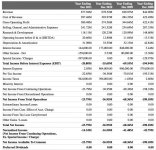
The other strange things is that though Avid have a great product set they haven't made a profit for the last five years and their revenue seems to be stagnating .... this is from their current financial reports which presumably will get re-stated once they've met current SEC accounting standards:

http://ir.avid.com/financials-statements.cfm

Terry, what's your view of why Avid are not growing their company given their strong presence in the professional post market?

Neil
 

Attachments

  • Avid Financial Statements - 2008 to 20011.jpg
    Avid Financial Statements - 2008 to 20011.jpg
    95 KB · Views: 0
Back
Top