Welcome to our community

Be a part of something great, join today!

  • Hey all, just changed over the backend after 15 years I figured time to give it a bit of an update, its probably gonna be a bit weird for most of you and i am sure there is a few bugs to work out but it should kinda work the same as before... hopefully :)

Eyes Wide Shut has no Cinematographer or DoP?

It's unfortunate, but I feel Malick has lost something in his last three films.
He has almost become too self conscious, and for once I feel that the emphasis on the image at the expense of the story has detracted from his filmmaking. It is beautiful to be sure, but even in tree of life, it felt like he was trying to create a story which justified the footage he somehow wanted to do something with. And god how I hate seeing the same footage twice in a film! That's film school 101. I can just here the professor saying "don't do it!".
The last LA film (see, I have already forgotten it's name!), feels like a very poor attempt at what Wim Wenders did so well in Wings of Desire so many years ago. Characters whispering over the image for the length of the film is already risky, but Berlin's angels sure are more interesting than these LA losers.
The great theme of his old work seemed to be about the relationship between man and nature...and where the limits of the two cross something happens to men which changes them.
However, I think Hollywood has gotten to him and it's a darn shame.

Eyes Wide Shut, was not tops for me either. Maybe I just couldn't get past Tom Cruise, but I do love Sydney Pollock. It also felt too much like a film set and seem to have lost some of that naturalism in some of Kubrick's previous works. A lot of people say that he was sick by that point and so wasn't present in the way he had been before...don't know.
 
Last edited:
I think the phrase "Know Thyself" applies to directors as much as anyone.

For a Creative having leadership of most complex art form in existence, consisting of collaboration of practially all others, being given huge resources, with power to affect minds of many, and create work which will be left for generations to come...

...I'd say the ancient maxim should apply the most.
 
It's unfortunate, but I feel Malick has lost something in his last three films.
He has almost become too self conscious, and for once I feel that the emphasis on the image at the expense of the story has detracted from his filmmaking. It is beautiful to be sure, but even in tree of life, it felt like he was trying to create a story which justified the footage he somehow wanted to do something with. And god how I hate seeing the same footage twice in a film! That's film school 101. I can just here the professor saying "don't do it!".
The last LA film (see, I have already forgotten it's name!), feels like a very poor attempt at what Wim Wenders did so well in Wings of Desire so many years ago. Characters whispering over the image for the length of the film is already risky, but Berlin's angels sure are more interesting than these LA losers.
The great theme of his old work seemed to be about the relationship between man and nature...and where the limits of the two cross something happens to men which changes them.
However, I think Hollywood has gotten to him and it's a darn shame.

Eyes Wide Shut, was not tops for me either. Maybe I just couldn't get past Tom Cruise, but I do love Sydney Pollock. It also felt too much like a film set and seem to have lost some of that naturalism in some of Kubrick's previous works. A lot of people say that he was sick by that point and so wasn't present in the way he had been before...don't know.

I haven't seen the last one but Tree and Wonder are up there in my top films list. A really interesting write up on To The Wonder and Tree. I think Malick makes films where there is no right or wrong way to interpret them.

I saw Eyes when it was released in theatres and didn't like it at the time. I am still not a big fan of it.
 
I agree with your implication that art is in the eye of the beholder. I also believe that every brain has wiring as unique as our fingerprints, and while we may be collaboratively led to hold similar beliefs, in isolation we vary, albeit to a small degree in some cases.

And while I may differ on what is art and what is storytelling in re: movies... that only goes to show we have different thresholds for what is art.

Not saying a shoot can't be art... if it was shot to be art and not to tell a story.

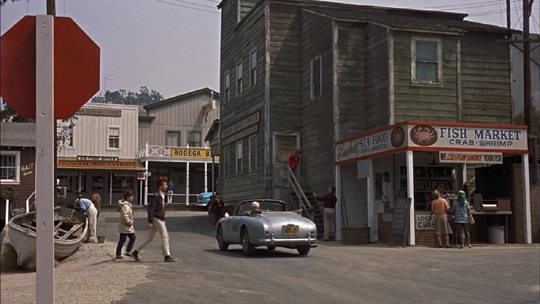
I recently re-watched the BR of the Birds. (Amazing restoration and transfer BTW) and when I was watching it the shots were art to me. Norman Rockwell type stuff. Especially the Bodega Bay scenes. To me art doesn't have to just be classic paintings and sculptures. To me art is all encompassing and includes those as well as music and cinema.


ac7f91c8e7a205f4a93dccb227443c3b.jpg


birds_10.jpg


birds08.jpg

As photos, your examples work as art for me. I have time to see everything in the image and contemplate what I'm seeing. In a movie, I'm more interested in how the moving images fit into the story.
 
I completely agree, but instead of the top level director doing the face to face you put an assistant director there to take care of that.
That's not the way it works in Hollywood. You have to be there, in the moment, giving the actors 100% of your attention. The assistant organizes the crew and keeps the set moving. There is an established chain of command, and to me a good director is right there, fighting the battle just a few feet away from the actors.

There have been attempts to direct actors from a distance, but I don't think they were successful. One that got a lot of publicity in the 1980s was Francis Coppola on One from the Heart, which (for its time) was an extremely high-tech production in which Coppola sat in a million-dollar Airstream trailer and directed the actors from PA speakers while watching remote monitors, a hundred feet from the sound stage. The problem with this method is that it completely eliminates the personal touch. Sometimes, you need to walk over to the actor, put your arm around their shoulders, then walk them off the set and explain something patiently and tactfully. Sometimes, you need to ream them out and warn them that their performance was horrible and come up with a fix. There are directors who will deliberately put the actor off-balance or even in tears to get the results they want on screen. You can't do this from a speaker or through an intermediary.

There are directors who are reportedly very distant and uninvolved. The main actors on American Graffiti have said that the most direction they ever got from George Lucas was either "faster and more intense," or "that was great! Let's try another one." Not a word about character or tone or emotion. And there are other directors who force the actors to line read and repeat the dialogue exactly as he wants it, almost like operating a puppet. By and large, I think the best directors avoid these extremes and adjust their approach depending on the needs of the actor and what's happening on the set, using a lot of tact and psychology. But none of these approaches will work from a distance.

I worked on sitcoms for many years, and even in these cases where the director could sit in the booth and just watch the four monitors, the top guys (and I'd put Andy Ackerman, James Widdoes, Peter Bonerz, and Jim Burrows in that league) all stand on the floor, just 15 feet from where the actors are. If they need to make an adjustment, they'll have everybody hold, huddle momentarily with the actor, speak very quietly, and then immediately do a pickup. Nothing over the speakers, nothing through an assistant -- they do it directly and get it done very quickly.
 
Or just animate all your characters and throw your voice while you attempt to make a movie. :)

But seriously, I get that there are circumstances where it's not physically possible to be at or near where the actors are, but I feel that a fundamental part of the whole process is this key interaction between the creatives. I've been on both sides of this and I understand it well. It's borderline insulting to the process.

David


That's not the way it works in Hollywood. You have to be there, in the moment, giving the actors 100% of your attention. The assistant organizes the crew and keeps the set moving. There is an established chain of command, and to me a good director is right there, fighting the battle just a few feet away from the actors.

There have been attempts to direct actors from a distance, but I don't think they were successful. One that got a lot of publicity in the 1980s was Francis Coppola on One from the Heart, which (for its time) was an extremely high-tech production in which Coppola sat in a million-dollar Airstream trailer and directed the actors from PA speakers while watching remote monitors, a hundred feet from the sound stage. The problem with this method is that it completely eliminates the personal touch. Sometimes, you need to walk over to the actor, put your arm around their shoulders, then walk them off the set and explain something patiently and tactfully. Sometimes, you need to ream them out and warn them that their performance was horrible and come up with a fix. There are directors who will deliberately put the actor off-balance or even in tears to get the results they want on screen. You can't do this from a speaker or through an intermediary.

There are directors who are reportedly very distant and uninvolved. The main actors on American Graffiti have said that the most direction they ever got from George Lucas was either "faster and more intense," or "that was great! Let's try another one." Not a word about character or tone or emotion. And there are other directors who force the actors to line read and repeat the dialogue exactly as he wants it, almost like operating a puppet. By and large, I think the best directors avoid these extremes and adjust their approach depending on the needs of the actor and what's happening on the set, using a lot of tact and psychology. But none of these approaches will work from a distance.

I worked on sitcoms for many years, and even in these cases where the director could sit in the booth and just watch the four monitors, the top guys (and I'd put Andy Ackerman, James Widdoes, Peter Bonerz, and Jim Burrows in that league) all stand on the floor, just 15 feet from where the actors are. If they need to make an adjustment, they'll have everybody hold, huddle momentarily with the actor, speak very quietly, and then immediately do a pickup. Nothing over the speakers, nothing through an assistant -- they do it directly and get it done very quickly.
 
Last edited:
That's not the way it works in Hollywood. You have to be there, in the moment, giving the actors 100% of your attention. The assistant organizes the crew and keeps the set moving. There is an established chain of command, and to me a good director is right there, fighting the battle just a few feet away from the actors.

There have been attempts to direct actors from a distance, but I don't think they were successful. One that got a lot of publicity in the 1980s was Francis Coppola on One from the Heart, which (for its time) was an extremely high-tech production in which Coppola sat in a million-dollar Airstream trailer and directed the actors from PA speakers while watching remote monitors, a hundred feet from the sound stage. The problem with this method is that it completely eliminates the personal touch. Sometimes, you need to walk over to the actor, put your arm around their shoulders, then walk them off the set and explain something patiently and tactfully. Sometimes, you need to ream them out and warn them that their performance was horrible and come up with a fix. There are directors who will deliberately put the actor off-balance or even in tears to get the results they want on screen. You can't do this from a speaker or through an intermediary.

There are directors who are reportedly very distant and uninvolved. The main actors on American Graffiti have said that the most direction they ever got from George Lucas was either "faster and more intense," or "that was great! Let's try another one." Not a word about character or tone or emotion. And there are other directors who force the actors to line read and repeat the dialogue exactly as he wants it, almost like operating a puppet. By and large, I think the best directors avoid these extremes and adjust their approach depending on the needs of the actor and what's happening on the set, using a lot of tact and psychology. But none of these approaches will work from a distance.

I worked on sitcoms for many years, and even in these cases where the director could sit in the booth and just watch the four monitors, the top guys (and I'd put Andy Ackerman, James Widdoes, Peter Bonerz, and Jim Burrows in that league) all stand on the floor, just 15 feet from where the actors are. If they need to make an adjustment, they'll have everybody hold, huddle momentarily with the actor, speak very quietly, and then immediately do a pickup. Nothing over the speakers, nothing through an assistant -- they do it directly and get it done very quickly.

Your examples are a good argument for "business as usual."

My point is that a super director in the vein of Clint Eastwood or Woody Allen, who I understand are not micro managers but instead delegate the roles to the actors, can work this way. Once this way of operating becomes mainstream, the actors will adjust, the on-location director's role will be defined... in short, the process will be honed.

Yes, there will still be the kind of actor-director relationships you outlined and many movies will be shot the old way... that is, the way they are shot now.

This is the future I'm talking about.
 
Last edited:
It would not be an improvement, it would not be an advancement in the art of filmmaking, to distance the director from the actors. A director's primary job on a film set is to monitor the performances. If that isn't a priority for them, they shouldn't go into directing. Of course, a director has a million other jobs, but working with the actors to get the right performance is vital to directing and no one else on a film set is allowed to be involved. When a take is over, you don't want the actor looking towards the boom operator or the camera operator for notes on their performance.

At some level, filmmaking is not about the technology. In the future, some things won't change, like the need for good scripts and good performances. Technology isn't going to make those two things easier.

It's not a question of something being the "old" way.

And your examples of Eastwood and Woody Allen are completely wrong -- they watch the actors on the set. That's what matters to them. They don't micromanage the performances but they don't ignore them either.

Emotional scenes can make the actors feel very vulnerable on the set and part of the director's job is to protect them and support them. So if an actor has a breakdown during the scene, the last thing after they exposed themselves emotionally to the camera is for someone other than the director to step up to them and give them notes. That would be like trying to seduce a woman through a third party speaking for you -- it may work but it's not the most effective way of forming a close relationship.

Would you raise your children through a third person speaking for you under the notion that this was the "new" way and that actually spending time with your children was old-fashioned?
 
It would not be an improvement, it would not be an advancement in the art of filmmaking, to distance the director from the actors. A director's primary job on a film set is to monitor the performances. If that isn't a priority for them, they shouldn't go into directing. Of course, a director has a million other jobs, but working with the actors to get the right performance is vital to directing and no one else on a film set is allowed to be involved. When a take is over, you don't want the actor looking towards the boom operator or the camera operator for notes on their performance.

At some level, filmmaking is not about the technology. In the future, some things won't change, like the need for good scripts and good performances. Technology isn't going to make those two things easier.

It's not a question of something being the "old" way.

And your examples of Eastwood and Woody Allen are completely wrong -- they watch the actors on the set. That's what matters to them. They don't micromanage the performances but they don't ignore them either.

But it would be an advancement in the BUSINESS of movie-making.

I haven't meant to suggest this is the preferred way of making movies, but rather the expected transformation where a younger generation prefers interacting with other people through tech gear.

And if you can get a future George Lucas (a techy kinda guy) to be able to sit in a control room with links to 2, 3, or more movie locations and reviewing instantaneous rushes or even real time camera streams and adding his magic touch to those productions... and if the technology allows him to oversee/direct 30 movies per year by not having to be on a physical set all the time... it's raining money!

As for the actor who breaks down after an emotional scene... hire an on-set psychiatrist... or a chaplain... or work with more stable actors. '-)
 
Last edited:
Just stop.

Really. Just stop.


But it would be an advancement in the BUSINESS of movie-making.

I haven't meant to suggest this is the preferred way of making movies, but rather the expected transformation where a younger generation prefers interacting with other people through tech gear.

And if you can get a future George Lucas (a techy kinda guy) to be able to sit in a control room with links to 2, 3, or more movie locations and reviewing instantaneous rushes or even real time camera streams and adding his magic touch to those productions... and if the technology allows him to oversee/direct 30 movies per year by not having to be on a physical set all the time... it's raining money!

As for the actor who breaks down after an emotional scene... hire an on-set psychiatrist... or a chaplain... or work with more stable actors. '-)
 
But it would be an advancement in the BUSINESS of movie-making.

No it wouldn't.

If you use a smartphone-controlled robotic solution to slice your bread you haven't advanced, you have just complicated your life by pampering the child within, with a special bonus of gradually deteriorating skills.

I haven't meant to suggest this is the preferred way of making movies, but rather the expected transformation where a younger generation prefers interacting with other people through tech gear.

Younger generation is being heavily idiotized through "smart" devices, being used to compensate for own mental faculties which unused deteriorate, and also dehumanized through lack of direct and natural human interaction.

Technology can neither compensate lack of mental faculties nor it can replace direct human interaction.

And if you can get a future George Lucas (a techy kinda guy) to be able to sit in a control room with links to 2, 3, or more movie locations and reviewing instantaneous rushes or even real time camera streams and adding his magic touch to those productions... and if the technology allows him to oversee/direct 30 movies per year by not having to be on a physical set all the time... it's raining money!

That is unrealistic.

Director has to be 100% focused on the film and has tons of factors to observe and consider on set in one project.

As for the actor who breaks down after an emotional scene... hire an on-set psychiatrist... or a chaplain... or work with more stable actors. '-)

You don't get it.

To be able to generate specific expressions, actors have to go through many emotions during the shooting day.
On demand .

While having to remember text, control face, tone, rhythm and body movement in perfect sync to camera and other actors and elements in the scene and repeat that a bunch of times .

Mind can only take so much.
 
No it wouldn't.

If you use a smartphone-controlled robotic solution to slice your bread you haven't advanced, you have just complicated your life by pampering the child within, with a special bonus of gradually deteriorating skills.


Younger generation is being heavily idiotized through "smart" devices, being used to compensate for own thought processes which unused deteriorate, and it is also dehumanized through lack of direct human interaction.

Technology can neither compensate lack of mental faculties nor it can replace direct human interaction.


That is unrealistic.

Director has to be 100% focused on the film and has tons of factors to observe and consider on set in one project.


You don't get it.

Actors go through heavy emotions many times during the day. While having to control face, tone, rhythm and body movement in perfect sync to camera and other actors and elements in the scene and repeat that a bunch of times . Mind can only take so much.

Heh, heh... obviously we see things differently. '-)

ADDITIONAL: I have decided to respond to one of your assumptions... that being the one highlighted, and further clarifies my remarks about hiring more stable actors.

My response is, have you ever heard of Joan Crawford, Bettye Davis, John Wayne, Jimmy Stewart... legendary actors all, who needed coddling? I doubt many if not most including Tom Hanks or Jennifer Lawrence and others are unable to give a stellar performance without breaking down emotionally.

A weak mind can only take so much, but actors generally go through a trial by fire (or being fired or not even hired) that often makes them stronger emotionally than the rest of us.
 
Last edited:
ADDITIONAL: I have decided to respond to one of your assumptions

There isn't a single assumption in the post you quoted.
 
Well, opinions then. We only have your word they are true.

I applaud your creative thinking and desire for advancement.

A very wise man once wrote "Opinion is a medium between knowledge and ignorance". In interpreting a basis for previously written I can understand why of those three it is easier to disregard one.

The perceived value of a Word has sadly fallen in a world filled with meaningless babble, but that is just a small tick in time.
 
I applaud your creative thinking and desire for advancement.

A very wise man once wrote "Opinion is a medium between knowledge and ignorance". In interpreting a basis for previously written I can understand why of those three it is easier to disregard one.

The value of a word has sadly fallen in a world filled with meaningless babble, but that is just a small tick in time.

Agreed.

(I think '-)

Oh, and it's not really my desire for advancement... I'll never be one shooting this way. It's just where I see technology and the changing brain of younger generations taking it.
 
Back
Top