Welcome to our community

Be a part of something great, join today!

  • Hey all, just changed over the backend after 15 years I figured time to give it a bit of an update, its probably gonna be a bit weird for most of you and i am sure there is a few bugs to work out but it should kinda work the same as before... hopefully :)

Eyes Wide Shut has no Cinematographer or DoP?

This one is in french sorry (maybe you can google translate).
"La société américaine des chefs opérateurs a obtenu depuis des décennies qu'un directeur de la photo distinct du réalisateur soit toujours crédité au générique et soit officiellement présent sur le plateau. Ça fait partie des conventions des films réalisés conformément à la charte, c'est-à-dire tous les films de studio. Parmi les autres conventions, le monteur et le réalisateur ne peuvent pas être la même personne et il ne peut y avoir qu'un réalisateur de crédité. C'est pour ça que Joel Coen est crédité comme réalisateur, Ethan Coen comme producteur et que Roderick Jaynes (Joel + Ethan) signe le montage. Pour Eyes Wide Shut, Kubrick a donné le titre à un des éclairagistes mais c'est un des films pour lesquels il s'est particulièrement occupé de la photo.
Sur 2001, le boulot est attribué à Geoffrey Unsworth (qui a son nom en gros au générique). Ceci dit, Kubrick avait déjà commencé sa collaboration avec John Alcott (qui s'est occupé de la première partie), lequel a ensuite signé la photo de tous les films jusqu'à Shining. Pour Full Metal Jacket, c'est son assistant Douglas Milsome qui a pris la relève. Ce dernier aurait aussi bossé sur Eyes Wide Shut mais les infos que j'ai obtenues à ce sujet sont pour le moins confuses, voire contradictoires.
Pour Eyes Wide Shut, le choix de la dénomination ("lighting cameraman") et d'un sous-fifre à ce poste indique clairement que Kubrick revendiquait la paternité du boulot.
Sur Spartacus, Russell Metty (La Soif du mal, Imitation of Life, Ecrit sur du vent) était en charge de la photo alors qu'Anthony Mann était encore réalisateur. Mann est viré et Kirk Douglas appelle Kubrick. Kubrick s'est vite engueulé avec Metty pour une divergence sur l'éclairage. Résultat, comme on ne pouvait pas le virer, Metty a passé plusieurs mois de tournage installé dans son fauteuil, histoire de pointer, pendant que Kubrick supervisait le boulot lui-même. Et ça lui a valu le seul Oscar de sa carrière !"

I'm sorry but this French writer has it all wrong. The lighting camerman doesn't operate the camera. That was a different title..

So yes Stanley might have been quite hands on with the camera on eyes wide shut perhaps, but so what?

This article reminds me of the book I read where they talked about Kubrick using the special "steadycam camera" on The Shining.

Freya
 
Maybe Google translation is off because I don't really see anything camera related in this article. And Larry smith is a member of the BSC and Eyes Wide shut an american movie, I guess there are international rules.
 
Maybe Google translation is off because I don't really see anything camera related in this article. And Larry smith is a member of the BSC and Eyes Wide shut an american movie, I guess there are international rules.

Could be the translation is off and you are right that it is an American movie but even so, the rules of the ASC don't really apply to a movie with a BSC member shot in the UK. We have our own guild and union rules over here.

Why are you so reluctant to believe that the French article is wrong?

Freya

Well whatever ....
 
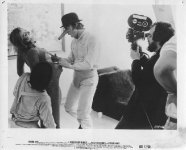
Lest there be any doubt about Herr Kubrick shooting on his films . . .
 

Attachments

  • Clockworx.jpg
    Clockworx.jpg
    47.3 KB · Views: 0
> > print was purloined many years ago from the MGM Studio photo vault by a friend's father < <
 
Kubrick ain't German - though he did marry a German, Christiane. He worked with a Michael Herr, who wrote perhaps the best bit of writing about Kubrick ever: 'Kubrick' - very insightful on a personal and professional level by a very good writer.

I've read pretty much everything about Kubrick and keep up with the forums on him. By all reports his cameramen worked like demons. Anyone on a Kubrick set did - and there were always very few crew because Kubrick and Harlan were so frugal with everything - no excess including no brilliant cinematographers sitting around on apple boxes.

Alcott said of The Shining that 'we were marching to Kubrick's drum' so he was executing his photographic direction but at the same time Kubrick was always open to ideas and would frequently solicit ideas from anyone on set, so I am sure that while, as Milsome said, 'it was very hard to impress Stanley', that the brilliant people around him were always striving to impress and contribute and that the best ideas won out no matter who they came from.
 
I'm sure that because of union rules, there were some standby people, a standby operator or unit stills photographer now and then (though obviously Kubrick didn't shoot all of the production stills on his sets -- if he did, he wouldn't appear in them, would he?) But the cinematographers weren't stand-by people just hired to satisfy a union rule. If Kubrick intended that, he would have hired some no-name beginner with no credits that could be signed up at guild minimum rate, he wouldn't have hired the top British cinematographers of the 1960's like Ozzie Morris, Geoffrey Unsworth, Gil Taylor. And I'm sure John Alcott's rate wasn't bottom floor after he won an Oscar for "Barry Lyndon". If you read some of the interviews with John Alcott, you realize that he worked with Kubrick to figure out things like lighting the African landscape set in "2001" -- Alcott didn't just sit in the corner and collect a paycheck.

Even though Kubrick operated the camera, you can tell from this interview that he and Alcott worked together to figure out how to shoot "Barry Lyndon":
http://www.visual-memory.co.uk/sk/2001a/bl/page1.htm
 
I'm a fan of Kurbick's Films and been watching them since childhood.

Few Things.
1. I know everyone is touting his cinematography skills, but amongst his peers, I'm not sure he was ever widely respected in that way.

Here are the 1988 Academy Noms for Cinematography(Full Metal Jacket)WINNER
The Last Emperor: Vittorio Storaro
NOMINEES
Broadcast News: Michael Ballhaus
Empire of the Sun: Allen Daviau
Hope and Glory: Philippe Rousselot
Matewan: Haskell Wexler

2. Not sure what you think a Director of Photography does, but it's usually determined by the Director and what role they want them to take, but it can also be by the producer, if they are the one that hires them.

3. IMHO, Cinematography is very unimportant in what makes a movie good, but is of great significance or value in creating a movie memorable.


PS: One thing you can say, in many circumstances, people did their best work while working under Kubrick's control.
 
More than a few people have said that if Kubrick weren't a film director he would have been the foremost cinematographer. Steven Spielberg attested that 'no one could shoot a picture better than Stanley [...] the craft was impeccable'. https://youtu.be/B62f1gQliLY?t=208

It seems the people who admire Kubrick films the most are filmmakers.

Here's Milsome operating camera for Kubrick (keep watching for a good laugh) https://youtu.be/0JwAnMUavzA?t=156


I'm a fan of Kurbick's Films and been watching them since childhood.

Few Things.
1. I know everyone is touting his cinematography skills, but amongst his peers, I'm not sure he was ever widely respected in that way.

Here are the 1988 Academy Noms for Cinematography(Full Metal Jacket)WINNER
The Last Emperor: Vittorio Storaro
NOMINEES
Broadcast News: Michael Ballhaus
Empire of the Sun: Allen Daviau
Hope and Glory: Philippe Rousselot
Matewan: Haskell Wexler

2. Not sure what you think a Director of Photography does, but it's usually determined by the Director and what role they want them to take, but it can also be by the producer, if they are the one that hires them.

3. IMHO, Cinematography is very unimportant in what makes a movie good, but is of great significance or value in creating a movie memorable.


PS: One thing you can say, in many circumstances, people did their best work while working under Kubrick's control.
 
I had heard a while back that lighting cameraman was usually a term used in Europe, but never really looked into it. it's kinda like the difference between cinematographer and DP, there's a distinction between the two depending on who you ask but in general they are interchangeable. for this specific situation i'm not really sure though why he didn't get like a co credit or something.
 
Kubrick did operate the camera on a bunch of his 1960s and 1970s films, but I think he stopped from The Shining on. Here he is operating the 65mm Super Panavision camera on 2001:

tumblr_mctcugdxCF1rz7c5mo1_1280_zpsmkllhsuq.jpg


That's not an easy camera to handhold. All of the shots with the astronauts walking down into the pit on the Moon to examine the Monolith were shot by Stanley. Also, the "breathing" on the soundtrack for astronaut Dave Bowman was actually Kubrick breathing into the microphone himself in post. He was definitely a hands-on guy.

I've been told by a person on the Eyes Wide Shut editing crew that Kubrick was a member of multiple unions and so he could operate or edit, but I don't know the details or how long he was able to do it. I did talk to a Universal crewmember who told me that Spielberg got his hands slapped early on during a TV episode of Marcus Welby where the director tried to operate the camera, and there were some complaints to the union about it.
 
He operated on The Shining, it's shown in the making-of documentary and Life of Pictures

Kubrick did operate the camera on a bunch of his 1960s and 1970s films, but I think he stopped from The Shining on. Here he is operating the 65mm Super Panavision camera on 2001:

tumblr_mctcugdxCF1rz7c5mo1_1280_zpsmkllhsuq.jpg


That's not an easy camera to handhold. All of the shots with the astronauts walking down into the pit on the Moon to examine the Monolith were shot by Stanley. Also, the "breathing" on the soundtrack for astronaut Dave Bowman was actually Kubrick breathing into the microphone himself in post. He was definitely a hands-on guy.

I've been told by a person on the Eyes Wide Shut editing crew that Kubrick was a member of multiple unions and so he could operate or edit, but I don't know the details or how long he was able to do it. I did talk to a Universal crewmember who told me that Spielberg got his hands slapped early on during a TV episode of Marcus Welby where the director tried to operate the camera, and there were some complaints to the union about it.
 
More than a few people have said that if Kubrick weren't a film director he would have been the foremost cinematographer. Steven Spielberg attested that 'no one could shoot a picture better than Stanley [...] the craft was impeccable'. https://youtu.be/B62f1gQliLY?t=208

It seems the people who admire Kubrick films the most are filmmakers.

Here's Milsome operating camera for Kubrick (keep watching for a good laugh) https://youtu.be/0JwAnMUavzA?t=156


Not sure what any of what you wrote means. If i was guessing, I would assume you've never worked on a film set. There, nothing wrong with that.

Not sure how to answer anything you wrote... it's like saying Hitchcock, might be a good camera man... he never tried, but did storyboard every shot and basic spelled out how to shoot everything, but he never touched the camera. Not sure anyone is calling him a cinematographer for his efforts.

All of you are ultra focused on one aspect of what Kubrick did, when he did a million things on set... he was the Director. What directors do.
 
More than a few people have said that if Kubrick weren't a film director he would have been the foremost cinematographer. https://youtu.be/B62f1gQliLY?t=208[/FONT][/COLOR]

I'm sure he had the skills and talent and eye to be among the best DOPs, but his personality would not have been right for the job, I think. Directors like him like to DIRECT and control. He would probably show up on set as the DOP and try to direct the whole film.

I have a huge amount of respect for directors like Kubrick and Malick and Tarkovsky, who are great photographers themselves, and can hold their own on set with basically any DP. For directors who make very visual cinema, I think it's important to understand and know the photography and camera side of things. This can make a difference in how scenes are set up and staged and blocked.
 
Totally agree Tom, that's astute.

Kubrick also operated on Full Metal Jacket and Eyes Wide Shut.

Jeffrey, the topic is Kubrick's hand in camera department. He knew more than many technicians and introduced many new approaches. More than one cinematographer admitted they were pretty much carrying out his specific camera and lighting directions in many respects, not just from a story boarding perspective but from a technical perspective. No story boarding artist will know how to provide colour timing figures or operate wheels but SK did. This is the basis for claiming that he would have been a great DP.


I'm sure he had the skills and talent and eye to be among the best DOPs, but his personality would not have been right for the job, I think. Directors like him like to DIRECT and control. He would probably show up on set as the DOP and try to direct the whole film.

I have a huge amount of respect for directors like Kubrick and Malick and Tarkovsky, who are great photographers themselves, and can hold their own on set with basically any DP. For directors who make very visual cinema, I think it's important to understand and know the photography and camera side of things. This can make a difference in how scenes are set up and staged and blocked.
 
He operated on The Shining, it's shown in the making-of documentary and Life of Pictures
Though... he did have two credited camera operators plus Garrett Brown himself running Steadicam. I suspect the other operators were running camera more than Kubrick was.

To me, I think it's a wiser idea to hire great specialists who are good at their jobs rather than trying to take the writer/producer/director and giving him a camera to operate -- even if it's Kubrick. I think it's better to sit back and be more objective about the performance and the flow of the scene, rather than worry about "did I start that pan too soon? How's the focus? Was there a bump at the end of the move?"

I'm not even jazzed about the idea of the DP operating the camera, because they've already got 10,000 other things to worry about.

On the bigger budget/complex storyline movies I completely agree.

But on a certain type of small budget movie, I think it is important NOT to specialize but instead become writer, director, cameraman, and even DoP if one has the basic skillset. For some it is easier and more precise to holistically get a scene recorded the way they see it in their heads rather than shoot it over and over trying to get someone else to understand what you see.
 
Back
Top