Welcome to our community

Be a part of something great, join today!

  • Hey all, just changed over the backend after 15 years I figured time to give it a bit of an update, its probably gonna be a bit weird for most of you and i am sure there is a few bugs to work out but it should kinda work the same as before... hopefully :)

DSMC Leica M Mount

Eric...very astute observations..thank you. The relay optic idea though defeats the beauty of these lenses and is a step back to giant retrofocus lenses that predominate the industry. Less glass, nodal point at the same distance from the focal plane as the focal length ...simple perfection and Leica viewfinder camera lenses are testament to this approach. Less is more.

Yup absolutely…

This is a bit long… but explains and lays out my Symetric/non-retrofocal technical philosophy.

We are doing high precision s-3d/photogrammteric to VR/CG type application on high res MF sensors. Basically the eyes for the software we have been developing for over six-seven years. But the technology has many cinemagraphic applications. So testing with Scarlet will be eminently useful.

So when you (RON) say “view-finder” camera we are building around 40MP sensors+ but using the Schneider –KREUZNACH Apo-Digitar5.6/47 XL-100 (degree) MC. This (as you probably know) is symmetric layout like the Biogons. The Schneider “Digitars” have been designed specifically for digital imaging i.e. smaller image circles than what one would need on regular 4” x 5” frame. So I try to twist the arm of very seasoned and notable professional photographers to use this lens (for example on an ALPA) and usually with reluctant skepticism they use it as they don’t believe that $1200.00 lens could possibly be better than the lenses that they use that are between $4K to $10k++. The last comment I got back from a professional MF shooter was “Eric it is rumored that your brain must be connected and powered by the core of the planet…”. They are totally blown away by the resolving power of these lenses (which not always typical of a Biogon style layout). So for Architectural work etc. From the ground, one camera was set up in an old English church, and the photographer could show the resident priest in amazing detail near real time tiny pin dots of wood worm… across the whole frame of a 500 hundred year old carved wood paneled ceiling (100 feet above their head) . Remember this is a wide angle lens and its maximum radial distortion is in a few microns rather than greater than a few thousand microns as would be the case for a lens that has a more typical 2% distortion. Admittedly the sweet spot of the lens is towards f-8 and f-11.

One of the reason we pursue Symetric lenses is so that we can calibrate and engineer far more accurately to extract 3d geometry and special stereo textures to build new types of extremely life like 3d/VR models (that are extremely efficient to render real time). Precision is important if you have to join together 3d geometries from multiple stereo camera positions so that you can capture more of the subject or scene without occluded geometries from only one single (stereo) view.


We tend to use wider stereo base separations to capture fine grained 3d surface texture as we are able (as by product) of the processes we use to re-sample the ranges of parallaxes into more comfortable total ranges of parallax WITHOUT flattening the fine 3d surface texture (i.e. no cardboard cut out effect) [we do have granted patents for this]...

I also go for the low distortion Biogons also as most “practitioners” of the art of s-3d are not aware that radial distortion causes heterogeneous Y parallaxes across the field of view. We have some Math Cad simulations that show a complex rippling pattern of good and bad Y parallaxes; basically a vertical lozenge shape from the centre of the stereo frame from the stereo overlap and the radial distortion of the left and right lenses overlaid. So I/we like the idea that we can get the S-3d as near perfect as anyone can IN CAMERA… rather than to have to degrade the imagery to compensate for a whole set of concatenated image transformations or worse multistep separately applied spatial transformations. I’m not sure in the “industry” how many folks are seriously re-sampling their stereo imagery to correct for radial distortion induced Y parallax. Most retro focal lenses have at least 2% radial distortion unless the lens is particularly long. In other words you can get a much better stereo effect for the audience as all the fine detail resolves properly without weird rippling patterns of Y parallax and less stereo fatigue (of course). [I like the fact that RED has a 4k laser projector in the works that will do justice to well executed S-3d, like nothing else].


Given than we don’t have the mirror box/DSLR/mirror/ shutter… for modern digital systems these cleaner optical approaches [As you say RON] can yield very beautiful results through the use of these types of symmetric lenses you mention. Would be great if these types of approaches can be fully realized on the EPIC/Scarlet especially for the wider angle lenses we can’t use right now.

For a lot of S-3d based applications (and I have been saying this for years) I think wide angle low distortion symmetric layouts are the way to go, and exactly as you say (RON) in some cases the retro-focal cinematic layouts introduce a ton of extra lense elements that ultimately add weight, expense and complexity AND take down to some degree the “cleanness” of the image. You can only munge through so many optical elements until you’re your basic MTF start to get a bit soft.

On the other hand the advantage of the primes is the complex mechanics and floating elements to compensate for breathing. I saw a few months ago a Stanley Kubrick movie (I don’t remember which one) but half of the pull in’s breath like hell. So I’m not 100% sure that breathing in s-3d is a huge problem or not as it may enhance the effect? And of course the cinematic primes are designed to be pretty sharp wide open. So it seems that some of the Leica range of lenses could be a good compromise and the simplicity of these lenses means potentially much higher precision complimentary mechanics can be engineered.

Lot to think about and DO about…

Eric


(sorry I didn’t mean for this to turn into “what I did last summer” (school essay) but seemed a good opportunity to explain WHY…?)
 
is RED going to fix that streak flare ?

Uhmm…gulp..?

I guess that sensor is very sensitive. So internal reflections could be picked up from that “chamber/filter arrangement etc.” especially shooting low light. I don’t know until I have equipment in hand. There are ways to cure that but… it’s going to be a few months before we figure out what’s what.

Mean time, time willing trawl through relevant threads concerning the issues you mention. In our case we will build a more fixed cowling/matt box. We will be making different mounts/plate for our own purposes so there may be ways to control that…

I have to admit that rectangular deep chamber seems to my eye to be an unusual design. At some point no doubt we will see the light/logic.

E

...

If it is from direct internal reflection from that socketed chamber’s left and right walls; if the design was changed to bounce wide angle stray light away from the sensor a few times in a dark space using 90 degree stepped and notched internal grooves and geometries with a larger and wider recess around the sensor then that might also enable all these wider angle lenses to be used too. 2 for one. I haven’t handled EPIC/Scarlet yet but wonder if the mechanisms for back focus adjustment are on the reverse internal face/wall of the front bulk head?
 
Sanjin. Calling Sanjin to the microphone...

Shane,

I don't so much to add at this very important and impressive tread discusion here but

must say that I was sitting already in that train about 4 years ago when I did my first tests

with the extraordinary Voigtländer Ultra Wide-Heliar 12mm f/5.6 Aspherical on my RED ONE M @ 4K.

Have a loo at the pictures below

IMS_Voigthlander_12mm_03.jpg

Belvedere Gardens Vienna: Shot on RED ONE M with Voigtländer Ultra Wide-Heliar 12mm f/5.6 Aspherical, September 23, 2008.

IMS_Voigthlander_12mm_04.jpg

Belvedere Gardens Vienna: Shot on RED ONE M with Voigtländer Ultra Wide-Heliar 12mm f/5.6 Aspherical, September 23, 2008.

Voigthlander_12mm_01B.jpg

Voigtländer Ultra Wide-Heliar 12mm f/5.6 Aspherical on RED ONE M, September 2008.

But I'm looking forward to order Ron's Leica M to Epic/Scarlet mount as soon as I can to continue that wonderful way of a pure rectilinear photography.
 
I'm curious why this "dumb" mount is more expensive than the Canon "smart" mount.

Odds are Canon mounts would outsell Leica mounts by at least 10:1

Demand for these, while they grant access to excellent lenses, is dwarfed by the amount of Canon glass and users out there.

My take anyway.
 
Jim states (twice) about modification of the SPM in the following thread:

http://www.reduser.net/forum/showthread.php?68947-Testing-with-Peter-Lik

Edit: Thread gone ....

"What was surprising was how well Leica M lenses did (we have a new Leica M mount for EPIC). They kept up with Master Primes and RPPs. Not much else did. Unfortunately, we have to modify our SPM (sensor positioning mechanism) for the wide angle Leica M lenses to work properly."

Maybe there is hope for the wider Leica M lenses in the future. Who knows? We can just speculate and hope :-)

Cheers

Michael
 
Jim states (twice) about modification of the SPM in the following thread:

http://www.reduser.net/forum/showthread.php?68947-Testing-with-Peter-Lik

"What was surprising was how well Leica M lenses did (we have a new Leica M mount for EPIC). They kept up with Master Primes and RPPs. Not much else did. Unfortunately, we have to modify our SPM (sensor positioning mechanism) for the wide angle Leica M lenses to work properly."

Maybe there is hope for the wider Leica M lenses in the future. Who knows? We can just speculate and hope :-)

Cheers

Michael

I think also perhaps from Jim’s perspective it’s important that photographers have an accessible way to get the absolute best results they can with the DSMC concept, especially those that have signed up for Scarlet-X.

So for example a lot of the Zeiss M type lenses can be purchased for less than $1200.00 and are extremely compact and very precisely engineered.

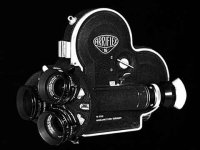
Who knows maybe one could engineer a rotating lens turret/carousel like the ARRI 16S and fix it onto a Scarlet/Epic.

Everybody goes on about this run and gun old style shooter thing. For the Scarlet or Epic I think that would be really cute… if it’s possible.

See this link on good photos and history of the 16s

http://arri16s.com/History.htm

FWIW a 10:1 ratio of M to Eos/Canon would be excellent!

Cheers,

Eric
 

Attachments

  • ArriStand[1].jpg
    ArriStand[1].jpg
    10.9 KB · Views: 0
  • NewStyle[1].jpg
    NewStyle[1].jpg
    11.8 KB · Views: 0
Guys,

just to remind you that Leica Noctilux-M 50mm f/0.95 ASPH is a cine lens and was used in shooting of several scenes for


image.php

HANNA shot by Alwin H. Kuchler, BSC and directed by Joe Wright

Alwin H. Kuchler, BSC:

“The Noctilux is the most beautiful lens I
have ever used, and I wish there were a
whole set of lenses made from the same
glass,” says the cinematographer. “It
does magic to flesh tones. We used it for
Hanna’s flashback of her mother
[played by Vicki Kreips], a scene we
shot in the absolute last light of day. It
was so dark I didn’t even bother to take
a light reading, but I felt optimistic that
something beautiful would come of it
because of the Noctilux. Vicki was
standing at a frozen lake, and we lit her
with an LED ring light that we
dimmed down during the shot. She just
fades into the background like a distant
memory.”


Wicked World By Ted Elrick


Pages 28-29, 2011 / 04 - April Issue of American Cinematographer >>>

TECHNICAL SPECS

2.40:1

4-perf and 3-perf Super 35mm;

Digital Capture

Arricam Studio, Lite; Arri 235;
Sony PMW-350, HXR-MC1P

Cooke, Angenieux, Leica and Zeiss

Kodak Vision3 500T 5219,
200T 5217; Vision2 50D 5201
Digital Intermediate
 
At $10,450 per LENS... it better be a Cine Lens :)

Today it's the fastest cine lens, probably the price is appropriate to its excellent optical and mechanical value and also it's still cheaper than many other cine primes,...
 
Guys,

just to remind you that Leica Noctilux-M 50mm f/0.95 ASPH is a cine lens and was used in shooting of several scenes for


image.php

HANNA shot by Alwin H. Kuchler, BSC and directed by Joe Wright

Alwin H. Kuchler, BSC:

“The Noctilux is the most beautiful lens I
have ever used, and I wish there were a
whole set of lenses made from the same
glass,” says the cinematographer. “It
does magic to flesh tones. We used it for
Hanna’s flashback of her mother
[played by Vicki Kreips], a scene we
shot in the absolute last light of day. It
was so dark I didn’t even bother to take
a light reading, but I felt optimistic that
something beautiful would come of it
because of the Noctilux. Vicki was
standing at a frozen lake, and we lit her
with an LED ring light that we
dimmed down during the shot. She just
fades into the background like a distant
memory.”


Wicked World By Ted Elrick


Pages 28-29, 2011 / 04 - April Issue of American Cinematographer >>>

TECHNICAL SPECS

2.40:1

4-perf and 3-perf Super 35mm;

Digital Capture

Arricam Studio, Lite; Arri 235;
Sony PMW-350, HXR-MC1P

Cooke, Angenieux, Leica and Zeiss

Kodak Vision3 500T 5219,
200T 5217; Vision2 50D 5201
Digital Intermediate

Crazy you brought up that article...I was just literally reading this article yesterday after re watching Hanna. Visually I believe the film to be one of my favorite action films. I love AND so appreciate that Joe Wright and Alwin Kuchler proved that an action film can be shot beautifully with out needlessly shaking the camera around to FAKE intensity.

-Dane

Yeah,

DVD/BRD is out here in Europe and you can watch it at home to study your favorite action film topic!!!
 
Today it's the fastest cine lens, probably the price is appropriate to its excellent optical and mechanical value and also it's still cheaper than many other cine primes,...

What do you mean cine-lens? I've seen the photography lens, which is one of the most amazing photography lenses ever made, but I was not aware there was a cine-version. Can you discuss?
 
What do you mean cine-lens? I've seen the photography lens, which is one of the most amazing photography lenses ever made, but I was not aware there was a cine-version. Can you discuss?

More precisely speaking any still lens can be a sort of customized for cine shooting or this can be called "cinevised" that means de-clicked and added focus and iris gears.

Btw, Arri London Rental supplied the Noctilux for that movie shot.

Maybe it's better to ask them how they did it.
 
More precisely speaking any still lens can be a sort of customized for cine shooting or this can be called "cinevised" that means de-clicked and added focus and iris gears.

Btw, Arri London Rental supplied the Noctilux for that movie shot.

Maybe it's better to ask them how they did it.

Oh ok. So it's not a cine lens.

It's the same lens as the photography one with geared rings. That was what I figured when I read the AC article... just wondered if you knew something I didn't. I'll contact them to be sure.

*edit: Email sent. I will update this thread if they respond with anything different.
 
Back
Top