Welcome to our community

Be a part of something great, join today!

  • Hey all, just changed over the backend after 15 years I figured time to give it a bit of an update, its probably gonna be a bit weird for most of you and i am sure there is a few bugs to work out but it should kinda work the same as before... hopefully :)

Dragon vs Canon 1Dx Color Matching

Hey, quick question: has anyone else gotten an ADD decode to work on Zeb's .R3D?

RedCine-X (latest version) won't actually give me a frame. When I turn off ADD, no problem.

Bruce Allen
www.boacinema.com
 
You need more than one frame to render ADD.

Ahaaaaa... ze penny drops.

So that's how RED got such great marks on DXO?

Because they were doing temporal noise reduction? Like Neat Video set to the mode where it works across multiple frames and figures out what is noise and what is picture and removes the noise?

Hahahaaa! That all makes sense now. I bet that if you took 5 frames in a row with a D800 or even a 1DX and then ran Neat Video on them... you'd probably get an even more stratospheric score.

And all of those people comparing Arri Alexa to Red Dragon with ADD should really be comparing Arri Alexa + Neat Video to Red Dragon with ADD?

Is there anywhere that it was officially mentioned? RED made is sound like it was just a really good deBayer.

Bruce Allen
www.boacinema.com
 
Bruce Allen said:
So that's how RED got such great marks on DXO?

I don't think ADD existed when the DXO review came out. It believe it was also using the older OLPF, which seemed to be better in low light and worse in highlights. (from memory) The new OLPF, with new calibration, shifted things to improve highlights.
 
Ahaaaaa... ze penny drops.

So that's how RED got such great marks on DXO?

Because they were doing temporal noise reduction? Like Neat Video set to the mode where it works across multiple frames and figures out what is noise and what is picture and removes the noise?

Hahahaaa! That all makes sense now. I bet that if you took 5 frames in a row with a D800 or even a 1DX and then ran Neat Video on them... you'd probably get an even more stratospheric score.

And all of those people comparing Arri Alexa to Red Dragon with ADD should really be comparing Arri Alexa + Neat Video to Red Dragon with ADD?

Is there anywhere that it was officially mentioned? RED made is sound like it was just a really good deBayer.

Bruce Allen
www.boacinema.com

Ummm, DXO Mark did not use ADD in their testing...
 
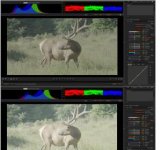
Tip of the Elk's tail to the shadow of the neck . . . more than the Dragon 16+ stops of exposure range? Hard to believe. I guess that goes to real world usable DR which is ultimately determined by Signal to Noise. You can't have high DR and high shadow noise. Looking at many of the above grades the shadow areas are just crushed making the image maybe an 8 stop DR shot. There is no depth to the resulting image - 16 stops is an HDR look with very open shadows - not a crushed JPG.

To the Black Shade: does there exist a single Official RED Engineering Document that is comprehensive and specific? I see millions of conflicting user generated posts on the subject and a scattered bit of RED hints but no current RED generated PDF style doc that explores this subject in depth. Why the mystery?

The Black Shade was done without a "Failed" indication, the camera was certainly up to temp and the T/E was green. That's all I know to do with the user controlled Black Shade component. What else could have been done and how do I pre-flight for BS issues so I don't have surprises in post? If there was a BS issue would that not show up in the Meta Data somewhere as a tagged bit of info? Seems like it should.

Would also like to know specifically how ISO800 creates more noise since I was lead to believe that ISO is Meta Data only and 800 is the high DR go-to setting to preserve highlights . . . like the Elk's ass. My friend saw this post and sent me a private message saying that on Dragon he only shoots up to ISO500 since that is much cleaner. How? Is there digital gain going on behind the scenes after all?

Would like to see if RED Engineering could jump in here come Monday.

I recently called RED about the black shading thing and mentioned there isn't any solid documentation on it. When asking questions about pixels that just wouldn't go away the tech rep said that "default black" (48th shutter speed) shading will default to 48th shutter but will calibrate it to the assembly line temperature. This info totally blew my mind and if that is indeed the case "default" shouldn't even be an option. Anyway, he said the safest bet is to always use the custom black shading even for 48th shutter.

I know last thing you need is another piece of conflicting information/ variable but that was straight from RED.
 
I don't think ADD existed when the DXO review came out. It believe it was also using the older OLPF, which seemed to be better in low light and worse in highlights. (from memory) The new OLPF, with new calibration, shifted things to improve highlights.

Interesting! DXO's article is a little low on specifics (post workflow), except that they tested at 250 ISO. I did notice:
"the Epic Dragon is certainly adopting multiple sampling techniques to reduce noise levels (also known as temporal noise reduction). Without such processing, such high SNR would only be possible from a sensor with an exceptional Full Well Capacity. Performances like this seem, to us, above the current technical capabilities of CMOS sensors."
http://www.dxomark.com/Reviews/RED-...xOMark-sensor-score-barrier/In-Depth-Analysis

Which DID made me wonder... DXO could of course be totally off-base though.

Back to ADD, is there any confirmation as to multiple-frame noise reduction / super-resolution being part of the reason why it needs multiple frames to work?

I can't think of many other reasons, but was wondering if there was an actual official explanation beyond "it squeezes the awesome out of the pixels"

Bruce Allen
www.boacinema.com
 
I recently called RED about the black shading thing and mentioned there isn't any solid documentation on it. When asking questions about pixels that just wouldn't go away the tech rep said that "default black" (48th shutter speed) shading will default to 48th shutter but will calibrate it to the assembly line temperature. This info totally blew my mind and if that is indeed the case "default" shouldn't even be an option. Anyway, he said the safest bet is to always use the custom black shading even for 48th shutter.

I know last thing you need is another piece of conflicting information/ variable but that was straight from RED.

The Default thing has come up on other threads, basically don't use it is the wisdom and everyone agrees it should not be selectable, whats more worrying is you can select 'default', execute a BS and the camera goes through all the steps of performing a BS but does not change the BS from default. BAD
 
Interesting! DXO's article is a little low on specifics (post workflow), except that they tested at 250 ISO. I did notice:
"the Epic Dragon is certainly adopting multiple sampling techniques to reduce noise levels (also known as temporal noise reduction). Without such processing, such high SNR would only be possible from a sensor with an exceptional Full Well Capacity. Performances like this seem, to us, above the current technical capabilities of CMOS sensors."
http://www.dxomark.com/Reviews/RED-...xOMark-sensor-score-barrier/In-Depth-Analysis

Which DID made me wonder... DXO could of course be totally off-base though.

Back to ADD, is there any confirmation as to multiple-frame noise reduction / super-resolution being part of the reason why it needs multiple frames to work?

I can't think of many other reasons, but was wondering if there was an actual official explanation beyond "it squeezes the awesome out of the pixels"

Bruce Allen
www.boacinema.com

The Dragon is such a highspeed sensor that there may be some readout averaging happening internally. So in other words Dragon could be a 200 fps sensor that internally averages 2 frames to halve the noise.
 
Ivan McCullough said:
whats more worrying is you can select 'default', execute a BS and the camera goes through all the steps of performing a BS but does not change the BS from default. BAD

I saw the post on this, but it was not my experience on 5.2.15. After the black shade, it was indeed using the first black shade I selected, of the four I ran.

The default one is news to me. I always use the default setting. I will give the other option a try.
 
The Dragon is such a highspeed sensor that there may be some readout averaging happening internally. So in other words Dragon could be a 200 fps sensor that internally averages 2 frames to halve the noise.

Interesting! Makes sense! Awesome. I haven't enjoyed a thread on REDUSER like this one for ages.

Bruce Allen
www.boacinema.com
 
I saw the post on this, but it was not my experience on 5.2.15. After the black shade, it was indeed using the first black shade I selected, of the four I ran.

The default one is news to me. I always use the default setting. I will give the other option a try.

Ok, so are you saying you could have 2 BS available to select from at any time on your MX?

edit , clarification: 2 BS's that were executed by you, ie one is not a factory default that cannot be altered..
 
Ivan McCullough said:
Ok, so are you saying you could have 2 BS available to select from at any time on your MX?

No, Dragon and up to 4 black shades can be done and saved internally. When done, the first black shade is selected. I have installed 5.2.9, 5.2.11, 5.2.14, and 5.2.15 and all seemed to select the first black shade in my list of multiple. I only black shade at FW time with the one exception being the hot pixel I saw.
 
No, Dragon and up to 4 black shades can be done and saved internally. When done, the first black shade is selected. I have installed 5.2.9, 5.2.11, 5.2.14, and 5.2.15 and all seemed to select the first black shade in my list of multiple. I only black shade at FW time with the one exception being the hot pixel I saw.

Ah ok, I was talking about MX, as I believe was the other thread as Reducation from months ago was mentioned.
 
Hi Zeb,

So far my experience with Dragon is that the principle noise is quite similar to the noise the MX sensor exhibits. This also counts for the sensitivity. I'm quite sure that Dragon has a "native" sensitivity of about ISO 320 but with the significant more DR there is more flesh to play with, ISO 800 is fine for many shots. The noise pattern seems to be more homogeneous and less "blotchy".

But Dragon does no wonders. My Dragon, new OLPF exhibits similar noise. BS done is as good as it gets.

Check out this R3D: https://www.dropbox.com/s/f9gh5km0ni94x8u/A002_C003_0516GZ.0000078F.R3D

Hans
 
I'm hoping the red noise I see in the low end of footage with new olpf/calibration can be easily fixed by firmware/software upgrade. I think it will be in a future revision.
 
I'm hoping the red noise I see in the low end of footage with new olpf/calibration can be easily fixed by firmware/software upgrade. I think it will be in a future revision.

That's a little discouraging but yeah, I'm sure it'll be taken care in future firmware. Has anyone happened to have done any side by side tests of old OLPF vs new OLPF?
 
Let me just say this is the most interesting and informative thread I have come across on any forum in a long long time.

Thanks everyone.
 
I'm hoping the red noise I see in the low end of footage with new olpf/calibration can be easily fixed by firmware/software upgrade. I think it will be in a future revision.

Yeah, I thought that this was why Dragon was so late.

All these kinks were going to be Ironed out and RED would have a camera come to market that was 'ready for prime time' as they say.

But then we get an iffy olpf, followed by a new olpf and new colour science (quite quick out the door). Upside-down olpfs not withstanding.....

With so many Dragons hitting the street ,(especially rental house upgrades), are owners not worried about users testing and feeling like its 'Emperors new clothes' time?

There is no doubting the Dragons superiority in certain areas (colour) but it has some trade-offs even before we start to talk about potentially immature colour science, ie unnecessary high rez and very large file sises...
 
I have not followed this thread in detail but to me the issue is low exposure. It could be shot with more than twice the light hitting the sensor. and the tail of the elk would still be within range.
 

Attachments

  • PastedGraphic-9.jpg
    PastedGraphic-9.jpg
    16.5 KB · Views: 0
Back
Top