Welcome to our community

Be a part of something great, join today!

  • Hey all, just changed over the backend after 15 years I figured time to give it a bit of an update, its probably gonna be a bit weird for most of you and i am sure there is a few bugs to work out but it should kinda work the same as before... hopefully :)

Depth of the field.

Matthew Scott

Well-known member
Joined
Nov 18, 2008
Messages
1,313
Reaction score
0
Points
0
Location
Melbourne, Australia
If I told you "shooting with a long lens will give you a shallower depth of field than say, shooting with a wide lens" I'm sure most, if not all of you would agree. But is that really true? Or is it simply the fact that the background "out of focus" area is magnified so much, that it appears to be shallower. Perceptually, the long lens will compress the scene, creating the illusion that depth of field is shallower, but isn't the "depth" the same? Isn't the out of focus component of the image "out of focus" the same amount, regardless of what lens you use?

Not that this really matters in the scheme of things, but I thought it was interesting none the less. The reason I raise this topic is because I know there are a lot of technically savvy people on here who might agree/disagree/learn something new by means of discussion. Either way, I think it's fun to discuss things like this, especially since it's something I thought I was sure of until reading the article below. Also, as I off-topically raised this point in another thread, I thought it should have it's own home here.

Below is the article that converted me.....some have already dismissed it as "totally off, both technically and visually", but to me, the proof is there! What do you think?

http://www.luminous-landscape.com/tutorials/dof2.shtml
 
But when you look at his test, the point still remains that long lenses COMPRESS space, and draw the background IN. And wide lenses EXPAND space...and thrust the backgrounds back. I thought it was interesting to see the CLOSE the Tower looks at 400mm, and how distant at 17mm.

When people say "Depth of Field", I think they mean this expansiveness...this perception of depth...that wide-angles certainly do a much better job of conveying.
 
Matthew,

DoF is consistent despite focal length if the following conditions are the same; the shot size, the aperture and the Circle of Confusion. Where the issue of more DoF in wider lenses arrives is that in common usage, the shot is not the same size (ie not close-up but a wide shot). Therefore the DoF increases. The other area of of change is the Circle of Confusion. It has a various factors that can change its value such as the resolution of the camera sensor/film, resolving power of the lens, contrast resolution of the lens, lighting contrast and how the workflow to the final screening is arrived at.
 
are we really looking at the same stuff?

dof.gif


depth of field - on a technical level - is the area/space/measurement of what is 'in focus'.

sometimes this is referred to, but in common usage most people (i think) are looking at 'how blurry are the out of focus parts?' and callng it deep or shallow, or making referential adjustments.

gremlin-400.jpg
gremlin-17-blowup.jpg


personally, i see a huge difference on both counts here. someone please explain to me if i'm off.
 
Peter is right,

But I don't unerdstand the "shot size" part...

personally, i see a huge difference on both counts here. someone please explain to me if i'm off.

Paul, in this example the camera is moving and therefore it changes the phisics of what we are looking at. Not really self explanatory...

If you don't change perspective (point of view) and if optically lenses are matched perfectelly, sensor resolution is not a topic and no other components are changed but just the mm of the lens. DoF is the same.

But while shooting, we never see these physics as we usually change perspective (moving the camera) and the scale of the shot when we change the lens.

What we change effectively from a 200 to a 18mm with the same attributes, is the "factor of enlargement" of a particular object and therefore the perception of out of focus area. Sort of a CoC "experienced before projection" or in camera... But this can only be "virtually true" as there are a lot of other optical components that play a role.

Pat
 
exactly, but each lens uses a different optical design - therefore they are not always (or maybe even usually) matched...
so when we talk about DOF, we can either get more technical (which I really don't think will help) or more perceptual/practical.
 
Another thing to consider is that the examples in that article had a massive distance between the subject and background.

Long lenses definitely reduce the depth of field, there is no question about that.

Do a test where the subject and background are 10 feet apart, not 1/2 mile and you will see that your depth of field (in the same field of view) can drop from 10 feet to 3 inches really quickly.
 
Peter is right,

But I don't unerdstand the "shot size" part...

For practical purposes, shot size can mean subject size relative to the frame. Circle of confusion differences aside, depth of field for a 24mm lens and a 105 is the same when the subject is the same size in the frame, and aperture is the same. Peter is also right that the misconception about this principle comes from the fact that wide lenses are generally used for wide shots; hence the subject is smaller in the frame. Move the subject closer and depth of field shrinks correspondingly.
 
It's quite easy to understand if you look at "zooming" as a regular photoshop picture crop (then not looking at picture resolution) In other words nothing really change when you zoom you are just ceffectivly cropping your view. But lenses do things so there will be some differences but it actually goes quite far.

Take a 18mm put on a tripod. now take a 200 mm put on the same tripod and adjust so the lens nodal point is in the same pos as your 18mm was. shot again....

Now the 200mm image should (if you got good lenses) be possible to scale down and put onttop of your 18mm and fit quite perfectly, same size blurs etc. (as long as focal distance and F stop was the same.


If you do not believe it try it...


I have done this quite many times to create crash zooms. Basically stand and shoot a wide scene and then put on a tight lens and shoot something in the same view as the wide shot.. then the images can be stitched together and you can post crash zoom in between... this little trick was going for high numbers back in the days when I was posting music videos :)
 
Here is a good example. I shot a multicam show last week. I have taken a mid and an M/C/U and gave them the same field of view by cropping the mid to match the close.

Same F stop, only difference is the close is a 300mm and the mid is 85mm. The 85mm is zoomed up to match so it's a bit gritty, but the DOF is clear.

Difference in DOF is pretty clear to me.

focal.jpg


Here are the originals:

300orig.jpg


85orig.jpg
 
Long lenses definitely reduce the depth of field, there is no question about that.

No they most certainly do not.

This is so irksome to me because it is so simple and almost nobody gets it, and everyone has misconceptions.

Only two things effect depth of field. Period.

First of all lets describe depth of field -

The nearest to the farthest distance in the frame that is in acceptable focus. Not angle of view, not how the bokeh looks, what's in focus. Those things are separate issues.

The two things are -

#1 f stop - Larger aperture = less depth of field

#2 Image magnification - This is how much are you enlarging the image on the negative/sensor. You can do this by using a longer lens, moving physically closer to the subject, or both. If you have a larger negative, you will use a longer focal length to get the same field of view -you are magnifying the image more. The shallower depth of field is a function of the magnification, not the longer lens. If, for example, you switched from spherical 35mm to anamorphic, you would need to switch to a 40mm to get the same field of view as the spherical shot. You will now have shallower depth of field. HOWEVER, if you do the same shot on the 20mm and just move in half the distance, the depth of field will be exactly the same because you have magnified the image the same amount.

Perhaps this is more clear perhaps not -

"DOF is determined by subject magnification at the film / sensor plane and the selected lens aperture or f-number. For a given f-number, increasing the magnification, either by moving closer to the subject or using a lens of greater focal length, decreases the DOF; decreasing magnification increases DOF. For a given subject magnification, increasing the f-number (decreasing the aperture diameter) increases the DOF; decreasing f-number decreases DOF."

I don't know how to be more clear than this -
 

Attachments

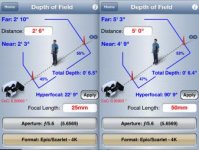
  • DOF chart.jpg
    DOF chart.jpg
    20.2 KB · Views: 0
first of all, if you want to get technical, 6.4 doesn't equal 6.5... and are you talking about larger diameter or number? please be respectfully precise if you're going to comment on hundreds of years of optical research. just sayin'

second of all, you can't force a technical definition of something when the 'folk' are using a word or term differently. you're complicating the issue by bringing field of view equalizations into the discussion, not elucidating anything. calculating depth of field is subjective - period. especially so when you're 'in the field'. visually, depth of field is most easily discerned by comparing what's in focus to what's out of focus. sorry 'bout it.

thirdly, wtf are we talking about and why does it matter, again?
 
I'm pretty sure the technical definition of DOF is important to focus pullers and DPs who are trying to help them. Directors who think you can go to a wide lens and move closer make life hard for everybody.
 
please be respectfully precise if you're going to comment on hundreds of years of optical research. just sayin'

Yeah, I just explained all the "optical resarch". These are the results. I'm not making this shit up.

"When s \ll H, m^2_\mathrm{h} \ll m^2, and

\mathrm {DOF} \approx 2 N c \, \frac {m + 1} {m^2} \,,

so that for a given magnification, DOF is essentially independent of focal length. Stated otherwise, for the same subject magnification and the same f-number, all focal lengths for a given image format give approximately the same DOF. "

Nick
 
since we're quoting shit to sound like we know what we're saying, let me redirect you back to the wikipedia article you quoted... this is literally just before the paragraph you quoted, actually.

"Several other factors, such as subject matter, movement, camera-to-subject distance, lens focal length, selected lens f-number, format size, and circle of confusion criterion also influence when a given defocus becomes noticeable. The combination of focal length, subject distance, and format size defines magnification at the film / sensor plane."

on a lighter note, i'm moving on... have a good night - no hard feelings :)
 
What I have been thinking is getting a single high end lens (i.e. new zeiss anamorphic), and shooting it at both 6k and 4k with the same lens for a quadhd wide screen 2.4 final. Basically if i shoot 40mm/6k/RC7~40mm and a 40mm/4k/RC3~80mm - I basically get the two main lenses I like (40mm and 80mm). Aside from saving $30k, this also helps me speed up shooting since I don't have to change lenses. Kind of a cool use for 6k I think.
 
that's just the same as cropping/reframing the 6k image... totally cool to use whatever methods work, and probably nobody will be able to tell on an HD internet output, but there are textural differences between the two, especially once scaling comes in. but you may or may not find that important. and just to muddy the discussion some more, you're talking about field of view more than depth of field... commonly confused (and interrelated) when people start getting technical purely for semantics debate.
 
To borrow a phrase, everyone is entitled to their own opinion, but not their own facts. If you want to say you prefer the look of long lenses to mediums and wides, so be it. If you want to say that long lenses inherently have less depth of field, that's just not the case.

This is of great relevance when a camera team, 2nd, 1st, and op, are trying to execute a difficult shot. I have often heard 1sts refer to lenses in the 32-35mm range as the "Fuck You" lens when an indecisive DP puts it up on the steadicam or hand held, and then ends up shooting medium closeups on it because they think it is "easier". The lenses in that range are often not marked as well as the 50 and 85 because they are seldom used for close ups.

Paul, frankly I don't understand your argument or your beef. But at any rate, I'm done beating a dead horse.

Nick
 
Back
Top