Welcome to our community

Be a part of something great, join today!

  • Hey all, just changed over the backend after 15 years I figured time to give it a bit of an update, its probably gonna be a bit weird for most of you and i am sure there is a few bugs to work out but it should kinda work the same as before... hopefully :)

DEEP ATOM down under

Ross, Ketch and Pedro, when do you guys expect the delivery of the Deep Atom rig?
 
Wish I would of read this earlier....

still....No tlike I had to much choice anyway. I had no ND's I had to go 100iso and everything in the pool today was shot at f8

I had resolution charts on each corner of my large chart.

I also panned side to side (the angles changed) and up and down.

I think I got enough within reason.....also I was all by myself and it was alot to do....

in any case, I'm all packed up for Catalina tomorrow....luckily I have a 1st AC friend that is joining be to help me schlep all the gear to casino point and help me with the tests.

unfortunately I cannot take my big chart with me on the boat plus all the gear so I'm taking the smaller resolution chart and I'll just do what I can with that in the open water.

like I said....so far so good.....

more importantly I'm having FUN!

Hey, Pedro, we are dying to see the charts shot underwater through the flat port shot with Ruby. Can you post some 1:1 corner crops? :001_smile:
 
OK Guys,

Finally I found a minute to shoot some tests through a flat port.
Attached here are 1:1 crops at 45° off optical axis (90° angle of view), which is probably the most representative angle for underwater.
The shot in air was made from 30% closer distance to account for water magnification factor.
Shot with Tokina 11-16mm at f/2.8 (which for flat port is the best and only gets worse as you step down), not that the lens choice seem to matter much in this case.... :shocked:
 

Attachments

  • IMG_0001.jpg
    IMG_0001.jpg
    29.2 KB · Views: 0
  • IMG_0002.jpg
    IMG_0002.jpg
    81 KB · Views: 0
Hi all,

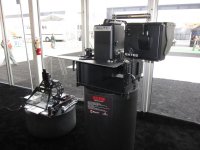
I'm at NAB with the 3Ality team (who are endlessly supportive and wickedly smart) and DEEP PULSAR / ATOM on display in their booth. On the left is the housing base with ATOM rig. On the right the main housing shell with Transvideo monitor housing. What you can't see behind the monitor is the underwater FIZ controller (which will be complimented by an IO/Convergence controller).

J-

IMG_2422.jpg
 
Hi all,

I'm at NAB with the 3Ality team (who are endlessly supportive and wickedly smart) and DEEP PULSAR / ATOM on display in their booth. On the left is the housing base with ATOM rig. On the right the main housing shell with Transvideo monitor housing. What you can't see behind the monitor is the underwater FIZ controller (which will be complimented by an IO/Convergence controller).

J-

View attachment 24141
Way to go John I am so excited that my Deep Atom is shipping in a couple of weeks!!!! The test footage looks so incredibly sharp edge to edge I am very impressed.
 
The test footage looks so incredibly sharp edge to edge I am very impressed.

What some people regard as "sharp" may not be sharp to others or not sharp at all. Can you post it? I can not fathom how can you possibly obtain sharp images through a flat port other than macro/closup. It is just physically impossible due to chromatic aberrations. This is illustrated in my post above.

Wide angle shot of a zone chart or SFR chart would be great.
 
Well, for all people that do like maths then...

The refractive index of air is 1.000.

The refractive index of water is approximately 1.33. However, this index varies in with the color (wave length) of the light. The refractive index of water is 1.343 for the 400 nm wave length (blue), and 1.334 for 550nm ‘green) and 1.330 for 700nm red spectrum.

The refractive index of water also depends on the water density, including factors such as the salinity, the temperature and the pressure. If we look at the refraction of a ray of composite white light as it leaves the air/water interface, we see that the deviation of the red, orange, yellow, green, and blue components of the white light will vary as a function of the color, the blue rays being more refracted than the reds, with the spectrum spread between them. This is the phenomenon known as light dispersion.

This dispersion has great importance in optical performance: the apparent distance of a subject that is linked to the refractive index because there is up to 1% variation between the blue and the red.

It is in the variations in the enlargement factor that this phenomenon is most sensitive.

Let's consider the enlargement refraction for indices of n1= 1.33 (red spectrum) and n2 = 1.34 (blue spectrum) for incident angles of 20° and 45°.

The magnification factors for 20° angle of incidence are m(r) = 1.403 for red and m(b) = 1.417 for blue spectrum.
The magnification factors for 45° angle of incidence are m(r) = 2.766 for red and m(b) = 2.964 for blue spectrum.

Accordingly, for 20° angle of incidence the difference between blue and red images at the edge of the 5k frame will be about 24 pixels.
Accordingly, for 45° angle of incidence the difference between blue and red images at the edge of the 5k frame will be about 80 pixels.

After converting to horizontal resolution it becomes clear that such optical ystem will not even resolve a fraction of standard definition in the corners.

The corner resolution in case of a 20° angle of incidence will be equivalent to less than that of standard definition.
The corner resolution in case of a 45° angle of incidence will be equivalent of roughly 1/5 of standard definition.


Flat ports also create severe "pin-cussion" distortion. But, they are also responsible for the variation in aperture.The real aperture will vary according to the point in the frame, This explains the phenomenon, mostly seen with wide-angle lenses, of the images being lighter in the centre than at the edges.

Additional aberrations degrading the image quality when photographing underwater with a flat port are astigmatism and coma. They originate in the differences in the path taken by rays coming from the subject in a plane including the optical axis, compared with rays situated on a plane which does not include the optical axis: so the image of a cross which is not situated on the optical axis will be situated on two different image planes (implying two different focus points), one where the horizontal branch of the cross is sharp, the other where the vertical (radial) branch is sharp. This defect is more pronaunced as the aperture is opened.

All of the optical defects associated with a flat port can be seen by a diver through a mask, as it is effectively a flat port. But because the eye’s field of view is relatively narrow and the line of sight usually perpendicular to the plane of the mask these defects do not appear very obvious.

However, when recorded and projected on a cinema screen, those flaws will be clearly visible by the audience. Most of them are difficult or impossible to correct in post.

I believe that it is a mistake to use a flat port in a cinema grade underwater housing.

Regarding convergence

Convergence control behind a flat port will only create further, this time asymetrical, chromatic aberrations and geometrical distortions. For this reason convergence control in underwater housings is typically done with image plane, not the lens. However, converging in camera was common because acquisition format was HD and distribution format was IMAX and further loss of resolution to converge in post was not acceptable. I see no practical reason to converge in camera when filming underwater when recording 5k. Having said that, our 3Deep housing has convergence control if that's what required. One that does not deteriorate image quality because it is not affected by the limitations caused by a flat port described above.
 
Last edited:
I just corrected the calculations adjusting for the variation in refractive indeces for red and blue as a function of angle of incidence. The results are much more dramatic showing that even modest 20 degree angle of incidence (40 degree viewing angle) will not reach quality of standard definition in the corners just as a result of chromatic aberrations alone. On top of that there will be compounding effects of distortions, coma, and astigmatism as well as aperture variation.

It is beyond my comprehension how anyone can call such optical system "sharp edge to edge".
 
Pawel perhaps there is a place for both systems...3Deep sounds like it will be good for all those big wide establishing shots but not so good for close ups and medium shots. As you can't really control interaxial and convergence 3Deep will have it's limitations. On the other hand Deep Atom has the ability to control IO and convergence and actually control depth, place the screen plain presicely and produce the 3D effect comfortably for an audience.
 
When Pawel shares knowledge I suggest everyone listen. He is dangerously smart and done his research. What he will bring to market will change the industry. Any free advice he offers is gold in my eyes!
 
he he heh I don't think I'm dangerously smart. But I am passionate about image quality and restlessly working on improving it.

In order to improve anything we must have a way of measuring it first. If we can't quantify what we are trying to improve upon: image sharpness, distortions, field curvature, coma, chromatic aberrations, astigmatism, all contributing to and defining the "look", we can not improve it.

I think all of us care about image quality. I've been fortunate to gain the background allowing me to calculate the results and avoid expensive testing. And testing is expensive. It often requires prototyping, testing rigs, optical bench, charts, software and prep time.

Now, getting back to the subject,

Ross, I think you should watch The Last Reef IMAX 3D, if you haven't seen it already. I believe it is the first large format underwater film that used a beam splitter rig. I think all of the previous rigs used in IMAX movies were side-by-side configurations. They filmed some very interesting macro shots. In fact, their project was predominantly focused on macro shots (and had working title "Macro"). It was mainly shot in Palau. Macro, like wide angle, has its challenges, mainly super shallow DOF so it is important to know the "sweet spot" of the rig and go with it. For example, Howard Hall writes about filming with massive Solido (side by side) IMAX housing, that the perfect camera to subject distance was about 1m. Anything closer, would be out of focus; anything further away would not have enough stereoscopic effect. I agree with you that having macro and wide angle 3D capability underwater would enormously enhance story telling ability. And, to my knowledge, it hasn't been done before. Not on a giant screen.

I can't wait to see some killer macro shots from that rig and I hope you don't mind my math spill or take it as personal (it is not), but a guide as to what lens selection you should consider to get great images from this beast. :)
 
Pawel is not sharing knowledge, he is pontificating on the theory upon which his system is based to obliterate, and lately not very kindly or civilizedly, the science behind any other system out there. On several threads all over this forum. Yes, he appears to be smart, though not humble enough to accept the limitations of his system, such as a decidedly narrow field of vision of less than 75 degrees, while not hesitating to "laugh out loud" at whatever his competitors have to say, managing along the way to throw overboard the efforts of companies like Gates, Aquavideo, and to discard their accomplishments with charts and numbers. I wonder how many people have run to sell their Gates housings since Pawel made his big announcement. Yes, I'm not too fond of Pawel's behavior, but his becoming a manufacturer of housings using a concept that has been pondered by several many people thousands of times has come at the expense of his self canonization into the God of Underwater Optics. All that said, I could not agree more with him on the fact that flat ports should not be used for underwater image acquisition at all, except for macro work.
 
Pawel I am still not sure what your point is? Given everyone on this forum understands that shooting through flat ports yields less sharp images corner to corner and that the only solution available today for shooting with a beam splitter rig is shooting through a flat port. As I said above Deep Atom is ideal for shooting close-ups and mediums shots as it has precise control over IO and convergence and most likely 3Deep might be great for shooting wides. Given that 3Deep costs well over $120K I am not sure who can afford to run both rigs? I am putting my money into Deep Atom because it is proven technology and it will cover most subjects I wish to shoot. Deep Atom is also ideal for features and drama as well as natural history as it has such precise control of IO and you can converge where ever you wish and position the screen plane as well.
 
Ross,

Re. The Cost

The Solido housing used by Howard Hall cost $3m to design and over $300k to build. It achieves approximately 1/100 of the corner sharpness that 3Deep is capable of and weighs about 100 times more. The cost of film, processing and printing of a single seven-minute IMAX film load is nearly $20,000.

I'm currently preparing to shoot a small budget 3D natural history feature. The budget is $3.5m. The cost of three 3Deep housings that we intend to use on the shoot is a proverbial drop in the ocean in the scheme of things.

I think that, for the kind of productions that these housings are aimed for, the cost of the rig is completely negligible.

As a side note, we decided to shoot macro using two SI 2K cameras because of increased DOF and we do not see significant improvement shooting macro in 4k or 5k. Consequently, we will need a much smaller beam splitter rig than Deep Atom for this purpose that will allow us better access to macro subjects than a large beam splitter housing would.

Re. Inter Axial distance

Underwater film making is bit different to topside. The background is not at infinity and most of the time it is just a few meters away from the camera. This allows wider and fixed camera separations for good 3D effect. Our eyes are separated by 65mm and we have no problem fusing images of subjects located only 30 cm before our eyes. Likewise, for distances from about 1m - 3 meters, inter axial distance of 100mm creates very good stereoscopic effect. Nearly all 3D IMAX films were shot side-by-side and with subjects between 1m - 5m before the camera. The only underwater 3D IMAX that was shot with a beam splitter was used for filming very small subjects, like in nudibrach size subjects.

Re. Convergence

Convergence is important in two situations:
1. for live broadcast where you can't adjust it in post (area Cameron/Pace specialise in)
2. if shooting low resolution (say high definition) for large screen

One significant difficulty with converging on set is that the convergence needs to be different for TV/DVD distribution and different for cinema. If you bake it in, you do not have the ability to change it in post easily.

Converging behind a flat port creates strong asymmetrical and weird distortions because the lenses will not be perpendicular to the port. Some underwater systems, like 3Deep are able to converge the image planes behind the lenses keeping the lenses parallel. I think Solido does this too.

Nowadays, with the introduction of 4k and 5k cameras most stereographers do not converge the cameras on set. For example, Pirates of the Caribbean is shot parallel with a view to converge in post. They have plenty of resolution to play with and do not risk incorrect convergence being baked into the footage, which is hard to correct. See director's notes on the bottom of this article in ASC magazine:

http://www.theasc.com/ac_magazine/June2011/PiratesoftheCaribbean:OnStrangerTides/page1.php
 
Pawel,

We have shot a good deal of beamsplitter ALEXA and EPIC material on our underwater housings and systems. It is not of macro material, and it looks beautiful on large screens.

The comment that "most stereographers do not converge the cameras on set" is very ill-informed at best. One feature (or even two or three) that shoot parallel and an article in a magazine do not make your statement valid.

Looking forward to seeing actual footage from your rigs instead of repeated statements and theory.

Best,

Lucas
 
I have used both PACE 3D riggs and found them amazing and easy to use .I was the first to use the PACE EPIC rig and operated all controls IO CONV focus roll all at my finger tips very simple and no stereographer underwater needed .All these images will end up on IMAX and cinema screens .You had a range of flat ports easy to swap out quickly .
The optimo zooms and the primes where flawless .The only thing nobody can get right was the balance and feel so you end up trimming the rig with weights as you would just like a Steadicam (TM) very personal .You could also do a quick client preview of 3D footage with a tricky little box that was mounted inside the rig .
Best thing of course is that when you go to PACE to rent you get and F1 crew of rocket scientists around you making changes or updating things then and there and the spare parts they send out is bigger than the housing itself .Also it can be all packed down very nicley .

I also built a 3D housing for SI 2K cameras and a beam splitter rig for a feature that gets released in September 12 worldwide .
It was used above and below and as a crash camera housing .Very simple had a max depth of 5 meters and was very very crude .The widest lens we used was a 9.5 and used the full apspect of my Flat Port made from a speacial mix of light sensitive chemicals .Perfect pictures not a flaw anywhere .It has now gone to rest though as a mailbox bolted to my front wall .

I am not a spec guy but if it works looks good in testing why not .
 
Last edited:
Lucas,

I've seen a lot of footage that "looks beautiful", some of which was shot with mini-DV cameras and some with flat ports.

"looks beautiful" is a very subjective word. But, rainbow-edged, distorted images with fuzzy edges produced with flat ports are not what I'm looking for. Not on a large screen and not in 3D.

After testing lenses that cause absolutely no distortions and produce perfectly flat, rectilinear and sharp 5k images underwater I'm only interested in "breathtaking" :smiley:

I'm interested in images that would hold up on a giant screen and shine with high-contrast detail in every point of the frame. I like images that do not make the audience dizzy. I want them to look natural and without distortions or lens astigmatism. I want them to look just like images that we see with our own eyes in air. I like 3D footage to not strain the eyes with field curvature, geometric distortions, chromatic aberrations or fuzzy edges. I like 5k underwater images that actually resolve the full resolution of the sensor across the entire frame, not in 10% of the frame.

If the optical system is incapable of resolving even standard definition quality across the entire frame, to me, it is defective on technical merits irrespective if it "looks beautiful" or not.

Flat ports have severe limitations that make it impossible to obtain sharp images in the corners even with medium shooting angles of 40 - 60 degrees: it is just simple laws of physics and I quantified the degradation caused by such port a few posts back showing that it would not resolve even standard definition across the entire frame. What is the point of shooting 4k or 5k with such an optical port?

Jim Jannard says that "1080p was the mistake of the decade". After having tested submersible lenses, I say that ports (particularily flat) were the mistake of the century. It's time to improve and innovate.

I sent you two emails offering that I come all the way from Tasmania to you and show you the footage, 3Deep and DeepX housings in flesh. I had no reply. If you are truly interested to see the images on a big screen the offer is still here. :smiley:

I have posted sample footage from DeepX some time ago here, if you are interested:

http://www.reduser.net/forum/showth...onos-15mm-lens-Underwater&p=971500#post971500

Mike Seymour from FXPHD in Sydney is working on the post of the sample footage. I believe he is showing it now at NAB now.

Can you post an MTF graph for the corner of the frame produced with the best PACE housing? Why would it perform differtently from the one that I posted above or calculated and showing that the image has massive chromatic aberrations and looks fuzzy on the edges even if shooting at moderate 40 degree field of view.

If you can't measure the optical performance of your system, you can't compare it and you can't improve upon it. I made my measurements and published them.

Can PACE and Gates measure and publish theirs? I think some objective and measurable data would be great for a meaningful discussion about image quality.

Re. Convergence

As I mentioned, convergence in post gives you the ability to adjust different toe-in for TV/DVD and for cinema and fine tune the 3D effect for different screen sizes. I said that converging on set was common when features were shot in HD as the loss of resolution when converging in post was significant to warrant converging on set. With 4k and 5k cameras there is no real need for converging on set unless you do live broadcast. Converging underwater, especially when shooting through flat port, would create severe distortions making it very difficult for viewer's brain to fuse such images and create headache watching them. It makes most people dizzy just sticking nose against flat aquarium window.

Anyway, 3Deep does provide ability to converge that does not cause any distortions or chromatic aberrations. I just do not think it is wise to do that unless you broadcast live.

Ross,

My sincere apologies for somewhat hijacking your thread about Deep Atom but, I hope, most of the above is relevant and educational to all of us wanting to improve underwater images.
 
Ross,

I'm not asking anyone to buy anything. All I asked for was some charts or measuremnts of optical performance of this housing.

Anyway, I wish you all the best with your Deep Atom.
 
Ross,

I'm not asking anyone to buy anything. All I asked for was some charts or measuremnts of optical performance of this housing.

Anyway, I wish you all the best with your Deep Atom.

Obviously it was a challenge to the product that is the subject of the thread and to point out the single area that your product excels at - corner resolution (while ignoring the negatives of massive interaxial, significant danger of flooding the Epic/scarlet sensor and/or possibly voiding the camera warranty simply by using your housing , limited lens choices using 20+ year old lenses, etc.)


Pawel:

You most definitely hijacked this thread with 20 or more posts, mostly challenging the efficacy of the subject of the thread. When you have a product to sell and aren't an advertiser, I think you have to walk a fine line and bend over backwards to be respectful (and I have tried to do this myself). Your point about resolution and your use of Nikonos 15mm lenses - (which Rudi and I brought up 3 or 4 years ago) should have been mentioned in one or two posts and then dropped or moved to your own thread.

I compete with Gates, but I totally respect what John and his team does, even while pointing out what I think are advantages of my product.

Deep Atom is clearly a product that required a very intense and expensive development program and accommodates one of the leading (and proven) topside 3D rigs for use underwater in a manner consistent with the finest 3D underwater high end motion pictures being made so far and the industry standard way of doing it - yet quite compact relative to earlier systems. As such it deserves respect and is worthy of its own thread. If you had comments about the size, or the way motors worked, or connectors or something it would be one thing - but to drone on repeatedly in this thread about your alternative and competing system and the wonders of the Nikonos 15mm lens is just rude and probably deserving of the ban hammer for a week or two.

There might actually be some better or cheaper alternative - but if you think so, say it once and leave.
 
Back
Top