Welcome to our community

Be a part of something great, join today!

  • Hey all, just changed over the backend after 15 years I figured time to give it a bit of an update, its probably gonna be a bit weird for most of you and i am sure there is a few bugs to work out but it should kinda work the same as before... hopefully :)

DaVinci Resolve, how good?

Nothing was lit in post. No light entered the material. Digital values were manipulated which appear to the viewer as if the scene was re-lit.
I think we're saying similar things in different ways, and you're arguing semantics. I say if I brighten one side of the set and darken the other, and then add a lot of level to one specific character without affecting anything else, and we deliberately place two shadows on the ground (what I call a "digital flag"), then we've done a degree of relighting. It's not relit from scratch, but it is changed 50% from what was actually shot. The before & after comparisons are often startling for the people in the room, and -- at least in my experience -- they're often very happy with the improvements. In other words: if it looks relit, then for all practical purposes, it has been relit.

I'm quick to say the two most important things: 1) without the DP doing the heavy lifting on set, our hands as colorists are completely tied; 2) we work in service of the picture, and I'm reluctant to make changes without the DP's approval unless for whatever reason they just can't be there and the money people demand it.

90% of the time, the changes I like to make are just pulling the background down a little bit, throwing a little more fill on the actors' faces, forcing the audience to pay attention to the key elements of the shot, and bringing out the best of what was actually exposed. When we have to do more than that and it turns into a massive roto/tracking session, it gets very arduous (and costly).

I would add -- just to get this thread back on track -- Resolve has all the tools I need to get these specific jobs done and to do them quickly and efficiently. There are limitations with Resolve and necessary workarounds, but I would say that for every platform out there. It's still robust enough that I think it holds up well in comparison with lots of tools out there. And it is interesting to note the large numbers of major commercials, TV series, and features that are done on Resolve every day.
 
It doesn't. It just is...

Yes it does. No it isn't.

:)

Though it is understandable why it may appear that way from your perspective and segment specialization.

I don't intend on attempting to convince you. The comment wasn't meant to start a debate.

For example, the latest versions of Baselight are designed to be used without any use of LUTs.
They still can be used, if so desired, but the point is you don't have to, because the LUTs ARE ON THE WAY OUT!

The point is clear without the yelling.
I just propose avoiding generalizations and all cool.
 
Luckily, Resolve is not the only game in town. If you want a better mousetrap, try Baselight/ Baselight Editions combo for Nuke VFX workflow. The workflow is based on ACES transforms, no LUTs and nothing gets baked in until the very end... Resolve's RCS is a failed attempt at copying Baselight implementation of Color Spaces. And Baselight allows you to chose your preferred IDT.


Thanks about the Baselight comments, I will spend some time with Baselight on my own time to see if it shortens the distant between goalpost.
 
I think we're saying similar things in different ways, and you're arguing semantics.

Yes.

Not arguing, making a distinction for those outside of this domain, interpreting reality through terminology seen online.

I say if I brighten one side of the set and darken the other, and then add a lot of level to one specific character without affecting anything else, and we deliberately place two shadows on the ground (what I call a "digital flag"), then we've done a degree of relighting.

You've done a degree of digital manipulation of image data, completely unrelated to light, until it reaches the image displaying device. Which in the context of post-production domain is referred to as "relighting".

Which is not a replacement for real light and unlike real lighting is an image destructive process.
Which can be done to a certain extent, until the image deterioration becomes visible and/or distracting, the extent dependent on camera performance and recording format data sampling properties.

It's not relit from scratch, but it is changed 50% from what was actually shot. The before & after comparisons are often startling for the people in the room, and -- at least in my experience -- they're often very happy with the improvements. In other words: if it looks relit, then for all practical purposes, it has been relit.

Looks can be deceiving. :)

That would be a cool name for a book on color grading.

Again, it hasn't actually been relit, it just looks that way and is referred to using that term. While I'm pretty sure all of this doesn't need to be explained to you or many folks here, and while I am also aware this may seem petty...if this is taken into consideration:

2cdcynn.png


...it may seem different.


When you use the same term to different people, someone unfamiliar to sensor properties/data sampling/image deterioration/light properties etc...might get the wrong picture.

Twice.

Latter being unrepairable.

I'm quick to say the two most important things: 1) without the DP doing the heavy lifting on set, our hands as colorists are completely tied; 2) we work in service of the picture, and I'm reluctant to make changes without the DP's approval unless for whatever reason they just can't be there and the money people demand it.

90% of the time, the changes I like to make are just pulling the background down a little bit, throwing a little more fill on the actors' faces, forcing the audience to pay attention to the key elements of the shot, and bringing out the best of what was actually exposed. When we have to do more than that and it turns into a massive roto/tracking session, it gets very arduous (and costly).

The technical challenge is less of an issue. Some of greater issues are: a) reactions after received invoices b) when that approach gets misused to compensate, which can lead to c) deterioration of cinematographic skills, and d) deterioration of values, and which has already led to e) the trend of sterilization of visual artwork, stripped of natural light properties.


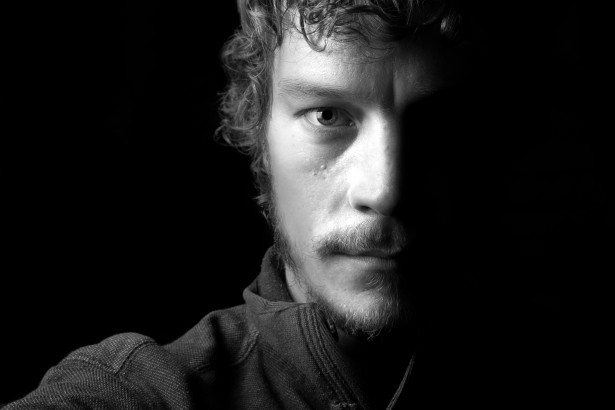
Exactly. I do run into inexperienced producers and directors from time to time who will have a shot like this:

man-with-half-face-on-shadow.jpg


and then say, "hey, can we throw a power window on the right side of this guy's face so that the lit side and the unlit side match, so I can see both of the actor's eyes?" And I tell them no, it cannot be done.

They don't get that you can only relight in post to a point. We can't add a backlight, we can't add an eye light, and we can't add fill that isn't there. We can place shadows, and we can enhance the original lighting on the set to a point.


"Bah...what do you know...I heard/read that this Oscar winning feature was completely re-lit in post...pff"


;)
 
Which is not a replacement for real light and unlike real lighting is an image destructive process.
Which can be done to a certain extent, until the image deterioration becomes visible and/or distracting, the extent dependent on camera performance and recording format data sampling properties.


Hrvoje, it is a common misconception that the technical quality of images is the limiting factor for what you can do in post. A well exposed image has a lot of "technical latitude", you can push it and pull it quite a bit without banding or noise or such.


However, there is an "artistic latitude" with the tools we use, that is most of the time way less than the "technical latitude". What I mean is that when you push the tools too much, the image detoriates artistically, but not technically.
 
However, there is an "artistic latitude" with the tools we use, that is most of the time way less than the "technical latitude". What I mean is that when you push the tools too much, the image detoriates artistically, but not technically.
That is very true. In the example I posted above, even with a raw image, if we try to lighten the shadow side of that face, all we'll get is an artificially brightened shadow. If we push too hard on that image, it's gonna fall apart very quickly. There are very real limitations as to how far you can go, particularly with rotoscoped windows. The harder you push the image inside and outside the window, the greater the risk that you'll see the mask, and the more artificial it can start to become.

Another great one that I run into all the time is time of day issues. They start shooting at 10AM, they get the wide shot, they get a crane shot, they go on a lunch break, they come back and do the medium shot, they start to do close ups, and suddenly it's 4:30 and we're starting to lose the light. If the shadows are getting very long, the color temperature is changing, and the background has gone dark, there's no real way to save it unless the DP breaks out a ton of lights. The opposite problem is also difficult: if they shoot a shot at 3PM but it's supposed to be 8:00 at night, taking down the sky and eliminating all tipoffs of sunlight is very, very challenging. We can always make it better, but there are lighting and exposure issues that are just not realistically possible to fix in post.

BTW, I just did a Google search for "Relighting in Post," and got 124,000 hits. So this is not a term I've created... it's one that's been used for many years in post. I again think it's just semantics, and as I clarified above it's the cinematographer who does the real lighting. All we can do in post is carve and shape that exposure to look like something else -- sometimes drastic, sometimes subtly, often inbetween. I sympathize with all DPs who fear a loss of control in post. I think this problem is only going to become worse as time goes on, and for this reason DPs need to make sure that as part of their deal, they're always involved in the post process, particularly in supervising and approving the final color.
 
Hrvoje, it is a common misconception that the technical quality of images is the limiting factor for what you can do in post.
A well exposed image has a lot of "technical latitude", you can push it and pull it quite a bit without banding or noise or such.

"Well exposed image" = technical quality

It is one of limiting factors. I mentioned above one of the aesthetic elements - sterilizing the image. I could go on about limiting factors but it would drift much further from the topic. There are many misconceptions in this industry and one could write a book just on that. The one you mentioned is certainly one of them but less damaging than the principle which leads to relying on post to dig one out of trouble.

How much can one push and pull depends on:

a) exposure properties
b) camera sensor, quantization & processing performance properties
c) recording format properties ( 8bit>10bit >12bit >14 bit (stills) >16bit for sampling + compression properties)
d) software/methodology properties

Raw + 12/16 bit sampling + low/no compression tends to get people carried away.

However, there is an "artistic latitude" with the tools we use, that is most of the time way less than the "technical latitude".

Agreed. One way of putting it.

What I mean is that when you push the tools too much, the image detoriates artistically, but not technically.

The image always deteriorates with manipulation, it's just that the deterioration may be beyond perceivable levels.

Banding, noise, posterization, visible loss of "density", reduction of tonalities, etc. are all properties which you are able to perceive and interpret as either aesthetic/artistic quality (something you can "feel"but cannot quantify) or as technical quality (something you can quantify and do not feel).

Deterioration starts with first processing error.
Which appears way before one's cognition of the visible outcome.
 
BTW, I just did a Google search for "Relighting in Post," and got 124,000 hits. So this is not a term I've created... it's one that's been used for many years in post. I again think it's just semantics, and as I clarified above it's the cinematographer who does the real lighting.

Yes, it is semantics but in the age of widespread informational accessability with greatly varying interpretation abilities, terminology soon steps out of its context and the semantic part stops being trivial with serious consequences. I've seen it enough times.

I propose seeing previous related posts as option #124001 for those who might easily get the wrong picture, instead of an attempt to correct your terminology or push the debate about it.
 
The image always deteriorates with manipulation, it's just that the deterioration may be beyond perceivable levels.
It depends on how far you push it. I guarantee you, with The Hobbit, The Revenant, many of the Marvel films, these images have been pushed and pulled almost beyond belief. The before and after results of what were accomplished in post with lighting, color, and contrast are mind-blowing.

My take is that we're generally better off bringing things down in post than on the occasions when we have to bring things up and brighten an underexposed piece of a shot. But I've done many, many projects going back 15-16 years where you have a very dark-skinned character next to a light-skinned character, and the first person desperately needs another 2/3 stop of fill. If we can do that and window it in such a way that it doesn't look like they're standing in a spotlight, we'll do it every time.

Is that relighting? It is... of a sort. Is there deterioration? I would argue the before & after effect is almost always an improvement. There's an old saying I'll misquote from Duke Ellington: If it looks good, it is good. It doesn't matter how you get there -- all that matters is what finally ends up on screen. I don't care if it comes from me or the DP or the camera or the catering guy, as long as the end result is what the director wants, and it looks correct technically and artistically, then we've all done our jobs.

Getting back to Resolve: I would bet we'll find out at NAB in April as to what will be in the next version of Resolve, and whether Blackmagic will be providing some kind of seamless integration between it and Fusion. As time as gone on, there are a lot of elements of color-correction that kind of overlap with the world of VFX, and I don't doubt that this trend will continue with all the major color-correction tools out there. I think the smart DPs out there will avail themselves of these tools to improve the final results, while also being aware of the potential danger for morons to drastically change the creative intent of the original cinematography.
 
Getting back to Resolve: I would bet we'll find out at NAB in April as to what will be in the next version of Resolve, and whether Blackmagic will be providing some kind of seamless integration between it and Fusion. As time as gone on, there are a lot of elements of color-correction that kind of overlap with the world of VFX, and I don't doubt that this trend will continue with all the major color-correction tools out there.

Good point, Marc.

I'm sure that BM listens to the market closely, others do as well. VFX and colour correction will eventually melt together in something that can perhaps be described as film design, being the DP and director the guys who create the canvas. This may take some of the DPs influence in the filmmaking process but hey, we have that in TVC land already. Grading and finishing, today still a split process, are already solely in the hands of the agencies' creatives. The DP's work ends at the set and the director's at the off-line edit bay. Not a good development.


Hans
 
Maybe they can do a blood effect. I saw a top TV production the other night and one person fell woinded and a dark mist like shadow spread over his mid section. With 3D modeling in particular a good blood spread effect should be possible that takes into account materials, shape and flow.
 
Maybe they can do a blood effect. I saw a top TV production the other night and one person fell woinded and a dark mist like shadow spread over his mid section. With 3D modeling in particular a good blood spread effect should be possible that takes into account materials, shape and flow.
I think it would be too much to expect for this to be done in Resolve. But it's possible that it could be done in Fusion someday. In truth, I think 3D-specific VFX software like Houdini is a better environment to do something like a blood mist over a body.

I'm actually nervous that BMD will try to cram a lot of Fusion effects features in Resolve. My take is, improve on the color-correction capabilities first and just keep Fusion as a separate program. But I'd have no problem if they had seamless integration with running Resolve and Fusion simultaneously, then handing off shots back and forth as necessary to do specific adjustments.
 
In any software. I don't think it will be too difficult. Once the software understands the shape of the textile, and places a suitable body shape underneath, the flow of bloc for a material can be modeled approximately simply to a standard better than what I saw. We don't need a more accurately render much of the time.
 
I'm actually nervous that BMD will try to cram a lot of Fusion effects features in Resolve. My take is, improve on the color-correction capabilities first and just keep Fusion as a separate program. But I'd have no problem if they had seamless integration with running Resolve and Fusion simultaneously, then handing off shots back and forth as necessary to do specific adjustments.
+100

yesterday i roundtripped to DS only to fix optical flow boundry violations and to access a high quality text gen, both could have been sorted with the tools in Fusion today if a fusion link existed...

then my Resolve v13 wishlist is all about enhanced gradeing tools and revised small surface mapping (or a new small bespoke surface ala Slate)

should note that in all fairness if i was working in Baselight or Nucoda there would have been no option but to roundtrip as neither of them have optical flow -or- text gen in the first place, just disapointing that they exist in Resolve, but are so crudely implemented as to make them unworkable for a high quality deliverable

Normaly i do all work on comericals in DS for this reason, the color managment tools are far behind Nucoda/Baselght/Resolve the gradeing tools have some better things, some not so much... but all that is out weighed by the flexibality of the system overall
 
Back
Top