Welcome to our community

Be a part of something great, join today!

  • Hey all, just changed over the backend after 15 years I figured time to give it a bit of an update, its probably gonna be a bit weird for most of you and i am sure there is a few bugs to work out but it should kinda work the same as before... hopefully :)

cooke anamorphics

Justus de Jager

Well-known member
Joined
Dec 18, 2012
Messages
329
Reaction score
0
Points
0
Location
Johannesburg, South Africa
Was wondering if anyone has any hands on experience using the new Cooke anamorphics on Red?

I have a project coming up but we can only afford 3 out of the set and was wondering if my Cooke 20-100mm Varotal could fill in the gaps?

I Will be greatfull for any advice, opinions or ideas.

kind regards

Justus
 
Personally I would stay on the 3 Anamorphics you end up getting because they are going to have such a different look (that awesome anamorphic feel you're paying for) than the 20-100. And honestly, I think you can get away easier on fewer focal lengths when shooting anamorphic because the desqueeze makes the lenses width feel like a lens that's half the focal length while the vertical feels like the actually focal length (a 40mm ana width feels like a 20mm horizontal).
The Kowa set only ever made 4 lenses, and I feel like it's pretty darn complete.

Thanks for the reply Daniel.

I Shot an indie feature recently with the Primo Anamorphics and I do love the ana look. I had a set of 4 as well on that film but also had an Angie Anamorphic zoom lens to fill in.
I was wondering if i used the 20-100 on the wider end because the anamorphic look in my limited experience really comes into their own in some of the longer lenses.

Anyways, will have to go do some tests I suppose.

Thanks again!

Regards

Justus
 
Watch Thelma and Louise. I'm pretty sure they're mixing anamorphic with spherical through out the movie.
 
Watch Thelma and Louise. I'm pretty sure they're mixing anamorphic with spherical through out the movie.

Would be great to know. Have not seen that film in years. I'm thinking of getting some wider spherical's and sticking to the 50, 75 and 100 Ana's

Regards

Justus
 
"Thelma & Louise" is all anamorphic, but Ridley Scott is very fond of using zoom lenses and except for some very rare zooms that have an anamorphic front element (Panavision's Panafocal, the Lomo Foton lens, and the recent 40-80mm, 70-200mm from Panavision and 45-90mm Hawk, etc), these lenses were conventional zoom lenses anamorphised with a rear adapter, which doesn't create the anamorphic artifacts were are all used to see in front anamorphics such as primes. Since anamorphic zoom lenses are at least a stop slower than their spherical versions, when they were most popular DPs tended to avoid them for night and interior scenes, and used them mostly for day exterior scenes. Vilmos Zsigmond was very fond of zoom lenses and his famous anamorphic shows from the 70's ("McCabe and Mrs. Miller", "The Long Goodbye", "The Sugarland Express", "Close Encounters of the Third Kind", "Heaven's Gate") used them both as a zoom lens and as variable prime lenses, except when low-light levels or handheld shots forced him to switch to primes.

The Cooke 20-100 and 25-250mm were popular anamorphic zoom lenses (40-200mm and 50-500mm). Todd-AO also adapted the Angenieux 20-120mm (40-240mm) for their anamorphic sets and both the Angenieux 25-250mm HR and the more recent Optimo 24-290mm have also been adapted to be used in conjuction with anamorphic lenses.
 
Last edited:
"Thelma & Louise" is all anamorphic, but Ridley Scott is very fond of using zoom lenses and except for some very rare zooms that have an anamorphic front element (Panavision's Panafocal, the Lomo Foton lens, and the recent 40-80mm, 70-200mm from Panavision and 45-90mm Hawk, etc), these lenses were conventional zoom lenses anamorphised with a rear adapter, which doesn't create the anamorphic artifacts were are all used to see in front anamorphics such as primes.

The Cooke 20-100 and 25-250mm were popular anamorphic zoom lenses (40-200mm and 50-500mm). Todd-AO also adapted the Angenieux 20-120mm (40-240mm) for their anamorphic sets and both the Angenieux 25-250mm HR and the more recent Optimo 24-290mm have also been adapted to be used in conjuction with anamorphic lenses.

Thanks for the info. I have never anamorphised a spherical lens. Any advice on doing it with the Cooke 20-100? What kind of adaptor would that be and where does one obtain it? I would certainly like to test it.

Kind regards

Justus
 
The rental house should provide you a 40-200mm lens, already anamorphosed by a trained lens technician, as a badly mounted adapter could create misalignment problems, back focus, image shifting, etc, etc. I'm pretty sure there are adapters for sale and can be used in a standard 20-100mm zoom lens with universal mount, but I don't think it's wise to do this process yourself for a professional job. Most anamorphic zoom lenses have permanent rear adapters.

The anamorphosed 20-100mm has a very old-fashioned look and I don't think that would intercut well with modern anamorphic primes, unless you stop it down a lot. It's very soft and the borders of the image doesn't hold focus very well, unless you stop it down a couple of stops (it's a T/4.5 lens). Check out "The Towering Inferno", which was mostly shot using this lens to see what I mean. It's advantage, if you're shooting interiors and you're trying to avoid distortions, is that it's wide angle is not as barrel distorted as a, let's say, a 40mm C-Series Panavision prime. It also has a very good minimum focus, better than most primes.

Thanks Ignacio

Kind regards

Justus
 
isn't the 20-100 rear anamorphic as well?

Won't have the same pizzazzz. Technical term
 
Keep in mind that these 35mm movies shot with rear-adapted anamorphic zooms and telephotos still benefitted from using the full height of the 4-perf negative in terms of grain reduction. This is less of an issue now with digital photography and post so it's less necessary to convert all of your lenses to anamorphic, you can mix spherical shots into the anamorphic project.
 
isn't the 20-100 rear anamorphic as well?

Won't have the same pizzazzz. Technical term

I agree Ryan. Was thinking of just using spherical cooke S4 on the wider end and use the Ana's for the longer end and not worrying about the Zoom at all.

regards

justus
 
Keep in mind that these 35mm movies shot with rear-adapted anamorphic zooms and telephotos still benefitted from using the full height of the 4-perf negative in terms of grain reduction. This is less of an issue now with digital photography and post so it's less necessary to convert all of your lenses to anamorphic, you can mix spherical shots into the anamorphic project.

Thanks David.

this is starting to look more and more like the path I will be going down.

Kind regards

Justus
 
Keep in mind that these 35mm movies shot with rear-adapted anamorphic zooms and telephotos still benefitted from using the full height of the 4-perf negative in terms of grain reduction. This is less of an issue now with digital photography and post so it's less necessary to convert all of your lenses to anamorphic, you can mix spherical shots into the anamorphic project.

Hi David,

I'm still trying to get a good grasp on when/why you mix spherical in with anamorphics. I'm seeing films where the bokeh is clearly due to anamorphic lens in some shots, spherical in others. So far, I've heard of people using spherical due to low-light/need for fast lenses. Are there any general principles as of today that people keep in mind when mixing anamorphic with spherical, specially when shooting with cameras like the red dragon/alexas?

I'm hoping to shoot a feature with a single anamorphic prime, but bring in a spherical zoom for nighttime shoots, or when mounted on a steadicam.

Thanks for any input!
Nikhil
 
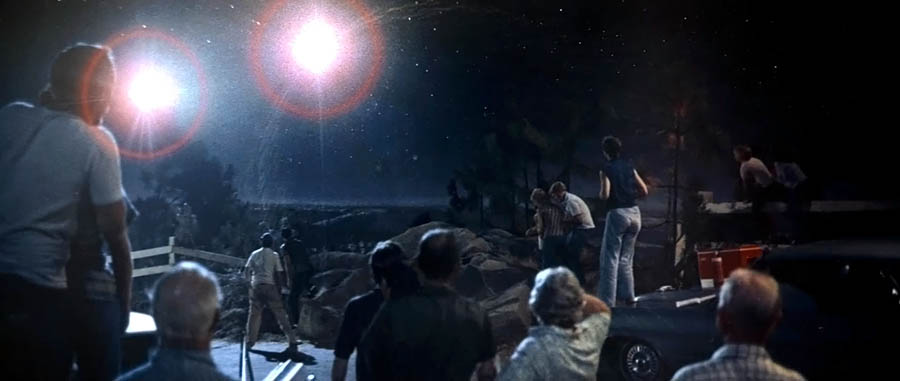
As people have noticed, rear-anamorphics (most zooms and telephotos with some rare exceptions) don't have the same bokeh as front-anamorphic primes, so you've been seeing this mismatch in bokeh for decades now of anamorphic photography, particularly in movies that use a lot of telephotos and zooms (ala Ridley Scott's anamorphic movies.) That's even compounded by anamorphic movies that use spherical VistaVision or 65mm for visual effects, such as "Close Encounters" or "Blade Runner" -- both movies have scenes where one shot shows 65mm spherical lens flares followed by another with 35mm anamorphic lens flares (the helicopters arriving at the mountain top road at night in "Close Encounters" for example.)

Recently I believe "Monuments Men" used spherical Master Primes for wide shots at night and anamorphic lenses for most of the movie.

The only real problem today with mixing the two is the set monitoring and dailies issue, having to deal with converting/unsqueezing the squeezed shots but cropping the spherical shots. Same problem for the final D.I., it just complicates things a little more.
 
Mixed bokeh example from "Close Encounters":

65mm spherical (on stage with front projection landscape):
closeencounters16.jpg


65mm spherical (for some reason, could have been shot in 35mm anamorphic since no effect was added):
closeencounters17.jpg


35mm anamorphic:
closeencounters18.jpg
 
Seems my chances are better at getting a set of Cooke Xtal Ana's for this film. Anyone have experience with theses? I have been researching them and cant wait to try them out. I like the fact that they are vintage. The director wants a more 70's feel for the film, and I think these lenses might just do the job. I believe they are converted Cooke S3's? Might go well with my Vintage Cooke 20-100 Varotal?

any thoughts?

regards

justus
 
Cooke Xtal Express lenses are beautiful and should match better with the 20-100mm in terms of sharpness, color, contrast, etc. even though the zoom will still lack true anamorphic artifacts.

Thanks Ignacio, Yes, my 20-100 will only be used for some specific zoom shots that the director wants in that typical 70's fashion.

Thanks for your help so far!

Kind regards

Justus
 
As people have noticed, rear-anamorphics (most zooms and telephotos with some rare exceptions) don't have the same bokeh as front-anamorphic primes, so you've been seeing this mismatch in bokeh for decades now of anamorphic photography, particularly in movies that use a lot of telephotos and zooms (ala Ridley Scott's anamorphic movies.) That's even compounded by anamorphic movies that use spherical VistaVision or 65mm for visual effects, such as "Close Encounters" or "Blade Runner" -- both movies have scenes where one shot shows 65mm spherical lens flares followed by another with 35mm anamorphic lens flares (the helicopters arriving at the mountain top road at night in "Close Encounters" for example.)

Recently I believe "Monuments Men" used spherical Master Primes for wide shots at night and anamorphic lenses for most of the movie.

The only real problem today with mixing the two is the set monitoring and dailies issue, having to deal with converting/unsqueezing the squeezed shots but cropping the spherical shots. Same problem for the final D.I., it just complicates things a little more.

Thanks so much for the notes and the still, David! Much appreciated! I'm going to go back and check out some of those films now, especially Monuments Men. Thanks again!
 
Back
Top