Welcome to our community

Be a part of something great, join today!

  • Hey all, just changed over the backend after 15 years I figured time to give it a bit of an update, its probably gonna be a bit weird for most of you and i am sure there is a few bugs to work out but it should kinda work the same as before... hopefully :)

Composite Prints Only

Roberto Lequeux

Well-known member
Joined
Jan 3, 2007
Messages
5,403
Reaction score
0
Points
0
Location
Los Angeles
I heard some houses do a composite print only for low budget independents going to festivals, for something like 20% the cost of a negative transfer + composite. I really don't know much about film printing and was hoping to get a brief explanation of the IQ 'negatives' and positives of a direct to composite vs. prints from negatives.

Does it look different? How?

Thanks.
 
Roberto, thats a straight to print film-out. They can be had for 4 digits, depending where you go. I have heard of them being used when you KNOW your film is going to change and you HAVE to submit on film for something.

-F
 
OK, I re-worded my question a bit better for those just coming into the thread now.

So how does a straight composite look compared to one from a negative?

It sort of sounds like it might go both ways. It could be better since it goes straight, or worse depending on the equipment... ?

Thanks!
 
If it's for just ONE print, then go with the cinevator. If you are planning to strike multiple prints or think you might want to color time your film-out a bit, the do a NEG.

-F
 
OK, I re-worded my question a bit better for those just coming into the thread now.

But bottom line, how does a straight composite look compared to one from a negative?

It sort of sounds like it might go both ways. It could be better since it goes straight, or worse depending on the equipment... ?

Thanks!

Not sure I get the question -- all a "composite print" means is a print with an optical soundtrack on it, the opposite would be a "silent print". For example, if you make an answer print off of the negative with a soundtrack on it, it is also a composite print.

If working from a digital master, besides digital projection, your choices are generally to either record directly to print stock, as with a Cinevator, or record to an internegative (i.e. digital negative) and make a print, or to an interpositive, then make an internegative off of that and then a print off of the internegative. Or record to camera negative stock (as with a CRT recorder) rather than internegative stock (as with a laser recorder), and then make a print (or then make an I.P., then an I.N. off of the I.P., then a print off of the I.N.)
 
I am trying to find out if a "direct release print" would look better or worse than a release print from a negative composite. I guess it would largely come down to the digital to analog "printer" (laser or otherwise), since degradation from negative to release print is likely minimal.

Sorry if my nomenclature isn't consistent, or accurate, and if my understanding of the procedures is too limited to formulate logical questions. Thanks for your help as I learn. This are all things for which I will seek my DP's guidance, but I am very interested and would like to have a good grasp of any IQ pros & cons if there are any clear ones.

Let me try again:

Does direct to Composite look better? Or are the laser printers more accurate, and accurate enough to overcome any degradation from the intermediate steps/transfers?
 
I am trying to find out if a "direct release print" would look better or worse than a release print from a negative composite. I guess it would largely come down to the digital to analog "printer" (laser or otherwise), since degradation from negative to release print is likely minimal.

Sorry if my nomenclature isn't consistent, or accurate, and if my understanding of the procedures is too limited to formulate logical questions. Thanks for your help as I learn. This are all things for which I will seek my DP's guidance, but I am very interested and would like to have a good grasp of any IQ pros & cons if there are any clear ones.

What's a negative composite?

Are you asking if recording to print stock directly looks better than recording to an internegative (or camera negative) and then making a print off of that?

Sort of depends, since generally the only people recording directly to print stock use a 2K Cinevator (though in theory, I believe other recorders can go to print stock, it's just not worth the expense.) So compared to recording from a 4K master to internegative and then making a release print, a 2K direct recording to print stock on a Cinevator would probably not be better, but it might not be worse either. But compared to recording at 2K to an internegative and then making a print, perhaps the Cinevator print would look a bit better.

The general rule is a one-off print is very expensive so as soon as you might need multiple prints, it's better to record to an internegative or negative since the per print cost would be much lower even if the initial cost of the film recording is very high.
 
He he, I made that up thinking the visual negative and audio negatives put together could be called a "negative composite"... :blush

You answered my question, it is a very close call. So either way it is not worth considering due to the additional expense for independents.
 
If it's just going to a few festivals, I would just go the Cinevator route. If you record out to IN, then make just one answer print off the IN (plus an optical soundtrack), it's going to be significantly more money and take more time. Perhaps the post facility/lab would be willing to do a short test with maybe :30-:40 seconds worth of material going both routes to see how they compare.

In a perfect world, the festivals would be able to accept 2K or 4K DCP files, just like a regular theater, or at least SR videotape. But a lot of them are still way behind.
 
Sort of depends, since generally the only people recording directly to print stock use a 2K Cinevator (though in theory, I believe other recorders can go to print stock, it's just not worth the expense.) So compared to recording from a 4K master to internegative and then making a release print, a 2K direct recording to print stock on a Cinevator would probably not be better, but it might not be worse either. But compared to recording at 2K to an internegative and then making a print, perhaps the Cinevator print would look a bit better.

Tunnel Post in Santa Monica does great Cinevator prints from RED.

Ask for Kyle -
 
I wonder why the same principle can't be applied to all release prints? Plug in your footage, do a short test print till it is dialed in right, then leave it cranking away. Whenever you need more you just pay a set up fee and the individual cost of your print count.
 
I wonder why the same principle can't be applied to all release prints? Plug in your footage, do a short test print till it is dialed in right, then leave it cranking away. Whenever you need more you just pay a set up fee and the individual cost of your print count.

You can do this if you are making a dozen prints - but if you are making hundreds or thousands of prints .... it's not fast enough and it would cost too much.
 
Because it is always cheaper to simply contact print a piece of film onto a new piece of film, versus digitally recording an image onto a piece of film. It's also a lot faster. If you have a high print order, the per-print cost of making a print off of an dupe neg drops below $1000 per release print. You'd never get a Cinevator print of an entire feature to cost that little.
 
I suppose a 4k IN would be significantly more expensive, but once you got it, then the rest of the process and your release prints would cost the same as they would if your negative had been printed form a 2k digital. Correct?

VFX and post in general would cost significantly more, but for non-VFX-intensive films it makes me wonder why there aren't more 4k filmouts being done. All it takes is to grade at 4k. And with 3k + ending up on the screen, well over twice the amount of detail, it is such a shame... Soon enough I suppose.

It shouldn't be very long before most of what we do nowadays is light enough for a PC to handle in RT... I hope people are at least analyzing the numbers before they commit, because with each passing project they are only getting closer. Artists will still earn the same, but they can also work faster each day.
 
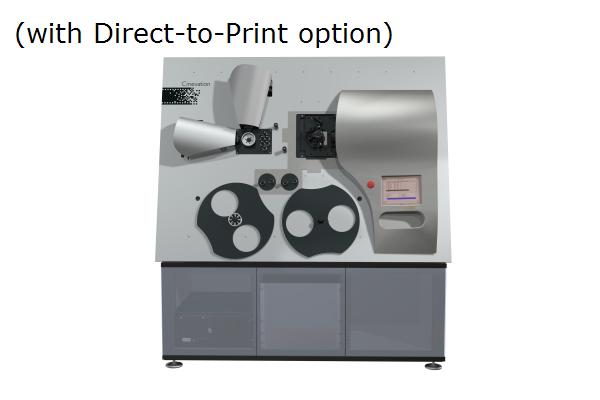
You can HOOK your AJA Kona 3 HD-SDI out with sound from your MacPro desktop to Cinevator HD recorder and get HD real time film printing.

Directly from your FCP Timeline via AJA Kona HD out to Direct-To-Film Printer.

Even you can watch it in a lab with your own eyes how that printing is made.

And you can't believe it that the intermediate negative film is going on the another side of that chain.

148_50_9_75_1_de.jpg

Cinevator®hd - HD Real Time Film Recorder/Printer.

http://www.cinevation.net/cinevatio...ion.net&page=p_product.jsp&cat=Cinevator&id=9
 
VFX and post in general would cost significantly more, but for non-VFX-intensive films it makes me wonder why there aren't more 4k filmouts being done. All it takes is to grade at 4k.

"All" it takes? Clearly you're unaware of the costs and complication involved in handling files that are over 36MB per frame. The vast majority of studio features have been and continue to be shot on film. Normal DI processes for film involve uncompressed scans of that material. Scanning at 4K and maintaining that path throughout the process demands very large, very very fast storage, and equally as fast color grading systems. At the present time, the only systems that really deliver uncompressed 4K material in real time reliably enough to be used in production are the Baselight 8 and the Quantel Pablo. These are very complex and costly systems.

The feature DI world, at least for the studio pictures you seem to be talking about, does not revolve around compressed R3D files, at least not in 2010. In fact, it doesn't revolve around any digital cameras. It revolves around film, and that's why things are done the way they are.
 
The feature DI world, at least for the studio pictures you seem to be talking about, does not revolve around compressed R3D files, at least not in 2010. In fact, it doesn't revolve around any digital cameras. It revolves around film, and that's why things are done the way they are.

Thanks. This perspective is the answer to my question. :beer:

I was in fact thinking of Pablo, and of REDCODE. It doesn't have to be a studio project to be graded on Pablo. Uncompressed is definitely not something I was thinking about. :)

Hopefully we'll see 2.5:1 loss-less take some of the "uncompressed" work. Might be more than some with HDR working the way we all hope/think it will.

Do you see higher REDCODE weights --I am thinking 5k at around RC80, or a bit more-- take some of that work?
 
Back
Top