


JudgeNick
Active member
- Joined
- Jan 26, 2024
- Messages
- 31
- Reaction score
- 13
- Points
- 8
Hey everybody,
I just got my first cinema camera, and decided go big or go home. So I bought the V-Raptor VV (soon to be upgraded to X, more on that in a bit).
I took a looooong time to choose the Raptor. Over several months I found myself doing lots of reading, viewing endless imatest charts from the likes of CVP and CineD, researching color spaces, watching review, downloading sample footage, etc. Those Xyla-21 charts would literally show up in my dreams at night. At the end of the day my question was, "should I wait a little longer and get an Alexa 35? Or Alexa Mini LF? Or just buy a V-Raptor right now?" Then RED offered financing and I jumped on it.
I'm coming from the world of mirrorless cameras. My previous A-cam was the Canon R5 C. I understood I'd be getting a fair bit more dynamic range, an appreciably larger sensor, and lots more frame rate options. Ok, cool.
But I was woefully unprepared for the absolutely PRISTINE CLEAN signal coming out of the Raptor. On my Canon, raising the shadows even a stop would bring a huge amount of chroma noise. The Raptor laughs at such moves. I can push three stops up and it's still just insanely beautiful. Every dot feels like it's "just right." Not only that, but something in the OLPF or sensor stack makes the footage so much smoother and more refined than the R5 C. Edges are still sharp, but not harsh. I really did not expect this. In fact, I expected to be mildly disappointed. The common wisdom was that mirrorless cameras are basically just as good as big boy cinema rigs. They shot The Creator on an FX3, doesn't that prove it? Well ... my experience has been that the difference is very real. Even my very non-technical wife could easily identify the Raptor in a side-by-side test of shots graded to be identical.
I've only had it a few weeks. But I have been absolutely giddy with the performance of this camera. Every time using it has been an absolute joy. And THEN ... yesterday RED goes and announces that I can have THREE MORE STOPS in the highlights? Sign. Me. Up. I had understood that the V-Raptor was something of a compromise compared to the Alexa cameras - I was getting a smaller form factor, lighter weight, less expensive rig, with equivalent or better shadow performance, and with a nice large VV sensor, but which would clip a few stops sooner in the highlights. I understood that an Alexa 35 would see about three stops brighter before giving up. And I accepted the compromise. And it's been great so far. The footage is wonderful. Still, I sometimes wish I could have that safety in split exposure environments, or transitional shots, or places like Las Vegas Boulevard with its combination of very dark shadows and very bright lights.
Then they announce X. And I am HERE for it. I'm watching Phil's posts very closely, as well as whatever CVP or CineD will show in their testing, but I've already booked a reservation for the upgrade service. Because if it's even half as good as the preliminary examples show, then it's worth it. If it lives up to what I'm hoping ... well then that's game over. Then it's basically Alexa 35 levels of dynamic range, with a larger sensor, in a camera 1/2 the size, 1/3 the price, with far more accessible options for media, batteries, and rigging. It basically removes the "compromise" I thought I was making. If the Raptor-X performs as expected ... it's basically the endgame. I can't imagine needing anything else for quite a long time.
In short, I absolutely adore the V-Raptor, but I'm preparing to lose my mind over the V-Raptor [X]. Thanks for reading!
-Nick
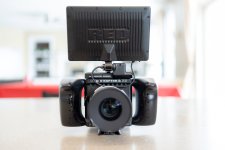
P.S. Here's me and my 1st-AD Oscar (the parrot) with my little handheld setup, including a couple of custom bits. (Right now they're one-offs, I'm not selling anything). It's some custom handles I designed, along with a low-profile monitor mount to keep everything really compact and the center of gravity lower. I really love how it handles this way. There's still room for a NATO rail on top for a rod or other bits, but if I need that kind of setup I usually just remove the left handle.



I just got my first cinema camera, and decided go big or go home. So I bought the V-Raptor VV (soon to be upgraded to X, more on that in a bit).
I took a looooong time to choose the Raptor. Over several months I found myself doing lots of reading, viewing endless imatest charts from the likes of CVP and CineD, researching color spaces, watching review, downloading sample footage, etc. Those Xyla-21 charts would literally show up in my dreams at night. At the end of the day my question was, "should I wait a little longer and get an Alexa 35? Or Alexa Mini LF? Or just buy a V-Raptor right now?" Then RED offered financing and I jumped on it.
I'm coming from the world of mirrorless cameras. My previous A-cam was the Canon R5 C. I understood I'd be getting a fair bit more dynamic range, an appreciably larger sensor, and lots more frame rate options. Ok, cool.
But I was woefully unprepared for the absolutely PRISTINE CLEAN signal coming out of the Raptor. On my Canon, raising the shadows even a stop would bring a huge amount of chroma noise. The Raptor laughs at such moves. I can push three stops up and it's still just insanely beautiful. Every dot feels like it's "just right." Not only that, but something in the OLPF or sensor stack makes the footage so much smoother and more refined than the R5 C. Edges are still sharp, but not harsh. I really did not expect this. In fact, I expected to be mildly disappointed. The common wisdom was that mirrorless cameras are basically just as good as big boy cinema rigs. They shot The Creator on an FX3, doesn't that prove it? Well ... my experience has been that the difference is very real. Even my very non-technical wife could easily identify the Raptor in a side-by-side test of shots graded to be identical.
I've only had it a few weeks. But I have been absolutely giddy with the performance of this camera. Every time using it has been an absolute joy. And THEN ... yesterday RED goes and announces that I can have THREE MORE STOPS in the highlights? Sign. Me. Up. I had understood that the V-Raptor was something of a compromise compared to the Alexa cameras - I was getting a smaller form factor, lighter weight, less expensive rig, with equivalent or better shadow performance, and with a nice large VV sensor, but which would clip a few stops sooner in the highlights. I understood that an Alexa 35 would see about three stops brighter before giving up. And I accepted the compromise. And it's been great so far. The footage is wonderful. Still, I sometimes wish I could have that safety in split exposure environments, or transitional shots, or places like Las Vegas Boulevard with its combination of very dark shadows and very bright lights.
Then they announce X. And I am HERE for it. I'm watching Phil's posts very closely, as well as whatever CVP or CineD will show in their testing, but I've already booked a reservation for the upgrade service. Because if it's even half as good as the preliminary examples show, then it's worth it. If it lives up to what I'm hoping ... well then that's game over. Then it's basically Alexa 35 levels of dynamic range, with a larger sensor, in a camera 1/2 the size, 1/3 the price, with far more accessible options for media, batteries, and rigging. It basically removes the "compromise" I thought I was making. If the Raptor-X performs as expected ... it's basically the endgame. I can't imagine needing anything else for quite a long time.
In short, I absolutely adore the V-Raptor, but I'm preparing to lose my mind over the V-Raptor [X]. Thanks for reading!
-Nick
P.S. Here's me and my 1st-AD Oscar (the parrot) with my little handheld setup, including a couple of custom bits. (Right now they're one-offs, I'm not selling anything). It's some custom handles I designed, along with a low-profile monitor mount to keep everything really compact and the center of gravity lower. I really love how it handles this way. There's still room for a NATO rail on top for a rod or other bits, but if I need that kind of setup I usually just remove the left handle.
