Welcome to our community

Be a part of something great, join today!

  • Hey all, just changed over the backend after 15 years I figured time to give it a bit of an update, its probably gonna be a bit weird for most of you and i am sure there is a few bugs to work out but it should kinda work the same as before... hopefully :)

Big Sur

Final Week

The big news was that we added a day to the schedule, making it now 21 days, and making our last week six days long. The reason was the wrap from Bixby Canyon. The original plan was that we had a day of scenes on the highway as Jack hitchhikes and cars drive by, etc. so the hope was that half of the crew could get the gear out of the cabin end of the canyon while the rest of the crew did the highway shots. But considering it took three days to get the gear into the canyon in a prep week, the idea that it could be taken out in a half-day of working light (since we were starting at midday every day due to night scenes on the schedule) with a partial crew while somehow getting enough gear out at call time to shoot the highway scenes… well, it was clear that this was too ambitious. So our line producer got permission to create a wrap-out day in the canyon and free the director and I to get more shots of Jack hiking through the woods with a small run & gun crew.

So Monday saw us still shooting cabin scenes, including the final shots of the movie, ending with lighting the cabin exterior again for moonlight, but now with the HMI’s on a different hilltop so I could get new angles. We had to drop one scene involving Jack running into another character at a creek in the moonlight because we didn’t have time to move to a creek nor was there available power to light the shot if we got too far from the generator by the cabin, and I didn’t feel confident that I could light a river with a putt-putt generator and a 1.2K HMI.

Tuesday was our wrap-out day from the canyon. Our plan for this splinter unit was first to have the B-camera crew work on the wrap-out to the camera truck back at the canyon entrance, and once they were done, join our little unit running around the woods. By this point, the whole area in our minds was divided by the eight river crossings that we had to make every day to get to the canyon. We had already spent some time shooting the creeks closest to the canyon so we started in the middle at crossing #5 and planned on working our way back to base camp at crossing #1, an area that had a wonderful grove of redwoods with nothing growing underneath, which was very moody.

The first problem was that our little crew got a bit big because we needed a 4-wheel gator for the camera gear and a pick-up truck for small grip items, plus a Jeep for the director, me, the AD, and actor, and another Jeep for the wardrobe and hair people (because of all the costume changes), plus room for the camera crew, two grips, and the props person doing all the smoke effects. Compound this with a one-way narrow road to and from the cabin to base camp that the rest of the crew had to use to get the gear out, meaning our unit had to find the few spots we could pull off the trail for vehicles, not to mention half the camera angles required putting the camera on the road. It was a tight squeeze. At some point, as it became clear that even this one wrap-out day was not enough to get gear that took three-days to get into the canyon back out of the canyon, we got asked to cut out small crew and vehicles in half so that they could contribute to the wrap-out. Now since the next shooting day involved all those highway hitchhiking scenes, I wasn’t too worried about the wrap-out because it could be finished the next day. But we scaled down our small crew even further, basically just taking the 6’ slider around with us, getting rid of the rest of the grip gear and putting the camera gear into the pick-up truck, freeing a gator for the wrap-out. By the end of the day we reached the grove of redwoods and got some nice shots by smoking up the woods and having shards of late afternoon light stream through. Meanwhile, I sent the B-camera crew to explore the stream that led to the beach underneath Bixby Canyon Bridge, a place I hadn’t been too since early prep more than a month ago. Turns out the river was more swollen and of course the woods had exploded with greenery with the coming of spring, so they had quite an adventure crossing rivers on fallen logs with the camera trying to reach the beach.

Wednesday involved the highway scenes. Now that we were out of the shade of the woods, so to speak, I started realizing how frustrating it was to have an 11AM call time every day because it meant that the first scenes were always shot under overhead noon sunlight, which was quite harsh. But there was no clever way around this because we had so many short scenes to shoot while the sun was up, and it was too windy to think about putting 20’x20’ silks over the actors. So I had to live with the hard sun as part of the look. We shot Jack hitchhiking along the Highway One, the main challenge here was traffic control (luckily the CHP was quite excellent at this, and very cooperative) and getting our period cars to keep running.

I had to keep the 24-290mm zoom on B-camera a lot of the time on this later part of the week because we had to work so fast shooting uncontrollable elements; plus with all the wind and blowing sand, it seemed safer to minimize the lens changes on at least one camera. And it’s the only lens I had that went longer than my 135mm Ultra Prime. But it’s not my favorite lens, being 24lbs or so… when doing one long-lensed shot of Jack on the highway, the focus was always too deep on the approaching cars when I wanted it on Jack in the f.g. – turned out that the front bracket supporting the zoom wasn’t tight enough and the lens was “sagging” in the mount. Once we lifted the lens and tightened the bracket, all our focus marks were now off but my focus-puller nailed the 250mm shot in one take once he got new marks. This is not the first time I’ve had this problem with the weight of the lens. And shooting into bright skies or glaring oceans just shows how much lower in contrast this lens is compared to the Master Primes (but then, what lenses aren’t lower in contrast than the Master Primes?)
(cont.)
 
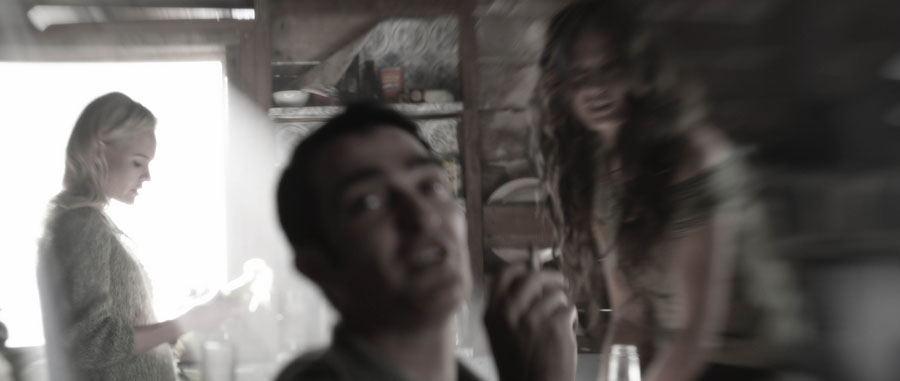
An example of shooting a POV using the Lensbaby, shot at night but lit for day:
bigsur33.jpg


Is this the 6K through the window? Was it naked? Did you light up a frame outside for ambient and to blow out the outside? Finally, fogger or Hazer? Thanks for all the info. I love the way it blows out without getting ugly.
 
When we scouted the highway for these shots, it was still closed immediately north of Bixby Bridge, but now that we were shooting these scenes, it struck me that we should also shoot some shots north of the bridge since in actuality, Jack was hiking to Monterey. So by the afternoon we ran north somewhere near Rocky Point Restaurant and did some shots where Jack stops along a fence to take off his shoes after hiking all day. The dramatic view was looking south so I found a camera angle where the Rocky Point Bridge was obscured by a hill, otherwise it would have looked like Jack had only hiked two miles before giving up, the bridge being such a distinctive landmark. Things were working out in terms of shooting the sequence in order so that the last shots would be at the end of the day, since we had already shot Jack being dropped off at a bus depot in Monterey while we were in San Francisco, at night. So I wanted a near sunset shot to create a transition. However, we needed to get back to Bixby Bridge to shoot a dusk-for-night shot of Jack being dropped off by a cab at the bridge for the first time. So the final day shot, where Jack gets picked up by a truck, had to be in the vicinity in order to not miss magic hour on the bridge. Again, we got lucky, there was only a small spot south of Bixby Bridge between where our equipment trucks ended and the temporary traffic lights began for the one-lane section that passed through the former landslide area between the Bixby Canyon and Rocky Point Bridges. I literally had something on each side of the wide shot to frame out but luckily the view looked right out on the ocean with the late afternoon sun glowing on the water. I tossed in a B-camera angle on the 135mm prime that turned out pretty well too, getting a nice silhouette shot of the truck and Jack climbing in.

The day ended with this dusk shot of the cab pulling up to the bridge and dropping Jack off.

Originally we were supposed to end the day getting a shot of Jack’s friends dining at Nepenthe restaurant in Big Sur, but even though this was a night scene, I felt we had to shoot it at magic hour or else there was no view from the restaurant porch, the most dramatic feature about the restaurant. At night, the background would be pitch-black. But I also needed to shoot the cab drop-off at Bixby Bridge at magic hour because there were too many restrictions with lighting the highway at night due to safety, plus it was often too windy there to raise a condor up anyway. So the Nepenthe scene was moved to Thursday when we planned on being south at Anderson Canyon.

So Thursday saw us the farthest south of Big Sur that we would ever shoot, just north of Eselen Hot Springs. Actually the scene we were shooting at a private home on the cliffs above Anderson Canyon were supposed to take place at Eselen, back when it was Slate’s Hot Springs. But the actual place had been too renovated over time to match how it looked in the 1950’s. As we passed Nepenthe on the way to Anderson, I began to get worried about the distance between them, having to race back up the highway at sunset for a half-hour drive at least to get a magic hour shot at the restaurant with nine cast members. It seemed a bit risky, especially with company lunch falling just an hour before sunset, and there is always time lost after lunch getting everyone back to speed. We decided that the cast should be treated to a dinner at Nepenthe at sunset so that they would already be there when the crew arrived. I sent some guys in advance to prelight the shot. Since the restaurant was open for business, I couldn’t be disruptive, plus I would have a generator there, so I went with hanging three Chinese lanterns off of trick line hung between two combo stands as the general lighting mixed with magic hour. I added a bit of edge lighting from a Woodylight in each corner and some weak fill from bouncing blue-gelled Source-4’s off of cards above the camera, so that as the twilight faded I could maintain some weak blue fill on the actors for a few more minutes.

So we shot some daytime canyon scenes, the hot springs scene, raced north the Nepenthe for the restaurant scene, then had to go back to Anderson Canyon because we owed this night creek scene where Jack runs into one of his friends in the middle of woods while the friend was fishing for dinner. The river running down the canyon was quite dramatic, bouncing over boulders between redwoods, but it was very rough terrain to do a night scene. I managed to light the canyon again by having the electrics climb the steep sides with cables and HMI’s in the daytime, but after we got the wide shot at night, my two crew members were injured when they slipped off of a wet boulder and fell into the river, sending them to the hospital accompanied by the set medic. We decided to shut down since it was only going to get worse, plus now we had no medic on set. But we never got the rest of the coverage of the scene, only the wide shot. We left most of the gear behind in the dark, feeling it was safer to send some crew people back in daylight to wrap it.

So now we had reached the final two days of the shoot, both at Rocky Point Bridge and the canyon and beach underneath, a place standing in for Bixby Bridge, the next bridge immediately due south just around the bend. The reason was the simple fact that there was hardly any workable beach under the Bixby Bridge, and we could get vehicles a bit closer to the beach under Rocky Point. But also, creatively, there was a lovely meadow below Rocky Point Bridge, creating some dramatic views with the bridge above and the ocean beyond, whereas there were too many trees and bushes under Bixby Bridge to see it from any distance as you walked down the trail to the beach. Friday was the last day with the full cast, who walk to the ocean and party into nightfall, when they build a big bonfire. We also had two other dramatic scenes, one involving a chat between Jack Kerouac and Carolyn Cassady as Neal Cassady plays on the beach with his kids, the other involving Jack watching Neal’s mistress Billie wander out into the dangerous waves. Then we ended with the bonfire party.

The two weeks of unending sunshine were finally relieved on Friday by an incoming cold weather front, bringing some moody skies finally, but also an arctic wind blasting the beach. The sky was particularly great for the scene where Jack watches Billie along the shore since his voiceover at this moment is full of dark thoughts. At night, the only problem was that the strong wind turned the bonfire more into a blowtorch, burning so fast and hot that after I got the wide and medium shots with the cameras, we had to pick them up while rolling to get closer angles before the fire was gone, and then do it again, a mad scramble while the fire was raging. So it was a bit of craziness that was over very quickly. Besides the fire, I had an 18K HMI on the cliff above for a backlight; I was worried that it would be too dim at that distance but in truth I ended up dropping two doubles in it just to make it dim enough for moonlight relative to firelight. I probably overexposed the fire more than I should have but with unscripted action, I had no idea how close or far the actors would get from the flames, and I didn’t want them underexposed if they wandered away from the fire. As we grabbed the cameras and went in tighter, I stopped down more and more, probably ending up at an f/4 at 1000 ASA or so.
(cont.)
 
The last day involved just our lead actor at the beach; there were a lot of pieces to get and I had to shoot one scene day-for-night in full sun just because he describes everything around him – the waves, the cliffs, a house on the hill, etc. – and there would have been no way to see any of that at night, so it seemed like a good scene for day-for-night, though he’s also supposed to be writing this stuff down, which implies he wouldn’t be doing this by moonlight. It was sort of a conundrum to me because if I had shot him at night, he would have been surrounded by pitch-black backgrounds – at least with the day-for-night, I could show the bridge looming over his head.

We also had to shoot a lot of pieces of his wandering down trails for a number of scenes, some with a lantern, some without. We only had time to light two areas at night, a section of woods and a trailing leading to a gate, we never had time to light a meadow as well, which we needed (when he first arrives, he leaves the cab at the top of the cliff on the bridge, walks a steep trail in the fog, reaches a gate, goes under the gate, finds a meadow, and falls asleep. And it all had to be heavily fogged. As it was, we only got some light artificial fog on the bridge for the cab scene, so some post augmentation may be needed. We manaed to fog the woods though.) I had the electrics make a prop lantern with a brighter bulb, powered by a cordless drill’s battery pack hidden inside his rucksack. We ended our day work with the scenes that take place at dawn when he wakes up in the meadow, wanders to the beach and meets a burro, and then hikes to his cabin. We shot it in late afternoon because our call time was 11AM again and I didn’t want to shoot a dawn scene at noon. But by late afternoon, it had totally clouded up so I played it as more of a pre-dawn light. The last few shots were made at late magic hour, shot wide-open, and I had to light his close-up on the ground at night, by bouncing an HMI into a 12’x12’ day blue bounce over his head. I tried a trick I heard about from the Jack Cardiff autobiography; when asked by Michael Powell for a transition shot to the beach in the morning after the opening sequence of “Matter of Life and Death”, Cardiff leaned over and breathed on the lens, so the first shot in daylight starts fogged and clears up. I did that for Jack’s close-up as he wakes up in the morning, had my 2nd AC Alex Worster lean over and breathe on the lens just as we called action. To make sure that the fogging cleared up completely and quickly enough, Alex used his canned air to clear the lens. I would have preferred to enhance the effect with a bit of orange backlight flaring the lens – and had a tungsten PARCAN standing by – but with all the wide shots having been done in heavy overcast, I decided to let the close-up also just be soft-lit or else it might have seemed odd to have orange sunlight on his face in his close-up only for him to stand-up into an overcast wide shot.

The night ended with the trail in the woods that I lit with the 18K HMI on the far hilltop above the canyon, plus a few Kinos for fill. For a handheld close-up, I also had my little Micro Litepanel on the camera for a weak amount of fill. We ended the night with a few shots done with my lensbaby on the camera, for a nightmare vision that Jack has while wandering in the woods.

One thing I want to mention is the B-camera and splinter unit work. While in San Francisco, we only had one afternoon where we split up the crews and I had my A-cam operator Theo Pingarelli shoot that stuff. We didn’t have a B-camera crew on the whole time anyway in San Francisco, but we did in Big Sur. My other operator from L.A., Chris Squires, came down to operate B-cam; he can also shoot, as can Theo, and Chris was able to go out a couple of times while we were at the cabin and get a few nature shots, but then Chris got a call to shoot a feature and had to leave. He asked his friend Josh Bleibtreu to replace him – Josh is an experienced 2nd Unit DP, having done many big projects like the “Pirates” and “X-Men” movies and “Apollo 13”, so I was lucky to have him on B-camera for this little movie. He and his wife also grew up in the Big Sur area and he had a home up there, so he was happy to be a part of a production about Big Sur. He’s also one of the nicest persons in the world, no attitude, very positive and very creative. I brought up someone I’ve known for years to become the A-cam 1st AC, Dave Mun; he did a great job until he got knocked off that boulder in the middle of the night and went to the hospital; our 2nd AC Alex Worster replaced him for a day and did a great job. My main operator, Theo, was my 1st AC over a decade ago on a number of low-budget movies before he moved up to operating; he’s also an old-fashioned stop-motion animator, working with a Mitchell in his basement with a rear-projection set-up. We share an obsession with “Space: 1999” though he doesn’t get my interest in “Star Trek.” I was also happy to have my longtime Key Grip Brad Heiner and Gaffer Keith Morgan with me, along with some familiar faces in their crews. All the San Francisco crew people were fantastic to work with, in particular 1st AC Paul Marbury and 2nd AC Annie Lee, plus the various B-camera people that came onto the show to help out. I also feel very lucky to have hired Dane Brehm to be our DIT; I needed someone with his experience dealing with a new camera like the Epic, and for figuring out our dailies workflow and data back-up & storage issues.

I want to express my gratitude for all the support I got from Jim Jannard and his team at Red, and Tonaci Tran for renting his Epic to us; it worked like a dream. I also want to thank all the producers for making this happen, but particularly those on the front lines with us every day: Sean O’Grady and line producer Mark Mathis. And also the people at LightIron for coming onboard, and the ColorFront people as well. And just as I am writing this, Tom Lowe has just arrived in Big Sur, shooting some stuff for his own movie but also something for ours, which is very exciting.

Finally, if this little movie turns out well at all, it would have to be due to director Michael Polish, for his visual imagination, good taste, and hard work at pushing all of us to work and create at a higher level. I think people will be impressed with what we did in 21 days with a tiny budget. Sure, I have some misgivings about what we did and didn’t get in our short time frame, but then, I always feel that way about everything I shoot, but I’m very excited about the project as a whole because I think it is a very cinematic, visual approach to an important novel that was very hard to adapt.
 
What a great crew. I hope it all works out well. I can't wait to see this in my local indie theater in Tokyo :)
 
An example of shooting a POV using the Lensbaby, shot at night but lit for day:
bigsur33.jpg


Is this the 6K through the window? Was it naked? Did you light up a frame outside for ambient and to blow out the outside? Finally, fogger or Hazer? Thanks for all the info. I love the way it blows out without getting ugly.

That was the 2K Xenon beaming through, with I think an 8'x8' Ultrabounce outside lit with some 1.2K HMI's. We had a hazemaker.
 
It was shot in regular mode since I wanted the windows & highlights to be blown-out. There was a white sheet outside the window anyway so what would be the point of HDRx other than perhaps to hold detail in the white plate she is holding? Besides, HDRx isn't so great when there is a lot of movement in the frame, and with the lensbaby shifting focus back & forth all over the place, details were constantly changing.
 
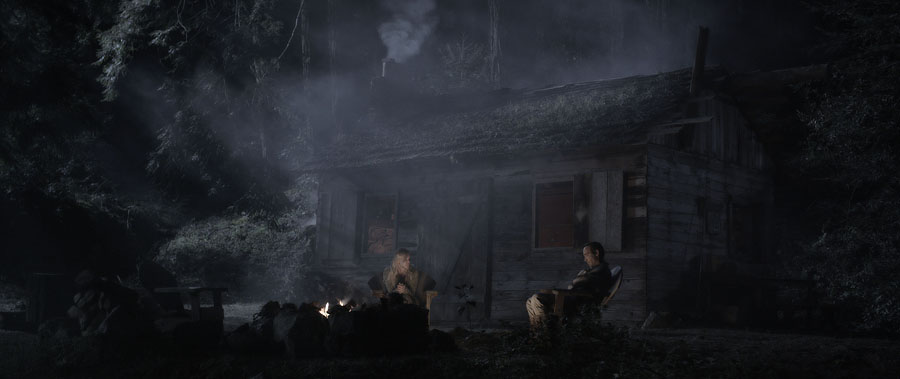
Here is a shot from the last night shooting at the cabin, when I put the HMI's on the other hillside of the canyon to light the cabin from the opposite direction. The lights were high enough that I didn't need a tree branch to hide them but when the smoke drifted up to the top left corner of the frame, it got a bit hot, so I put an ND.60 grad in the camera to darken that corner of the frame:

bigsur38.jpg


There was a 4K HMI on the hill with two 1.2K HMI's, and on the opposite side, an Image-80 Kino raked the side of the cabin, besides the fire there was a 2'-2-bank Kino on the ground in front of the fireplace with orange gel on it. Inside the cabin were some orange-gelled 1K's on flicker boxes.
 
It was shot in regular mode since I wanted the windows & highlights to be blown-out. There was a white sheet outside the window anyway so what would be the point of HDRx other than perhaps to hold detail in the white plate she is holding? Besides, HDRx isn't so great when there is a lot of movement in the frame, and with the lensbaby shifting focus back & forth all over the place, details were constantly changing.

Understood and noted. Wasn't critiquing, just curious ;) it's a great looking shot, you know.
 
David, this is bringing back a lot of memories for me. I worked on a documentary and covered all of the ground you are discussing. Big Sur is a fascinating area. We were at the actual property and had a lot of access. Anyway, here is a link to the doc if anyone is interested. http://www.kerouacfilms.com/onefastmove/index.html

David, amazing images and can't wait to see what you guys have done with the film.

On a side note, one night I decided to venture off the property to record night sounds. I went up the road quite a bit and while getting some interesting sounds, pretty sure I was only about twenty feet from a mountain lion. At least that's what it looked and sounded like from where I was standing. An incredible place for sure.
 
David, this is bringing back a lot of memories for me. I worked on a documentary and covered all of the ground you are discussing. Big Sur is a fascinating area. We were at the actual property and had a lot of access. Anyway, here is a link to the doc if anyone is interested. http://www.kerouacfilms.com/onefastmove/index.html

Two of our producers, Jim Sampas and Orian Williams, also produced your movie, and I know Richard Rutkowski, who shot it -- tried to get him to come up to work on B-camera in Big Sur but he got a commercial job and had to back out.
 
Two of our producers, Jim Sampas and Orian Williams, also produced your movie, and I know Richard Rutkowski, who shot it -- tried to get him to come up to work on B-camera in Big Sur but he got a commercial job and had to back out.
Say hello to Jim for me. We had a good time working with Ben Gibbard recording the soundtrack for One Fast Move. Jim's a good guy.
 
That's a stunning night shot of the cabin, David!

Graeme
 
The cabin at night was the most striking image to me, too. But my second reaction was "HDR-ish" It didn't quite fit with the more natural tonality of every other still. I don't know what mood you were going for, so I can't judge it artistically. But something about the tonal value and evenness of the moonlight hitting the side of the cabin, as well as the relative values of the fire, inside lamp, and moonlight strike me as unnatural. Having the light emanating from the window light Jack's front is masterful, but also seems a bit too bright. I know these aren't final grades, and I'm a nobody, but that's my $0.0002
 
:cheers2:Thank you again David. Incredible wealth of information here about how a master solves lighting problems against the odds on a very tight schedule. Absolutely stunning imagery. Can't wait to see the film.
 
The cabin at night was the most striking image to me, too. But my second reaction was "HDR-ish" It didn't quite fit with the more natural tonality of every other still. I don't know what mood you were going for, so I can't judge it artistically. But something about the tonal value and evenness of the moonlight hitting the side of the cabin, as well as the relative values of the fire, inside lamp, and moonlight strike me as unnatural. Having the light emanating from the window light Jack's front is masterful, but also seems a bit too bright. I know these aren't final grades, and I'm a nobody, but that's my $0.0002

Because there is a bit of day-for-night in the sequence as Jack wanders the woods that same story night, I wanted to make sure that the night-for-night work had enough light all around or else it would have been jarring to intercut day-for-night with night-for-night. Also, that night Jack sees visions in the woods and has nightmares while trying to sleep, so the whole night had to have a somewhat surreal tone, almost like a horror movie.
 
Because there is a bit of day-for-night in the sequence as Jack wanders the woods that same story night, I wanted to make sure that the night-for-night work had enough light all around or else it would have been jarring to intercut day-for-night with night-for-night. Also, that night Jack sees visions in the woods and has nightmares while trying to sleep, so the whole night had to have a somewhat surreal tone, almost like a horror movie.

Well, like has been said many times already - a master at work.

So, did/will you use HDRx to help match this night-for-night to the day-for-night?
 
Back
Top