Welcome to our community

Be a part of something great, join today!

  • Hey all, just changed over the backend after 15 years I figured time to give it a bit of an update, its probably gonna be a bit weird for most of you and i am sure there is a few bugs to work out but it should kinda work the same as before... hopefully :)

Big Sur

All the best to you, David. You are so faithful about answering questions I feel sure you must have missed my question earlier. It was:

Quick question. Will you shoot timebase 23.976 or 24 fps? And why?
 
We are doing well. We've completed week one with the Tonaci and Brook Willards Epic's with some gorgeous footage to boot. They are just purring along. Our AC's are all traditional Film folks and are getting a crash course in digital cinema but are now loving the size and ease of use. We've been in San Francisco's "Tenderloin" district the last few days that has been nothing less than a circus. The folks who know where that is will understand;) David will have some examples of HDRx to show when he has a moment to comment. I'm happy to anwser any questions anyone may have about our very unique workflow and anything pertaining to the Colorfront system.
 
While in the final stages of "post-NAB re-entry" I discovered this thread. Made my morning. As Dane generously mentioned, our company http://creativescience is providing the Colorfront On-Set Dailies system which Dane expertly integrated into his kit. I'd also like to echo his appreciation toward Deanan and the team at Red who delivered what so far has been a rock solid Mac SDK to Colorfront's software engineers making Epic support seamless. Especially as teams on both sides were busy prepping for NAB, with Colorfront's team spread between their office in Hungary and our office in Sherman Oaks.

Thank you Dane, Red, and Colorfront.

Marco Bario
Sherman Oaks, CA
creativescience.com
 
End of Week 1 of 4

The week went very well considering all the logistical and budgetary challenges; we’re getting everything we need within normal shooting hours more or less, though some locations have needed a lot of wrap time for certain crew members, and the transportation department has worked very hard dealing with all of the moves across the city, a city with unique parking challenges.

My crew have been doing top-notch work, including my regular key grip Brad Heiner and gaffer Keith Morgan, as well as my main operator Theo Pingarelli. The local crew has been great, particularly 1st AC Paul Marbury, 2nd AC Annie Lee, and DIT Dane Brehm.

The Epic cameras have been working very smoothly, even more smoothly than the Red Ones I did “Manure” and “Stay Cool” on – these are seriously well-built machines, especially considering how new they are. The small size and the high sensitivity make them ideal for run-n-gun independent filmmaking.

The only thing that can get a little annoying is that if the operators want to use the EVF’s and we have to use the menu controls on the Red LCD, we have to shut down and reboot every time we switch between the EVF and LCD. (It recently occurred to me that most operators I know have reached that point in life where focusing on an LCD is difficult without reading glasses, hence why they prefer the EVF since it has a diopter.) Anyway, the Redmote will make all of these issues go away but right now, we are working with a very stripped-down Epic. I guess the side handle can also be used to get to the menu through the EVF.

The images out of the camera are stunning; the clarity is wonderful. We only changed the chroma level in the camera menu to reduce the saturation of the image as part of the period look we are going for. That’s about it other than the normal adjustments to ASA and color temperature, etc.

Generally outdoors in daytime I’ve been shooting at 500 ASA, mainly because I don’t want to deal with 800 ASA, but inside, I’ve mainly shot at 800 ASA, with some night work at 1250 or 1600 ASA, once at 2000 ASA.

Most of the time we shoot on the ARRI Master Primes, but when I have a B-camera covering a tighter angle, they get the Ang. Optimo 24-290mm… it’s necessary mainly because 75mm is the longest prime I’m carrying, and these B-cam shots are often done at 100mm and longer. At 800 ASA indoors, I’ve sometimes used ND.6 filters on the camera just to get the shooting stop down to the T/5.6 to T/8 when I’ve got a lot of windows in the room and the level of daylight illumination is very high. Otherwise, most interior scenes are shot between T/2.8 and T/4… if I plan on running two cameras, I have to keep in mind that the Optimo is a T/2.8 lens when lighting the room.

Though I’m carrying a couple of Schneider Black Frost filters (1/8 and ¼), so far I haven’t used them except for one insert; the “black fog” diffusion effect I want to add in post is invariably going to soften the image a little bit so it seems safer to shoot clean for most of this movie, even though occasionally the Epic image is so darn sharp and detailed on faces I get a bit worried. But so far we’ve only been shooting scenes with the male characters; I may slide in some filters on when we start shooting scenes with women in them to avoid being unflattering.

Dane has been providing me with TIFF’s of frames from each set-up so I can play with them on my computer later. The frames are gamma-corrected (not Log) with the desaturation added. I usually add a bit of a blur overlay to diffuse the blacks using Photoshop and then pass the photos along to the director. My technique is a bit crude though and softens the image more than I intend in the final color-correction, but the visual idea is there. I'll post some of my frames but keep in mind all the monkeying I've done in Photoshop before you try to form any opinions about the Epic; believe me, the RAW frames are extremely sharp and clear.

Even though adding smoke to the interiors has always been a trademark of the period films I’ve made with the Polish Brothers (“Northfork” and “Manure”, not to mention “Astronaut Farmer” though not a period movie technically), many locations have told us we can’t use a hazemaker with oil-based smoke, so we’ve used a fogger with water-based smoke, the result being that I’m dealing with more drifting clouds and wisps, plus quick dissipation, than I wanted to. That’s a bit frustrating… though easier on my lungs.

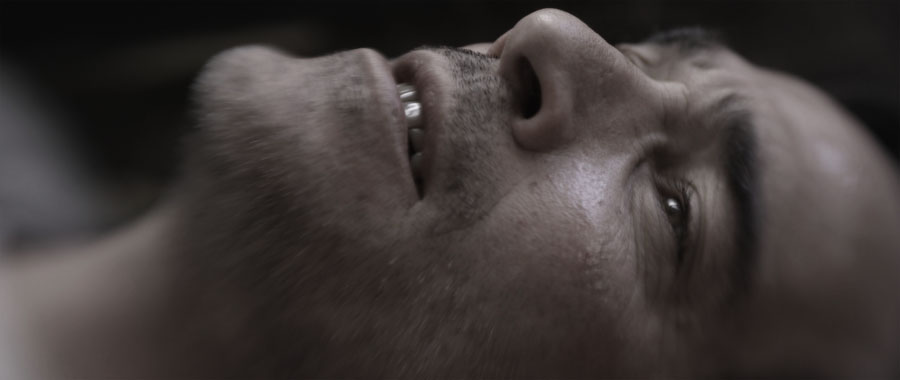
I’ve done a couple of shots using my new PL-mount Lensbaby, which I picked up at an expendables store just before I came up here, a great investment at only $300. It’s mainly been for scenes where Jack Kerouac is drinking heavily for a distorted effect. Kinda fun to play with, squeezing a rubber lens back and forth.

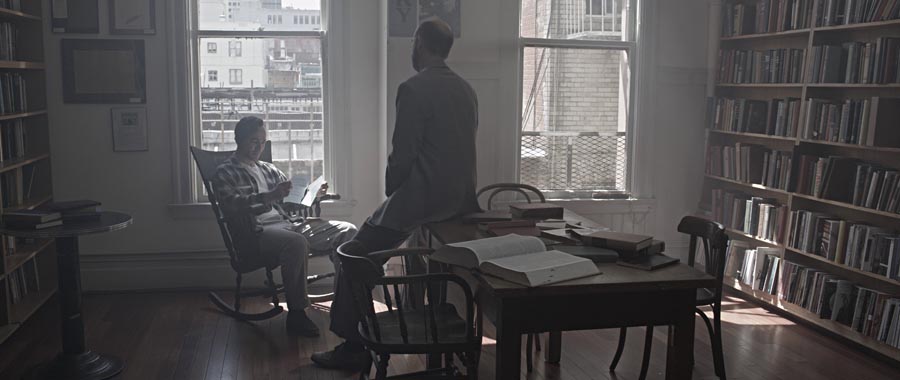
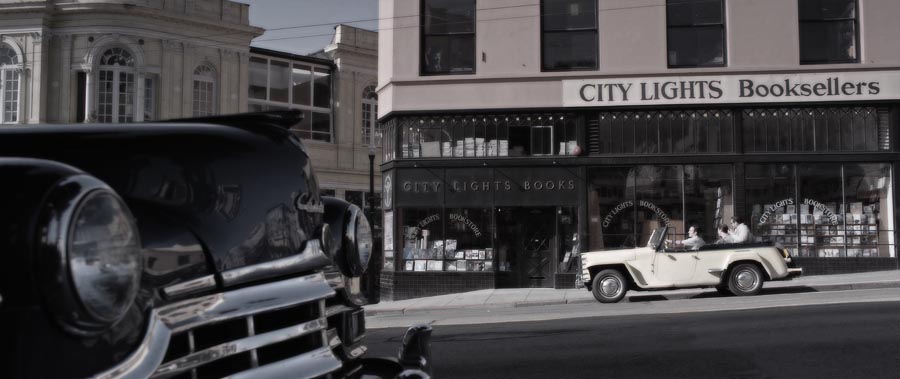
Day 1 was spent at City Lights Bookstore and then some exteriors in the vicinity.

bigsur10.jpg


I used minimal lighting inside the bookstore on a second floor reading room. There was real sunlight coming through the windows, plus one Joker-800 Source-4 Leko bounced off of the ceiling and coming through another window was a 12K HMI PAR on scaffolding through a 4’x4’ diffusion frame to create an edge from the opposite direction as the angle of the sun. Once I went into close-ups, I either just used a white beadboard to reflect some of the real sun onto the faces, or bounced the Source-4 from more of a side angle instead of overhead. I turned on the HDRx function to give me some more detail outside the windows, but even without it, the Epic was holding the view out the windows pretty well.

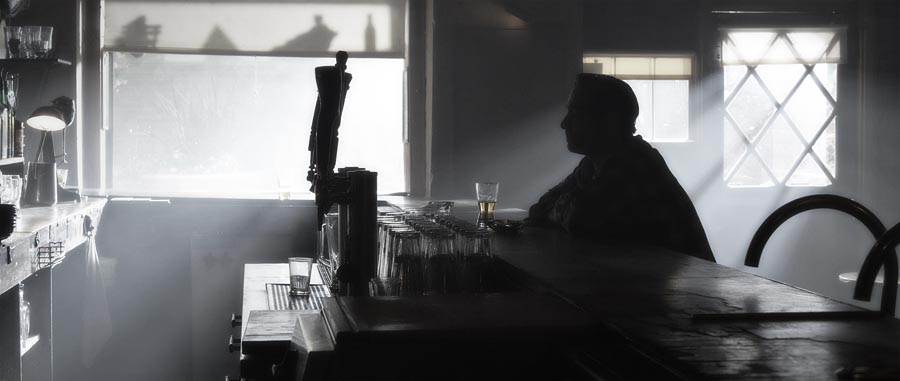
Day 2 saw us back in the same area shooting inside some bars across the street from City Lights Bookstore. The scripted scenes all were at night but shot during the day… but when we left the first bar, we pulled down our tent and did an unscripted shot of Jack Kerouac drinking alone, silhouetted by a shaft of light (from a 2K Xenon) – I always find those sorts of old photos the most compelling, seeing people drink in the daytime.

bigsur15.jpg


I also did some slow-motion work in the first bar for a montage of Jack’s first night in town; I only went up to 48 fps, which seemed slowed enough, plus between the T/2.8 limitation of the Optimo zoom for B-camera and the difficulty in rigging lights in the place, I felt that I only wanted to deal with lighting up the bar to T/4 at 1250 ASA I think (thus shooting at T/2.8 at 48 fps). Any higher levels of illumination would have been difficult and would have overpowered the natural ambience in there.

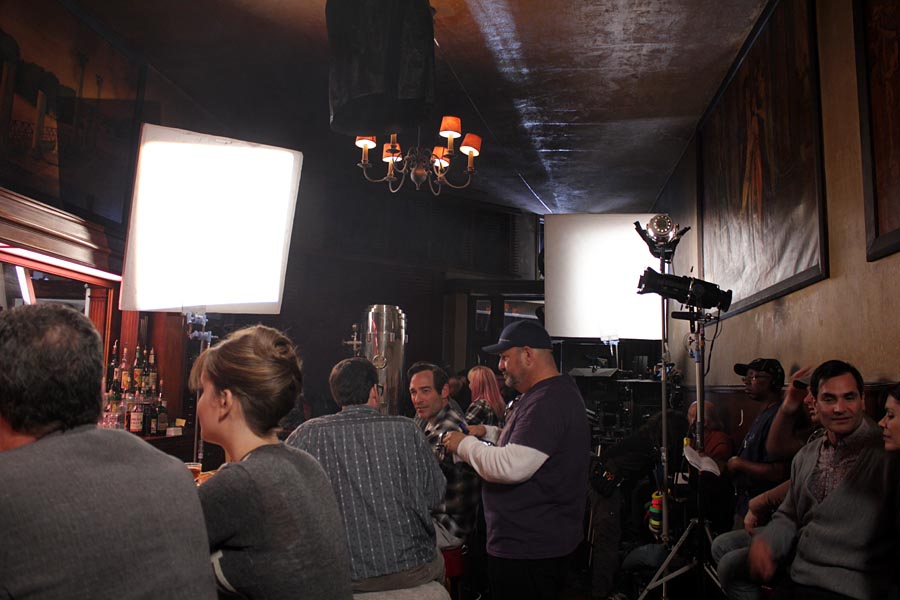
I lit the second bar with some Chinese Lanterns rigged high above in a row along the very long counter; the ceiling being old, these were the lightest things I could think to rig up there. I augmented this with some Source-4 or tweenie bounces, plus some Woodylights (medium Chimera bank on a 4-bulb 1K-total fixture that my gaffer Keith Morgan designed and built.) Lit to T/2.8 at 24 fps at 1000 ASA I believe.

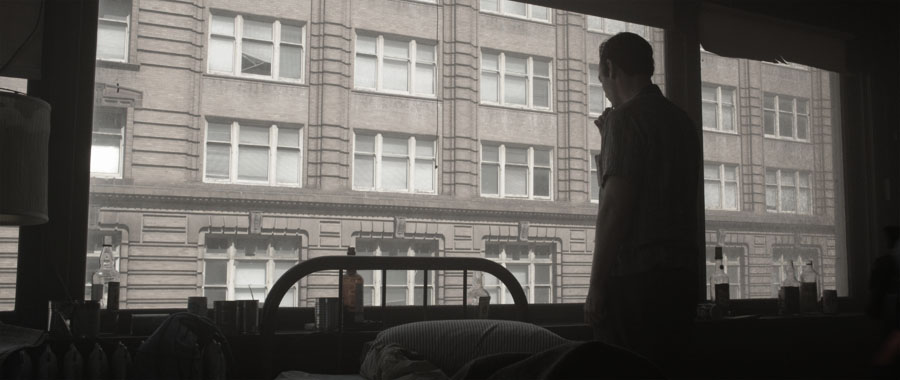
Day 3 was spent inside a room at the old Oldfellows Building on Market Street. It had a great period feeling and some views onto old brick buildings; even though the windows were larger than would be typical of a cheap hotel, since the movie opens in this room, we felt that we had to be in a more interesting space in terms of the view. There was also an old bar inside the building that we could use. Even with an ND.60, at 800 ASA I was often at a T/8 in there just to balance with the views outside the windows. I also turned on HDRx so that I had the option of pulling more detail outside the windows later in the D.I.

Day 4 was just a block or two southeast at an old hotel on Mission St. and 6th – that day was interesting mainly because the neighborhood was rather rough, culminating in someone walking out of a porn shop across the street engulfed in flames (he was, not the shop). We had to clean excrement and vomit off of the sidewalks in front of our equipment trucks just to work. The hotel interiors were very small and mostly shot with small tungsten units like Chinese Lanterns, Source-4 bounces, and Woodylights.
 
Last edited:
Day 5 saw us all over town, starting at a bus station near Laguna Honda Hospital. We had a number of shots to do of a period bus which we could only afford to rent for one day, so we shot at one station meant to be in San Francisco and ended our night at another building in Golden Gate Park dressed to look like a station in Monterey. We only had ten-minute windows between working buses arriving and leaving at the first station, compounded by the problem of the period bus breaking down. With a hour of downtime, I suggested we run over to a hilltop I passed when driving into location to shoot a shot of Jack walking across town; it had a nice view of distant houses where non-period elements were very small in frame. After shooting the bus finally, we split up the units, sending one camera crew to the Great Highway to shoot drive-bys of the bus and other period cars, while a smaller unit went over to Crissy Field to shoot a dialogue scene. This was the location I picked while walking around on an afternoon after work during prep; the weather was so bad that I got soaked but I loved the mood there. But when we returned during the tech scout one morning, it was clear and far too sunny and saturated, plus completely front-lit. So I pushed for that scene to be scheduled in the afternoon since I knew we’d be looking at the Golden Gate Bridge to the west, and while I prayed for some clouds to roll in, I figured that even if it cleared up, at least I wouldn’t be in front-light.

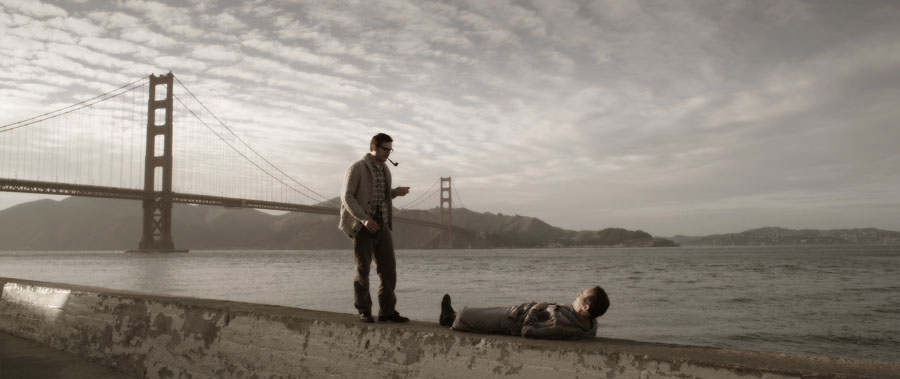
I went with the Crissy Field unit, sending operator Theo Pingarelli to shoot the car stuff. We got very lucky with the weather, a mild overcast rolled in near sunset, giving me some haze while not obscuring the Golden Gate Bridge. Though not as stormy as the first time I visited the park, it was perfect weather for the scene. The only trouble was the lack of lenses; I gave the splinter unit my Master Primes since they had to do drive-bys in magic hour, but that only left me one 20mm Ultra Prime and the 24-240mm Optimo zoom, and switching between the two was an ordeal due to the different baseplates, rods, etc. I tried to shoot the wide shot on the 20mm prime… it was funny because the bridge looked a bit smaller in size than I wanted so I tried moving in closer to the actors on the sea wall but the bridge didn’t really change size since it was actually very far away and I was only moving ten feet closer or so, which didn’t make a difference as far as the background size went. You forget how big that bridge is. I discovered that while the 24-290mm is great for shooting close-ups, when I lost the light and was trying to grab shots with the zoom wide-open, the lens wasn’t that good for wider shots in low light levels. I really need more lenses in my package if I’m going to be splitting up the camera crews more often. We finished the night in the dark over at an old structure on Fulton Ave. in Golden Gate Park, dressed to be a bus station that Jack Kerouac travels to. I couldn’t get a placement for a condor or lift of any kind because the street (and all the side streets) have power lines crisscrossing the sky. So I had to rely on the art department hanging China hats in the structure to light up the interior, the rest was achieved just with a few lights here and there uplighting trees. I had one rake on the street from a Barger Baglite, otherwise the real streetlamps were doing a lot of the work for me.
 
Keep in mind this is cropped, reduced, and highly compressed as a JPEG, but here is an example of a frame pulled by Dane with our basic desaturation applied:
bigsur16.jpg


The interior was just lit with a 800w Joker bounce off of the ceiling, otherwise, it's mostly available light. You can see how much the Epic is holding detail in both the interior and the exterior, and this was shot with HDRx on, so in post, I'll have even more overexposure detail to play with than what this frame shows. But it demonstrates how good the dynamic range of the camera is.
 
This footage looks great David. It will help to give EPIC and RED the reputation they deserve. I admire your huge technical and cultural background and the way to see things and deal with small lights and low budget situation. Somehow your work represents for me the best ingredients of the old and the new world. I like that and I am a big fan of Kerouac
 
So is Light Iron all ready for some HDRx processing? :)
 
Thanks for keeping us up-to-date David - they're some lovely images you're posting!

Graeme
 
Thanks for sharing! Lovely images too.
 
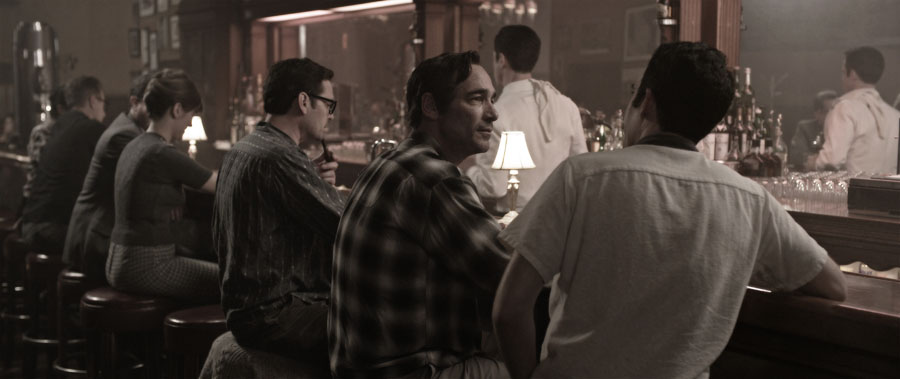
Here's an example of the simple lighting I've been doing -- this shot was lit with some hanging Chinese Lanterns (skirted), a Source-4 bounced off of a 4x4 beadboard for a key, a tweenie bounced off of another 4x4 for fill, and a raking edge light from a 1K Woodylight. This is a shot looking back towards the camera:
bigsur7.jpg


This is the shot itself:
bigsur17.jpg


Here are some other shots from the first week, this is from the hotel room day:
bigsur18.jpg


This is a close-up I shot with the Lensbaby:
bigsur19.jpg


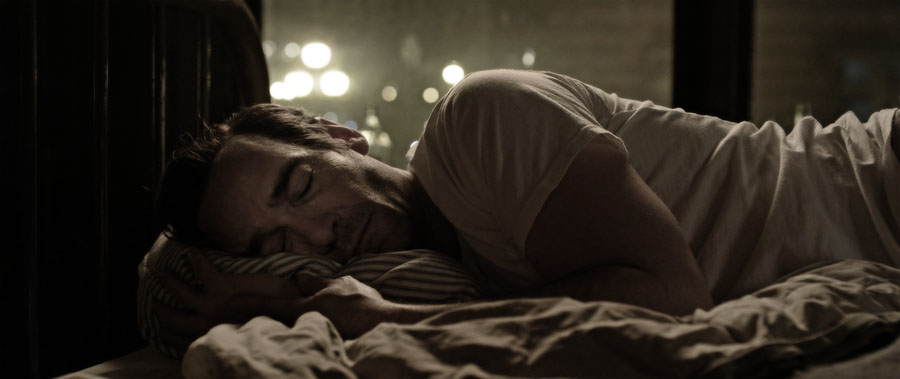
A night shot:
bigsur20.jpg


Crissy Field, with the weather cooperating:
bigsur21.jpg
 
Beautiful. Can you see any difference between EPIC and RED ONE MX? Are you checking dailies in REDCINE-X? Anything we can do to help?

Love your work... and even more that you share here. I hope all REDUSERS understand how lucky we are to have you posting this stuff.

Jim
 
Beautiful. Can you see any difference between EPIC and RED ONE MX? Are you checking dailies in REDCINE-X? Anything we can do to help?

Love your work... and even more that you share here. I hope all REDUSERS understand how lucky we are to have you posting this stuff.

Jim

Agreed. David has been one of the biggest sources of not only knowledge but inspiration since finding out about this board. Thanks David for sharing -- I will be checking this thread often and taking notes :)

Anthony
 
Beautiful. Can you see any difference between EPIC and RED ONE MX? Are you checking dailies in REDCINE-X?

Yes, Dane pulls frames for me thru RedCine-X and I'm always checking in at the camera truck at Dane's set-up to see the frames on a big computer monitor. He's also putting them through the ColorFront system for dailies.

I can see the increased clarity of the image being shot at 5K, but mainly what I'm seeing is a smoother image with more natural contrast and color. I can't say it is dramatically different than the Red One M-X image, but it feels more "natural", a more accurate reproduction of reality (which I then manipulate into something stylized...) It's hard to describe the improvement, but low-light areas seem cleaner, fine detail seems to be preserved better, and overall it feels more "filmic" if that means anything, the way things roll off into bright and dark. My desaturation is probably doing a disservice because if you saw the full-color images, it looks very rich and believable, immediate. Probably the better color science, the lower compression, etc. has helped. I also haven't run into any moire problems.
 
David, thanks for taking the time to post on your progress. I am really looking forward to seeing this film, as the concept along with the stills you have posted, have me hooked. It's been a very interesting read so far.

Cheers
 
Great images, David. Looking forward to see them moving.
 
Back
Top