Welcome to our community

Be a part of something great, join today!

  • Hey all, just changed over the backend after 15 years I figured time to give it a bit of an update, its probably gonna be a bit weird for most of you and i am sure there is a few bugs to work out but it should kinda work the same as before... hopefully :)

Best skin tones

Right so is skin tone representation a big problem for stills photographers who shoot digitally? If not why not?
Joe Mannion that's a good question. I personally don't deal much with stills so I can't answer that although I am one of the people who can tell the huge difference between awful digital (Red/Alexa) skin tones and that of 35mm film.
A few possible reasons are:
1. digital stills photography has far more overtaken 35mm stills where almost no professional photographer shoots on film anymore as opposed to the film industry where 35mm film is technically still shot more often than digital although that is obviously coming to a fast end. So what I'm saying is that since the digital revolution took over stills photography much sooner and faster, one conjecture is that no one really even remembers or knows the difference anymore simply because digital is already so wide spread so there is not even comparisons anymore being done. Whereas in motion picture film, the digital vanguard is just now taking a hold and so the comparisons are still strong and visible.
2. This is just speculation on my part but a large percentage of professional stills photography work is done on studios with perfect front lit subjects where the difference probably is not as great. You see in PERFECTLY lit conditions it's much easier to make digital come as close as possible to film. But in motion picture film where a moving frame takes a subject through various shades of light/color/shadow and sometimes through areas that are not properly or ideally lit, it's much easier to see the short comings of digital skin tones. For instance like I said earlier in places where there are blow outs and the digital sensor can't handle the dynamic range, skin tones tend to start looking not as good because color in the highlight areas is washed out etc, whereas moments like this in professional photoshoots would usually not exist as lighting is much more tightly controlled.
3. it can be argued up until very recently digital PHOTOGRAPHY sensors had far higher capabilities than motion picture sensors as they have far higher color fidelity, resolution dynamic range etc. Up until a year or two ago most digital CINEMA cameras had 11 or 12 stops of dynamic range and 12 bit files, and 2k resolution (the equivalent of 2 or 3 megapixels) or less whereas Hasselblad and other digital PHOTO cameras for years already have had upwards of 50 megapixels, 16 or higher bit files, much higher color rendition because of that fact and 14-15 stops of dynamic range.
This is because it's much easier to have such higher fidelity and power in just ONE image than it is to make a cinema camera that can shoot with that much power in 24 images per second. So it can be argued that one of the reasons digital PHOTOGRAPHY has done much better against 35mm film photography than digital CINEMATOGRAPHY has done against 35mm film is simply because of that which I just described.
 
I would say that still photography have similar issues. All still cameras render skin tones differently. I remember the Nikon vs. Canon arguments over skin tones. It has now transferred to video funny enough.


Right so is skin tone representation a big problem for stills photographers who shoot digitally? If not why not?
 
Right so is skin tone representation a big problem for stills photographers who shoot digitally? If not why not?

A couple possibilites:

1. Nikon, Canon and medium format digital sensors capture skin tones better than RED / Alexa.

2. The lighting used in still camera shoots is better suited to digital camera sensors.

3. The software processing is better.

4. Since it's a still, you can repaint the color if it's dodgy.

Personally I still prefer the look for film for stills, but digital is getting into the "good enough" range - and it has so many other advantages... it's an easy decision.

Digital for cinema is not yet in the "good enough" range for certain projects. Hope that'll change - but going to 6K without improving color a lot will not help!

Bruce Allen
www.boacinema.com
 
Thinking about some of the language we use to describe color tonality, particularly with skin tones, and I am struck by how often we use words that offer "emotional context". It's not uncommon for a grading session to become 3 people in need of a thesaurus. Simple example: director/DP/producer; needs to look more "inviting" or make that guy look "meaner". Colorist briefly ponders career choice, then tries words that embellish the original note like "warm and inviting"? - since warm (typically more red) is something the controls on the grading box actually offers... ;-)

Totally agree with you Blair. Love the thesaurus bit.
 
2. The lighting used in still camera shoots is better suited to digital camera sensors.
www.boacinema.com

Not diminishing the work that still needs to be done with ref to colour and digital cinema imagers (and their post processing) BUT I do know that I am regulary shinning patchy part spectrum light into skin and am not suprised that I get odd part pictures out (re colour). Today I regulary shoot with HMIs and high qualtiy LED panels both of which are not full light and seem to have akward half synergies with digital imagers (right overall ballence for easy white but lots missing)

We have tested 1/2 3/4 and full daylight corrected large Tungsten fictures on skin and it looks great BUT it is too hot and inconvenient.

Most really sythentic skin tones I see are the result of:

The comon delusion that great colour (and colour balence) is created afterwards not on set and the colourist ends up leaving to heavy a scar after they have balenced things. I have colourist friends who pull of miracles but there is always a cost.

Heavy handed post colour work as directors/colourist try and find a heavy 'LOOK' that will bind a load of disparate feeling footage together. (I want to quote the Dude here but can't quite rember the line... his rugs' advantages?)

Dreadful TVs badly setup..

That said there has been some fantastic films (many shot on film) which have sythentic looking skin tones and not just recent work... Black Narcissus had massive colour fights and the work is great... Also I often like the slightly limited range I get out of skin with balenced HMI and EPIC. Anyone else feel the same..?

M
 
Really interesting discussion. I'm surprised there aren't more side by side tests online but I did find some interesting comparisons with Kodak Vision 3 and the MX sensor here. So I thought I would share.

http://www.filmconvert.com/examples/default.aspx

Interesting link. I think the comparisons are dodgy though.

What has been done to the Vision3 image we are looking at? It's certainly not a log DPX scan which would be much flatter. So I will assume the film example on the film convert website was graded based on some aesthetic sensibility. Then they apply their process to the R3D files which adds contrast, sat, etc and makes it look similar to their manufactured target image.

I'm not saying their process isn't potentially a valuable tool for some projects, just that their "proof" comparisons are telling only a limited story.

Cheers - #19
 
Good point I would love to see the raw files before the look is applied but I imagine it wouldn't be very informative or interesting to look at matched flat log files. Also I don't know if anyone can look at a log file and judge the subtle tones that make skin feel alive effectively.

I guess the danger is that they want to show there product in the best light possible. In a perfect world I think you would get a color grader to make the most pleasing final image using film. Then see if your digital image can be modified to meet up with the raw film in a way that when the same grade is applied to the digital image they are identical. Then you can start to have a conversation about the differences in how they capture color information.
 
A couple possibilites:
1. Nikon, Canon and medium format digital sensors capture skin tones better than RED / Alexa.

2. The lighting used in still camera shoots is better suited to digital camera sensors.

3. The software processing is better.

4. Since it's a still, you can repaint the color if it's dodgy.

I think it is a little bit of all the above, but my money is on 3. as the main cause, with a stiff dose of 2. to back it up.

(Background- I started as a stills photographer, shooting slide film, and went digital fairly early).

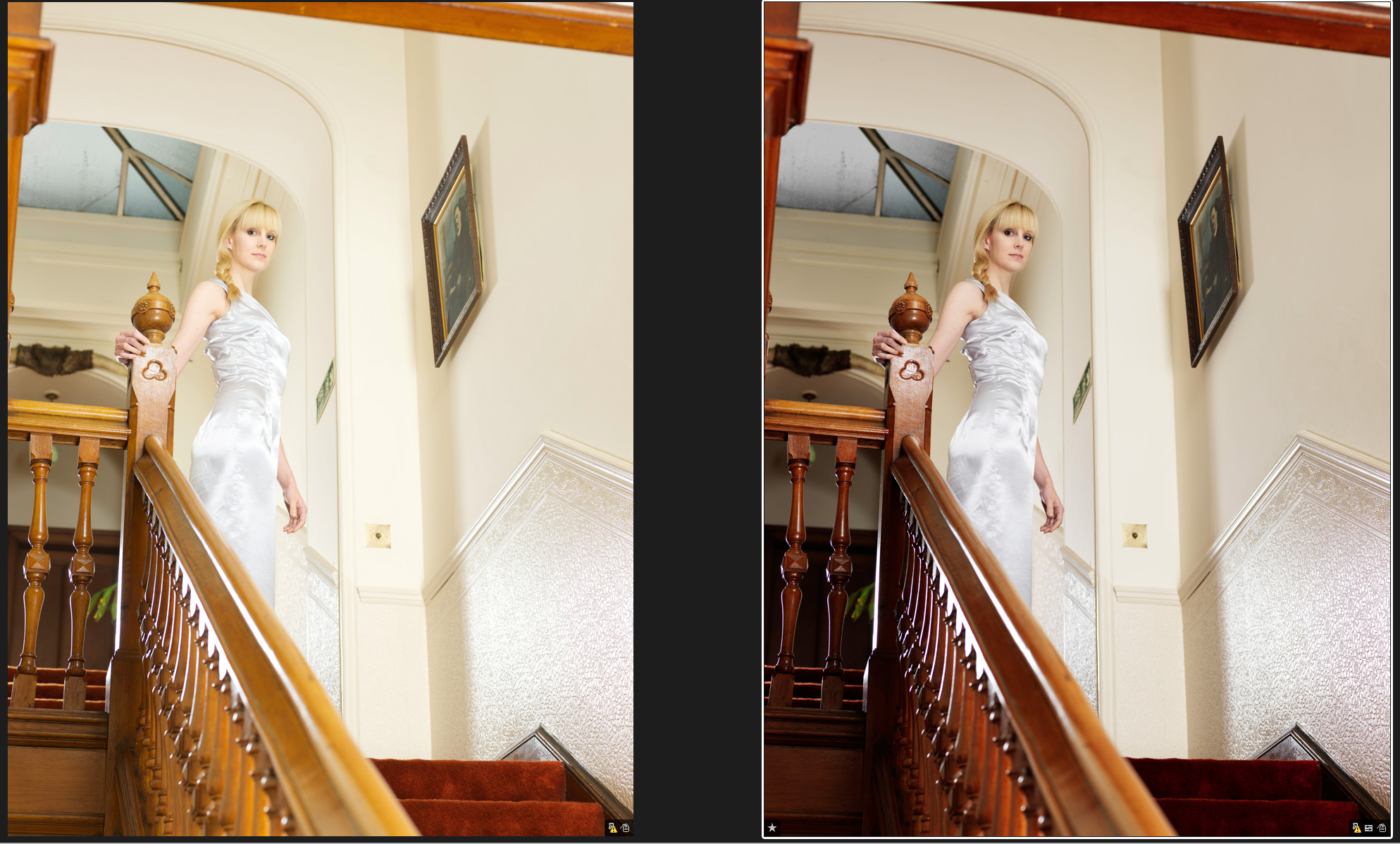
Still camera manufacturers have put a great deal of work into their colour science. That often adds some "special sauce" when you process the images through the manufacturer's own processing software. For example, below is a Hasselblad digital shot as seen in Apple Aperture and (exported as TIFF from) Hasselblad Phocus.

The difference in rendition is clear. It's the same shot, and with nominally the same colour settings! Actually the Hasselblad looks a bit magenta and the Apple a bit green to me; given the colour cast from the carpet, the Hasselblad is much closer to how it looked in reality.

I always look at both RAW processor's interpretation and pick the one I like best as my starting point for grading. It is almost like having a choice of film emulsions. With a little work, you can get the two to match more closely, but they never quite agree on highly saturated tones or on skin tones, especially the difference between skin highlight and shadow tones. 90% of the time I prefer the Hasselblad rendition. Sometimes the Aperture rendition is more flattering to skin out of the box because it seems to compress the contrast range in the skin tones, which helps if there are makeup or bad skin issues.

Personally I like Canon's skin tone rendition, and Hasselblad's, rather than Nikon (when guys with Nikons come to my workshops they invariably seem to have the skin tones turned to such bright orange that it looks like they have been spray painted with fluorescent paint, to my eye).

I think digital cine companies still have a way to go with the colour science. The massive step forward from RedColor2 to RedColor3 illustrates that.

I've also done some experiments (none to hand to post at the moment, sorry) using my video lighting to shoot stills with the Hasselblad. It became clear that nothing I have in my lighting armoury right now gets CLOSE to the gorgeous colour rendition of big flash units, which rely on a nice hot plasma discharge to produce their light, much in the same way as the sun does. If these things could synchro fire at 25 frames per second, with enough oomph to overpower direct sunlight like they can for stills, I think we'd see some advances in the way skin tones are rendered on digital ;-)

As for repainting the colour- I don't need to. With a little basic grading (setting colour temp, tweak the curves and contrast) I'm good to go. I rarely need to do any secondary colour correction on stills. By contrast I find myself reaching for the power window and a skin tone key much more frequently in motion footage. I think it is because the special sauce colour science, especially pre-RedColor3 was just not as well-tuned as it is in the stills RAW processing software these days.

Cheers, Hywel.


http://www.restrainedelegance.com/preview/arieltimestwo1.jpg


arieltimestwo1.jpg
 
I just watched The tree of Life (again!). I am sure, the film stock used is a 2-perf 3-perf like the one below, Only a little less saturated.
In my opinion, best skin tones ever!!

 
I just watched The tree of Life (again!). I am sure, the film stock used is a 2-perf 3-perf like the one below, Only a little less saturated.
In my opinion, best skin tones ever!!


Why would they shoot 2-perf on a 1.85:1 show with that big a budget?
 
Back
Top