Welcome to our community

Be a part of something great, join today!

  • Hey all, just changed over the backend after 15 years I figured time to give it a bit of an update, its probably gonna be a bit weird for most of you and i am sure there is a few bugs to work out but it should kinda work the same as before... hopefully :)

Backfocus Adjustment WITHOUT Red Focus

Sascha Rossier

Well-known member
Joined
Sep 27, 2009
Messages
233
Reaction score
0
Points
0
Location
Zürich, Switzerland
Website
www.sascharossier.com
Since my Camera-Tech told me he doesn't have the right Equip to backfocus my scarlet.
(And i live in Switzerland, where dedicated Camera-Tech-Houses are a really rare species ;-)
I plan to backfocus myself.

I've found this thread about Adjusting Backfocus:
http://www.reduser.net/forum/showthread.php?67871-EPIC-Backfocus-Adjustment-Tutorial

But what about the Owners of Canon-Mounts? There is no RED FOCUS for Canon Mounts.

Someone providing a Step by Step tutorial on how to adjust Backfocus on the Scarlet
without a RED FOCUS would be hugely appreciated. Maybe using a standard Siemens-Chart.
 
I would love to purchase a EF mount RED Focus. Step by Step in the meantime is also appreciated
 
I have heard that you can aim your lens at the moon and then make sure that the moon
is in sharp focus when your lens is set to infinity. If the moon is not sharp, then you would
adjust the back focus until it is. However, I don't know if this method is correct.

Anyone???
 
This is how I do it -

1. Download a siemens star - search google images and find the biggest, cleanest one you can. Print it out to paper.
2. Find a focus distance mark on your lens around 9 feet away and set your lens to focus there.
3. Turn on edge focus (I use the peaking one, not the dark one) and magnify
4. Set up the siemens star on a c-stand (or similar) exactly that distance from the sensor mark on the camera (it's a circle with a vertical line through it)
5. Remove the bolt on top of your camera with a torx 10 wrench to find BF adjustment under it.
6. Use the same torx 10 wrench to move the bolt to and fro until the center of the star is sharp.
7. To confirm, find a focus distance mark on your lens that is close, 1 foot - 3 feet or so...set the lens focus there, and move the star to the corresponding distance - your BF should be good.
 
I would not recommend setting back focus to photo lenses. They do not have precise marks. Backfocus is most likely set correctly when your camera was shipped. I have had a Epic for 5 months and never had to adjust back focus. I check it every time I have a shoot with PL lenses.
If you have the PL mount check it with a few wide angle fast lenses ( master prime 14mm wide open) at a reputable rental house. If it's off check more lenses first before adjusting.
With the PL mount correctly calibrated I switched to my Optitek Nikon mount and calibrated the lenses see http://www.reduser.net/forum/showthread.php?74627-Using-Nikon-Lenses-on-Epic-and-other-cameras.
 
I set my depth (what some people call back focus) with my Arri depth collar and gauge, then use the gauge to set my collimator (hand built by me), then set my Nikon lens with my collimator, then set my Epic with the Nikon lens.

If you have a KNOWN GOOD Nikon lens, you can skip the collar/gauge/collimator steps, as I said in my video. How exactly you will know your Nikon lens is good (that is, has accuate footage marks) can be a problem. If you have 6 Nikon lenses and they all agree except one that is beat up, then probably you can go by the five good ones, preferably a wider one, like a 25mm or so, which has narrower depth of focus, making your adjustment more accurate. If you have 6 Nikon lenses and no two footage scales agree, then you must get a know good lens.
 
I really wish there was more info on this topic.
 
Definitely do it with a known good wide lens at a precisely marked distance.

The moon is not a good idea: most lenses will focus a tiny little bit beyond infinity to give room for manufacturing tolerances and heat expansion, otherwise you might not reach infinity in a worst case condition at all.
 
Definitely do it with a known good wide lens at a precisely marked distance.

What Uli said.

I use a collimated (precise) 18mm SuperSpeed. Open the aperture to 1.3, take a Siemens Star, set the distance of the focal plane to 80cm, and set lens focus to 80cm. If the focus is soft adjust the back-focus until the focus is spot on. Carry the camera backwards to 1.20m and check the focus again. If it is off again get a new lens. If there is a slight softness check again how accurate you matched the witness mark. In doubt get new lens. With a little routine you will adjust back-focus this way in a minute.

Don't use anything longer than 18mm and don't stop down.

Hans
 
I have heard that you can aim your lens at the moon and then make sure that the moon
is in sharp focus when your lens is set to infinity. If the moon is not sharp, then you would
adjust the back focus until it is. However, I don't know if this method is correct.


Anyone???

That goes a long way. The only thing to add to this is that you need a "known lens" i.e. a lens that you know is correct. That you can check by testing the lens on several cameras if it's a Canon for example. The canon 5D's, 7D's and such actually normally have quite accurate back focus. So if you take your EOS lens and test in on a few 5D's and get infinite to be correct on all of them then you can use that lens to set the back focus of the epic / scarlet.

then you test with all your lenses if they all get the right focus at infinite then you are probably correct.

Adjusting the focus on the epic / scarlet is easy.
shoot for the moon and adjust the back focus screw until sharp. Then measure about 3 meters. and check again with a focus chart.

If your different lenses differ then those need to be calibrated.
 
The RED Focus is PL. I'm not sure if you'll be spot on if you change the mount after adjustment.
 
Didn't know it was for Canon calibration, sorry.

Is the flange of a photo lens as precise as pl mount lens? Modern photo lenses are designed for AF and Backfocus is not as critical as for cine glass and therefore they could have different flange length... It's also due to the AF design that the meter scale is smaller than cine glass.

Pat
 
Zoom is better

Zoom is better

The easiest way to check flange is using a wide zoom lens at close distance.
Again- this zoom lens needs to be verified to be correctly adjusted (for BF) on the collimator first.
it's easiest because with the zoom you don't need to worry about the distance from the chart- as long as both ends (wide and long) are in focus you are fine.
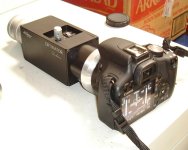
BTW the Optimator is the only flange depth testing instrument available with PL, PV, Nikon, Canon, BNCR camera mount adapters
 

Attachments

  • DSCF0098.jpg
    DSCF0098.jpg
    90.4 KB · Views: 1
Definitely do it with a known good wide lens at a precisely marked distance.

The moon is not a good idea: most lenses will focus a tiny little bit beyond infinity to give room for manufacturing tolerances and heat expansion, otherwise you might not reach infinity in a worst case condition at all.

Thank you Uli.
 
Back
Top