Welcome to our community

Be a part of something great, join today!

  • Hey all, just changed over the backend after 15 years I figured time to give it a bit of an update, its probably gonna be a bit weird for most of you and i am sure there is a few bugs to work out but it should kinda work the same as before... hopefully :)

Ask David Mullen ANYTHING

Thanks for the comprehensive answer.

Do you get offered low indies at all anymore or is all your stuff already above a certain budget? Do you miss working in a freer enviroment? If so, what are the things you miss most?

One more question has been bothering me quite a bit. Sometimes when I read a script there are scenes where I can't really see it visually, and can't make anything out of it. Most of the time the input from the director also doesn't really help but I have to shotlist and light the scene. Do you have that sometimes (or does it get covered by experience completely) and if so, do you maybe have a couple of tips on how to solve such issues? I just can't let myself resort to two-shot / ots / ots, but can't really bring anything more exciting on the table as the scene doesn't ring a creative bell.

chris, you know that the forum is back? I agree, if a respected superior peer compliments on ones work there is nothing better and it's even worth breaking rules and feeling bad for a couple of days when discovered :).
 
Thanks for the comprehensive answer.

Do you get offered low indies at all anymore or is all your stuff already above a certain budget? Do you miss working in a freer enviroment? If so, what are the things you miss most?

One more question has been bothering me quite a bit. Sometimes when I read a script there are scenes where I can't really see it visually, and can't make anything out of it. Most of the time the input from the director also doesn't really help but I have to shotlist and light the scene. Do you have that sometimes (or does it get covered by experience completely) and if so, do you maybe have a couple of tips on how to solve such issues? I just can't let myself resort to two-shot / ots / ots, but can't really bring anything more exciting on the table as the scene doesn't ring a creative bell.

Sure, I get offered small indies, and do them now and then, it's just that I'm trying to move up to bigger projects.

If you're talking about being stuck as to where to put the camera and how to cover the scene, I tend to look at the problem from a Hitchcockian angle, which is "who is the main character and what is he reacting to, looking at?" When in doubt, shoot the scene from the perspective of the main character in the scene, from their actual or emotional point of view. You basically follow the emotions of the scene. The other approach, a more objective one, depends on understanding the intellectual conceit of the scene and then enhancing the themes using visual tricks. Maybe the theme is "identity" or "family" or "isolation", etc.

You also look at the tempo of the scene, what the pacing should be. Should it have nervous energy, should it have a quiet reflective tone?

As far as lighting, again, you have to support the emotions of the scene. That will help narrow down your choices. Otherwise, you try to look at the light sources in the room and take advantage of them, alter them, or add your own sources.
 
Hi David. I have a question about a look I have seen in many digital shot movies. It reminds me of silver retention and bleach by pass sometimes. Like for example The Spirit. I know The Spirit was shot with F900 or F950 cameras. But it has this look to it. I first thought it was just added grain. But in close ups sometimes it looks like the actor's pores are dirty or something. I have seen this look in several digital movies. Do you know why it looks like this and how they achieve this look? Thanks.
 
"The Spirit" was shot on the Genesis camera; "Sin City" was shot on the F950 I believe.

I think you're mainly seeing the combination of the sharpness of the Genesis image enhanced with a lot of contrast added in post and the blacks being crushed, which also increases contrast & sharpness -- all of this increases variations in skin tones. And when you take a lot of the color saturation out, all you're left with in the skin tones is surface texture.

There may also be some electronic sharpening involved somewhere in the post chain adding to the effect. Which may also be enhancing the noise structure of the image.
 
Hi David,

Thank you for taking the time to contribute to this forum. My questions are: Have you seen the movie 'Avatar'? What impact, if any, do you think this 3D movie will have on the industry from a technical perspective? And, if you have seen it, did you personally enjoy it?

V/R,

Roger
 
"The Spirit" was shot on the Genesis camera; "Sin City" was shot on the F950 I believe.

I think you're mainly seeing the combination of the sharpness of the Genesis image enhanced with a lot of contrast added in post and the blacks being crushed, which also increases contrast & sharpness -- all of this increases variations in skin tones. And when you take a lot of the color saturation out, all you're left with in the skin tones is surface texture.

There may also be some electronic sharpening involved somewhere in the post chain adding to the effect. Which may also be enhancing the noise structure of the image.

Thanks David. I stand corrected. The Spirit was Genesis indeed. But I seem to remember some other movie shot on the F900 which had a similar look, although can’t remember which one now. In my opinion it doesn’t look like the effect of just added post sharpness and contrast combined with the sharpness of the Genesis. The grain is more obvious in some shots than others but when it’s there it really looks like added grain rather than sharp detail. I may be wrong though:

http://img697.imageshack.us/img697/6512/picture12io.png

http://www.dvdbeaver.com/film2/DVDReviews45/the spirit blu-ray/large/large the spirit blu-ray6.jpg

http://www.dvdbeaver.com/film2/DVDReviews45/the spirit blu-ray/large/large the spirit blu-ray7.jpg

http://i543.photobucket.com/albums/gg472/Blu-news2/Screenshots/TheSpirit05.jpg

http://i543.photobucket.com/albums/gg472/Blu-news2/Screenshots/TheSpirit06.jpg


In any case, what is your opinion on adding film grain to digital?
Do you think it works and can look realistic?
In film, the grain is part of the image. In digital added grain just seems to float above the image like a filter. At least it used to be that way. Maybe now there are better techniques to add grain to digital?
In film the grain also gives the impression of more perceived sharpness. I wonder it this translates to digital too. Although when you use a 35mm adapter and have the ground glass off the static grain tends to make the image look sharper. Not sure if for the same reasons though.
 
They did so much compositing and post digital diffusion that I wouldn't be surprised if there was some sort of pass to add faux grain, but I don't know.

The principle works the same whether you add grain to digital images, or with film, in terms of the grain pattern... that, if sharp, grain gives the viewer the impression that the image must be in sharp focus with fine detail, even though it's the grain that is the fine detail.

Trouble with grain is that it disappears depending on the viewing size and resolution of the display, so grain levels for one format may be too light or too heavy for another. The other problem with grain is that it can create artifacts when a lot of compression is applied, like for HD broadcast.
 
Hey guys.. re: faux grain/noise

Used A LOT in vfx in general. If you haven't noticed, that's a real good thing! :) A great study of faux grain on film might be Transformers I&II. Have a good look at those CG robots.. study the grain on them.. it's all added. More easy places to study added grain are any time you see a CG element.. robots, cars, buildings, planets.. for faux "grain" on digital try the creatures, ships.. on District 9(all shot on digital cinema cameras, a lot Red One).

For faces that have been retouched: gotta add grain/noise back to match... that may be what you are looking at on those CU images you posted..maybe.. ..I'm not a Genesis image expert but overall throughout the film it looked to me the grain/noise was a result of strong grading more so than an added fx... just imho..

~s
 
Last edited:
Okay, David, I know you just got back from AVATAR. So my question is: Are you ready to shoot a 3D film? :w00t:
 
However the grain on film is where the image is formed, adding an overlay of grain is not going to realistically simulates film grain structure. Right? Wrong?

Is there a plugin or a way or some film that used an advanced technique to add grain in order to simulate 35mm grain structure?

I've been wondering about this for quite some time.
 
Well, grain has been added to CGI effects for a decade now so that they intercut with non-efx shots made on film -- it seems to work pretty good.

Sure, you can't exactly recreate the same image structure on a microscopic level, but at the image size most people watch movies at, it's close enough for government work, as they say, depending on the method used (the cheap method is to just add noise to the image, which is not the same as sampling a frame of film to copy its grain structure, as many efx artists do. Just don't ask me for the particulars, I'm not an efx artist.)
 
Okay, David, I know you just got back from AVATAR. So my question is: Are you ready to shoot a 3D film? :w00t:

Yes!

Though I'm still of the belief that the movie would also have to look good in 2D since that's how a lot of people are going to see it, in 2D theaters and later on TV. A lot of 3D movies have been shot in 1080P and in 2D, they look like a typical HD movie; the 3D takes your eye away from the normal clues that you are watching something shot on an F950 or F23, etc.
 
Please, anyone else who wants to add to my answers too, please do so...

I’m a big fan of Chris Doyle, particular his work in “Fallen Angels”, “In the Mood for Love”, “Hero”, “2046”. He did some nice subtle period work recently in “The White Countess”, though not as snazzy as his work for Wong Kar Wei. I have one of his still photography books, “A Cloud in Trousers”, which has a lot of what looks like push-processed slides. I think in terms of photographing urban landscapes, especially at night, he’s probably Number One.

A DP’s work sometimes falls into two rough categories, naturalism/realism and expressionism/impressionism. Either they are creating a believable effect… or they are distorting reality for a psychological effect. Or course, movies do both, in the same movie, all the time, but some DP’s lean more one way than the other. People like Roger Deakins, David Watkin, Nestor Almendros, Gordon Willis, tend towards a naturalistic approach grounded in reality, whereas someone like Robert Richardson, Chris Doyle, Janusz Kaminski, Vittorio Storaro lean towards a more manipulated distorted reality, either more operatic & theatrical, or more expressionistic or impressionistic. But I don’t want anyone to take these labeling too seriously – it’s just a loose way of thinking about how one works, sees the world or art.

A lot of this, of course, is grounded by the material being adapted, and by the director’s visual taste too. And you can also see documentary impulses weaving through Robert Richardson’s or Chris Doyle’s work, even while they also can be quite theatrical at times.

I’d love to shoot for David Lynch, Ridley Scott, Terrance Malick… just to learn something from them.

Recent movies with good images… well, the Autochrome-inspired flashbacks in “The Illusionist” were interesting… the faux Technicolor look of parts of “Tears of the Black Tiger”… the long takes in “Children of Men”… the overall mood of “The Fountain”… many moments in “The New World”.

Chinese Lanterns: I use them all the time. I haven’t used too many all at once, though I once lit a running shot through the woods by hanging a string of Chinese Lanterns with daylight photofloods in them. In terms of using a lot of them in a grid pattern in a ceiling, that should work fine as long as there aren’t simpler and faster ways to get a soft overhead light effect. Just depends.

It's funny with my little experience in filming (less than 4yrs) I love the story and Cinematography work in the Illusionist not to mention Perfume Story of a Murderer.

http://www.apple.com/trailers/dreamworks/perfume/

I have to see the other movies now
 
Poor Man's IMAX.

Poor Man's IMAX.

Hi David, I have a question for you.

I was wondering if it could be possible to create a poor man's IMAX? By this I mean resurrecting the idea of the old Cinerama instead now using digital cameras.

Would it be easier given todays technology to align 2 or 3 cameras horizontally or vertically to create the shot? I suspect this is cheaper than shooting actual IMAX and yes it will not be as sharp and beautiful as shooting IMAX.

An SI-2K Mini for example could work quite nicely as an array of three CMOS blocks mounted in a custom rig and perfectly aligned. In post you could stitch these together and output to the specs of IMAX.

Christopher: we have been discussing this in another thread about full frame and 645 epic (David has made a number of posts over there as well.) At 9K the 645 Epic is about the same size and resolution as actual IMAX film and wouldn't require any multicamera rigs and could use existing medium format still lenses or Imax lenses.

Epic X, Epic FF35 and IMAX... thread:

http://reduser.net/forum/showthread.php?t=38767
 
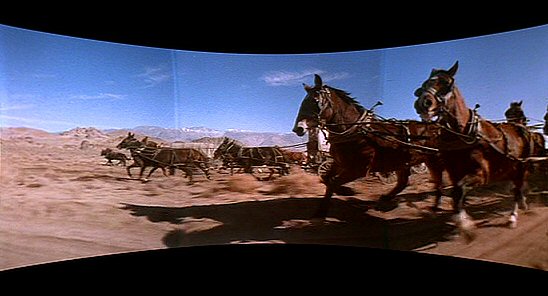
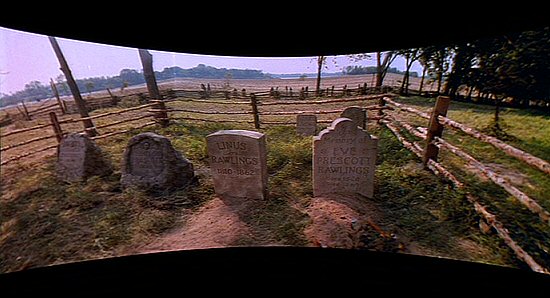
One of the strengths and weaknesses of the 3-camera Cinerama was that each third of the final 2.66 frame had its own vanishing point (each camera had a 27mm lens on it by the way, for a total view of 144 degrees.) This created a lot of distortion, particular when the camera was not dead-on to the horizon line. On the other hand, there was no barrel distortion as a super wide-angle lens with a 144 degree view might have. But it had the odd effect on the big screen that no matter where you stared at the image, you seemed to be staring into the center of it.

Here are two frames from the old unrestored DVD of "How the West Was Won", I added the curved screen effect in Photoshop. You can see the problem when you titled the camera down:

htwww3.jpg


htwww5.jpg


But you can see here in these Todd-AO 65mm frames from "Around the World in Eighty Days", the problem with trying to get the same wide-angle view with a single lens:

atwied1.jpg


atwied3.jpg


Nowadays we have rectilinear wide-angle primes that correct out the barrel distortion. Anyway, I don't see the need to stitch frames together, though it is done all the time in efx work, tiling background plates.
 
I've been a wide angle junkie since my teens ( now 42 ) and spent years trying to hunt down a Goerz Hypergon.... settled with Super Angulons on 4X5 and 8X10 and interested but not tried the canon 11-22mm on the RED with it's 107 degree field of view....

but my god.... 144 degrees is truly amazing!

I'm looking forward to what the big RED's will do... especially that 617!
 
Back
Top