Welcome to our community

Be a part of something great, join today!

  • Hey all, just changed over the backend after 15 years I figured time to give it a bit of an update, its probably gonna be a bit weird for most of you and i am sure there is a few bugs to work out but it should kinda work the same as before... hopefully :)

Ask David Mullen ANYTHING

Yes he used the Lensbaby and the Arri Shift and tilt lense system at 35mm and wider.
 
Hmmm! all is possible is Post

Hmmm! all is possible is Post

You can create the same feeling in post build Z-depth 3D per scene, and assing diferent FOV per layer..make 3d mask moving dummy (actors, oclusion object etc etc) is very hard work.


Seems to me that post-effects on a two-dimensional plane will only give you...two-dimensional effects. I greatly admire still and cine -photographers who are not afraid to "command" the light before it is captured on a flat surface (film or sensor plane). There is a difference on how the light "dances" through diffusion and focus especially noticeable in... the play of the highlights? I've seen all sorts of post-blurring, rarely does it achieve the organic feel of something that was shot "that way". Kudos to Mr. Mullen and others who go to the trouble for in-camera fx... you have fans! :thumbsup:
 
Ummm... reproducing optical tricks in post, sounds like a recipe for " wow that looks totally digital". It will always look much better if you do it optically. Its like the people who add anamorphic flares to non-anamorphic footage. It will look fake compared to the real thing.
 
Hi David...

Quick question for you. I am shooting a PSA in an indoor pool venue. The venue is very hot and humid...and I am afraid the lens will fog up every thirty seconds. Is there anything that I can apply to the lens filter to prevent heavy fogging?

Thanks in advance for your help.

JEFF
 
Generally if your lenses acclimate to a more humid environment, they are OK, but in extreme cases, I'm not sure - I haven't run into that too often (I once shot a handheld shot of someone opening an oven to pull out a turkey, up close to the oven door, and was blinded momentarily by fogging...)

I would think that somehow blowing air onto the lens may help, but I think the first trick would be to acclimate the lenses to the room. Maybe someone else can chime in who has dealt with this.

In just generally muggy spaces, I haven't had too much probably with lens fogging IF they have been sitting in the room for awhile. The climax to "Jennifer's Body" was shot inside a muggy indoor pool and we didn't have a problem with our lenses. Just glancing around online, the general solution seems to be to get the lenses to acclimate, in the meantime, a hair dryer can help:

http://photo.net/bboard/q-and-a-fetch-msg?msg_id=00122f
 
David- We had the privilege of seeing some scenes from MANURE (aka Smell of Success) ala Michael Cioni at REDUCATION and just wanted to say, it was breathtakingly filmed. I am a HUGE fan of your work, and just wanted to give some pre-release kudos. Just STUNNING work with the R1, on what Build 15 or 16?
 
As David said, as long as the lenses are the same temp as the room you are in you won't get condensation on the lens. If you are coming into the room from a cold environment, make sure that the cases are airtight, and let them reach room temp before opening them. If you intend to bring the camera in built, get a large waterproof bag (like a kayaking backpack) and put the camera in that before you go into the room, and let it reach room temp in the bag.

Nick
 
Regarding those production stills from Manure: I noticed that the backdrops hang straight down. Wouldn't it aid the viewer's perspective and nullify cast shadows to hang the backdrop at an angle(for example 45 degrees as opposed to 90) to the ground and print it anamorphically so that the perspective matches? Are there some barriers that I'm not aware of that inhibit this approach? I'm pretty ignorant of the "outdoor soundstage" style of shooting, so I'd appreciate your wisdom on this.

Thanks.
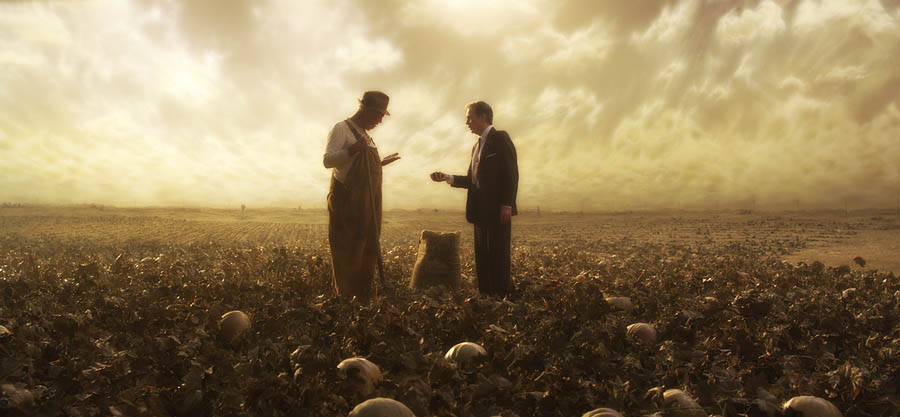
 
Some plays use stages that angle upwards slightly towards the backdrop (hanging at a 90 degree angle) in order to create the illusion of more depth. Not sure if they employed this technique but its is cool nonetheless.
 
Regarding those production stills from Manure: I noticed that the backdrops hang straight down. Wouldn't it aid the viewer's perspective and nullify cast shadows to hang the backdrop at an angle(for example 45 degrees as opposed to 90) to the ground and print it anamorphically so that the perspective matches? Are there some barriers that I'm not aware of that inhibit this approach? I'm pretty ignorant of the "outdoor soundstage" style of shooting, so I'd appreciate your wisdom on this.

Thanks.
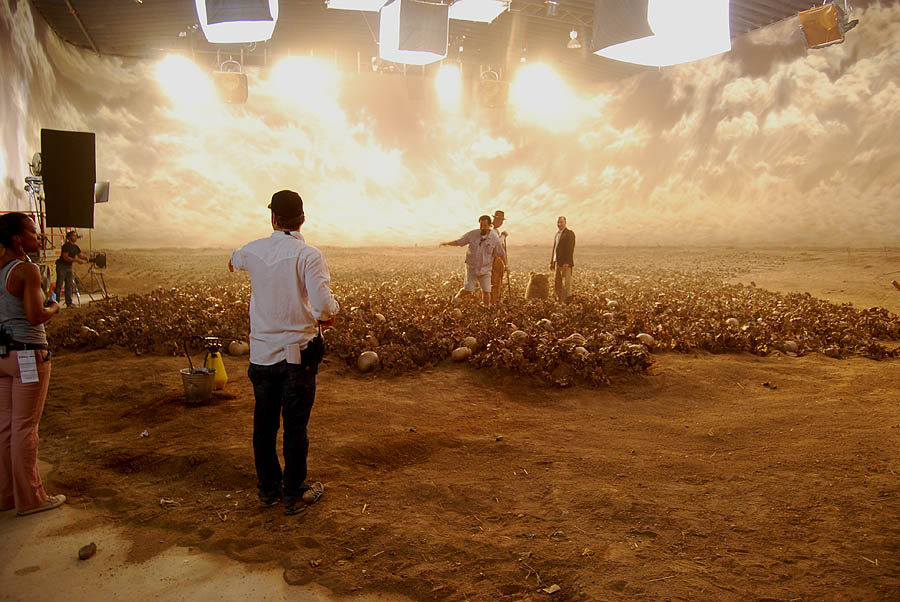
The only backdrops were the sky, the receding ground was part of the stage floor and had a small ramp along the sides tilting the last 6' upwards, right up against the bottom of the sky backdrop.

The backdrop was painted canvas. It covered 3 and 2/3's of the four sides of the rectangular stage, with curved corners. It would have been impossible to hang canvas at an angle, not to mention that at an angle, it would have made the available floor space smaller since our set extended up to the fire lanes on all sides (the lane was behind the hanging canvas.) It would have had to been a solid angled set wall in order to be rigid and smooth, and curve around all four corners of the stage -- WAY out of our budget, not to mention, again, it would have cut into the floor space.

Generally backings are not angled on stages, again, mainly because they are hung from rails or pipe, they are not rigid unless stretched onto a frame.

Besides, since the backing was just of sky & clouds, it did not would not really have benefitted, perspective-wise, from being tilted away from the lens.

If you look at this frame, keep in mind that one-quarter inside from the right edge of frame is the corner of the soundstage, so that "sky" and ground on the last quarter are bending at a 90 degree angle towards the camera. One of the side effects of the rectangular shape of the stage was that I had to keep the camera at horizon level or lower -- too high and I saw the "V" shape of the corner of the stage instead of a straight horizon. Too low and the "V" shape was at the top of the sky backing where two stage walls met, but that was always cropped out, i.e. kept above the frameline:

900manure2.jpg


Here's a photo of us setting up the shot:
manureset2.jpg


Here's a shot of another set-up for another scene, the crew members show you the scale of the set:
manureset3.jpg


This was the final shot:
700manure157.jpg
 
Last edited:
That's just awesome how you faked the sunset!
Recently I shot a 360 move around a performing Band. The whole clip had pure white backround so we hang a circle off the rig but with all the light the inside of the circle heated up an it began to shrink.
Do you know what your crew did to really fix the backdrop properly?
 
It was heavy painted canvas -- it was hung very well by the construction crew, but it still had a few wrinkles in it and the grips sometimes spent time tugging at the base in different directions trying to get the wrinkles out.

That fake sunset shot required that we pull back the base of the canvas to create a small gap between the backing and the edge of the set so I could hide a light stand to mount that 5K on the top of the horizon. Then I had to wash out the shadow of the 5K fixture off of the backing it was nearly touching, try to get the wrinkles out of the backing created by pulling it away, and then hope that the light flared and burned out enough to hide the yoke of the fixture.
 
Wow, those canvas backdrops are stunning. I see this as a great example of how old school techniques can be brought into 21st century digital cinema. You would expect them to film in front of a green screen and then digitally create the background but there is something fascinating about the painted background. As a painter myself, I can really appreciate the technical artistic skill it took to create these backdrops and the seamless integration of the floor into these backgrounds. Simply amazing. It reminds me a little of 300 but cooler because it is not digital.
 
A rather un-artistic question,

David, how do you handle posting stills from running productions? I've seen before that you posted actual RED frames from "Manure", did you clear that with production or did your good relationship with the directors enable you to do that? I've also seen that you used to post stills which were snaps of your own camera featuring stand-ins, that's probably on bigger budget studio features? If you are not allowed to publish anything do you get told explicately? Or do all your contracts have that within them?

I've read before that the cinematographer as the creator of those images is allowed to use still frames for his own benefit, but can't use moving footage.

Thanks for any information, you're really one of the few DPs who let people see their work in progress and that's priceless!
 
I depend on the goodwill of the director and producers. I try to avoid using stills with the lead actors in them unless they are fairly small in frame.

I can tell you it's getting harder and harder to openly discuss one of my productions due to all the confidentiality agreements you have to sign up front before you begin every movie. I feel a bit freer on independent films where promotion is part of the game, so generally any internet buzz that can be generated is OK. Especially since often when you are shooting the indie, there's no studio involved, no distributor in place. So it's really just a matter of getting permission from the producers.

I generally mention it to them up front "hey, I write a blog about the technical issues I encounter when shooting, with some photos of the lighting set-ups" and they are OK with it.

But since "United States of Tara" was a Dreamworks/Showtime production, I didn't post much about it.

For "Jennifer's Body", I tried to stick to non-controversial technical issues and only show photos of stand-ins.

But as I said, it's been getting harder to get away with these production journals.

Basically I believe in the value of educating people by giving them an accurate picture of what's involved in making a movie, though I have to leave out some of the personal politics. But too often in articles on movies, everything seems too easy, problems never seem to arise. I don't feel that is accurate or informative.
 
David,

Just want to let you know how much I appreciate you continuing to share your knowledge and experience with us! Thanks!

I broke my heart when Roger Deakins had to take down his site.... some people just got mean and nasty and Roger got fed up with it.
 
Last edited:
Back
Top